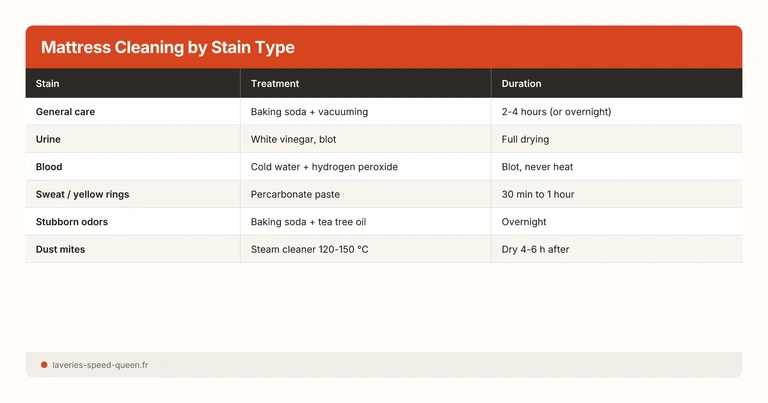
In short: a mattress cannot go in a washing machine — it must be cleaned in place with baking soda (deodorises, absorbs moisture) and a vacuum cleaner (removes dust and dust mites). Frequency: every 3 to 6 months. For targeted stains (urine, blood, sweat), apply the appropriate treatment. A waterproof mattress protector is the best prevention — and that one does go in the machine. At the laundromat, wash your covers, protectors and pillows in the large-capacity machines.
At a Glance
Baking soda + vacuuming every 3-6 months — the basic maintenance routine that removes dust, odours and dust mites.
Treat stains immediately — the faster you act, the easier the stain is to remove.
Waterproof mattress protector is essential — blocks sweat, liquids and dust mites.
Regular ventilation — air the bedroom and let the mattress breathe for 15 minutes every morning.
Covers and protectors in the machine — 60 °C to eliminate bacteria and dust mites.
Why Clean Your Mattress
We spend an average of 8 hours per night on our mattress — a third of our lives. During that time, the mattress absorbs sweat (0.3 to 0.5 litres per night depending on the person and season), dead skin cells (around 1.5 g per night), sebum and dust.
This combination creates an ideal environment for dust mites — microscopic arachnids that feed on dead skin cells. A 2-year-old mattress can harbour between 100,000 and 2 million dust mites. Their droppings are the leading household allergen and cause rhinitis, asthma and eczema in sensitive individuals. Our guide on dust mite allergy and laundry details the complementary measures you can take.
Beyond dust mites, an unmaintained mattress gradually develops odours (bacterial decomposition of sweat), yellow stains (oxidation of perspiration) and in extreme cases, mould (moisture trapped in the foam).
Routine Maintenance: Baking Soda + Vacuuming
This is the core method, to be carried out every 3 to 6 months. Simple, affordable and effective.
What You Need
- Baking soda↗ (food-grade, 200-300 g per clean for a double mattress)
- Vacuum cleaner with flat nozzle (not the rotating brush)
- Optional: tea tree or lavender essential oil (natural antibacterial)
Step-by-Step Protocol
- Strip all bedding — sheets, duvet, pillows, cover and mattress protector. A good opportunity to wash everything in the machine.
- Vacuum the surface — go over the entire mattress with the flat nozzle. Focus on seams, edges and corners where dust collects. Vacuum the sides too.
- Sprinkle with baking soda — spread an even layer across the entire surface. For extra deodorising power, mix the baking soda with 10 drops of essential oil before sprinkling.
- Leave to work — minimum 2 hours, ideally 4 hours or overnight. Open the window to ventilate the room.
- Vacuum thoroughly — move slowly to collect all the baking soda, including from seams.
- Flip and repeat — if your mattress is reversible, do the other side.
Let It Breathe Each Morning
Every morning, pull the duvet to the foot of the bed (don’t make the bed immediately) and open the window for 10-15 minutes. This simple habit lets overnight moisture evaporate instead of staying trapped in the mattress. It’s the best daily prevention against odours, dust mites and mould.
Stain Treatment: By Type
A mattress is exposed to different types of stains. Each one requires a specific treatment because the chemistry of the pigments differs.
Urine Stain
The most common (bedwetting, incontinence, pets). Blot, spray white vinegar + water (50/50), dab, sprinkle with baking soda, leave overnight, vacuum. For dried stains, add hydrogen peroxide. See our complete urine stain guide.
Blood Stain
Blot with cold water (never hot — blood coagulates). If the stain is dried, apply hydrogen peroxide (3%): it fizzes on contact with haemoglobin and breaks it down. Blot, rinse with a damp cloth, let dry.
Sweat Marks
Yellow marks are caused by the oxidation of urea and mineral salts in sweat. Mix sodium percarbonate (2 tbsp) in a little warm water to form a paste. Apply to the marks, leave for 1-2 hours, blot with a damp cloth, let dry.
Coffee or Tea Stain
The tannins in coffee respond well to white vinegar. Soak a clean cloth in neat white vinegar and dab the stain from the outside in. Leave for 15 minutes, blot with a damp cloth. Sprinkle with baking soda to absorb residual moisture.
Chocolate Stain
Chocolate contains fats and tannins. Scrape off the dried excess, then apply damp Marseille soap directly to the stain. Rub in circles, leave for 30 minutes, blot with a damp cloth.
Mould
Mould stains on a mattress indicate chronic excess moisture. Scrub with neat white vinegar, let dry in sunlight if possible (UV kills spores). Air the bedroom thoroughly and check the ventilation. A breathable mattress protector helps prevent recurrence.
The White Vinegar Method: For Stains and Odours
White vinegar is the second essential product for mattress cleaning after baking soda. Its action is complementary.
How to use it on a mattress:
- Mix white vinegar↗ and cold water (50/50) in a spray bottle.
- Spray the target area (stain or smelly zone). Don’t soak the mattress — a few spritzes are enough.
- Blot with a clean, dry cloth after 15-20 minutes.
- Sprinkle with baking soda to absorb residual moisture.
- Let dry completely before remaking the bed.
White vinegar excels on urine odours (it neutralises ammonia), sweat stains and superficial mould residue. Its own smell disappears as it dries.
Steam Cleaning: The Deep Treatment
A steam cleaner is the most effective tool for deep cleaning a mattress. Steam (120-150 °C) penetrates a few centimetres into the foam, killing dust mites, bacteria and mould spores through heat.
How to use it:
- Use the flat nozzle (not the brush).
- Move slowly across the entire surface in parallel strips.
- Don’t linger too long in one spot — excess moisture is the mattress’s enemy.
- After steaming, let the mattress dry for at least 4-6 hours in a well-ventilated room (window open).
- Drying is non-negotiable — a mattress left damp after steaming (not dried enough) develops mould within days. Allow at least 4-6 hours of drying time with the window open.
- No steam on fresh protein stains — heat cooks proteins (blood, urine). Treat the stain with cold water first, then steam once the stain is removed.
The Mattress Protector: Essential Prevention
A mattress protector is the single best investment for your bedding. It radically simplifies maintenance: when an accident happens (heavy sweating, urine, spilled liquid), you wash the protector instead of cleaning the mattress itself.
Types of Mattress Protector
| Type | Waterproofing | Breathability | Comfort | Washing |
|---|---|---|---|---|
| PU (polyurethane) membrane | Excellent | Good | Silent, flexible | 60 °C machine |
| Terry + PU membrane | Excellent | Good | Soft, surface-absorbent | 60 °C machine |
| PVC | Total | Low | Noisy, less comfortable | 40 °C machine |
| Tencel / bamboo | Good (with membrane) | Excellent | Very soft, temperature-regulating | 40-60 °C machine |
| Full encasement (6 sides) | Total | Variable | Complete dust mite protection | 60 °C machine |
Caring for Your Mattress Protector
Wash the mattress protector at least every month, at the same time as your sheets. Temperature: 60 °C to destroy dust mites and bacteria. A mattress protector is a bulky item that benefits from the large-capacity machines available at the laundromat — the higher water volume ensures a more thorough rinse.
Bedding: What Goes in the Machine (and at the Laundromat)
While the mattress itself cannot be machine-washed, all the items that cover it certainly can.
Sheets and Pillowcases
60 °C for white cotton, 40 °C for colours or percale. Wash every 1-2 weeks. Laundromat machines (10-18 kg) let you wash all your bedding in a single cycle.
Mattress Protectors and Pads
60 °C, every month. Waterproof protectors are thick — the laundromat machine delivers a better result than a domestic 5-7 kg machine.
Pillows
Synthetic pillows go in the machine at 60 °C. Feather pillows at 40 °C with tennis balls to maintain loft. Frequency: every 3-6 months.
Duvet
A duvet is often too bulky for a domestic machine. The 14-18 kg machines at laundromats are ideal. Wash 1-2 times per year.
Duvet Cover
40-60 °C depending on the fabric. Wash the duvet cover every 2-3 weeks. Close buttons/snaps before washing to prevent other items from getting trapped inside.
Common Mistakes
- Trying to machine-wash a mattress — physically impossible and destructive to the filling. Cleaning must be done in place.
- Soaking the mattress — pouring water or liquid product in large amounts soaks the foam deep inside. Trapped moisture promotes mould. Spray, don't pour.
- Not drying after steaming — a damp mattress after steam cleaning develops mould within days. Allow at least 4-6 hours of drying time with the window open.
- Using bleach — bleach yellows the foam, produces irritating fumes in a confined space (bedroom) and can damage the cover fabric.
- Skipping the mattress protector — without protection, the mattress absorbs sweat, liquids and dust from day one. A £20-30 protector safeguards a £500+ mattress.
- Never airing — a mattress that's never exposed to fresh air accumulates overnight moisture and becomes an incubator for dust mites and bacteria.
- Hot water on protein stains — hot water coagulates proteins in urine and blood, permanently setting the stain.
Professional Cleaning: When to Call an Expert
In some cases, home cleaning isn’t enough. A professional mattress cleaner uses specialised equipment (injection-extraction, UV-C, ozone) that treats the mattress in depth without soaking it.
When to call a professional:
- Extensive mould (more than 20-30 cm of affected surface).
- Bed bug infestation — cleaning alone isn’t sufficient; professional pest treatment is required.
- Persistent odour despite multiple baking soda + vinegar treatments.
- High-end mattress (natural latex, memory foam) that you don’t want to risk damaging.
The cost of professional mattress cleaning ranges from $80 to $200 depending on size and level of treatment.
Mattress Lifespan and Signs It’s Time to Replace
Even with good maintenance, a mattress has a limited lifespan. Manufacturers recommend replacing it every 8 to 10 years, but certain signs should alert you sooner:
- Visible sagging — a dip in the centre or in your usual sleeping position.
- Waking up in pain — back pain or stiffness that wasn’t there before.
- Noisy springs — a sign of mechanical wear (spring mattresses).
- Persistent odour — despite thorough cleaning, the mattress smells of old sweat.
- Worsening allergies — if your allergy symptoms increase despite cleaning, the accumulation of dust mites in the deep layers may be the cause.
When you replace your mattress, fit it with a waterproof protector immediately — it’s far easier to keep a mattress clean than to clean a soiled one.
Bedding Maintenance Schedule
| Item | Frequency | Method | Temperature |
|---|---|---|---|
| Sheets and pillowcases | Every 1-2 weeks | Washing machine | 40-60 °C |
| Duvet cover | Every 2-3 weeks | Washing machine | 40-60 °C |
| Mattress protector | Every month | Washing machine | 60 °C |
| Pillows | Every 3-6 months | Washing machine (laundromat for volume) | 40-60 °C depending on filling |
| Duvet | 1-2 times per year | Laundromat (14-18 kg machine) | 40-60 °C depending on filling |
| Mattress (surface) | Every 3-6 months | Baking soda + vacuuming | — |
| Mattress (deep) | Once per year | Steam cleaner | 120-150 °C steam |
Summary: 3 Common Scenarios
Scenario 1 — Quarterly routine maintenance: Strip all bedding. Vacuum the mattress. Sprinkle 200-300 g of baking soda. Leave for 4 hours with the window open. Vacuum. Flip the mattress (or rotate head-to-foot). Remake the bed with clean linen. Time: 15 minutes of active work + 4 hours resting.
Scenario 2 — Child’s urine stain discovered in the morning: Strip the sheets. Blot the mattress. Spray white vinegar + water (50/50). Dab. Sprinkle baking soda generously. Leave all day. Vacuum in the evening. Wash sheets and mattress protector at 60 °C (at the laundromat for bulky bedding).
Scenario 3 — Yellowed mattress with sweat odour: Vacuum the surface. Apply a paste of sodium percarbonate↗ + water on the yellow marks. Leave for 2 hours. Blot with a damp cloth. Sprinkle baking soda over the entire mattress. Leave overnight. Vacuum. If the odour persists, repeat with a white vinegar spray before the baking soda.
As an Amazon Associate, we earn a small commission on purchases made through affiliate links in this article — at no extra cost to you. This helps us maintain this site and produce free guides.
Your sheets, covers, mattress protectors, pillows and duvets can be washed in professional machines at our laundromats in Blagnac, Croix-Daurade and Montaudran. The large-capacity machines (10-18 kg) handle double duvets and bulky bedding loads in a single cycle. 60 °C programme available to eliminate dust mites and bacteria. Payment contactless card or cash. See our prices.
Sources and References
- Washing a duvet
- Washing a pillow
- Baking soda for laundry
- White vinegar and laundry
- Dust mite allergy and laundry
- Removing urine stains
- Removing blood stains
- Dust mite biology — life cycle and allergens (Der p 1, Der p 2) in mattress dust
- Baking soda efficacy — volatile organic compound absorption through surface adsorption