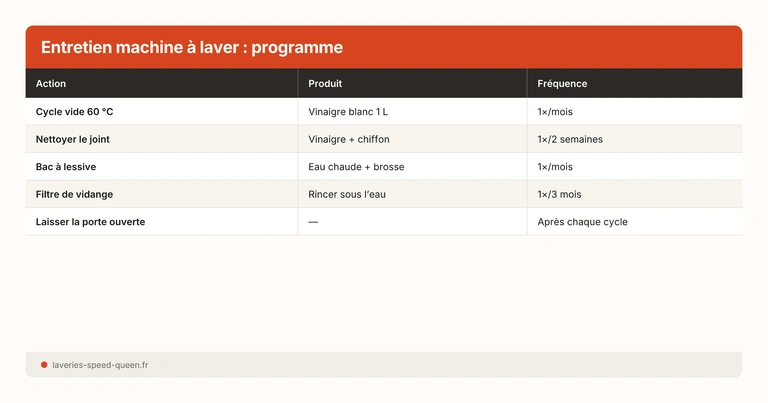
In short: The most effective protocol combines manual cleaning (door seal, drawer, filter) with a hot empty cycle at 60-90 °C. Use 500 mL of 8 % white vinegar for monthly maintenance, 1 L for catch-up, and baking soda in a separate phase.
At a Glance
Once a month: empty cycle at 60 °C minimum (90 °C if available).
Precise dosing: 500 mL of white vinegar monthly (1 L for catch-up).
Never mix vinegar + baking soda in the same step.
Every 2-3 months: drain filter — place a towel on the floor first.
After every wash: wipe the door seal and leave the door/drawer ajar.
Why You Need to Clean Your Washing Machine
A poorly maintained machine accumulates four enemies: limescale, biofilm, detergent residue and standing water.
The drum may look clean, but deposits build up mainly in hard-to-see areas. The real risk isn’t visible dirt — it’s biofilm, a layer of bacteria protected by a slimy matrix that resists simple rinsing. The most effective product for regular maintenance is household white vinegar (14 %)↗: anti-limescale, deodorising and antibacterial in one step. For targeted descaling in hard water areas, supplement with citric acid↗, which is more concentrated on mineral deposits.
Why 30-40 °C Cycles Aren’t Enough
Low temperatures save energy and protect certain fabrics, but they don’t permanently destroy bacteria living inside the machine.
Schmithausen et al. (University of Bonn, 2019) documented the presence of ESBL-producing Klebsiella oxytoca in a domestic machine used at low temperatures.
The American Society for Microbiology sums up the problem: temperatures in energy-efficient machines have often dropped below 60 °C, becoming less lethal for pathogens.
The Useful Threshold: 60 °C
Below 60 °C, some bacteria survive. A monthly maintenance cycle at 60 °C minimum (90 °C for catch-up if available) limits biofilm persistence — without giving up your daily eco cycles.
The “Stale Laundry” Smell: Moraxella osloensis
Kubota et al. (2012) identified Moraxella osloensis as one of the bacteria responsible for the musty smell on poorly dried laundry, through a volatile compound: 4-methyl-3-hexenoic acid (4M3H).
When this smell returns despite a normal wash, it’s often a sign that biofilm has taken hold inside the machine itself.
What Nies et al. (2019) Show in Practice
Nies et al. (Microorganisms, 2019) demonstrate that the bacterial flora varies by zone within the machine. Practical takeaway: don’t just clean the drum — treat the door seal, drawer and filter too, then follow up with the monthly hot cycle.
Signs of an Established Problem
Musty smell when opening the door.
Laundry that smells "off" despite a full cycle.
Black marks inside the door seal folds.
Slimy film in the detergent drawer.
Greyish residue on clothes after washing.
When a Single Clean Isn’t Enough
If the smell persists despite following the full protocol in this article:
- run two consecutive empty cycles at 90 °C (or 60 °C if 90 °C is unavailable),
- if black marks remain ingrained, consider replacing the door seal,
- beyond 8 to 10 years, recurring odours may also signal normal wear on the machine.
Quick Monthly Clean: The Empty Cycle (Core Method)
If you remember only one thing: a hot empty cycle every month with the right dose.
The Right Vinegar Dose: 500 mL or 1 L?
Both doses make sense depending on the state of your machine.
Standard monthly maintenance
500 mL of 8 % white vinegar in the detergent drawer. This is the maintenance dose — sufficient if the machine is cleaned regularly.
Catch-up clean
1 L of 8 % white vinegar directly in the drum, then run a hot cycle. Reserve this for persistent odours, visible limescale or months of neglected maintenance.
For 14 % vinegar, reduce the active dose: 500 mL maximum, then top up with water to avoid excessive acidity.
Temperature: 60 °C Minimum, 90 °C for Catch-Up
Recommended Setting
60 °C minimum for the monthly routine. Go up to 90 °C if your machine allows it and you’re treating a strong odour, old deposits or heavy build-up. See our washing temperature guide for fabric-specific thresholds.
Duration and Steps
- Machine empty.
- Add vinegar (dose according to condition).
- Cotton/maintenance programme at 60 °C or 90 °C.
- Full cycle without interruption.
- Leave the door open when the cycle ends.
Typical duration: 1 h 30 to 2 h 30 depending on the model.
Deep Clean Zone by Zone
The empty cycle alone doesn’t replace manual cleaning of the critical spots.
| Zone | Frequency | Exact Method |
|---|---|---|
| Drum | 1x/month | Empty cycle at 60-90 °C + vinegar (see dosing above). |
| Door seal | After every wash + 1x/month deep clean | Pure vinegar on a cloth, soft toothbrush inside the folds, wipe dry. |
| Detergent drawer | 1x/month | Remove the drawer, soak 20 min in hot water + vinegar, scrub, rinse. |
| Drain filter | Every 2-3 months | Towel + container, open slowly, remove debris, rinse, refit. |
| Porthole / door | 1x/week | Microfibre cloth + vinegar, then dry to prevent streaks and greasy film. |
Drum
Run the hot empty cycle first, then let it air-dry for 2 to 4 hours.
Door Seal
Pull open each fold of the seal. Deposits lodge in the lower groove, not on the visible face.
Drawer
Clean the drawer housing with a thin brush too — otherwise deposits return quickly.
Filter
If the machine has never been opened, go slowly the first time to avoid a sudden water spill.
Baking Soda: When and How to Use It
Don't confuse machine maintenance with laundry care
This article covers cleaning the washing machine itself. If you’re looking for how to use white vinegar on your clothes as a rinse aid or occasional fabric softener alternative, read our
dedicated guide to white vinegar for laundry
. The doses and goals are different.
Useful dose: 2 tablespoons (about 60 g) in the drum.
Baking soda is effective for deodorising and helping to loosen certain organic residues.
It is less effective than citric acid↗ on limescale, but useful as a second phase after a vinegar cycle.
Common Mistake: Vinegar + Baking Soda Together
Why you need to separate the phases
When you pour vinegar and baking soda together, they react immediately: acid + base → water + CO2 + salt (sodium acetate). The fizzing looks impressive, but the targeted cleaning effect is reduced. Use two separate steps: vinegar first in a hot cycle, then baking soda on a second short cycle.
2-Phase Protocol
- Hot vinegar cycle (standard dose).
- Second cycle with 2 tbsp baking soda in the drum.
- Final rinse with plain water if needed.
Descaling: White Vinegar or Citric Acid
The choice depends mainly on how hard your water is.
In moderately hard water areas, monthly vinegar maintenance is often enough.
In harder water areas, citric acid is more effective at breaking down established mineral deposits.
| Product | Dose | Recommended Use |
|---|---|---|
| White vinegar 8 % | 500 mL (maintenance) to 1 L (catch-up) | Monthly maintenance, mild odours, moderate deposits. |
| Citric acid | 2 tbsp (about 40 g) | Targeted descaling in hard water areas, every 1 to 2 months. |
Check the water hardness in your area on your local water supplier’s website, then adjust the frequency accordingly. For a detailed descaling protocol, see our descaling guide.
After Textile Dyeing: Special Protocol
After home dyeing, you need to neutralise residual pigments before washing light-coloured laundry again.
Quick procedure:
- Remove all remaining laundry.
- Run an empty cycle at 60-90 °C with 500 mL of white vinegar↗.
- Run a second cycle with 2 old towels to absorb remaining pigments.
- Check the door seal, drawer and porthole.
- If colour transfer is visible, repeat the empty cycle.
Mistakes and Products to Avoid
- Mixing vinegar + baking soda in the same drawer — instant neutralisation, reduced effectiveness.
- Running only 30-40 °C cycles for months — faster deposit build-up.
- Cleaning only the visible drum — the problem is often in the seal and drawer.
- Ignoring the drain filter — a common cause of odours and slow draining.
- Eyeballing or overdosing detergent — residue builds up in the drawer, hoses and drum.
- Repeated use of concentrated bleach or harsh cleaners — can weaken seals and plastics with no benefit for routine maintenance.
- Closing the door straight after washing — traps moisture, odours develop faster.
- Putting off maintenance until it smells — the longer you wait, the harder the clean.
Recommended Frequency by Usage
The frequency depends on your laundry volume and the types of cycles you run (cold/hot).
| Zone / Action | Couple (3-4 loads/week) | Family of 5 (7-10 loads/week) | Commercial / Laundromat |
|---|---|---|---|
| Wipe seal + air out | After every wash | After every wash | After every cycle |
| Hot empty cycle | 1x/month | Every 2 weeks | Scheduled maintenance programme |
| Detergent drawer | 1x/month | Every 2 weeks | Frequent operator checks |
| Drain filter | Every 2-3 months | Every month | Regular technical maintenance |
| Citric acid descaling | Every 2 months (if hard water) | Every month (if hard water) | Per local protocol and water hardness |
The Advantage of Professional Machines
Domestic and professional machines have different operating demands.
In a laundromat, Speed Queen machines combine a 304 stainless steel drum, cycles up to 90 °C and scheduled maintenance protocols. High extraction limits residual water at the end of the cycle, reducing the time moisture sits in the drum. For bulky loads (duvets, children’s laundry, sportswear), alternating between home and a professional machine can help maintain a consistent hygiene standard.
See: our laundromats, prices, first time at a laundromat, eco laundromat technologies.
Methodology and Sources
This guide cross-references manufacturer maintenance practices with microbiological publications on domestic washing machines. Goal: translate those sources into an actionable protocol (dose, temperature, frequency) for everyday use. The doses given are domestic benchmarks — adjust if your machine manual imposes specific limits.
Sources and References
- Schmithausen et al. (2019), Applied and Environmental Microbiology (lien externe) — transmission of Klebsiella oxytoca via a domestic machine, role of low temperatures.
- Nies et al. (2019), Microorganisms, 8(1):30 (lien externe) — bacterial composition in domestic machines by sampled zone.
- Bockmühl (2017), Journal of Applied Microbiology (lien externe) — literature review on laundry hygiene and critical washing parameters.
- Kubota et al. (2012), Applied and Environmental Microbiology (lien externe) — role of Moraxella osloensis in the characteristic musty laundry smell.
- American Society for Microbiology (2019) (lien externe) — impact of low temperatures in energy-efficient machines.
- UFC-Que Choisir: washing machine and maintenance guides (lien externe) — consumer benchmarks on maintenance and performance.
- Speed Queen Commercial — machine specifications (lien externe) — manufacturer data on professional machines.
- Washing temperature guide — fabric and hygiene thresholds.
- Detergent residue and sensitive skin — impact of residue on skin comfort.
Daily Habits That Prevent 90 % of Problems
The monthly clean matters, but it’s the daily habits that make the real difference long-term. Five simple actions, taking just seconds after each wash, are enough to keep your machine healthy between deep cleans.
After every cycle, wipe the door seal with a dry cloth — this is the single most important habit. Water that pools in the seal folds is the primary breeding ground for mould. Then leave the door and detergent drawer ajar for 2-4 hours to ventilate the drum. Remove laundry immediately when the cycle ends: a damp drum with clothes inside is the ideal environment for odour-causing bacteria.
Also check regularly that the detergent drawer doesn’t have slimy residue. If you use liquid detergent, a sticky layer often forms at the bottom of the drawer. A quick rinse with hot water every 2 weeks prevents build-up. These habits take just 30 seconds and dramatically reduce the need for intensive catch-up cleaning sessions.
As an Amazon Associate, we earn a small commission on purchases made through affiliate links in this article — at no extra cost to you. This helps us maintain this site and produce free guides.
Want to avoid bad odours on bulky loads (duvets, sheets, sportswear) with machines maintained daily? Our laundromats in Blagnac, Croix-Daurade and Montaudran are open daily. Check out our prices or discover our laundromats.