In short: Delicate fabrics (silk, wool, cashmere, linen, lace, viscose, corduroy, leather) should be washed at 30 °C max on a delicate cycle, inside a mesh laundry bag. No spin above 600 rpm. Overdosed fabric softener can weigh down silk and wool fibres. In a Speed Queen laundromat, softener is dispensed automatically at a controlled dose, and the professional rinse (50-60 L) limits residue. Some fabrics like leather and suede should never go in a machine.
At a Glance
Gentle settings — delicate/wool cycle matching the care label.
Protection — laundry bag, gentle spin, garments turned inside out.
Flat drying — no tumble dryer, no hanging while wet.
Identifying Delicate Fabrics
Most sensitive fabrics should be washed at 30 °C max, with a low spin and a mesh bag whenever there is a risk of snagging.
Before washing, you need to know what you are dealing with. Here are the main categories:
Animal Fibres
Fragile Natural Fibres
Man-Made Fibres
High-Risk Items
Always Read the Care Label
Care symbols tell you what is possible. A basin with a hand means “hand wash” — but in practice, the delicate cycle on a good machine often does just as well.
Settings and Cycles by Fabric
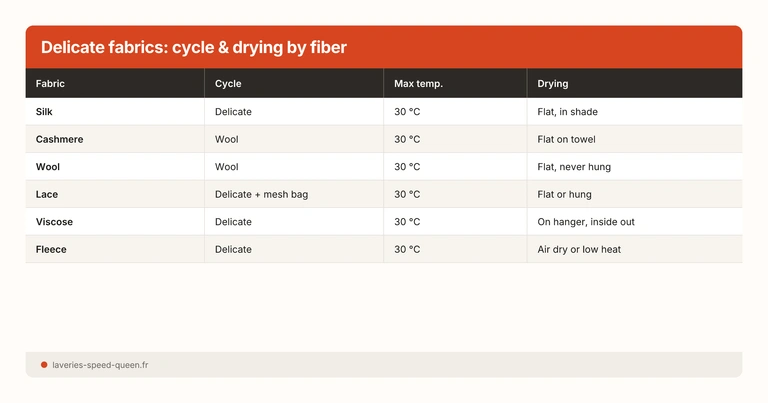
The basic rule is simple: delicate/wool cycle, 30 °C (40 °C only for certain linens), then dry flat.
Start with the care label. It tells you the limits for washing and drying.
| Fabric | Max. Temperature | Cycle | Drying |
|---|---|---|---|
| Silk | 30 °C | Delicate | Flat, in the shade |
| Cashmere | 30 °C | Wool/Delicate | Flat on a towel |
| Wool | 30 °C | Wool | Flat, never tumble-dry |
| Lace | 30 °C | Delicate | Flat on a terry towel |
| Angora | 30 °C | Wool/Delicate | Flat, never tumble-dry |
| Linen | 40 °C | Normal or delicate | Air-dry, iron while damp |
| Viscose / Rayon | 30 °C | Delicate | Flat, never tumble-dry |
| Corduroy | 30 °C | Delicate | Inside out, air-dry |
Always Check the Label
For all delicate fabrics, always check the label before washing. The temperature listed in the table is a common maximum, but your garment may require a lower one. If in doubt, see our care label guide.
Preparation Before Washing
Proper preparation (sorting, turning garments inside out, closing zips, using a laundry bag) greatly reduces the risk of distortion and broken fibres.
Good preparation makes the difference between a successful wash and a disaster.
Read the label — Check the symbols and specific instructions
Sort by colour — Delicate fabrics bleed more easily
Close fasteners — Zips, buttons, hooks can snag fibres
Turn garments inside out — This protects the visible surface
Use a laundry bag — Essential protection for lace and silk
Guide by Fabric Type
Each fabric has a key constraint: silk and lace need an ultra-gentle cycle, cashmere and wool need minimal agitation, viscose and corduroy need carefully controlled drying.
Silk (Dresses, Blouses, Scarves)
Silk is beautiful but fussy. It dislikes hot water, friction and the tumble dryer.
Recommended Method
Delicate cycle at 30 °C max, spin at 400 rpm. Remove immediately after the cycle and dry flat in the shade. Never use bleach on silk. Overdosed fabric softener weighs down silk fibres. In a Speed Queen laundromat, automatic dosing and generous rinsing limit this effect.
Cashmere (Sweaters, Scarves, Waistcoats)
Cashmere is the most delicate fabric. It felts very easily if the temperature is too high or the agitation too rough.
Watch Out for Felting
Cashmere felts with heat and agitation. Use the wool cycle, minimum spin. Always dry flat, never hung (it stretches). Use a suitable detergent if the label recommends it.
Lace (Lingerie, Curtains, Doilies)
Lace has intricate patterns that snag easily. A laundry bag is mandatory.
Essential Protection
Always place lace in a fine-mesh bag. Delicate cycle, gentle spin. Dry flat on a terry towel.
Wool (Sweaters, Scarves, Blankets)
Wool is tougher than cashmere, but it also shrinks at high temperatures.
Wool Cycle
Our machines have a wool cycle that is gentler than a standard wash. Gentle spin, flat drying. Check the label to confirm that machine washing is allowed.
Machine-Washing a Wool Sweater
A common question: can you really put a wool sweater in a washing machine? The answer is yes, in most cases, as long as you follow a few strict rules. It all starts with the care label. If you see the basin symbol with a 30 °C marking and the “reduced mechanical action” pictogram (a bar under the basin), machine washing is allowed. If the symbol shows a hand in the basin, the manufacturer recommends hand washing — but a delicate cycle at 30 °C with a very gentle spin produces an equivalent result on most modern machines, including Speed Queen machines at the laundromat.
Cycle and temperature. Always select the wool or delicate cycle. The temperature must never exceed 30 °C. Above that, the scales on the wool fibre (the keratin cuticle) open under heat and lock together through mechanical agitation: this is felting. The process is irreversible — a felted sweater will never recover its original size or softness. Set the spin to 600 rpm max, or 400 rpm for fine wools. A higher spin distorts the knit stitches.
The laundry bag↗. Always place the sweater inside out in a fine-mesh laundry bag. This reduces friction against the drum and other garments, limiting both felting and pilling (the formation of small fibre balls on the surface).
Wool types and their machine-wash tolerance. Not all wools react the same way:
- Merino: the wool best suited to machine washing. Its fibres are fine (15 to 24 microns in diameter) and often treated with a “Superwash” process by manufacturers, which smooths the scales to reduce felting. If the label says “machine washable”, you can confidently wash at 30 °C.
- Lambswool: a soft fibre, slightly thicker than merino. It tolerates machine washing at 30 °C on a wool cycle, but it pills more during the first few washes. A laundry bag is essential.
- Alpaca: a hollow, highly insulating fibre that is naturally hypoallergenic (no lanolin). It is more fragile than merino and does not tolerate agitation well. Machine washing at 30 °C on a very gentle cycle is possible, but hand washing is preferable for quality pieces.
- Cashmere: the most delicate. Hand washing remains the recommended method to preserve the softness of this exceptionally fine fibre (14 to 19 microns in diameter). In a machine, never exceed 30 °C with a 400 rpm spin, and do not overload the drum.
Mistakes that destroy a wool sweater. Hot water (40 °C and above) causes irreversible felting: the fibres shrink and stiffen into a compact block. The tumble dryer is strictly forbidden — drum heat worsens felting and can reduce the sweater by two sizes. Hanging a wet sweater on a hanger stretches the shoulders and hem under the weight of the water: the distortion is often permanent on knits.
Proper drying. Remove the sweater immediately after the cycle. Lay it flat on a dry terry towel, reshape it by hand (shoulders, sleeves, length), then let it air-dry away from direct sunlight and heat sources. Turn it over after a few hours for even drying. For more on preventing shrinkage, see our guide to avoiding shrinkage.
Linen (Shirts, Trousers, Tablecloths, Sheets)
Linen is tougher than most people think. It is a strong natural fibre that can withstand high temperatures. Its main drawback: it wrinkles heavily and may shrink on the first wash if it has not been pre-shrunk (sanforised).
How to Wash Linen Properly
Avoid overloading the machine — linen needs plenty of water for a good rinse. Check the label for the right temperature. For ironing, iron linen while still slightly damp for a smooth finish.
Linen Softens Over Time
Unlike other fabrics, linen becomes softer and more pleasant with every wash. A linen sheet that feels stiff at first will be much softer after 5-10 washes. At the laundromat, detergent and softener are included — but it is really the washing itself that softens linen fibres.
Viscose and Rayon (Dresses, Blouses, Linings)
Viscose (also called rayon) is a man-made fibre produced from wood cellulose. It has the feel of silk but behaves very poorly when wet: it swells, loses shape and shrinks easily. It is one of the trickiest fabrics to wash.
Watch Out for Shrinkage
Viscose can shrink if precautions are not taken. Delicate cycle, minimum spin. Use a laundry bag. Never wring the garment to remove water — roll it in a towel and press gently.
Drying Is Critical
Dry flat without exception. Wet viscose is fragile and loses shape under its own weight if hung. Iron on the reverse side as the label directs.
Corduroy (Trousers, Jackets, Shirts)
Corduroy has raised ribs that crush easily. A bad wash can permanently flatten the ribs and give a worn-out appearance.
Recommended Method
Always turn the garment inside out to protect the ribs. Delicate cycle matching the label. Avoid mixing with fabrics that shed lint (fleece, terry cloth) — lint gets trapped in the ribs and is very difficult to remove. Air-dry inside out on a hanger.
Washing a Swimsuit
Swimsuits face a particularly aggressive cocktail for fibres: pool chlorine, sea salt, sunscreen and UV. Their composition — mostly elastane (Lycra/Spandex) blended with polyamide or polyester — requires specific care to retain their stretch and colour.
Immediate rinsing is rule number one. After every use, rinse the swimsuit in cold water as soon as possible. Chlorine (sodium hypochlorite) degrades elastane fibres through oxidation: the longer it stays in contact with the fabric, the more the fibres lose their stretch. Sunscreen, meanwhile, contains oil-based UV filters that embed in the textile and cause yellowish stains that are nearly impossible to remove if not rinsed quickly. Cold water is enough for this first rinse — hot water would set the greasy residue.
Machine washing. A swimsuit can go in the machine, but with strict precautions:
- Temperature: 30 °C max. Heat accelerates elastane degradation and makes the fabric lose its ability to snap back (the swimsuit “bags out” and no longer holds its shape).
- Cycle: delicate, gentle spin (400 to 600 rpm).
- Protection: place the swimsuit in a fine-mesh laundry bag to prevent snagging and friction against other clothes.
- No softener: softener leaves a film on fibres that blocks the micro-pores of the fabric. On a swimsuit, this reduces stretch and speeds up wear. In a Speed Queen laundromat, automatic dosing stays moderate, but if you wash at home, skip softener entirely for swimsuits.
- No bleach: household chlorine attacks elastane in exactly the same way as pool chlorine, but in a more concentrated form.
Drying. The tumble dryer is strictly off-limits for swimsuits. Elastane starts to degrade at around 150 °C, and the heat of the drum (even on a low-temperature setting) shortens its lifespan considerably. Air-dry flat on a towel or a drying rack, in the shade. Direct sunlight causes gradual fading, especially on bright colours and prints. Do not wring the swimsuit — press it gently inside a towel to absorb excess water.
Washing frequency. Wash the swimsuit after every use. Chlorine continues to degrade fibres as long as it remains in the fabric, even when dry. On holiday, if you cannot run a machine every day, a thorough cold-water rinse after each swim is enough until a proper wash. A well-cared-for swimsuit retains its stretch and colour for 1 to 2 seasons of regular use.
Fleece Blankets and Polyester Throws
Fleece is made of polyester fibres that are sensitive to heat. To keep it soft, wash at 30 °C max and avoid any direct heat source.
Fleece (often recycled PET) traps air for insulation. Heat melts these microfibres, fuses them together and makes the fabric irreversibly rough.
30 °C Maximum
Polyester handles heat poorly. A delicate cycle on cold or 30 °C is ideal.
Limit Softener
Softener blocks the micro-pores of fleece, reducing its softness and insulating power.
Air-Dry
Fleece dries very quickly. Avoid a hot tumble dryer, which burns the fibres.
Rescuing a Rough Fleece
If it has not melted, rewash without softener with an intensive rinse at the laundromat, then gently brush the fibres once dry to restore their loft.
Throws and Sofa Blankets
How to wash a throw depends on its composition. Identify the material (cotton, wool, faux fur) to choose the right cycle and machine.
Large sofa throws (200x250 cm) require an 18 kg machine to ensure effective agitation and rinsing.
| Material | Washing | Drying |
|---|---|---|
| Cotton / Waffle Cotton | 40-60 °C, normal cycle | Moderate tumble-dry allowed |
| Faux Fur | 30 °C, delicate, laundry bag | Air-dry only, brush afterwards |
| Thick Wool | 30 °C, wool cycle | Flat drying is essential |
| Chenille / Acrylic | 30 °C, delicate | Tumble-dry on low heat |
- Pet hair — Remove it with a lint roller before washing to avoid clogging the machine.
- Overloading — An over-compressed throw will not rinse properly and will remain rough.
Seasonal Storage of Delicate Fabrics
How you store delicate items between seasons is just as important as how you wash them. A cashmere sweater stored poorly over summer can be eaten by moths or distorted by incorrect folding.
Moth Protection
Clothes moths (Tineola bisselliella) feed exclusively on animal fibres: wool, cashmere, silk, angora. They are attracted by perspiration residue and organic stains — which is why you should always store clean garments.
Cedar wood — the most common natural method. Cedar blocks or rings release an aromatic oil (thujone) that repels adult moths. Sand the surface every 6 months to release fresh oil. Effective for prevention, but insufficient against an existing infestation.
Dried lavender — a complement to cedar. Lavender sachets repel moths and scent the clothes, but their effectiveness fades after 3-4 months. Replace them each season.
Chemical mothballs (naphthalene, paradichlorobenzene) — effective but their strong odour permeates fabrics and can irritate the airways. Reserve these for confirmed infestations, in a well-ventilated space.
Folding vs Hanging
Fold knits (cashmere, wool, angora) — hanging them on a hanger stretches the shoulders and fibres under their own weight. Place tissue paper between folds to prevent crease marks.
Hang woven garments (silk, linen, viscose shirts) on padded or wooden hangers. Thin wire hangers can leave rust marks and distort the shoulders.
Store in a dry place, out of direct light. Humidity encourages mould, and UV degrades the colours of silk and wool.
Recognising Signs of Wear
Some damage on delicate fabrics is reversible, some is not. Identifying these signs lets you adjust your care routine before it is too late.
Pilling — the small fibre balls that appear on cashmere, wool and angora. Caused by friction. Remove them with a fabric shaver (de-pilling comb), never by pulling with your fingers. To limit pilling, turn garments inside out before washing and use a laundry bag.
Felting — wool and cashmere that shrinks and becomes stiff after a wash that was too hot or too rough. Felting is irreversible: the scales on the wool fibre lock together under the effect of heat and movement. The only prevention: wool cycle at 30 °C max, gentle spin.
Loss of lustre — silk loses its characteristic shine after repeated washes or contact with alkaline products (powder detergent, bleach). To preserve the sheen, use a gentle liquid detergent and rinse thoroughly.
Dry Cleaner vs Laundromat: When Dry Cleaning Is Justified
Dry cleaning (perchloroethylene or solvent-based) is not always necessary for delicate fabrics. Many items labelled “dry clean recommended” wash perfectly well in a machine on a delicate cycle.
Dry cleaning is justified for: structured suits and tailored garments, clothes with bonded linings, heavy wool coats, heavily stained silk or viscose pieces.
A machine is fine for: cashmere and wool sweaters (wool cycle, 30 °C), silk blouses (delicate cycle, laundry bag), lace lingerie (fine-mesh bag), scarves and shawls.
Dry cleaning costs 5-15 EUR per item. For a cashmere sweater you wear regularly, machine washing is more practical and more economical. See our guide to washing a suit if you are deciding between dry cleaning and machine washing.
What You Should Never Do
- Overload the drum: A drum that is too full creates more friction. Fill to 30-40 % max for delicates.
- Use standard detergent: Its enzymes destroy protein fibres (wool, silk). Always use a special enzyme-free detergent.
- Add fabric softener: It coats the fibre, suffocates it and makes it dull. It is strictly prohibited on cashmere and silk.
- Wring to remove water: This permanently breaks silk fibres and distorts wool. Blot in a towel instead.
Recommended Washing Frequency
To preserve the fibres, the recommended frequency is spaced out: approx. 2-3 wears for silk, 3-4 for cashmere, 4-5 for wool.
Delicate fabrics do not need to be washed as often as cotton:
Silk
After 2-3 wears, unless stained or smelly
Cashmere
After 3-4 wears, air out between uses
Wool
After 4-5 wears, wool naturally freshens in open air
Why Use a Laundromat for Delicate Fabrics?
The main advantage is the stability of the cycles and the drum space, which reduce friction compared to small, overloaded home machines.
Our Speed Queen machines have specific advantages for delicate fabrics:
- Specialised cycles — Wool, delicate, with stable settings
- Large drums — Garments have room to move without rubbing
- Gentle detergent — Our detergents are mild, with no harsh agents
- No investment — No need to buy a special machine for your delicates
Have delicate fabrics to wash? Discover our 3 laundromats in Toulouse and Blagnac. Our machines have the right cycles, and we can advise you if you are unsure.
As an Amazon Associate, we earn a small commission on purchases made through affiliate links in this article — at no extra cost to you. This helps us maintain this site and produce free guides.