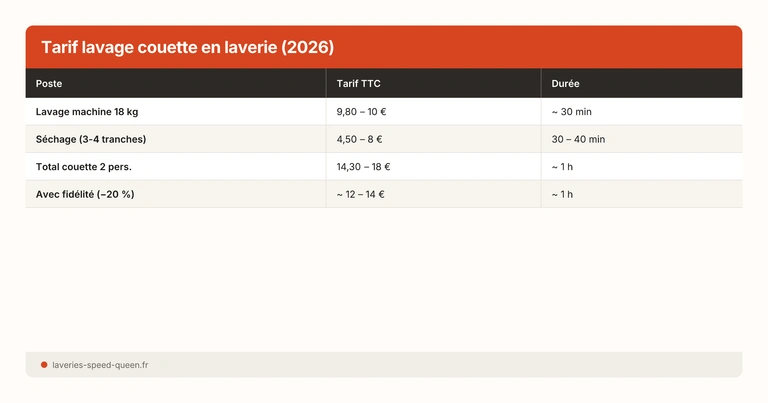
In short: washing a double duvet at a laundromat costs approx. 14-18 EUR all-in (18 kg wash approx. 10 EUR + drying approx. 4.50-8 EUR), drying takes 40-60 min in a commercial dryer, and the right rhythm is twice a year at the change of season. At a well-equipped laundromat, detergent and fabric softener are included, and the whole process — wash + dry — takes about 1 hour. That is 2 to 3 times cheaper than a dry cleaner (25-45 EUR), faster (approx. 1 hour vs 3-7 days) and gentler on the filling.
At a Glance
18 kg wash: approx. 10 EUR — detergent and fabric softener included, cycle approx. 30 min.
Drying: 4.50-8 EUR — 3-4 sessions of 10 min at 1.50-2 EUR per session. 40-60 min total.
Total: approx. 14-18 EUR — with a loyalty card: approx. 12-14 EUR (-20%). Dry cleaner: 25-45 EUR.
Total time: approx. 1 hour — duvet ready the same day.
Frequency: 2x/year — at the change of season (March + September). 3-4x if allergies or pets.
How Much Does It Cost to Wash a Duvet at a Laundromat?
The price depends on the duvet size (and therefore the machine needed) and the drying time. For a double duvet, you absolutely need an 18 kg machine — the drum must be large enough for the duvet to tumble freely and be properly washed.
Typical Laundromat Pricing (2026)
| Item | Cost (incl. tax) | Duration | Included |
|---|---|---|---|
| 18 kg wash cycle | 8-12 EUR | approx. 30 min | Detergent + fabric softener (auto-dosed at most modern laundromats) |
| Drying (per 10-min session) | 1.50-2.00 EUR | 10 min per session | — |
| Duvet drying (3-4 sessions) | 4.50-8.00 EUR | 30-40 min | Depends on thickness and filling type |
| Double duvet total | 14-18 EUR | approx. 1 hour | Full wash + dry, detergent and softener included |
| With loyalty card (-20%) | approx. 12-14 EUR | approx. 1 hour | Discount on wash cycle |
Prices vary by location
The prices above are typical for self-service laundromats in 2026. Costs vary depending on the brand, city and whether detergent is included. In major cities like London, New York or Sydney, expect the higher end of the range. Always check your local laundromat’s price list for exact rates.
Comparison: Laundromat vs Dry Cleaner vs Home
One of the first questions when a duvet needs cleaning is “what gives the best value for money?” Here is an honest comparison of the four main options.
| Option | Cost | Turnaround | Pros | Cons |
|---|---|---|---|---|
| Self-service laundromat | 14-18 EUR | approx. 1 hour | Immediate, water-based wash, large drums, commercial drying, detergent included | Trip required |
| Dry cleaner | 25-45 EUR | 3-7 days | No effort | Expensive, chemical solvents, long wait, can weaken filling |
| Home machine (if large enough) | approx. 2-3 EUR | 4-6 hours | Cheapest | Drum often too small, incomplete drying |
| Home pickup service | 30-50 EUR | 24-48 hours | Convenient, delivery | Most expensive, limited availability |
The self-service laundromat offers the best trade-off between cost, results and speed. A dry cleaner charges double or triple for a comparable result — sometimes worse for natural filling, since dry-cleaning solvents (perchloroethylene) can weaken feathers and fibres. A home machine is the cheapest option, but most domestic washers have a 7-9 kg drum — far too small for a double duvet that needs 18 kg of capacity to tumble freely. As for drying at home, that is often where the problems start (see drying section below).
Duvet Wash Prices by City
Laundromat prices vary significantly by region. Location, commercial rent and local competition directly affect posted prices.
| Region | 18 kg Wash | Drying (30-40 min) | Estimated Total |
|---|---|---|---|
| London / New York / Sydney | 12-16 EUR | 8-12 EUR | 20-28 EUR |
| Major European cities | 10-14 EUR | 6-10 EUR | 16-24 EUR |
| Mid-sized cities (Europe/US) | 8-12 EUR | 5-8 EUR | 13-20 EUR |
| Smaller towns | 7-10 EUR | 4-7 EUR | 11-17 EUR |
The differences come down mainly to commercial rent (a city-centre location in London or Paris costs 3 to 5 times more than one in a suburban area) and local energy costs. In some cities, detergent is not included, which can add 1 to 2 EUR to the total. At well-equipped laundromats (like Speed Queen), detergent and fabric softener are always included, making the real per-visit cost more competitive. With a loyalty card (-20%), the total can drop to approx. 12-14 EUR — among the most competitive rates for an all-inclusive duvet wash.
How to Optimise the Cost
Loyalty card or app
Up to -20% on washes. Many laundromats offer top-up bonuses: for instance, 20 EUR loaded = 25 EUR credit. Check your local laundromat for details.
Batch your duvets
If you have 2 single duvets, wash them on the same day — an 18 kg machine can fit 2 thin single duvets at once. Drying will need to be done separately.
Spin well before drying
A good spin cycle reduces drying time (and therefore cost). If the duvet comes out very wet, run a short extra spin before transferring to the dryer.
Go on weekdays
Laundromats are quieter during the week. You will have immediate access to the large machines and dryers without waiting.
How Long Does It Take to Dry a Duvet?
Drying is the critical step when washing a duvet. Filling that remains damp develops mould within hours. And this is precisely the step where a commercial laundromat dryer makes the biggest difference compared to drying at home.
Drying Times by Filling Type and Machine
| Duvet | Home dryer (8-9 kg) | Commercial laundromat dryer (14-25 kg) | Air drying (good conditions) |
|---|---|---|---|
| Single, thin synthetic | 1h30-2h | 30-45 min | 1-2 days |
| Single, thick synthetic | 2h-2h30 | 40-50 min | 2 days |
| Double, standard synthetic | 2h30-3h (often insufficient) | 45-60 min | 2-3 days |
| Double, down/feather | 3h+ (centre often still damp) | 50-70 min | 3 days minimum |
| King-size 220x240 cm | Drum too small | 60-75 min | 3-4 days |
Why Home Dryers Struggle with Duvets
The main problem is not the heat — it is the space. A home dryer with an 8-9 kg capacity has a drum in which the duvet takes up nearly all the volume. Hot air simply cannot circulate through the filling.
Drum too small
The duvet stays compressed against the walls. Air passes around it but does not penetrate the filling. Result: the outside dries, the centre remains damp for hours.
Insufficient power
A domestic dryer heats at approx. 2 kW. A commercial dryer delivers 3 to 5 times more thermal power, evaporating water much faster — without overheating the fabric.
No reliable moisture sensor
Most home dryers use a timer or basic sensor that measures surface moisture. The interior filling can remain damp without the machine detecting it.
The Speed Queen concept: wash + dry in approx. 1 hour
The table above shows drying times only, for comparison between machines. At a well-equipped laundromat like Speed Queen, the concept is wash + dry in approx. 1 hour total — a differentiator that not every laundromat offers. Commercial dryers have a drum twice as large, 3 to 5 times more heating power, and a moisture sensor that stops the cycle at the right moment.
Air Drying: Possible but Risky
Air drying works in good weather (direct sunlight, wind, low humidity), but it is slow and requires vigilance:
- Duration: 2-3 days minimum in good conditions
- Turn regularly: every 3-4 hours to expose both sides
- Check the centre: the interior filling is always the last to dry
- Indoor risk: without ventilation and sunlight, the risk of mould is high
If you are not confident you can dry completely outdoors, use a commercial dryer at a laundromat. The cost (4.50-8 EUR) is trivial compared to the risk of having to replace a mouldy duvet. For tips on managing moisture from indoor drying, see our guide to indoor drying humidity.
How Often Should You Wash Your Duvet?
In a single night, an adult loses on average 0.3 to 0.5 litres of sweat (source: physiological studies on nocturnal thermoregulation). Over 6 months, that is approx. 55 to 90 litres of moisture partially passing through the cover and soaking into the filling. Add dead skin cells, dust mites and body secretions. The duvet cover is an excellent barrier, but it cannot protect the filling indefinitely.
Recommended Frequency by Profile
| Profile | Frequency | Why |
|---|---|---|
| Normal use, adult, with cover | 2x/year | The build-up of sweat and dust mites remains manageable over 6 months with a cover changed regularly |
| Dust mite allergies | 3-4x/year | Dust mites colonise the filling even through the cover. Wash at 60 degrees C if the filling allows it |
| Pets sleeping on the bed | 3-4x/year | Hair, dander and animal odours penetrate the filling. Also see our pet hair removal guide |
| Heavy night sweating | 3-4x/year | Sweat soaks the filling faster — especially without a cover or with a low-absorbency polyester cover |
| Children (bedwetting, spit-up) | As needed + 2x/year minimum | Wash as soon as soiled. Mattress protectors help but do not always cover the duvet |
| No duvet cover | Every 1-2 months | The duvet receives sweat, dead skin and hair directly — much more frequent washing needed |
Why Twice a Year Is the Right Benchmark
Sweat accumulates
Even with a cover, some of the overnight moisture reaches the filling. Over the months, the duvet becomes heavier, less fluffy, and develops a body odour that a clean cover can no longer mask.
Dust mites colonise the filling
Dust mites feed on dead skin and thrive in warm, humid environments — exactly what a duvet filling is. They pass through the cover and settle into the filling, especially when washing is postponed.
Seasonal washing is the best compromise
Too few washes = poor hygiene. Too many washes = premature filling wear (especially for down). 2 washes per year, aligned with the change of season, strikes the right balance between cleanliness and longevity.
The Ideal Schedule
March-April: winter to summer duvet switch
Wash the winter duvet BEFORE putting it away. Store it clean and dry in a breathable cover (not an airtight plastic bag that traps residual moisture).
September-October: summer to winter duvet switch
Wash the summer duvet before storing it. If your winter duvet was stored clean, a simple airing is enough before putting it back on the bed.
Switch day = wash day
The simplest approach: the day you switch duvets, take the one you are storing to the laundromat. Wash + dry in approx. 1 hour, detergent included, and it is ready for clean storage.
The duvet cover: your first line of defence
A well-maintained duvet cover (changed every 2 weeks, washed at 60 degrees C) significantly reduces the amount of sweat, dead skin and dust reaching the filling. It is what makes the difference between “2 washes a year is enough” and “you need to wash every month.” For best practices, see our complete duvet washing guide and how often to wash your sheets.
Protecting Your Duvet Between Washes
Air it every morning
Instead of making the bed immediately, open the duvet and let it breathe for 10-15 min. Overnight moisture evaporates and dust mites dislike dry, aired environments.
Change the cover every 2 weeks
Change the duvet cover at the same pace as your sheets. It is the most effective barrier between your body and the filling.
Occasional sun exposure
In good weather, hang the duvet in the sun for a few hours (avoid strong wind for down duvets). UV light helps to naturally sanitise the filling.
Clean and breathable storage
Store the washed and perfectly dry duvet in a breathable fabric cover. No airtight plastic bags — residual moisture would cause mould and odour.
The Complete Laundromat Protocol
Here are the 5 steps to wash and dry a duvet at a laundromat, from start to finish. Follow them in order for a flawless result.
Choose the 18 kg machine
For a double duvet, the 18 kg machine is mandatory. The 9 kg is too small: the duvet cannot tumble freely and the wash will be mediocre. At most laundromats, the 18 kg cycle costs approx. 10 EUR with detergent included. See our complete duvet washing guide for details by filling type.
Start the cycle at 30 degrees C
Select 30 degrees C for both synthetic and down — this temperature cleans effectively without damaging the filling. Pay by card, app or loyalty card. The cycle lasts about 30 minutes.
Transfer immediately to the dryer
Do not leave the duvet waiting in the machine after the wash. Damp, compressed filling develops odours within 30 minutes. Choose the largest available dryer.
Add 2-3 tennis balls and set the right temperature
The balls beat the filling, break up clumps and allow hot air to reach the centre of the duvet. Temperature: 50-60 degrees C for down/feather, 55-65 degrees C for synthetic. See our drying temperature guide.
Dry in sessions and check the centre
Run 3-4 sessions of 10 min (approx. 4.50-8 EUR total). Press the centre of the duvet firmly between each session. If there is the slightest coolness or dampness, run another session. Only store when perfectly dry — the filling in the centre is always the last to dry.
When to Choose Another Option
The laundromat is not always the right choice. Here are the cases where an alternative may be preferable:
- Duvet not machine-washable (crossed-out tub symbol) — take it to a specialist duvet cleaner, not a standard dry cleaner
- Very high-end duvet (eider down, silk) — specialist cleaner with a guarantee
- You have a 12+ kg machine at home — home wash at approx. 2 EUR, but drying is often insufficient. See our machine capacity guide for duvets
- Reduced mobility or unable to transport — home pickup service if available in your area
For down and feather duvets, see our complete duvet washing guide which covers the additional precautions in detail.
Common Mistakes
- Using the 9 kg machine to save money — the duvet will not be properly washed. The cost of the 18 kg machine is justified by the result.
- Skipping drying to save money — damp filling develops mould within hours. Drying is mandatory, not optional. The cost (4.50-8 EUR) is trivial compared to the risk.
- Storing a duvet that is not completely dry — the filling develops mould within hours in a wardrobe or under a cover. Always check the centre.
- Forgetting tennis balls in the dryer — without them, the filling forms compact clumps that dry poorly and never regain their loft.
- Using maximum heat to speed things up — down and some synthetics cannot withstand high heat. Risk of irreversible damage to the filling.
- Going to the dry cleaner out of habit — for most machine-washable duvets, the dry cleaner is more expensive (25-45 EUR) and not better. Solvents can even weaken natural filling.
- Never washing your duvet — even with a cover, the filling absorbs sweat and dust mites over the months. Hygiene deteriorates slowly but surely.
- Storing a dirty duvet for the summer — 6 months of storage in a cupboard amplifies odours and dust mite populations. Wash BEFORE storing.
Sources and References
- Speed Queen commercial dryer technical documentation — airflow and moisture sensor specifications
- Dry cleaner price range (25-45 EUR for a standard duvet depending on city), field data March 2026
- Nocturnal thermoregulation study — estimated perspiration 0.3-0.5 L/night under normal conditions
- How to wash a duvet — complete guide
- Is your duvet machine-washable?
- What size machine for a double duvet
- How often to wash your sheets
- Dust mite allergy laundry guide
- Complete drying guide — times and temperatures
As an Amazon Associate, we earn a small commission on purchases made through the affiliate links in this article — at no extra cost to you. This helps us maintain this site and produce free guides.
Washing your duvet at a laundromat costs approx. 14-18 EUR and takes about 1 hour, detergent included — cheaper and faster than a dry cleaner. Twice a year at the change of season is the right rhythm. Find a Speed Queen laundromat near you or read our complete duvet washing guide.