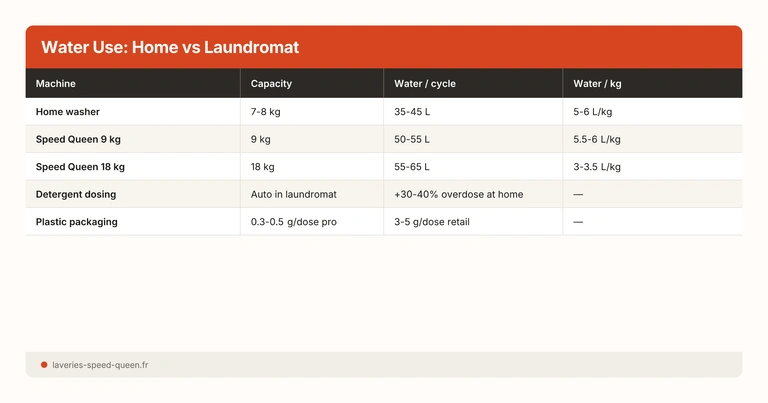
In short: Professional laundromat machines use 30-50% less water per kilogram and 20-30% less energy per kilogram than standard domestic machines. The ecological advantage is reinforced by proximity: on foot, by bike, or by public transport, the balance is clearly positive. Our laundromats are accessible by metro, tram, and bus.
Detergent Chemistry: Professional vs Consumer
In practice, automatic dosing at the laundromat prevents the overdosing common at home (often +30 to +40%) and limits unnecessary chemical residues.
The detergents used in self-service laundromats are not the same as those sold in supermarkets. Their formulation addresses different requirements: effectiveness in short cycles, compatibility with hard water, and automatic dosing. Here is what sets them apart in concrete terms.
Concentration and Effectiveness
Professional detergents are concentrated formulations: the amount of active surfactants per millilitre is 2 to 3 times higher than in a consumer product. The result: a smaller dose delivers the same or better cleaning performance. At the laundromat, dosing is handled by an automatic pump - each cycle receives exactly the right amount.
At home, studies from AISE (the International Association for Soaps, Detergents and Maintenance Products) show that consumers use on average 30 to 40% more detergent than the recommended dose. This overdosing has direct consequences:
- Surfactant residues left in the fibres (skin irritation, stiff textiles)
- Additional chemical load in wastewater
- Product waste and higher costs
Formulation Adapted to Local Water
Professional detergents include sequestering agents (EDTA, citrates, phosphonates) that neutralise calcium and magnesium ions in hard water. In France, many urban areas sit between 20 and 35 degrees French (Toulouse 25-30, Lyon 25-30, Paris 25-35 depending on the arrondissement) - a range where adjusted detergent dosing and regular machine maintenance become necessary. Consumer detergents also contain sequestrants, but their dosing is calibrated for average hardness - insufficient in harder water areas without manual adjustment.
For more on how water hardness affects washing, see our washing temperature guide. You can also learn how to wash at cold temperatures to reduce your environmental impact.
No Added Fragrances or Dyes
Professional detergents are generally free of synthetic fragrances, optical brighteners, and dyes. These additives, present in most consumer detergents for marketing reasons (pleasant smell, “whiter than white” laundry), provide no cleaning benefit. Their absence reduces the chemical load of rinse water and limits the risk of skin reactions - an advantage for sensitive skin and baby clothes.
Environmental Impact: Less Packaging, Less Waste
Professional packaging (10-20 litre containers) generates significantly less plastic waste than individual bottles (1-2 litres):
The comparison table below details the concrete differences between consumer and professional detergent.
| Criterion | Consumer detergent | Professional detergent (laundromat) |
|---|---|---|
| Packaging | 1-2 L bottle | 10-20 L container |
| Plastic per dose | approx. 3-5 g | approx. 0.3-0.5 g |
| Dosing | Manual (imprecise) | Automatic (exact) |
| Average waste | 30-40% overdosing | Negligible |
Automatic dosing and bulk packaging simultaneously reduce product waste and packaging waste. For more on the hygienic aspects of professional machine washing.
At a Glance
Less water per kilogram - professional machines consume less at equivalent loads.
Controlled detergent - biodegradable and automatically dosed.
Accessible by public transport - metro, tram, bus, or bike: the balance is highly favourable.
The Real Comparison: Laundromat vs Home Machine
The key figure is the per-kilogram ratio: a well-filled professional machine uses 30-50% less water per kg than a standard domestic machine.
The following comparison is based on a standard domestic machine (7-8 kg, less than 5 years old) versus professional laundromat machines.
Water Consumption
A standard domestic machine (7-8 kg) typically uses 35-45 litres per cycle. Professional laundromat machines, thanks to their larger capacity (9-18 kg), use 30-50% less water per kilogram when fully loaded. The larger the machine and the fuller the load, the greater the water saving per kg.
Professional machines use more water in absolute terms per cycle - this is what allows more effective rinsing (and better hygiene, as explained in our article on laundromat hygiene). But per kilogram of laundry, consumption is significantly lower. Actual consumption varies depending on the programme chosen, fill level, and water hardness.
Energy Consumption
A domestic class A washing machine typically consumes 0.8-1.0 kWh per cycle. Professional laundromat machines use 20-30% less energy per kilogram of laundry, thanks to optimised cycles and the efficiency of processing larger loads in a single run.
This comparison assumes the machine is well filled. A large professional machine half-empty loses its per-kg advantage. The benefit is real when you make use of the available capacity.
Why the Difference?
Professional Speed Queen machines are built for intensive use. Their drum is better balanced, their heating system more efficient, and their programmes are optimised for the best efficiency-to-consumption ratio.
What Speed Queen Does Differently
The efficiency gain comes mainly from three combined levers: centralised heating, adaptation to actual load weight, and higher-performance extraction.
Centralised Heating System
In our laundromats, water is not heated by each machine individually. A central water heater keeps the water at temperature.
During a standard cycle, the water arrives already warm. The machine only needs to raise it by a few degrees instead of starting from cold. The result: less energy consumed and shorter cycles.
Adaptive Programmes
The machines detect the weight of the laundry and adjust:
- The amount of water injected
- The cycle duration
- The agitation intensity
A small load does not consume as much as a large one. Note that many domestic machines use the same amount of water regardless of how full they are.
High-Performance Extraction
Good extraction means less water in the laundry at the end of the cycle. And less water = less time in the dryer = less energy.
Our machines spin hard with a perfectly balanced drum. The laundry comes out less wet than from a standard domestic machine.
The Drying Question
Drying typically accounts for 1.5 to 2 kWh per cycle, making it the biggest factor in total energy footprint.
This is where the environmental balance can tip. The tumble dryer consumes a lot of energy, at the laundromat as well as at home.
Fast Professional Drying
Our professional dryers are more powerful than domestic models. They dry faster (20-30 min versus 1h30-2h at home), so they consume roughly the same or less energy overall for the same result.
Drying time: 20-30 min for everyday laundry
Consumption: approximately 1.5-2 kWh for a full cycle
No Humidity at Home
A drying rack releases approximately 2 litres of water into the air per wash load - a source of mould, condensation, and odours. By drying at the laundromat, you avoid this problem and leave with laundry ready to put away.
Professional Drying: Fast and Efficient
Professional drying combines power and speed. The result: dry laundry in 20-30 minutes, no humidity in your home, and no waiting 12 to 24 hours on a drying rack.
What About the Trip to the Laundromat?
Good news: our laundromats are accessible by public transport, bike, or on foot from most neighbourhoods in Toulouse and Blagnac.
The mode of transport plays a role in the overall ecological balance. The shorter and greener the trip, the greater the advantage.
Impact by Mode of Transport
| Transport | 2 km round trip | 10 km round trip |
|---|---|---|
| On foot / bike | 0 kg CO2 | 0 kg CO2 |
| Public transport | approx. 0.05 kg CO2 | approx. 0.15 kg CO2 |
| Petrol car | approx. 0.3 kg CO2 | approx. 1.5 kg CO2 |
For reference: a laundromat wash cycle has a moderate carbon footprint thanks to the French electricity mix. These figures remain orders of magnitude - the exact footprint varies depending on the programme chosen, machine fill level, and local conditions. Choosing green transport keeps the overall balance very favourable.
Easy Access
Our laundromats are served by metro, tram, and Tisseo buses. Blagnac is 5 min from the T1 tram and Croix-Daurade is 5 min from metro B (Borderouge). Free parking if you come by car.
Detergents: An Often-Overlooked Factor
The main lever here is exact dosing: even the same detergent, over-dosed, directly increases the chemical load on wastewater.
The detergent used also has an environmental impact. In our laundromats, this parameter is controlled:
What We Use
- Biodegradable professional detergents
- Phosphate-free (phosphates pollute waterways)
- Automatic dosing: no overdosing, no waste
Automatic dosing is a key element. At home, overdosing is common (“so it washes better”). In reality, too much detergent does not clean better and pollutes more.
Comparison with Consumer Detergents
Supermarket detergents often contain:
- Synthetic fragrances (persistent in the environment)
- Optical brightening agents (disruptive to aquatic life)
- Questionable preservatives
The professional detergents used in our laundromats are formulated to be effective and to break down quickly.
Our Supplier: La Lessive de Marcelle (Procalp, Tarn)
Our Speed Queen laundromats use the professional detergent La Lessive de Marcelle (lien externe), manufactured in Aussillon in the Tarn department by Procalp (lien externe), a family business founded in 1885. The range is Ecocert-certified and formulated with renewable plant-based ingredients. Procalp is a member of the Cluster Chimie Verte Occitanie (lien externe) and has its own on-site R&D laboratories.
Verifiable details:
- Legal identity and RCS: Legal notices - La Lessive de Marcelle (lien externe)
- Composition, dosing, and Ecocert certification: Ecocert 3-in-1 detergent (lien externe)
- Local manufacturing and history: About Procalp (lien externe)
Shared Equipment: The Pooling Advantage
A professional machine running 8 to 10 cycles per day spreads its manufacturing impact over far more kilograms washed than a domestic appliance.
An often-overlooked ecological argument: a shared machine means fewer individual machines to manufacture.
The Manufacturing Impact
Manufacturing a domestic washing machine generates a significant carbon footprint (the exact figure varies depending on the production chain and materials). This machine will be used perhaps 3-4 times a week for 10-15 years.
A laundromat machine runs 8-10 times a day. It potentially “replaces” dozens of domestic machines over its lifespan (which is longer, because it is designed for that).
Professional Maintenance
A well-maintained machine consumes less and lasts longer. Our machines are checked regularly:
- Filter cleaning
- Seal inspection
- Programme testing
A poorly maintained domestic machine (clogged filter, worn seals) can consume 10-20% more water and energy.
The Overall Balance: When Is the Laundromat Truly Eco-Friendly?
The most favourable scenario combines a short distance (under 2 km), a full load, and travel without a private car.
The laundromat is clearly advantageous if:
You live within 2 km (trip on foot, by bike, or by public transport)
You wash full loads (machine well filled)
You do not own a machine at home (no equipment duplication)
You wash bulky items (duvets, curtains) that require an 18 kg machine
How to maximise the ecological advantage:
Walk, cycle, or take the metro to get there
Fill the machine well to use the full capacity
Combine your washes (duvets, bed linen, clothes) into a single trip
What You Can Do to Optimise
Four actions are enough to reduce the impact: full machine, appropriate programme, fast professional drying, and public transport.
A few simple steps to make your laundromat visit as eco-friendly as possible:
1. Fill the Machines Properly
A half-empty machine is water and energy wasted. Wait until you have enough laundry for a full load.
2. Choose the Right Programme
A gentle cycle is sufficient for the vast majority of washes. Save the more intensive programmes for cases that truly require them (heavily soiled laundry). For more, see our guide to laundry care labels.
3. Take Advantage of Professional Drying
Professional dryers dry in 20-30 minutes (versus 1h30-2h at home) and avoid humidity problems associated with indoor drying racks. Leave with dry laundry, ready to put away - no mould or condensation in your home.
4. Walk or Take Public Transport
If possible, avoid the car. The tram or metro have a much lower impact.
Summary
Laundromats are not “eco-friendly” by magic, but they have real advantages:
- Optimised machines that use less water and energy per kilogram
- Biodegradable detergents dosed automatically
- Shared equipment across many households
- Regular professional maintenance
The balance depends mostly on your situation: distance, mode of transport, and what you wash. For many people - especially those without a machine at home - the laundromat is a sensible solution, including from an environmental standpoint.
As an Amazon Associate, we earn a small commission on purchases made through the affiliate links in this article - at no extra cost to you. This helps us maintain this site and produce free guides.
Want to learn more? Our laundromats welcome you 7 days a week from 7am to 10pm at Blagnac Andromede and Toulouse Croix-Daurade.
Methodology and Sources
- The environmental orders of magnitude (water, energy, CO2) are presented as operational estimates, not as universally certified measurements.
- External references serve as a framework (ANSES for indoor air quality/humidity, ADEME for energy/carbon orders of magnitude) and internal data come from our equipment/pricing pages.
- The final balance always depends on machine fill level, the programme chosen, and the mode of transport to the laundromat.
Maintain Rather Than Replace: The 10-Year Calculation
The textile industry is the 2nd most polluting in the world. Every textile properly maintained and used longer is one less textile to produce, transport, and discard. Here is the concrete calculation.
Sheets: 3 Replacements Avoided
Without proper care: lifespan 3 years, 3 sets purchased over 10 years = approx. 300-450 EUR. With professional washing: lifespan 5-6 years, 2 sets are enough = approx. 200-300 EUR. Saving: 100-150 EUR + 1 fewer set in textile waste.
Towels: Domestic Overdosing Kills Them
Automatic dosing at the laundromat uses the exact amount of detergent. At home, overdosing (very common) leaves residues in the fibres that stiffen them and accelerate wear. Well-maintained towels last 4-5 years instead of 2-3.
Duvets and Pillows: Avoiding Premature Replacement
A duvet washed regularly in an 18 kg machine (enough volume not to compress the filling) retains its loft for 6-8 years. Compressed in a 7 kg domestic machine, it loses its insulation in 3-4 years. Difference: 1 quality duvet (80-150 EUR) saved.
Overall, a household that properly maintains its textiles can potentially save 300-500 EUR over 10 years in avoided replacements (operational estimates based on the examples above - actual results vary depending on initial textile quality and washing habits).
Laundromat vs Domestic Machine: Ecological Footprint Compared
The ecological comparison between a laundromat and a domestic machine goes beyond water consumption per cycle. You need to factor in machine manufacturing, its lifespan, and drying efficiency.
| Criterion | Domestic Machine | Professional Laundromat |
|---|---|---|
| Water per kg of laundry | 30-50% less per kg | 30-50% less per kg |
| Machine lifespan | 7-10 years (approx. 2,000 cycles) | 15-25 years (approx. 30,000 cycles) |
| Drying energy (duvet) | Domestic dryer: 2-3 kWh | Professional dryer: 25-30 min optimised |
| Detergent dosing | Manual (frequent overdosing) | Automatic (exact dosing) |
| Manufacturing impact | 1 machine per household | 1 machine shared among dozens of households |
The most often overlooked point is the manufacturing impact. A domestic washing machine represents 200-300 kg of CO2 in production. At a laundromat, this footprint is spread across tens of thousands of cycles and hundreds of households - a fraction of the impact per wash.