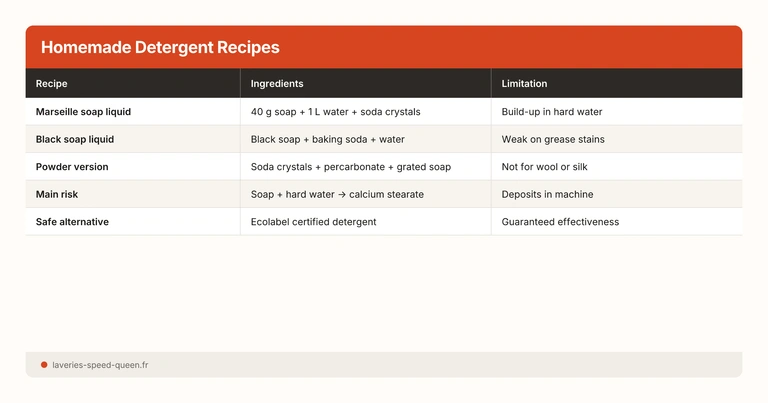
In short: Homemade laundry detergent can work for everyday maintenance, but it is not a miracle solution. On lightly soiled clothes, it may suffice. On greasy stains, dull whites, and hard water, its limits are real. The key issue is not “homemade vs store-bought” — it is chemistry: soap
- limescale = deposits. This guide gives you recipes that work, what they cannot do, and how to prevent machine build-up.
At a Glance
Yes, it can work for light soiling with careful dosing.
No, it is not universal: greasy stains and bright whites remain difficult.
Build-up risk is real, especially in medium-hard to hard water.
Three useful recipes: liquid Castile soap, liquid black soap, and a powder version.
Pragmatic approach: alternate with a machine-formulated detergent when needed.
Soap ≠ Detergent: Chemistry First
The debate around homemade detergent is often moralised, when really it is a matter of physical chemistry.
Soap and synthetic detergent both clean, but not in the same way — and not with the same tolerance for hard water.
- Soap: a fatty acid salt produced by saponification (lye + oil/fat).
- Synthetic detergent: industrially designed surfactants, often more stable in the presence of calcium and magnesium.
The central problem with classic soap-based homemade detergent has been known for a long time:
soap + hard water → insoluble calcium stearate (soap scum).
Simplified equation:
Ca²⁺ + 2 C₁₇H₃₅COO⁻ → Ca(C₁₇H₃₅COO)₂↓
The precipitate does not “disappear” — it gradually deposits.
Observable consequences over repeated cycles:
- greying of fabrics,
- fibres becoming stiffer,
- lingering odours,
- residue on the drum, seals, and hoses.
This is not an internet myth
The soap-limescale reaction is a chemistry textbook classic. User reports and comparative tests confirm the same reality: in hard water, a soap-based detergent demands more vigilance than a modern detergent formula designed for that environment.
For a formulated option when you would rather not improvise, see also our guide on how to choose the right detergent.
Real Castile Soap: How to Identify It
The term “Castile soap↗” is used broadly, sometimes misleadingly.
The “72% oil” marker is itself often misunderstood.
What “72%” Really Means
“72%” refers to the total proportion of saponified fats in the finished soap.
It does not mean “72% olive oil.”
Useful Label Checks
Short ingredient list
Look for mentions like sodium olivate (olive) or sodium palmate (palm), with sodium hydroxide for saponification.
Few additives
A genuine traditional Castile soap avoids synthetic fragrances, colourants, and long lists of auxiliary agents.
Historic manufacturers
The most commonly cited UPSM members: Marius Fabre, Savonnerie du Midi (La Corvette), Le Sérail, Fer à Cheval.
Many products labelled “Castile soap” are actually syndets (synthetic detergents) or blends.
That is not necessarily “bad” per se, but it is not the same raw material — nor the same behaviour in the wash.
Reference source
UFC-Que Choisir published a useful investigation into the naming and actual compositions:
Savons de Marseille: c’est du propre? (March 2021)
.
Recipe #1: Liquid Castile Soap
This is the most widespread homemade detergent recipe. It can suit everyday laundry that is lightly to moderately soiled.
Exact Amounts
- 40 g of grated Castile soap
- 1 L of hot water
- 1 tbsp of washing soda↗ (level)
Step-by-Step
- Finely grate 40 g of soap.
- Heat 1 litre of water (do not boil).
- Add the grated soap, stirring until dissolved.
- Mix in 1 level tablespoon of washing soda.
- Stir for another 2 to 3 minutes.
- Let the mixture cool slightly, then pour into a clean container.
Machine Dosing
Start with around 80 to 120 ml per cycle, then adjust based on the actual result (smell, feel, cleanliness).
Do not overdose “just to be safe” — overdosing increases residue and makes rinsing harder.
Storage
Store for 1 to 2 months maximum.
The texture thickens at rest — that is normal. Shake before use.
To understand why some stains persist despite this recipe, see our tough stain solutions guide.
Recipe #2: Liquid Black Soap
A simpler version to dissolve, useful for those who want quick preparation.
Exact Amounts
- 2 tbsp of soft black soap
- 1 L of hot water
- 1 tbsp of baking soda
Method
Mix the black soap into the hot water, then add the baking soda.
Stir until homogeneous, let it cool, and bottle.
What Works Well
Everyday maintenance of lightly soiled clothes.
Quick preparation with no grating step.
Generally more stable texture than some grated soap recipes.
Limits to Know
- Reduced performance on embedded grease stains,
- variable effectiveness on dull whites,
- results depend on water hardness.
Recipe #3: Powder Version (No Water)
This version avoids the storage issues of liquid recipes and simplifies keeping.
Exact Formula
- 200 g of washing soda
- 100 g of sodium percarbonate↗
- 100 g of baking soda
Mix dry in an airtight, dry jar.
Dosing
Use 1 to 2 tbsp per machine load depending on the load size and soil level.
Advantages
Good stability
No water = long shelf life as long as the container stays dry.
Easy dosing
Simple spoon measurement — no shaking a thickened liquid.
Versatile on cotton
Can suit sturdy household linen and non-delicate white cotton.
Fabric Warning
This formula is alkaline. It is not recommended for wool, silk, or delicate fabrics.
If your goal is whiter whites, percarbonate can help — especially from 40 °C upwards. Details here: how to whiten yellowed laundry.
Honest Comparison: Homemade vs Store-Bought
The useful point is not to declare a universal winner, but to know when each option is appropriate.
| Criterion | Homemade | Store-bought |
|---|---|---|
| Light stain removal | ✅ | ✅ |
| Grease stain removal | ❌ | ✅ |
| Bright whites | ❌ | ✅ |
| Cost per wash | ✅ (usually lower) | ❌ (usually higher) |
| Environmental impact | ⚠️ depends on ingredients and usage | ⚠️ depends on formula and dosing |
| Build-up risk | ⚠️ real risk with soap + hard water | ✅ formulated to minimise deposits |
Key references:
- UFC-Que Choisir (March 2023, stain remover test): baking soda was among the least effective options on grease stains — sometimes “even worse” than commercial stain removers depending on the scenario.
- UFC-Que Choisir (March 2021): warning about the “Castile soap” label and the actual composition of products.
For a broader environmental comparison (machines, energy, dosing, cycles), see also eco-friendly laundromat technologies.
Build-Up: The Real Risk
This is the most underestimated topic in “magic recipe” content.
Calcium stearate does not just float in the water — it ends up depositing.
Affected areas:
- tub and drum,
- seals,
- hoses,
- detergent tray.
In many regions, water hardness can easily reach 15-20 gpg (grains per gallon), qualifying as moderately hard to hard water.
That is enough to significantly increase the risk of deposits with soap-based detergents if machine maintenance is neglected.
Minimum maintenance protocol
If you use a soap-based homemade detergent, run at least one empty hot cycle monthly at 90 °C (194 °F), with a visual check of the seal and detergent tray. You can supplement with a white vinegar cycle as needed depending on the machine’s condition.
Step-by-step guide: how to clean your washing machine.
Washing Soda, Baking Soda, Percarbonate: The Differences
Looking for a product deep-dive rather than a recipe?
This page covers the homemade detergent logic. If your question is mainly about the product itself, see also
our complete guide to sodium percarbonate for laundry
. For white vinegar in the rinse, see
white vinegar and laundry: useful applications, limits, and mistakes to avoid
.
These three powders are often confused. They do not have the same pH nor the same use.
| Product | Approx. pH | Main Use | Precautions |
|---|---|---|---|
| Baking soda | 8.5 | Deodorise, lightly buffer alkalinity | Limited cleaning action on grease stains |
| Washing soda | 11.4 | Degrease and boost the detergent | Avoid on wool, silk, and delicate fabrics |
| Sodium percarbonate | Alkaline + active oxygen | Whiten/oxygenate, active from 40 °C upwards | Test on colour-sensitive items, protect eyes/hands |
Baking soda
More of a deodoriser than a powerful cleaner. Good complement, poor full replacement.
Washing soda
Strong on grease, but more aggressive. Respect dosages and compatible fabrics.
Percarbonate
Oxygen-based whitening agent. Its activity increases with temperature.
To choose the right temperature based on fabric type and the chemistry you are using, see our washing temperature guide.
Skin Impact: Think About Residue Too
Another angle often overlooked in homemade recipes is skin tolerance.
A “natural” formula is not automatically “neutral” for all skin types.
The real lever remains: correct dosing + sufficient rinsing + suitable fabric.
If you have reactive skin, see our full guide: detergent residue and sensitive skin.
What About the Laundromat?
Even if you make your own detergent at home, the laundromat remains a useful complement for bulky items (duvets, curtains, large loads). Professional Speed Queen machines use auto-dosed detergent, which limits dosing errors and the build-up risks associated with soap recipes. Discover our 3 laundromats in Toulouse and Blagnac and see first time at a laundromat to get started.
Why Online Recipes Often Fail
Forums and social media are full of enthusiastic testimonials about homemade detergent — but also disappointed feedback a few months later. The gap comes down to two factors most recipes never mention.
Hard Water Neutralises the Soap
Water hardness varies considerably from one area to another. A recipe that works in a soft-water region (approx. 5 gpg) can fail completely in a moderately hard area (approx. 15 gpg) or a hard-water zone (approx. 20+ gpg). In hard water, soap reacts with calcium to form calcium stearate — an insoluble deposit that cleans nothing and accumulates in fibres and in the machine. The recipe author may live in a soft-water area without realising it. Check your water hardness on your utility company’s website or with a TH test strip (available at pet shops or online, approx. $5) before committing.
Build-Up Is Gradual and Invisible
The second problem is that homemade detergent can seem to work fine for 2-3 months before the first signs appear. Soap deposits accumulate cycle after cycle in the drum, seals, and hoses. Symptoms arrive gradually: greying fabrics, a musty smell in the machine, less absorbent towels. At that point, the build-up requires deep cleaning (hot cycle at 90 °C + white vinegar↗, or even disassembling the detergent tray). Many users blame these symptoms on the machine or the fabrics — not the detergent.
The right approach: if you make your own detergent, schedule a monthly maintenance cycle at 90 °C (194 °F) with a machine-formulated detergent, and watch for three warning signs — drum odour, greying whites, and “cardboard-stiff” towels.
When to Alternate with Store-Bought Detergent
The most pragmatic approach is not to pick a side (homemade or commercial), but to alternate based on need. Homemade detergent works well for lightly soiled everyday laundry: t-shirts, sheets, indoor clothes. For whites that need refreshing, stubborn stains (grease, blood, wine), or sportswear with a heavy bacterial load, a detergent formulated with enzymes and bleaching agents will deliver better results.
A workable rhythm: homemade for 3 out of 4 cycles, store-bought for 1 out of 4 (for whites or heavier loads). This regular cycle with a machine-formulated detergent also helps limit the gradual build-up described above.
Also consider testing your water every 6 months with a TH test strip (available at pet shops or online). If your water gets harder — which can happen after a source change by your utility — adjust your recipe or increase the alternation frequency.
Common Mistakes
- Equating natural with universal: a homemade recipe can be useful without being suited to every fabric.
- Using fake Castile soap: the label alone does not guarantee a traditional composition.
- Overdosing to "wash better": this increases deposits, makes rinsing harder, and causes machine odours.
- Ignoring water hardness: in medium-hard to hard water, the risk of soap scum increases.
- Using alkaline powder on wool/silk: risk of fibre damage.
- Never running machine maintenance: without a periodic hot cycle, deposits accumulate.
Sources
- UFC-Que Choisir, “Savons de Marseille: c’est du propre?”, March 2021: quechoisir.org
- UFC-Que Choisir, stain remover test, March 2023 (performance comparison, including baking soda)
- Standard soap chemistry principles: precipitation of calcium fatty acid salts in hard water
As an Amazon Associate, we earn a small commission on purchases made through affiliate links in this article — at no extra cost to you. This helps us maintain this site and produce free guides.