In short: Wash your sheets every 1-2 weeks. Each night, you lose roughly 0.5 litres of sweat and shed skin cells that feed dust mites. Cotton sheets: 60 °C for optimal hygiene. Linen or sateen sheets: 40 °C on a delicate cycle. If you are allergic to dust mites, a weekly wash at 60 °C is recommended.
At a Glance
Pillowcases: once a week — the item in direct contact with your face, sebum and saliva.
Sheets: weekly in summer, fortnightly in winter — sweat output doubles in warm weather.
60 °C for whites, 40 °C for colours — 60 °C significantly reduces the allergen load in bedding.
Complete drying is essential — sheets stored while still damp develop mould and odours.
Frequencies and Temperatures by Fabric
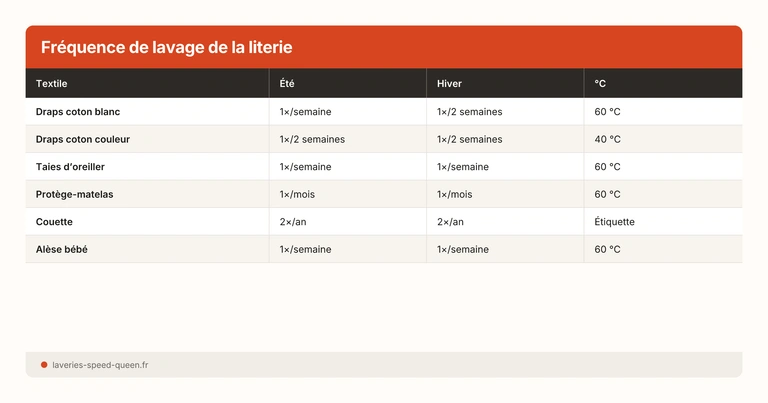
For standard bedding, follow this baseline: pillowcases every week, sheets every 1-2 weeks, and 60 °C whenever allergies are a concern.
| Fabric | Summer | Winter | Temperature | Machine |
|---|---|---|---|---|
| White cotton sheets | Weekly | Fortnightly | 60 °C | 9 kg |
| Coloured cotton sheets | Fortnightly | Fortnightly | 40 °C | 9 kg |
| Sateen cotton sheets | Fortnightly | Fortnightly | 30 °C | 9 kg |
| Duvet covers | Twice/month | Twice/month | 40-60 °C | 18 kg |
| Pillowcases | Weekly | Weekly | 60 °C (white) / 40 °C (colour) | With sheets |
| Mattress protector | Monthly | Monthly | 60 °C | 9 kg |
| Duvet | Twice a year (spring + autumn) | Per care label | 18 kg | |
| Baby mattress pad | Weekly | Weekly | 60 °C | 9 kg |
For duvets and pillows, see our dedicated duvet washing guide.
Mattress Protector: The Forgotten Essential
The chart above lists the mattress protector at once a month — but many people never wash theirs. The reason for the lower frequency is simple: the mattress protector does not touch your skin directly. The fitted sheet acts as a barrier, slowing the build-up of sebum and dead skin on its surface. But “slower” does not mean “non-existent”.
Each night, some of your overnight sweat (roughly 200 ml per adult) soaks through the sheet and accumulates in the mattress protector. This moisture, combined with body heat, creates an ideal environment for dust mites and bacteria. After two or three months without washing, the mattress protector can develop a faint but noticeable smell, even with freshly laundered sheets on top.
Baby mattress pads are the exception: they should be washed at least once a week. Nappy leaks, spit-up and the higher sweat rate of infants justify a much more frequent cadence. Always wash at 60 °C.
Three signs your mattress protector needs washing: a slightly sour smell when you lift the fitted sheet, yellowish stains visible on the surface, or a “not fresh” feeling at bedtime despite clean sheets. If any of these appear, do not delay — the problem only gets worse.
Important drying note: if your mattress protector has a waterproof polyurethane (PU) membrane, do not tumble dry it. The drum heat degrades the membrane, which can melt, crack or peel away. Air dry only for these models. Terry cloth or fleece mattress protectors can go in the dryer without issue.
For the full anti-dust-mite washing protocol for all bedding (mattress protector, pillows, duvet), see our dust mite allergy and laundry guide.
Why These Frequencies
These frequencies match the real accumulation rate: overnight sweat, sebum and dead skin cells add up every night and feed dust mites.
Dust mites multiply fast
A mattress used for several years can harbour a large dust mite population. Their droppings, invisible to the naked eye, are a leading cause of household allergies (source: ANSES). Washing bedding at high temperatures limits this exposure.
Sebum builds up every night
The body produces a significant volume of overnight sweat, plus sebum from the face and scalp. Pillowcases concentrate these residues — which is why they need washing more often than sheets.
Dead skin and dust
We naturally shed skin cells every night. Combined with ambient dust, they create an ideal breeding ground for dust mites and bacteria.
Signs You Need to Wash More Often
If you notice morning allergies, a persistent smell or skin irritation, switch to a weekly cadence for sheets and pillowcases immediately.
Morning allergies — stuffy nose, sneezing or irritated eyes when you wake up. Dust mites are likely the cause.
Smell on the sheets — if you detect even a faint odour, you are overdue for a wash.
Oily skin or acne — pillowcases loaded with sebum worsen skin problems. Wash pillowcases at least once a week.
Pets on the bed — fur, saliva, bacteria: wash sheets and pillowcases weekly, year-round.
If you suspect bed bugs, frequency alone will not solve the problem
In that case, you need a dedicated laundry protocol: sealed bags, heat compatible with the care label and clean reconditioning. See
our bed bug laundry guide
instead.
Making the Most of Your Laundromat Visit
The most efficient setup: wash 2 bedding sets in an 18 kg machine, then tumble dry — total session around 1 hour.
Combine sheets and pillowcases in an 18 kg machine
A complete double bed set (fitted sheet, duvet cover, 2 pillowcases) weighs 2-3 kg. You can load 2 sets into an 18 kg machine and wash everything in one go. Faster and cheaper than two 9 kg machines.
Run 2 machines in parallel
If you also have towels or clothes, start a second machine at the same time. Both finish together, then you move to drying. Total time: roughly 1 hour.
Do not overload the drum
Sheets need room to tumble freely. A sheet crushed into a ball will not wash or rinse properly. Fill the machine to two-thirds maximum.
Mistakes to Avoid
- Washing white sheets at 40 °C — not hot enough to kill dust mites; wash at 60 °C
- Overloading the machine — sheets form a compact ball that is poorly washed and rinsed
- Mixing delicate sheets with terry towels — the friction damages sateen and silk
- Storing sheets while still damp — mould is guaranteed within days
- Forgetting the mattress protector — it absorbs sweat that passes through the sheet; wash it monthly
Annual Cost of Washing Sheets at a Laundromat
At around 5.50 euros per weekly visit, the annual budget comes to roughly 286 euros, or 229 euros with a 20% loyalty discount.
| Frequency | Cost/visit (9 kg) | Annual cost | With loyalty -20% |
|---|---|---|---|
| Weekly | 5.50 euros | 286 euros | 229 euros |
| Fortnightly | 5.50 euros | 143 euros | 114 euros |
| 2 sets in 18 kg | 10 euros | 260 euros (weekly) | 208 euros |
If you wash two sets every week, grouping them in an 18 kg machine works out cheaper than two separate 9 kg washes, with the bonus of a single trip and a single drying phase.
Sheets and Allergies: The 60 °C Protocol
For allergy sufferers, temperature is decisive: dust mites die above 56 °C (ANSES benchmark), and a 60 °C cycle eliminates roughly 99% of dust mites from washable bedding.
In practice, the most reliable protocol is: sheets and pillowcases at 60 °C every week, complete drying, then add an anti-dust-mite mattress protector to limit recolonisation between washes. See our dust mite allergy and laundry guide for the full protocol. To maintain wash quality over time, also schedule washing machine maintenance with our guide to cleaning your washing machine.
Bedding at the Laundromat: An Underrated Option
Many people reserve the laundromat for duvets and curtains, but sheets and duvet covers belong there too. Professional machines offer a specific advantage for bedding: the higher water volume (50-60 litres) allows a deep rinse that removes sweat, sebum and detergent residues trapped in the fibres.
In a domestic 7-8 kg machine, a double bed set weighs around 3-4 kg and takes up considerable space. Agitation and rinsing are often limited. In a 9 kg laundromat machine, the same load has more room to tumble freely.
For families, the benefit is even greater: 2 bedding sets in an 18 kg machine instead of 2 separate cycles at home. Wash at 60 °C, dry immediately, and your sheets are ready to go back on the beds that same evening — without a drying rack occupying the living room for 24 hours.
As an Amazon Associate, we earn a small commission on purchases made through affiliate links in this article — at no extra cost to you. This helps us maintain this site and produce free guides.
Time to change the sheets? Our laundromats in Toulouse and Blagnac have 9 kg and 18 kg machines with detergent included. Wash + dry in 1 hour. Check our prices.
How to Keep Sheets Fresh Between Washes
A few habits reduce the necessary washing frequency without compromising hygiene.
Air the bed every morning — open the duvet and let the mattress breathe for 15-20 minutes before making the bed. Overnight moisture (roughly 0.5 litres of sweat per night for an adult) evaporates during this time instead of staying trapped in the fibres.
Use a pillow protector under the pillowcase — this intermediate layer absorbs sweat and sebum before they reach the pillow. The protector washes at 60 °C and extends the pillow lifespan.
Shower in the evening rather than the morning — a clean body deposits less sebum, sweat and dead skin cells on the sheets overnight. The single most effective habit for spacing out washes.
Choose percale cotton sheets — percale is smoother than jersey or flannel, which limits the build-up of lint, hair and dead fibres. It also dries faster, reducing the time between washing and putting sheets back on.
Methodology and Sources
- Hygiene and allergen benchmarks are based on ANSES documentation on indoor air quality and household allergens.
- Washing frequencies are formulated for practical domestic and laundromat use, then cross-referenced with our internal bedding guides.
- Temperatures are given as useful maxima by fabric type and should always comply with care labels.
New Sheets: Should You Wash Them Before Use?
Yes, always wash new sheets before sleeping in them. New textiles contain manufacturing residues: chemical finishes (to stiffen the fabric for retail display), unfixed dyes and sometimes traces of formaldehyde used as an antifungal during transport. A first wash at 40 °C removes these residues and softens the fabric. For white cotton sheets, a first wash at 60 °C is even more effective.
This first wash also serves as an initial shrinkage: non-pre-shrunk cotton can lose 3-5% of its size on the first cycle. Better for that shrinkage to happen before you have got used to how the sheet fits the mattress. Linen sheets behave the same way: a first wash at 40 °C stabilises dimensions and softens the fibre.
Clean Sheets and Sleep Quality: What the Science Says
Beyond hygiene, sheet cleanliness directly affects your sleep quality. The connection is both physical (irritants, allergens) and psychological (comfort sensation).
Skin irritation and acne
Sheets accumulate sebum, sweat and dead skin from the very first night. After 7 days, this biological layer promotes spots, itching and redness — especially on the face in contact with the pillowcase. A weekly wash at 60 °C eliminates these residues.
Nasal congestion and allergies
Dust mites colonise sheets within 2-3 weeks. Their droppings are the leading cause of indoor respiratory allergies: stuffy nose, morning sneezing, itchy eyes.
The psychological factor
The smell of clean sheets and the feeling of freshness make it easier to fall asleep. National Sleep Foundation surveys show that 73% of people report sleeping better in freshly washed sheets. It is not a luxury — it is sleep hygiene.
If you suffer from sleep problems, unexplained spots or morning congestion, the frequency of your sheet washing is the first thing to check — before seeing a dermatologist or allergist.
Annual Budget: The Real Cost
A weekly laundromat wash represents a predictable budget. Here is the calculation with Speed Queen Toulouse rates.
| Frequency | Machine | Cost/week | Cost/year | With loyalty (-20%) |
|---|---|---|---|---|
| Weekly (recommended) | 9 kg: 4.90-5.50 euros + drying approx. 3 euros | approx. 8 euros | approx. 415 euros | approx. 330 euros |
| Every 10 days | 9 kg: 4.90-5.50 euros + drying approx. 3 euros | approx. 8 euros | approx. 290 euros | approx. 230 euros |
| Fortnightly (minimum) | 9 kg: 4.90-5.50 euros + drying approx. 3 euros | approx. 8 euros | approx. 210 euros | approx. 165 euros |
Weekly washing is the standard recommended by dermatologists and allergists. If your budget is tight, every 10 days is still acceptable — but never go longer than 2 weeks, especially in summer or if you sweat at night.
To optimise the budget, combine sheets + pillowcases + towels in the same 9 kg machine (total capacity around 3-4 kg of laundry). The loyalty card (-20%) pays for itself in 2 visits.