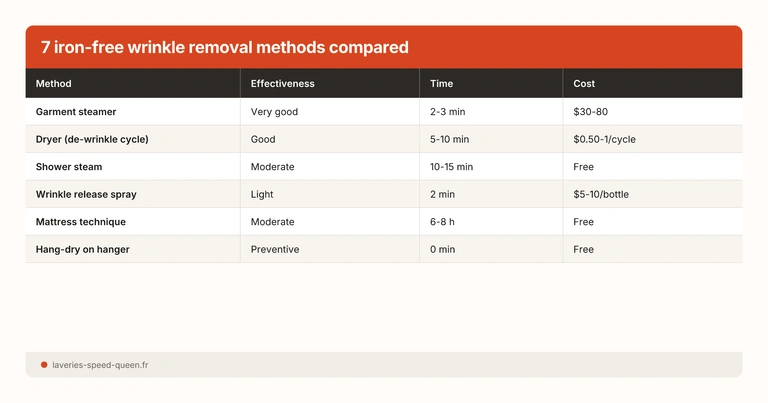
In short: you can absolutely remove wrinkles from your clothes without an iron. A garment steamer is the most versatile alternative, the tumble dryer dewrinkle cycle handles a full load in 5-10 minutes, and bathroom steam is enough for light wrinkles. For last-minute touch-ups, a wrinkle release spray does the job. The iron remains essential, however, for shirt collars, trouser creases and heavy cotton.
At a Glance
Garment steamer -- best all-round alternative. 2-3 min per garment, no direct contact.
Tumble dryer 5-10 min -- dewrinkle cycle + remove immediately and hang.
Shower steam -- hang in the bathroom during a hot shower.
Remove from the machine immediately -- the first alternative is not letting clothes get wrinkled in the first place.
The iron is still king -- collars, cuffs, trouser creases: no alternative matches the precision of an iron.
Why Look for Alternatives to an Iron
Ironing is one of the least loved household chores. According to consumer surveys, over 60 % of people say they dislike ironing, and around 20 % never iron at all. The reasons are predictable: it takes time, you need to set up the board, heat the iron, and the risk of burns is real.
But disliking the iron does not make clothes come out smooth. The good news is that several alternative methods genuinely work — some better than an iron in certain situations. The bad news: none of them fully replaces the iron for every use case.
For shirts in particular
If your main concern is ironing shirts, check out our full guide on
ironing temperatures by fabric
, which includes a dedicated section on alternatives to the iron and zone-by-zone technique when the iron is still needed.
Method 1: The Garment Steamer
The garment steamer is the most effective and versatile alternative to an iron. It projects a jet of steam that relaxes textile fibres without direct contact with the fabric.
How It Works
Steam at 100 degrees C penetrates the fibres and breaks the hydrogen bonds that hold wrinkles in place. The weight of the hanging garment, combined with gravity, smooths the fabric as the fibres relax. No board needed, no risk of shine marks or burns on the fabric.
Which Fabrics
The steamer excels on light and medium-weight fabrics: silk, viscose, polyester, light cotton, blends. It is especially recommended for delicate fabrics where direct iron contact is risky. On heavy cotton and linen, it reduces wrinkles but does not eliminate them completely.
Technique
- Hang the garment on a sturdy hanger, placed up high
- Pull the fabric downward with one hand to create tension
- Pass the steamer from top to bottom, 2-3 cm from the fabric
- Linger on wrinkled areas with slow passes
- Let the garment air-dry for a few minutes before wearing
Cost and Limitations
An entry-level steamer costs 30-50 euros, a high-performance model 60-100 euros. Water consumption is low (200-300 ml per tank fill). The main limitation: a steamer cannot create a sharp crease (suit trousers) or smooth a shirt collar as precisely as an iron.
Method 2: The Tumble Dryer (Dewrinkle Cycle)
This is the most efficient alternative for dealing with several garments at once, and it is especially useful at a laundromat.
How It Works
The dewrinkle cycle (or “refresh” / “steam refresh” depending on the brand) sends steam or moderate heat for 5-10 minutes, with a slow drum rotation that shakes the fibres loose. Some cycles add a cool-air phase at the end to lock in the result.
Technique at a Laundromat
At a Speed Queen laundromat, place the wrinkled clothes in the dryer (no more than 3-4 items so the drum has room). Add a damp washcloth to create steam. Run a short cycle on moderate heat (5-10 minutes). Remove immediately when the cycle ends and hang each garment on a hanger.
Which Fabrics
Excellent on cotton-polyester blends, easy-iron shirts and workwear. Good on regular cotton (reduces wrinkles by 60-70 %). Less effective on linen and very thick fabrics. Always check that the garment is dryer-safe (circle-in-square symbol not crossed out). See our care label guide if in doubt.
The Damp Washcloth: The Game-Changing Trick
Add a damp washcloth (wrung out, not soaking) to the drum with the dry clothes. The moisture evaporates during the cycle and creates a mini steam environment that softens the fibres. It is the most effective technique for reviving a batch of wrinkled clothes without re-washing them.
Method 3: Bathroom Steam
The simplest, cheapest and laziest method. It works better than most people expect.
Technique
Hang the garment on a hanger in the bathroom, as close to the shower as possible (without getting wet from the spray). Take a hot shower for 10-15 minutes. The ambient steam saturates the air and penetrates the fibres. After the shower, smooth the fabric by hand, pulling downward. Leave the garment hanging for 15-20 minutes to dry.
Which Fabrics
Good on light and medium-weight fabrics: viscose, polyester, silk, light cotton. Light wrinkles disappear; moderate wrinkles soften. Deep creases in heavy cotton or linen will barely budge.
Limitations
The method is slow (30-45 minutes total), depends on your bathroom setup (a large, well-ventilated bathroom produces less steam), and only handles 1-2 garments at a time. It is also useless if you have a powerful extractor fan that draws out all the steam.
Method 4: Wrinkle Release Spray
Wrinkle release sprays (Faultless, Downy Wrinkle Releaser, or homemade versions) soften the fibres when sprayed on, then you smooth the fabric by hand or by pulling it taut.
Technique
- Hang the garment on a hanger
- Spray evenly over the wrinkled area (from 20-30 cm away)
- Pull the fabric downward and smooth with the palm of your hand
- Let it dry for 5 minutes
Homemade Version
Mix in a spray bottle: 200 ml water, 1 tablespoon of white vinegar↗, 1 teaspoon of fabric softener. Shake before each use. The vinegar softens the fibres and the softener reduces static.
Cost and Effectiveness
A shop-bought spray costs 5-10 euros for 20-30 uses. The homemade version costs just a few cents. It is genuinely effective on light wrinkles but limited on deep creases. Think of it as a touch-up tool, not a full ironing replacement.
Method 5: The Mattress Trick
Also known as “overnight ironing”, this method uses your body weight during sleep to flatten clothes.
Technique
- Lay the garment flat between the fitted sheet and the mattress, at chest or leg level
- Smooth the fabric carefully so it lies perfectly flat, with no secondary creases
- Sleep on it as normal
- In the morning, remove the garment — the flat areas are smooth
Which Garments
Works well on trousers (legs laid flat), straight skirts, T-shirts and the front/back of shirts. Does not work on sleeves, collars or any area with volume.
Limitations
The method is very slow (an entire night), only treats one area at a time, and poor placement can create new wrinkles instead of removing them. It is handy as an occasional fix, not for daily use.
Method 6: Pressure Rolling
A pressure roller (or a bottle filled with hot water) applies localised pressure that crushes wrinkles.
Technique
Lay the garment flat on a hard surface. Fill a bottle with hot water (not boiling). Roll it firmly over the wrinkled areas, pressing down and moving in the direction of the fibres. The combination of heat and pressure smooths the fabric.
Effectiveness
Modest but real on localised wrinkles. Mostly useful when travelling and no other method is available. Results are better on lightweight fabrics (polyester, viscose) than on heavy cotton.
Method 7: Hanger Drying (Remove Immediately)
This is the zero-effort method — and paradoxically, the most effective one for prevention. The principle: stop clothes from getting wrinkled in the first place.
Technique
Remove the garment from the washing machine immediately when the cycle ends. Shake it vigorously 2-3 times to loosen the rough creases. Hang it on a hanger (not folded over a drying rack). Smooth the seams and edges by hand. Let it air-dry naturally.
Why It Works
Wrinkles form when wet fabric dries in a crumpled position. If the fabric dries hanging vertically, the weight of the water pulls the fibres downward and aligns them naturally. A garment removed immediately, shaken and hung up, has almost no wrinkles when dry — even in pure cotton.
The Trap: Forgetting Clothes in the Drum
A garment left for 1-2 hours in the machine after the cycle ends develops deep wrinkles. These “drum creases” are the hardest to remove without an iron. If your laundry smells bad after washing, that is a sign it sat too long.
The 5-Minute Rule
The 5 minutes after a wash or dry cycle ends are the most important. Removing clothes immediately and hanging them up is the single most effective thing you can do to reduce — or even eliminate — the need for ironing. This is especially true at a laundromat, where you are on site for the entire cycle.
Cost / Effectiveness Comparison
| Method | Light Wrinkles | Deep Creases | Time per Garment | Cost |
|---|---|---|---|---|
| Garment steamer | Excellent | Good | 2-3 min | 30-100 EUR |
| Tumble dryer dewrinkle | Excellent | Average | 5-10 min (batch) | Cycle cost |
| Bathroom steam | Good | Poor | 30-45 min | Free |
| Wrinkle release spray | Good | Poor | 5 min | 5-10 EUR |
| Mattress trick | Good (flat areas) | Average (flat areas) | 1 night | Free |
| Pressure rolling | Average | Poor | 5-10 min | Free |
| Hanger drying | Excellent (prevention) | — | 30 sec | Free |
When the Iron Is Still Essential
Let us be honest: some situations demand a real iron, and no alternative delivers the same result.
Dress shirt collars and cuffs
A crisp collar requires the mechanical pressure and direct heat of an iron. A garment steamer is not enough for a professional finish.
Suit trouser creases
The centre crease is formed by pressure + heat + steam, held for several seconds. Only an iron can do this.
Heavy cotton and linen
Heavy cotton (200+ g/m2) and linen resist all gentle methods. They need 180-230 degrees C + steam + pressure. Check our ironing temperature guide for the right settings.
Hems and seam creases
Reshaping a hem or marking a seam crease requires the precision of an iron pressed flat with pressure.
Combining Methods: The Optimal Strategy
The real solution is not to replace the iron entirely, but to reduce ironing time to a minimum by combining good practices.
Step 1: Prevention at Washing
Remove laundry immediately, shake, hang. This eliminates 70 % of wrinkles at the source. For best washing practices, see our guide on washing machine programmes.
Step 2: Optimised Drying
At a laundromat, use the dryer’s anti-crease programme. Remove clothes while still slightly damp and hang on hangers. See our drying guide for details.
Step 3: Steamer for Touch-Ups
Run the garment steamer over any clothes that still have light wrinkles. 2-3 minutes per garment.
Step 4: Iron Only What Really Needs It
Reserve the iron for dress shirts, suit trousers and hems. With the three previous steps, only 2-3 items per week will genuinely need the iron.
Fabrics That Almost Never Need Ironing
Some fabrics are naturally wrinkle-resistant. If you hate ironing, steer your purchases toward these materials:
- Polyester and cotton-polyester blends — synthetic fibres bounce back to their original shape after washing
- Jersey (knitted cotton) — the knit structure of a T-shirt resists creasing
- Wool (knits) — the stitches recover their shape; never iron a knitted jumper
- Easy-iron / non-iron shirts — cotton treated with a resin that prevents wrinkles
- Stretch fabrics — elastane (Lycra) pulls the fabric taut and naturally smooths wrinkles
Conversely, pure cotton (poplin, oxford), linen and viscose are the worst offenders for creasing. To understand how to adapt your wash to each fabric, see our washing temperatures guide.
Mistakes to Avoid
- Steaming a dirty garment -- heat (even steam) sets perspiration stains and odours.
- Over-wetting with spray -- a soaked fabric takes ages to dry and may stain. Spray lightly.
- Leaving clothes in a heap after the dryer -- wrinkles reform within 10 minutes in a basket.
- Holding a steamer too close to synthetics -- steam at 100 degrees C can distort nylon if the jet is too close.
- Assuming all alternatives are equal -- each method has a specific sweet spot. Choose based on the fabric and wrinkle severity.
- Ignoring the drying stage -- 80 % of wrinkling happens during drying. Good drying reduces the need for any corrective method.
At the Laundromat: Making the Most of Professional Drying
Professional tumble dryers at a laundromat are a major asset for avoiding ironing. Their large drums (10-18 kg capacity) give clothes more room to tumble freely, producing less wrinkling than a compact domestic dryer.
Optimal laundromat strategy: do not overload the dryer (fill to 60-70 % max), choose a moderate-heat programme, and be on hand to remove clothes the second the cycle ends. Hang shirts and trousers on hangers immediately. With this approach, you can halve your ironing time — or eliminate it altogether for clothes made from blended fabrics.
As an Amazon Associate, we earn a small commission on purchases made through the affiliate links in this article — at no extra cost to you. This helps us maintain this site and produce free guides.
Our laundromats in Blagnac, Croix-Daurade and Montaudran have professional tumble dryers with an anti-crease programme. A well-managed dryer session at a laundromat is the best strategy to minimise ironing. Payment contactless card or cash. See our prices.
Sources and References
- Ironing guide: temperature by fabric
- Drying guide
- Care label symbols guide
- Washing temperatures
- Delicate fabrics: care guide
- Washing machine programmes
- Laundry smells bad after washing
- Hydrogen bonds in textile fibres — mechanism of wrinkle formation and release
- Elastic recovery properties of synthetic vs natural fibres