Laundry sheets are a pre-dosed film of surfactants encased in polyvinyl alcohol (PVA) that dissolves on contact with water. Ultra-compact format, zero plastic bottles, simplified dosing: the advantages are real for travel and small living spaces. On the other hand, cleaning performance is weaker than conventional detergents on stubborn stains, the cost per load is high and cold-water dissolution is not always complete. This guide cuts through the marketing.
At a Glance
Convenient format -- ultra-light (2-3 g per sheet), no jug, no measuring. Ideal for travellers, students and small flats.
Decent results on everyday laundry -- sheets handle moderately soiled daily wear well. They lack punch on greasy or protein-based stains.
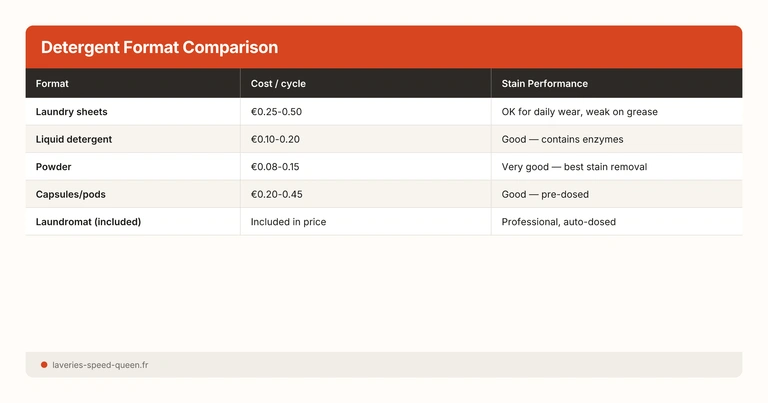
High cost per load -- EUR 0.25 to 0.50 per cycle versus EUR 0.10 to 0.20 for a standard liquid detergent.
Check the ingredients -- PVA is biodegradable, but some sheets contain fragrances or optical brighteners. Read the INCI list.
Unnecessary at a laundromat -- detergent is already included and pre-dosed in professional machines.
How Laundry Sheets Work
A laundry sheet is a thin film (roughly 0.5 mm thick) made primarily of polyvinyl alcohol (PVA), a water-soluble polymer. The cleaning agents — surfactants, sequestering agents, sometimes an optical brightener — are embedded directly into the film during manufacturing.
The Dissolution Mechanism
When the sheet contacts water, PVA dissolves gradually and releases the surfactants trapped in its structure. The process unfolds in three stages:
- Hydration (0-30 seconds): water penetrates the PVA film and begins to break the hydrogen bonds between polymer chains. The sheet swells and softens.
- Dissolution (30 seconds to 3 minutes): the PVA chains separate and pass into solution. Surfactants are released into the drum water.
- Cleaning action: the freed surfactants work exactly like those in liquid detergent — their amphiphilic molecules encapsulate greasy soiling in micelles and make it soluble in the rinse water.
Dissolution speed depends on two factors: temperature (the warmer the water, the faster it goes) and mechanical agitation (drum rotation accelerates the process). At 30-40 degrees C, dissolution is usually complete in under 2 minutes. Below 20 degrees C, it can take 5 minutes or more, and some budget sheets leave a gelatinous residue.
What a Typical Sheet Contains
The composition varies across brands, but the core structure is the same:
- Polyvinyl alcohol (PVA): the dissolvable carrier that forms the film. Accounts for 30 to 50 % of the sheet’s weight.
- Anionic surfactants (sodium lauryl sulfate, sodium laureth sulfate): the primary cleaning agents. They lift grease and grime from fabrics.
- Non-ionic surfactants (ethoxylated fatty alcohols): complement anionic surfactants, especially in hard water.
- Sequestering agents (sodium citrate, EDTA): neutralise water hardness so the surfactants can work properly.
- Glycerine: plasticiser that keeps the sheet flexible.
- Fragrance (optional): added to most consumer-grade sheets.
- Optical brightener (optional): creates the illusion of a whiter white under UV light.
Enzymes: the Missing Ingredient
The vast majority of laundry sheets contain no enzymes (proteases, lipases, amylases). Enzymes are fragile proteins that degrade quickly in dry form without controlled storage conditions. This is the main reason sheets underperform compared to liquid or powder detergents on protein-based stains (blood, egg, sweat) and set-in grease marks.
The Real Advantages of Laundry Sheets
Zero Plastic Bottles
A recyclable cardboard box holds 30 to 60 sheets. That replaces one or two 3-litre detergent jugs, saving 200 to 400 g of plastic per year.
Ultra-Lightweight
One sheet weighs 2 to 3 g. A 60-sheet pack weighs under 200 g -- compared to 3 kg for an equivalent jug of liquid detergent. Ideal for travel or hauling groceries upstairs.
Perfect for Travel
No liquid to declare in your carry-on, no risk of spills in your suitcase. Slip a few sheets into a zip bag and you are sorted -- on a plane, camping, or in an Airbnb.
Foolproof Dosing
One sheet = one dose. No measuring cap, no overdosing. The format eliminates the two most common mistakes: too much detergent (residue) and too little (poorly cleaned laundry).
Space Savings and Storage
The sheet format eliminates the bulky-storage problem. A 60-sheet pack is the size of a paperback, whereas a detergent jug takes up a quarter of a shelf. For a student studio, a camper van or a flat without a utility room, the space saving is tangible.
Storage is simpler too: no sticky cap, no leaking jug, no dried detergent residue on the shelf. Sheets keep in their original box, in a dry place, for 12 to 24 months with no loss of effectiveness.
The Drawbacks You Should Know
Lower Efficacy on Stubborn Stains
This is the main criticism. On everyday laundry (t-shirts, sheets, moderately soiled towels), sheets deliver a satisfactory result. But once stains get serious — set-in cooking grease, yellowed shirt collars, dried blood, red wine marks — the gap with a properly formulated detergent becomes visible.
Three factors explain the shortfall:
- Lower concentration: a 2-3 g sheet contains less active matter than a dose of liquid detergent (30-40 ml) or powder (30-40 g).
- No enzymes: as explained above, sheets generally do not include proteases, lipases or amylases. Yet these enzymes are the most effective agents against biological stains.
- No bleaching agents: powder detergents often contain sodium percarbonate↗, a powerful oxygen-based bleaching agent. Sheets do not.
High Cost per Load
Price remains the main barrier to mass adoption. In 2026, the cost per cycle sits between EUR 0.25 and 0.50 for mainstream brands, and can exceed EUR 0.60 for premium ones. By comparison, a supermarket liquid detergent works out at EUR 0.10-0.20 per cycle and a powder detergent at EUR 0.08-0.15.
Over a year (roughly 200 cycles for a household), the difference adds up:
- Sheets: EUR 50 to 100 per year
- Liquid detergent: EUR 20 to 40 per year
- Powder detergent: EUR 16 to 30 per year
Incomplete Cold-Water Dissolution
Cold cycles (below 20 degrees C) are increasingly popular for environmental and cost reasons. However, PVA dissolution slows considerably at low temperatures. Undissolved sheet residue can end up on the laundry at the end of the cycle — white or gelatinous marks that require an extra rinse.
Tip: if you wash in cold water, tear the sheet into 4 pieces before placing it in the drum. The contact surface with water is multiplied and dissolution is noticeably faster.
Non-Adjustable Dosing
One sheet = one dose. That is an advantage for standard loads but a drawback for edge cases:
- Heavily soiled load (gym clothes, workwear): one sheet is not enough, two is too much.
- Small load (3 delicate items): a full sheet is an overdose.
- Very hard water (> 20 gpg / > 35 degrees f): more sequestering agents are needed, but the dose is fixed.
With liquid or powder detergent, you can adjust the dose to the millilitre or gram. Correct detergent dosing remains a key factor in results — and sheets only allow rough adjustments (half-sheet or double sheet).
- Do not put the sheet in the detergent drawer -- it must be placed in the drum so it dissolves in direct contact with water. In the drawer, it sticks and does not dissolve.
- Do not use cold water without precaution -- below 20 degrees C, tear the sheet into pieces to ensure complete dissolution.
- Do not automatically double the dose -- two sheets on moderately soiled laundry create overdosing that leaves residue and makes rinsing insufficient.
- Do not store in a damp place -- PVA absorbs ambient moisture. Sheets stick together and lose their integrity if the pouch is not sealed properly.
- Do not skip pre-treatment -- on a stubborn stain, a sheet alone is not enough. Pre-treat with Marseille soap or a stain remover before running the machine.
Comparison: Sheets vs Liquid vs Powder vs Pods
| Criterion | Sheets | Liquid | Powder | Pods |
|---|---|---|---|---|
| Everyday laundry efficacy | Good | Very good | Very good | Good |
| Stubborn stain efficacy | Low | Good | Very good | Good |
| Enzymes | Rarely | Yes (most) | Yes | Yes |
| Bleaching agent | No | Rarely | Yes (percarbonate) | Sometimes |
| Cost per load | EUR 0.25-0.50 | EUR 0.10-0.20 | EUR 0.08-0.15 | EUR 0.20-0.45 |
| Adjustable dosing | No (half or 1 sheet) | Yes (by ml) | Yes (by g) | No |
| Cold-water dissolution | Partial | Complete | Sometimes partial | Good |
| Plastic packaging | No (cardboard) | Yes (jug) | Yes/No (cardboard possible) | Yes (pouch + PVA film) |
| Weight (60 doses) | approx. 150 g | approx. 3 kg | approx. 2 kg | approx. 1.5 kg |
| Travel friendly | Excellent | Poor | Average | Good |
| Overdosing risk | Low | High | High | Low |
| Overall environmental impact | Good | Average | Good | Average |
What the Comparison Reveals
Laundry sheets↗ excel on convenience (weight, footprint, dosing, travel) and plastic footprint (no jug). They fall behind on raw cleaning power (no enzymes, no bleaching agent, lower concentration) and cost per load.
Powder remains the highest-performing format on whites and stubborn stains thanks to oxygen-based bleaching agents. Liquid detergent offers the best value-for-money with adjustable dosing. Pods share the same drawback as sheets (fixed dose) with a larger plastic footprint.
For a full breakdown of detergent formats, see our complete detergent comparison guide.
The Environmental Question
Is PVA Really Biodegradable?
Polyvinyl alcohol is classified as biodegradable according to standardised tests (OECD 301B and 302B). It is broken down by specific micro-organisms into CO2 and water. However, this classification is based on optimal laboratory conditions. In the real world:
- Biodegradation depends on the presence of adapted bacteria at the local wastewater treatment plant.
- Water temperature plays a role: below 15 degrees C, degradation slows significantly.
- PVA that passes through treatment plants without being degraded ends up in waterways, where its persistence is less well documented.
The overall balance is still strongly positive compared to HDPE plastic jugs, which take hundreds of years to break down. But the “zero waste” label deserves a caveat: the sheet is a dissolved waste, not an absent one.
The Carbon Footprint of Transport
The real environmental advantage of sheets lies in logistics. A lorry carrying laundry sheets moves 10 to 15 times less weight and volume than one loaded with jugs of liquid detergent (of which 60-80 % of the weight is water). This translates into a significant reduction in transport-related CO2 emissions.
Who Are Laundry Sheets Actually For?
Travellers and Backpackers
The unbeatable format on the go: lightweight, compact, no leak risk, no liquid banned from hand luggage. Slip 10 sheets into your toiletry bag.
Studios and Small Flats
No utility room, no cupboard space: sheets fit in a drawer. Perfect for students in halls or renters of micro-apartments.
Zero-Waste Lifestyles
If cutting plastic packaging is a priority, sheets are the least-packaged format on the market. The cardboard box is recyclable, no jug to throw away.
Lightly Soiled Daily Wear
T-shirts, underwear, sheets worn for a week -- everyday laundry without specific stains is perfectly handled by one sheet.
Who Should Look Elsewhere
- Families with children: food, grass and paint stains need enzymes and stain-lifting power that sheets do not offer. Choose a liquid or powder detergent with enzymes.
- Heavily soiled or professional garments: intensive sportswear, work clothes, kitchen aprons. The active-agent concentration in a sheet is insufficient.
- White laundry: without sodium percarbonate, sheets do not bleach. Whites will gradually grey. See our guide to whitening yellowed laundry.
- Very hard water: above 20 gpg (35 degrees f), the sequestering agents in a sheet are not enough to neutralise limescale. Surfactants lose effectiveness.
Tips for Getting the Best from Laundry Sheets
Maximising Efficacy
- Pre-treat stains before washing: rub a little Marseille soap on the damp stain and leave for 15 minutes. The sheet handles the overall wash; pre-treatment deals with localised stains.
- Do not overload the drum: two-thirds full is the ideal load. An overpacked drum prevents the dissolved sheet from circulating properly.
- Choose the right temperature: 30-40 degrees C is the sweet spot for full dissolution and effective cleaning. See our guide on choosing between 30 and 40 degrees.
Choosing a Quality Brand
Not all manufacturers are equal. Here are the criteria to check before buying:
- Visible INCI list: if the manufacturer does not publish the full ingredient list, walk away.
- Active-agent concentration: the best sheets show more than 50 % active matter (surfactants + sequestering agents). The worst drop below 30 %.
- Fragrance-free option available: an unscented version is a good sign of formulation transparency.
- Certifications: EU Ecolabel, USDA BioPreferred, or equivalent. They guarantee a minimum level of biodegradability and the absence of problematic compounds.
Sheets + Pre-Treatment = The Winning Combo
Laundry sheets work best as a maintenance detergent combined with targeted pre-treatment. Use Marseille soap or sodium percarbonate on stains before running the machine. The sheet handles the overall wash; the pre-treatment tackles the tough spots.
At the Laundromat: Detergent is Already Included
At a self-service laundromat, the choice between sheets, liquid, powder or pods simply does not arise. Detergent is included and pre-dosed in every machine. This professional-grade detergent is formulated specifically for high-efficiency machines: concentrated surfactants, enzymes, anti-redeposition agents and limescale sequestrants. It outperforms any consumer format, including sheets.
You do not need to bring anything. No jug, no sheet, no pod. Dosing is automatic and adjusted to the selected cycle. This is actually one of the key advantages of the laundromat over washing at home: you never have to worry about correct detergent dosing.
The only situation where pre-treatment is still useful at the laundromat: a specific stubborn stain. Rub it with Marseille soap↗ at home before you come — the machine will do the rest.
As an Amazon Associate, we earn a small commission on purchases made through the affiliate links in this article — at no extra cost to you. This helps us maintain this site and produce free guides.
Rather not worry about choosing your detergent? Our laundromats in Blagnac, Croix-Daurade and Montaudran include professional-grade detergent, pre-dosed in every machine. Payment contactless card or cash. See our prices.
Sources and References
- How to choose a detergent: full comparison
- Detergent dosage: the complete guide
- Marseille soap for laundry: uses and pitfalls
- Homemade detergent: recipes and limits
- Sodium percarbonate: usage guide
- Whitening yellowed laundry
- Washing at 30 or 40 degrees: which to choose?
- Removing a red wine stain
- OECD Guidelines for the Testing of Chemicals — Biodegradability tests 301B/302B (lien externe)
- Regulation (EC) No 648/2004 on detergents (lien externe)