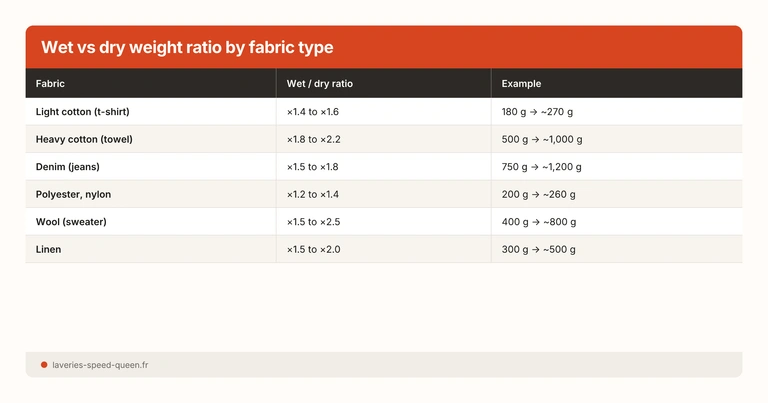
In short: washing machine capacity — whether it reads 7, 9, or 18 kg — always refers to the weight of dry laundry. Wet cotton weighs roughly 1.5 to 2 times more, and wet synthetics 1.2 to 1.4 times more. That is normal: the machine is built to handle this extra weight during the cycle. Your only reliable loading reference is the dry weight.
At a Glance
Capacity is always dry weight -- not wet weight, never.
Wet cotton weighs x1.5 to x2 -- the most absorbent everyday fibre.
Synthetics absorb very little -- x1.2 to x1.4, which is why they dry fast.
The hand test is the best guide -- one hand's width of space above the laundry in the drum.
Short Answer: Dry, Always Dry
The capacity shown on a washing machine is the maximum weight of dry laundry it can accept for a quality wash. This holds true across all brands and formats — front-loader, top-loader, domestic, commercial — and has been the standard for decades.
Why not wet weight? Because it is unstable. The same pair of jeans weighs 750 g dry but anywhere from 1.1 to 1.5 kg wet, depending on the programme, spin speed, and time elapsed since the cycle ended. Dry weight does not change. It is the only benchmark manufacturers can calibrate reliably.
In practice: if your machine reads 9 kg, you can load up to 9 kg of dry laundry. The drum, motor, and suspension are all dimensioned to support the added weight of water during washing and spinning.
How Much Does Wet Laundry Weigh? Ratios by Fibre
The ratio between dry and wet weight depends mainly on the fibre. Natural fibres absorb far more water than synthetics. Here are the typical ranges for laundry after a full cycle with a standard spin.
| Fibre / Textile | Wet / Dry Ratio | Real-World Example |
|---|---|---|
| Thin cotton (t-shirt, dress shirt) | x1.4 to x1.6 | 180 g t-shirt —> approx. 270 g wet |
| Thick cotton (towel, tea towel) | x1.8 to x2.2 | 500 g towel —> approx. 1,000 g wet |
| Denim (jeans) | x1.5 to x1.8 | 750 g jeans —> approx. 1,200 g wet |
| Polyester, nylon | x1.2 to x1.4 | 200 g sport polo —> approx. 260 g wet |
| Wool (jumper, scarf) | x1.5 to x2.5 | 600 g wool jumper —> approx. 1,200 g wet |
| Linen | x1.6 to x2.0 | 250 g linen shirt —> approx. 450 g wet |
| Thick terry cloth (bathrobe) | x2.0 to x2.5 | 1,200 g bathrobe —> approx. 2,700 g wet |
| Bedding (fitted cotton sheet) | x1.5 to x1.8 | 800 g double sheet —> approx. 1,300 g wet |
Why these ratios vary
The exact figure depends on fabric thickness, GSM (grams per square metre), spin speed (800, 1,000, or 1,400 rpm), and the programme used. The ratios above correspond to a standard spin (approx. 1,000 rpm). A faster spin reduces the ratio; a gentle spin increases it.
The Weight on the Machine = DRY Weight (Clearing Up the Confusion)
The most common source of confusion is a simple but flawed line of reasoning: “My duvet weighs 2.5 kg, my machine is 8 kg, so it fits.” The machine’s figure is indeed dry weight, and so is the duvet’s. But capacity is not just about weight — it is also about volume and water circulation.
What really matters is the combination of three factors:
- The total dry weight of your load — it must not exceed the machine’s rated capacity.
- The volume occupied in the drum — a bulky textile (duvet, pillow, puffer jacket) can fill the drum long before hitting the weight limit. This is the most common issue with double duvets.
- The fibre type — because wet weight varies enormously depending on whether you are washing cotton, synthetics, or wool. And it is the wet weight the machine must support during the cycle.
The international standard IEC 60456, used by manufacturers to test washing machines, clearly defines the rated load in kilograms of dry laundry. All test programmes are calibrated on this basis. If your machine reads 9 kg, it was tested and certified for 9 kg of dry laundry — no more, no less.
How Much Does Wet Laundry Weigh? Coefficients by Fabric
To understand the real extra weight the machine handles during the cycle, here are the absorption coefficients by fabric type. These figures correspond to weight after a full cycle with a standard spin (approximately 1,000 rpm).
Cotton: The Absorption Champion
Cotton is the most common and most absorbent fibre. A 180 g cotton t-shirt comes out of the drum at roughly 270-300 g. A 500 g terry towel can exceed 1,000 g when wet. This absorption is why an all-cotton load is the heaviest for the machine to manage and the longest to dry.
Synthetics: Light When Wet, Quick to Dry
Polyester and nylon absorb very little water (coefficient x1.2 to x1.4). That is why sportswear dries so quickly. On the other hand, synthetics swell in volume inside the drum and should only fill half the capacity. See our sportswear care guide for best practices.
Denim: Heavy and Slow to Dry
Jeans are a special case: thick, dense fabric that absorbs a lot (coefficient x1.5 to x1.8 depending on the GSM). A single pair of jeans weighs around 750 g dry and can exceed 1.2 kg wet. Two or three pairs of jeans in the same load significantly increase the wet weight in the drum.
Impact on Spinning and Drying
Wet weight does not only concern washing. It has direct consequences on the two steps that follow.
Spinning: Wet Weight Creates Imbalance
During the spin cycle, the drum rotates at high speed (800 to 1,400 rpm). If the wet load is unevenly distributed — for example, one very heavy item on one side and light pieces on the other — the centrifugal force creates an imbalance. Modern machines detect this and reduce speed or redistribute the load. But over time, repeated imbalances wear out the suspension and bearings.
Drying: Wet Weight Dictates the Time
The more water the laundry retains after spinning, the longer and more energy-intensive drying becomes. That is why a good spin (high speed compatible with the textile) is the best way to reduce the time and cost of drying. At a laundromat, commercial dryers have the airflow and capacity to handle these heavy loads in a reasonable time.
Machine Stress: The Overloading Vicious Circle
Regularly overloading a machine — even while staying under the dry weight limit — accelerates mechanical wear. Excessive wet weight strains the shock absorbers, suspension springs, bearings, and drive belt. Over time, this causes abnormal vibrations, noisy spinning, and premature breakdowns. For bulky loads (duvets, curtains, blankets), a laundromat is often the most economical long-term choice.
Why Cotton Absorbs So Much (and Synthetics So Little)
The difference in absorption comes from fibre structure, not garment thickness.
Natural fibres (cotton, linen, wool)
These fibres are hydrophilic: their molecular structure attracts and retains water inside the fibre itself. Cotton can absorb up to 25-27 % of its weight in water before even feeling damp to the touch (source: The Textile Institute).
Synthetic fibres (polyester, nylon)
These fibres are hydrophobic: water stays on the surface and between the yarns without penetrating the fibre. That is why a polyester t-shirt dries so quickly -- and why it weighs barely more wet than dry.
Thickness amplifies the effect
A cotton terry towel combines an absorbent fibre + high GSM + a looped structure that traps water. The result: it can weigh more than double when wet. This is the heaviest category to handle in a washing machine.
What This Means in Practice
For a Domestic Machine (7-10 kg)
With an 8 kg machine, your 6-7 kg dry load (recommended three-quarter fill) will weigh between 9 and 14 kg once wet, depending on the type of laundry. The machine is designed to handle this weight.
But the real risk is not weight — it is volume. Thick, absorbent textiles (towels, sheets, duvets) swell so much in water that they block agitation, even if the dry weight is within limits. That is why the hand test rule is more reliable than a scale for loading.
For a Commercial Machine at a Laundromat (9-18 kg)
At a laundromat, the drums are sized for heavier loads and bulkier textiles. Our Speed Queen 18 kg machines handle duvets, sheets, and towels that would jam a domestic drum with no trouble. The extra wet weight is managed by a more robust commercial suspension system.
Wet weight explains noisy spinning
When a machine vibrates heavily during the spin cycle, it is often because the wet load is unevenly distributed. A terry towel in one corner of the drum, surrounded by lightweight synthetic t-shirts, creates a significant imbalance because the wet towel weighs 4 to 5 times more than the wet t-shirts around it.
How to Load Properly Without a Scale
The hand test
Load the drum, then place your hand flat above the laundry. If one hand's width of space remains between the laundry and the top of the door opening, you are good.
Adjust to the textile type
Cotton and linen: fill to three-quarters. Synthetics: to half (they swell in water). Wool and delicates: no more than one-third of the drum.
Learn the weight benchmarks
T-shirt approx. 180 g, jeans approx. 750 g, double sheet approx. 800 g, towel approx. 500 g. A few benchmarks are enough to estimate a load without weighing. Full chart here.
Mix thicknesses
Do not fill the drum with only towels or only t-shirts. A mix of thicknesses improves agitation and reduces imbalance during spinning.
Common Mistakes
- Weighing laundry when wet to gauge the load -- completely distorts the estimate. Always weigh dry.
- Filling to maximum capacity every wash -- 70-80 % is enough for proper agitation. The drum needs space.
- Ignoring the volume of thick textiles -- a 2.5 kg duvet takes up as much room as a 7 kg load of clothes. Volume often limits before weight does.
- Loading only heavy OR only light items -- a drum filled exclusively with terry towels will create a significant imbalance during spinning.
- Forgetting that spin speed affects wet weight -- an 800 rpm spin leaves more water than a 1,400 rpm spin, which can overload the dryer afterwards.
Practical Application at the Laundromat
At a laundromat, the dry-versus-wet weight question comes up differently than at home. The machines display a capacity in kilograms of dry laundry — that is your loading reference. But understanding how wet laundry behaves helps you plan your drying more effectively.
For example, a 7 kg cotton load in a 9 kg machine will weigh approximately 12-14 kg coming out of the wash. Transferring this wet load to the dryer is physically heavier than you might expect. Bring a sturdy bag or use a trolley if the laundromat provides one.
The wet-to-dry weight ratio also affects drying time. Cotton absorbs 1.5 to 2 times its weight in water; synthetics only 0.3 to 0.5 times. A load of cotton towels will therefore need 2-3 drying sessions, while a load of synthetic clothes will be dry in 1-2 sessions. Adjust your drying budget accordingly.
Methodology and Sources
This article addresses the specific sub-question “is machine capacity measured in dry or wet laundry?” along with absorption ratios by fibre. The absorption coefficients are orders of magnitude drawn from textile science literature and operational laundromat experience. They vary with fabric weight, programme, and spin speed.
Sources and References
- Washing machine manufacturers (Bosch, Samsung, LG, Speed Queen) — technical specifications: capacity is systematically expressed in kg of dry laundry
- The Textile Institute, Handbook of Textile Fibres, data on moisture absorption by fibre (cotton: 25-27 % moisture regain, polyester: 0.4 %)
- IEC 60456 — international standard for testing household washing machines, defining rated capacity in dry laundry weight
As an Amazon Associate, we earn a small commission on purchases made through the affiliate links in this article — at no extra cost to you. This helps us maintain this site and produce free guides.
Capacity is clear — it is dry weight. To find out how much each garment weighs, see our full laundry weight chart. And to estimate your load automatically, try the online calculator.