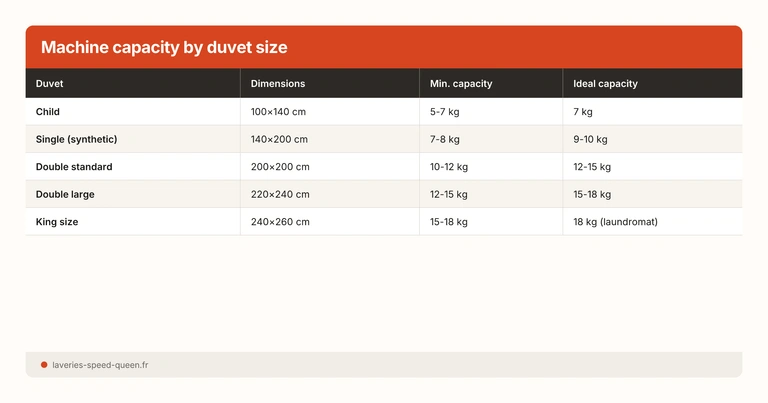
In short: a double duvet (200x200 cm) requires at least 10-12 kg of machine capacity. A large duvet (220x240 cm) needs 15-18 kg. Most home washing machines top out at 8-10 kg — too small for the majority of double duvets. 18 kg laundromat machines are purpose-built to wash any duvet comfortably.
At a Glance
Single duvet (140x200) -- minimum capacity: 7-9 kg. Fits in most home machines.
Double duvet (200x200) -- minimum capacity: 10-12 kg. 8 kg machines are not enough.
Large duvet (220x240) -- minimum capacity: 15-18 kg. Best solution: laundromat.
Down/feather duvet -- allow extra capacity compared to synthetic (more volume at the same weight).
The Short Answer
To wash a double duvet properly, you need a machine with at least 10-12 kg capacity. For larger sizes (220x240 cm and above), aim for 15-18 kg. The standard capacity of home washing machines (7-10 kg) is often too small for double duvets — it is one of the most common reasons people visit a laundromat.
The issue is not the weight of the duvet (2-3 kg dry for a double), but its volume once inside the drum. The duvet must be able to tumble freely so that water and detergent penetrate the entire filling.
Full Compatibility Chart
| Duvet | Dimensions | Average dry weight | Minimum capacity | Ideal capacity |
|---|---|---|---|---|
| Child | 100x140 / 120x150 cm | 0.5 - 1.0 kg | 5-7 kg | 7 kg |
| Single synthetic | 140 x 200 cm | 1.0 - 1.8 kg | 7-8 kg | 9-10 kg |
| Single down/feather | 140 x 200 cm | 0.8 - 1.5 kg | 9-10 kg | 10-12 kg |
| Double synthetic lightweight (summer) | 200 x 200 cm | 1.2 - 1.8 kg | 10 kg | 12 kg |
| Double synthetic standard | 200 x 200 cm | 2.0 - 2.8 kg | 12 kg | 15-18 kg |
| Double down/feather | 200 x 200 cm | 1.5 - 2.5 kg | 12-15 kg | 18 kg |
| Large synthetic | 220 x 240 cm | 2.5 - 3.5 kg | 15 kg | 18 kg |
| Large down/feather | 220 x 240 cm | 2.0 - 3.0 kg | 15-18 kg | 18 kg+ |
| King size | 240 x 260 cm | 3.0 - 4.5 kg | 18 kg | 18 kg+ |
Minimum vs ideal capacity
The minimum capacity assumes a lightweight duvet that fits into the drum without forcing. The ideal capacity guarantees a quality wash with proper tumbling and thorough rinsing. When in doubt, always go for the larger capacity — a duvet packed in too tightly gives a poor result.
Capacity by Exact Dimension
The chart above gives an overview, but many readers want the answer for their exact duvet size. Here is the detail for every common dimension.
140x200 cm duvet (single)
This is the standard size for a single bed. In synthetic, the weight is around 1 to 1.8 kg. In down, between 0.8 and 1.5 kg. A 7 to 9 kg home machine is sufficient in most cases, provided the duvet is not extremely thick (fill weight above 400 g/m2). This is the only size where a home machine is generally adequate.
200x200 cm duvet (standard double)
The most common double-bed size. A standard synthetic duvet in this size weighs 2 to 2.8 kg dry. Volume in the drum is the real problem: even though the weight seems reasonable for an 8 kg machine, the duvet compresses the drum contents to the point where tumbling stops. Minimum capacity: 10 kg. Ideal capacity: 12-15 kg. At a laundromat, an 18 kg machine handles it comfortably.
220x240 cm duvet (large)
This is the most popular size for queen and king beds. Synthetic duvets in this size weigh between 2.5 and 3.5 kg, but their unfolded volume is considerable. Minimum capacity: 15 kg. Ideal capacity: 18 kg. A standard home machine (7-10 kg) is too small in every case. This is the size that most often justifies a trip to the laundromat.
240x260 cm duvet (king size)
The largest consumer size, made for king-size beds. These duvets weigh 3 to 4.5 kg dry, but their volume is such that an 18 kg machine is the strict minimum. Some premium king-size down duvets may even need professional cleaning if the fill weight is very high.
Volume vs Weight: Why Weight Alone Is Not Enough
This is the most common mistake. Many people check the weight of their duvet (say, 2.5 kg), compare it to their machine capacity (say, 8 kg), and assume it will be fine. The maths seems logical, but it ignores a critical factor: volume.
Trapped air in the filling
A duvet is not a solid block. It is filled with air trapped within the filling fibres — that is precisely what makes it insulating. This trapped air gives the duvet an apparent volume far greater than its weight would suggest. A 2.5 kg synthetic duvet can occupy 80 to 100 litres unfolded, while a 2.5 kg load of clothes takes up only 20 to 30 litres.
The drum must tumble, not store
A washing machine drum is not just a container. For an effective wash, water and detergent must circulate through the entire filling, and the duvet must be able to turn and flip during the cycle. If the duvet fills the entire drum, it stays static: the wash is superficial, rinsing is incomplete, and detergent residue remains trapped inside. When it comes to the dry-versus-wet weight ratio, remember that the duvet also absorbs water, which amplifies the volume problem.
The door test
This is the most reliable practical test. Place the duvet in the drum without compressing it. If you can close the door without forcing and there is visible space between the duvet and the top of the drum (roughly a third of the drum volume free), the wash is feasible. If you have to push the duvet to close the door, or if the duvet touches the glass, the machine is too small. Do not start the cycle.
The compression trap
A duvet that only fits into the drum by forcing it in will give a poor wash. Water circulates poorly through compressed filling, rinsing is insufficient, and the spin cycle creates a dangerous imbalance for the machine. If you have to force it, use a larger machine at a laundromat.
Why Down Needs More Capacity
At the same weight, down takes up more space than synthetic. A 1.5 kg goose-down duvet occupies as much space in the drum as a 2.5-3 kg synthetic duvet. This is due to the structure of the feathers, which trap a great deal of air.
Synthetic: dense and compressible
Synthetic fibres (polyester, microfibres) are more compact. The duvet compresses better and takes up slightly less space in the drum -- but it also absorbs more water, which increases the wet-load weight.
Down and feathers: light but very bulky
Down is lighter per kilo, but each cluster traps a large volume of air. In a tight drum, the duvet cannot expand and the filling is not tumbled properly. The risk: clumps of poorly washed feathers.
Alternative fillings (wool, bamboo)
Wool or plant-fibre duvets have intermediate properties. Always check the label -- some natural fillings are not machine-washable. For those that are, allow the same capacity as for down.
The Problem with Home Machines
The vast majority of washing machines sold for home use have a capacity of 7 to 10 kg. That is perfectly fine for everyday laundry, but not enough for most double duvets.
| Machine capacity | Largest duvet it can wash | Standard double duvet? |
|---|---|---|
| 7-8 kg | Light single (140x200 synthetic) | No |
| 9-10 kg | Thick single or very light summer double | Borderline |
| 12 kg | Standard synthetic double (200x200) | Yes, if synthetic |
| 18 kg (laundromat) | All sizes, all fillings | Yes, comfortably |
Buying a 12-15 kg washing machine just for duvets is not always worthwhile: these models cost more, use more energy and water for everyday loads, and only run at full capacity a few times a year. This is precisely the use case where a laundromat makes the most sense.
Washing a Double Duvet at a Laundromat: The Protocol
Check the label
Uncrossed washtub symbol = machine-washable. Note the maximum temperature. See our guide to checking if your duvet is machine-washable if in doubt.
Choose the 18 kg machine
Put the duvet in the drum on its own -- no other items. The duvet must be able to unfold and tumble freely.
Cycle and detergent
30-40 degrees C for synthetic, 30 degrees C for down. Liquid detergent only (powder does not rinse well out of thick filling). No softener for down.
Professional drying
Transfer immediately to a large tumble dryer. Add 2-3 tennis balls to redistribute the filling. At Speed Queen, wash plus drying takes about 1 hour total. Thorough drying is essential.
Total time: about 1 hour
At Speed Queen, wash plus drying takes about 1 hour — not every laundromat can match that. You can stay or come back. The duvet is ready to go back on the bed the same evening — no risk of mould or damp filling.
Common Mistakes
- Trusting the weight alone -- 'it weighs 2.5 kg, my machine does 8 kg, should be fine'. No: it is the volume of the duvet, not its weight, that determines whether it fits usefully in the drum.
- Compressing the duvet to close the door -- if you have to force it, the drum is too small. The wash will be poor and the spin cycle risks damaging the machine.
- Washing the duvet with other items -- the duvet must be washed alone to have the space it needs for tumbling.
- Drying partially -- filling that is still damp in the centre develops mould within hours. Press the centre of the duvet before putting it back on the bed.
- Using powder detergent -- powder dissolves poorly in thick filling and leaves residue. Liquid detergent rinses out far more effectively.
Recommended Washing Frequency for Duvets
Knowing which machine to use is essential, but washing frequency matters too. A duvet inside a cover should be washed 2 to 4 times a year — once per season is a good rhythm. Without a cover, increase to every 1-2 months, since the duvet directly absorbs sweat, dead skin, and dust mites.
People with dust-mite allergies should wash their duvet monthly at 60 degrees C if the filling allows it. Dust mites are killed at 55 degrees C and above — a 30 degrees C wash does not eliminate allergens. See our dust-mite laundry protocol for the full guide.
At a laundromat, the cost of a duvet wash (EUR 9-12 wash + EUR 4-6 drying) is reasonable if you go 2-4 times a year. That is EUR 30-72 per year for a duvet that is always fresh, washed in a properly sized machine, with no risk of overloading your home appliance.
Methodology and Sources
The recommended capacities are based on technical documentation from washing machine manufacturers (Bosch, Samsung, LG, Miele) and duvet manufacturers (Dodo, Bleu Calin, La Compagnie du Blanc). Duvet weights are approximate ranges from product data sheets. Operational experience with professional Speed Queen laundromat machines confirms that 18 kg machines can comfortably wash all consumer-market duvets.
Sources and References
- La Compagnie du Blanc, What capacity washing machine to wash a duvet?, accessed 15 March 2026
- Dodo, Can you wash a duvet in the machine? All our advice, accessed 15 March 2026
- Speed Queen, SC range technical documentation, drum volume specifications
- GINETEX, Textile care symbols, accessed 15 March 2026
- How to wash a duvet — complete guide
- Check if your duvet is machine-washable
As an Amazon Associate, we earn a small commission on purchases made through the affiliate links in this article — at no extra cost to you. This helps us maintain this site and produce free guides.
For a double duvet, the 18 kg laundromat machine is the simplest solution. Find
our Speed Queen laundromats in Toulouse and Blagnac
, or read our complete duvet washing guide for the full protocol by filling type.