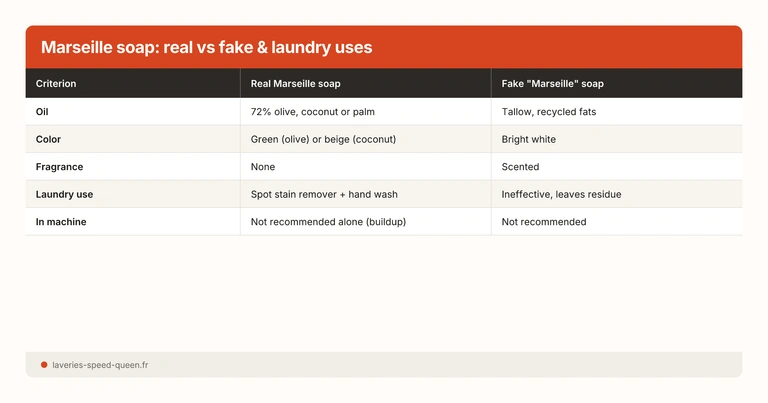
Marseille soap is an excellent local stain remover before washing: rubbed directly onto a damp stain, it lifts grease and grime thanks to its alkaline pH. However, used as the sole detergent in a washing machine, it clogs the drum, hoses, and fabrics with greasy residue — especially in hard water. The right approach: stain pre-treatment and hand washing of delicate fabrics. For the machine, stick with a formulated detergent.
At a Glance
Local stain remover = excellent -- rub on the damp stain, leave 15-30 min, machine wash. Effective on grease, sebum, and grime.
Machine detergent = not recommended alone -- clogs the drum (greasy residue + limescale), no enzymes, no anti-redeposition agents.
72% vegetable oil -- the only reliable criterion for genuine Marseille soap. No fragrance, no colouring.
Hand washing = ideal -- wool, silk, lingerie. Gentle, hypoallergenic, biodegradable.
At the laundromat = not needed -- detergent is included and pre-dosed in every machine.
Genuine Marseille Soap: How to Spot the Real Thing
The term “Marseille soap↗” is not a protected designation. Any manufacturer can put the name on their product regardless of composition. The result: the majority of soaps sold as “Marseille” in supermarkets do not follow the traditional process and contain additives (fragrances, colourants, preservatives, EDTA, BHT) that have nothing to do with the original product.
The Criteria for Genuine Marseille Soap
Genuine Marseille soap meets a precise set of standards, codified by the Union des Professionnels du Savon de Marseille (UPSM):
Composition. At least 72% vegetable oil — traditionally olive oil for green soap, coconut (copra) or palm oil for beige soap. The rest is caustic soda (which disappears through saponification), water, and salt. Nothing else.
Process. Marseille soap is “cauldron-cooked” through a 5-step process lasting approximately 10 days: mixing, salting out, cooking, washing, and settling. This process removes glycerine and impurities, producing a pure, hard soap.
No additives. No fragrance, no colouring, no preservatives, no added glycerine, no animal fat (tallow). If the ingredient list mentions “parfum/fragrance”, “CI 77891” (titanium dioxide, a white colourant), “EDTA”, or “BHT”, it is not genuine Marseille soap.
| Criterion | Genuine Marseille soap | Fake “Marseille-type” soap |
|---|---|---|
| Oil | 72% olive, coconut, or palm | Tallow (animal fat), low-cost palm oil, recycled fats |
| Colour | Green (olive) or beige (coconut) | Bright white, pink, blue (added colourants) |
| Scent | Neutral to slightly oily | Lavender, floral, “freshness” (synthetic fragrance) |
| Texture | Hard, dry, cracks over time | Soft, creamy, does not dry out |
| Price | $10-18 per kg (600 g block) | $3-6 per kg |
| Manufacturing | Cauldron-cooked, 10 days | Rapid industrial saponification |
Where to find genuine Marseille soap?
A handful of recognised manufacturers produce genuine Marseille soap using the traditional process: Savonnerie du Midi, Le Fer a Cheval, Marius Fabre, Savonnerie du Serail. Look for the “Savon de Marseille veritable” label registered by the UPSM. In health food stores, always check the ingredients — even organic soaps labelled “Marseille” may contain essential oils (technically an added fragrance).
Use #1: Local Stain Remover Before Washing (the Best Use)
This is the application where Marseille soap truly excels. Rubbed directly onto a damp stain, it combines three complementary actions.
Surfactant action. Marseille soap is a natural surfactant — its molecules (fatty acid salts) have a hydrophilic end (attracted to water) and a lipophilic end (attracted to fat). They encapsulate grease in micelles and make it soluble in water. This is the fundamental mechanism of any soap.
Alkaline action. Marseille soap has a pH of 9 to 10, placing it firmly in alkaline territory. This alkalinity has two useful effects: it saponifies (chemically dissolves) some of the embedded grease, and it dislodges organic pigments bound to fibres by acid bonds.
Mechanical action. Rubbing a dry soap bar directly on damp fabric creates gentle friction that penetrates the fibre structure and mechanically lifts dirt particles. The soap layer that forms then acts as a poultice, maintaining contact between the cleaning agents and the stain.
Stains Where It Excels
Collars and cuffs
Sebum and sweat that build up on friction zones are body fats. Marseille soap dissolves them perfectly.
Greasy food stains
Oil, butter, sauce -- any stain with a grease component responds to soaping. Rub, leave 15 min, wash.
Mud and dirt
Soil is a mix of mineral particles and organic matter. Soap dislodges both. Let mud dry, brush off, then soap.
Baby stains
Spit-up, pureed food, nappy blowouts. Marseille soap is hypoallergenic -- ideal for sensitive infant skin.
Stains Where It Falls Short
Marseille soap is not a miracle product. On certain types of stains, it is insufficient on its own:
- Blood stains: haemoglobin proteins require enzymes (proteases) that soap does not contain. Marseille soap helps as a complement, but sodium percarbonate or hydrogen peroxide are more effective.
- Red wine stains: tannins resist soaping alone. Salt (in an emergency) then percarbonate are the go-to allies.
- Coffee or tea stains: tannins + melanoidin pigments. Marseille soap only acts on the superficial grease component.
- Grass stains: chlorophyll is a pigment resistant to conventional surfactants. Rubbing alcohol or white vinegar↗ are better suited.
Use #2: Pre-Treating Collars and Cuffs
Shirt collars and cuffs are the areas most exposed to body contact. Sebum (skin oil), sweat, and dead cells accumulate there cycle after cycle, creating a progressive greying that detergent alone cannot remove — especially on white shirts.
Marseille soap is the most effective pre-treatment for these areas. Before each wash:
- Dampen the collar or cuff with lukewarm water.
- Rub the soap bar directly onto the greyed or yellowed area.
- Leave for 15 to 30 minutes — longer if the mark is old.
- Machine wash as normal.
This simple treatment, repeated each wash, prevents sebum build-up and keeps white shirts genuinely white. It is equally effective on yellow sweat stains under the arms.
Use #3: Hand Washing Delicate Fabrics
Marseille soap is the ideal product for hand washing fabrics that the machine would damage: wool, silk, cashmere, fine lingerie, vintage embroidery.
Why It Is Perfect for Hand Washing
- No enzymes: the enzymes (proteases, cellulases) in modern detergents gradually attack protein fibres (wool, silk). Marseille soap contains none.
- Gentle pH: pH 9-10, moderately alkaline. Strong enough to clean, not aggressive enough to damage animal fibres (wool degrades above pH 11-12).
- Easy rinsing: Marseille soap rinses out easily in cold water, leaving no residual film on fibres like some synthetic detergents do.
- Hypoallergenic: no fragrance, no colouring, no preservatives — nothing that could irritate sensitive skin during prolonged contact.
Hand Washing Protocol
- Grate or cut 10-15 g of Marseille soap into fine flakes.
- Dissolve in a basin of lukewarm water (30 degrees C max for wool and silk).
- Submerge the garment and gently work the fabric without rubbing or wringing.
- Soak for 10 to 15 minutes if needed.
- Rinse in cold water (same temperature as the wash bath for wool — thermal shock causes felting).
- Press dry in a terry towel — never wring wool or silk.
- Dry flat on a clean dry towel.
The Pitfall of Homemade Marseille Soap Detergent
Homemade detergent made from grated Marseille soap has become hugely popular, driven by the zero-waste movement and distrust of industrial detergents. The basic recipe is simple: soap flakes + hot water + baking soda↗ +/- washing soda↗ +/- essential oil.
It works for washing lightly soiled clothes. But it presents three serious long-term problems that online tutorials downplay or ignore.
Problem 1: Machine Clogging
Marseille soap is a soap in the chemical sense: a fatty acid salt. In hard water (common in many regions), calcium ions in the water react with the fatty acids in the soap to form lime soap — an insoluble, whitish, sticky residue.
This lime soap gradually builds up on the drum walls, in drain hoses, on the heating element, and in the pump. Over weeks, it accumulates and creates a greasy biofilm that encourages bacteria and mould growth. This is exactly the problem described in our guide to cleaning your washing machine — and homemade Marseille soap detergent is one of the most common causes.
Problem 2: No Enzymes or Anti-Redeposition Agents
A formulated detergent (even an eco-friendly one) contains enzymes (proteases, lipases, amylases, cellulases) that actively break down proteins (blood, sweat), fats (sebum, cooking oil), starches (food stains), and cellulose fluff. Marseille soap has none of these enzymes.
It also contains anti-redeposition agents (carboxymethylcellulose, polymers) that prevent lifted dirt from settling back onto fibres during the cycle. Without these agents, dirt suspended in the drum water reattaches to the laundry — a phenomenon that gradually greys whites and dulls colours.
Problem 3: Gelling
The water + Marseille soap mixture is unstable at room temperature. As it cools, it partially gels or forms compact lumps. This gel can block the machine’s detergent drawer, preventing the detergent from being properly distributed during the cycle. Moreover, dosing becomes random: some parts of the bottle are liquid, others are solid.
- Homemade Marseille soap detergent as your only detergent -- clogs the drum and plumbing in hard water. No enzymes = ineffective on protein and grease stains. Gels in the bottle.
- Adding soap flakes directly to the drum -- flakes do not always dissolve completely, especially at low temperatures. Soap residue remains on clothes and inside the machine.
- Replacing fabric softener with Marseille soap -- Marseille soap has no softening properties. It even leaves a slightly rough film on fibres. Use white vinegar as a natural fabric softener.
- Using fake scented Marseille soap -- added fragrances and colourants can irritate sensitive skin and leave residue on fabrics.
- Overdosing the soap -- more soap does not equal cleaner clothes. Excess soap creates residue that traps dirt instead of flushing it out. The right dose for pre-treatment: a thin layer rubbed onto the damp stain.
The Pragmatic Alternative: Combining Marseille Soap and Formulated Detergent
The best use of Marseille soap for laundry is not to replace your detergent, but to complement it:
- Before washing: use Marseille soap as a pre-treatment on stains and dirty areas (collars, cuffs, armpits).
- During washing: use a formulated detergent (preferably eco-certified, Ecocert or EU Ecolabel) that contains the enzymes, anti-redeposition agents, and limescale sequestrants needed.
- For hand washing: Marseille soap is perfect for wool, silk, and delicate fabrics.
- For correct detergent dosing: follow the manufacturer’s recommended doses based on your water hardness and soil level.
This approach combines the best of both worlds: the natural stain-lifting power of Marseille soap and the technical effectiveness of a modern detergent.
A homemade detergent that actually works?
If you insist on making your own detergent, add washing soda (sodium carbonate) to the Marseille soap. Washing soda softens the water (sequesters calcium), boosts degreasing power, and limits lime soap formation. Dose: 2 tablespoons of washing soda per litre of liquid detergent. See our homemade detergent guide for an optimised recipe.
At the Laundromat: Detergent Is Already Included
At a self-service laundromat, the Marseille soap question is moot: detergent is included and pre-dosed in every machine. This professional detergent is specifically formulated for high-efficiency machines: high-performance surfactants, enzymes, anti-redeposition agents, limescale sequestrants — everything needed for an effective wash with no residue.
You do not need to bring anything. The only situation where Marseille soap remains useful even at the laundromat is pre-treating a stubborn stain before putting the garment in the machine. Rub the stain with Marseille soap at home, let it sit, and put the garment straight into the machine when you arrive at the laundromat.
As an Amazon Associate, we earn a small commission on purchases made through the affiliate links in this article — at no extra cost to you. This helps us maintain this site and produce free guides.
Rather not worry about choosing the right detergent? Our laundromats in Blagnac, Croix-Daurade and Montaudran provide professional detergent, included and pre-dosed in every machine. Payment contactless card or cash . See our prices.
Sources and References
- How to clean your washing machine
- Homemade detergent: recipe and limitations
- Detergent dosage: the complete guide
- White vinegar and laundry: uses and limitations
- Sodium percarbonate: usage guide
- Which detergent to choose: the comparison
- How to wash a wool sweater without shrinking
- Union des Professionnels du Savon de Marseille (lien externe)