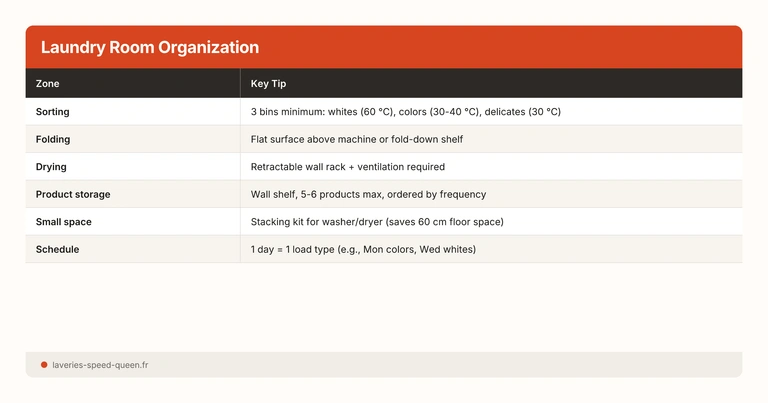
In short: a well-organised laundry room relies on 3 sorting baskets minimum (whites, colours, delicates), a folding surface, products stored up high (wall shelf, not the floor) and a weekly schedule (one day = one type of laundry). For small spaces: stack washer and dryer (stacking kit), install a retractable drying rack. At the laundromat, sorting is done before you leave home — guaranteed time savings.
At a Glance
3 baskets minimum -- whites, colours, delicates. Sort throughout the week, not on laundry day.
Folding surface -- folding table, drop-down top or washer lid. Folding immediately eliminates ironing.
Products up high -- wall shelf above the machine. 5-6 active products max, arranged by frequency of use.
Organised drying -- retractable rack or tower airer. Ventilation is mandatory to prevent mould.
Fixed schedule -- one day = one laundry type. Spreads the load and eliminates decisions.
Sorting: The Foundation
Sorting determines everything else — wash quality, garment lifespan, time spent. Poorly sorted laundry produces a poor wash: whites grey from mixing with colours, delicates are damaged by an aggressive programme, towels shed lint onto black clothing.
The goal is to group textiles that wash under the same conditions: same temperature, same programme, same spin speed.
The 3-Basket System
This is the minimum for a 1-3 person household.
Basket 1 — Whites (60 degrees C, cotton programme). White sheets, white towels, tea towels, white cotton underwear, face cloths. These textiles handle high temperatures and benefit from a hot wash for hygiene.
Basket 2 — Colours (30-40 degrees C, normal programme). T-shirts, shirts, trousers, jeans, socks, light cotton or blend jumpers. The bulk of everyday laundry. 30 degrees C for bright colours and new garments, 40 degrees C for everything else.
Basket 3 — Delicates (30 degrees C, delicate programme). Wool, silk, velvet, lingerie, garments with sequins or embroidery, bras (in mesh bags). Reduced spin. Some of these items are hand-wash only.
Expanding to 4 or 5 Baskets
For a larger family or specific needs:
- Kids basket: children’s clothes are often more stained and wash at 40 degrees C with regular pre-treatment.
- Pet textiles basket: blankets, throws and pet cushion covers — pet hair must not contaminate the rest of the laundry.
Sort Throughout the Week
The biggest time saver: each household member drops their dirty clothes directly into the right basket. Sorting happens at every undressing, not on laundry day. When a basket is full, it is ready to wash — no additional sorting needed.
Label baskets clearly (use pictograms for young children who cannot read yet). Place them somewhere accessible — bedroom, hallway or bathroom — not in a closed cupboard where nobody sees them.
The Folding Zone: The Most Common Mistake
Most laundry rooms lack a flat surface for folding. Result: clean laundry piles up on the sofa, the bed or in a “to fold” basket that never empties. Creases set, ironing becomes necessary, and laundry lingers.
Solutions by Available Space
Dedicated laundry room (over 4 m2)
Install a fixed wall-mounted worktop (40-50 cm deep, 90 cm high). It serves as a folding surface, stain pre-treatment area and temporary storage. Open legs underneath allow baskets to slide in below.
Compact laundry room (2-4 m2)
A wall-mounted drop-down worktop folds out for folding and folds away after. Alternative: a folding board placed on top of the washing machine (front-load machines offer a 60 x 60 cm surface).
Laundry in a closet
No folding surface in the closet itself -- fold on the kitchen table or nearest bed. The key is folding immediately after removing from the rack: no intermediate 'to fold' basket.
No laundry room (living room / bathroom)
The dining table or kitchen worktop serves as a temporary folding surface. Laundry must be folded and put away straight after drying -- do not let it accumulate on a shared surface.
Fold on exit: the golden rule
Laundry fresh from the dryer or rack is at its softest and least creased. Fold it immediately — every hour of delay adds creases that will need ironing. For shirts, hang them on hangers straight from the machine (while still slightly damp).
The Drying Zone
Drying is the step that takes up the most space and time in the laundry cycle. A well-organised drying zone saves space and prevents moisture problems.
Wall-Mounted Retractable Rack
This is the most space-efficient solution for small areas. The rack mounts on the wall and unfolds like an accordion when needed. Folded, it protrudes only 3-5 cm from the wall. Capacity: 1-2 loads depending on the model.
Installation: mount at shoulder height (1.50-1.60 m) for comfortable hanging. Choose a wall near a window or ventilation vent.
Vertical Tower Airer
A vertical tower airer offers a large drying area (15-20 m of line) on a small footprint (60 x 60 cm). It is mobile — you can move it near a window or radiator depending on the season. Downside: it takes up space when unfolded and does not stow as discreetly as a wall rack.
Retractable Clothesline (Above the Bath)
For homes without a laundry room, a retractable clothesline above the bath is a simple, near-invisible solution. The line extends from wall to wall and retracts after use. Capacity: half a load of lightweight items.
Ventilation: Essential
One wash load releases 2-3 litres of water that evaporate during drying. Without ventilation, this moisture condenses on walls and windows, encouraging mould. Three solutions:
- Open window during drying (the simplest, free solution).
- Extraction fan — check that the vent in the laundry room or bathroom is working.
- Electric dehumidifier — the most effective option in a windowless room. A 10-litre/day dehumidifier↗ costs GBP 120-200 and removes drying moisture in a few hours.
Product Storage
A laundry room cluttered with scattered bottles and tubs is an inefficient laundry room. Simplify and organise.
The 5-6 Product Rule
Most households need only 5-6 active products to cover all laundry needs:
- Everyday detergent (liquid or pods) — for 90 % of loads.
- Sodium percarbonate — whitening, stain removal, disinfection. Replaces bleach in most cases.
- White vinegar — natural softener, limescale remover, deodoriser.
- Marseille soap — stain pre-treatment.
- Baking soda — deodoriser, detergent booster.
- Delicates detergent (optional) — for wool, silk and lingerie.
Any product you have not used in 6 months is probably unnecessary — get rid of it.
Optimal Storage
Wall shelf above the washing machine, at eye level (1.50-1.70 m). Arrange left to right in order of frequency of use: everyday detergent first (used every load), stain removers in the middle, specialty products on the right.
Place a tray or drip tray under liquid detergent bottles to catch leaks and drips. Decant large bottles (5 litres) into smaller containers (1 litre) — easier to dose and handle at height.
Never on the floor — floor-level products are hard to access, exposed to moisture and spills, and create clutter.
Small Space: Laundry in a Closet or Bathroom
Not every home has a dedicated laundry room. In flats, the washing machine is often in the bathroom, kitchen or a utility closet.
Laundry in a Closet (65 cm Wide)
A 65 cm wide, 60 cm deep closet accommodates a standard washing machine. Above: a shelf for products. On the door: a hook for a laundry bag. It is functional, compact and invisible once the door is closed.
If the closet height allows (2 m+), stack a dryer above the washer with a stacking kit (see next section).
Laundry in the Bathroom
The bathroom is the most common washing machine location in flats. Advantages: water and drainage access, ventilation (extraction fan). Disadvantages: often tight on space, ambient humidity.
Optimise with a column unit around the machine: it frames the washer and adds side shelves and a worktop above. Add a retractable line above the bath for drying.
Laundry in the Kitchen
Under the worktop (built-in) or in a dedicated corner. Integration is discreet but access to the drum can be blocked by adjacent cabinets. Make sure the machine sits on anti-vibration pads to limit noise during meals.
Stacking Washer and Dryer: The Stacking Kit
Stacking the dryer on the washing machine is the best way to save 60 cm of floor space — the footprint of two appliances reduces to one.
Stacking Rules
- The dryer always goes on top (it is lighter — 30-40 kg vs 60-80 kg for the washer).
- Use a stacking kit made for your models (GBP 25-65). The kit bolts between the two appliances with metal brackets and stops the dryer sliding during spin vibrations.
- Never stack without a kit — spin vibrations gradually shift the upper appliance, risking a fall.
- Check dimension compatibility: most standard machines are 60 cm wide x 60 cm deep. Condenser dryers can be slightly deeper (62-65 cm).
- Some kits include a pull-out shelf between the two appliances — handy for laundry products.
Total Height
Washer (85 cm) + kit (2-5 cm) + dryer (85 cm) = roughly 1.75 m. The dryer controls are accessible for most people. Add a stable step-stool if needed.
Condenser vs vented dryer
When stacking, a condenser dryer is more practical — it does not need a vent hose to the outside. It collects water in a tank you empty after each cycle. A heat-pump dryer (advanced condenser) uses 50 % less energy but costs more upfront.
The Weekly Schedule
A fixed schedule eliminates the question “when do I do a load?” and prevents laundry from piling up. The principle: one day = one type of laundry.
Sample Schedule for a Family of Four
| Day | Laundry type | Programme | Temperature |
|---|---|---|---|
| Monday | Colours (everyday clothes) | Normal | 30-40 degrees C |
| Wednesday | Whites (sheets, towels, tea towels) | Cotton | 60 degrees C |
| Friday | Delicates + special items | Delicate | 30 degrees C |
| Saturday | Catch-up or bulky items | Variable | Variable |
Adjustments
- Single person: 2 loads per week are enough (colours Monday, whites Thursday).
- Family with children: add a mid-week cycle for kids’ laundry (often dirtier and bulkier).
- Household with pets: a dedicated pet-textile cycle on Saturday.
The Saturday “catch-up” handles surprises (sheet stain mid-week, extra gym kit) without derailing the schedule.
At the Laundromat: Sort BEFORE You Leave
If you use a laundromat for large items (duvets, curtains, sofa covers) or your regular wash, home organisation is even more important. Laundromat time is limited and paid — every minute counts.
Prepare at Home
- Sort into your baskets in advance. Arrive at the laundromat with bags already sorted by programme (one bag = one machine).
- Pre-treat stains before leaving. The laundromat cycle does not include a stain-treatment pause.
- Pre-dose detergent at home if bringing your own (in a small dosing bottle). At the laundromat, detergent is often included in the cycle price.
- Bring a clean bag for washed laundry — do not put clean items back in the bag that held the dirty laundry.
Optimise Time on Site
Start the machine, then use the waiting time (30-45 minutes) productively.
Mistakes to Avoid
- No baskets = no sorting -- without a sorting system, dirty laundry piles up loose and sorting is done (badly) on laundry day.
- Products on the floor -- clutter, spill risk, moisture. Store up high on a wall shelf.
- Too many products -- 10+ bottles in the laundry room means you are not using half of them. Simplify to 5-6 essentials.
- No ventilation for drying -- 2-3 litres of water per load evaporate. Without ventilation: mould on walls.
- Stacking without a kit -- spin vibrations shift the dryer. A stacking kit is mandatory.
- Laundry 'to fold' that piles up -- fold immediately on exit. The intermediate basket is a trap.
Laundry Room Setup Checklist
Here is a recap of what you need for a functional laundry room, from most essential to most optional:
- 3 labelled sorting baskets (essential, GBP 12-30)
- Wall shelf for products (essential, GBP 12-25)
- Retractable rack or tower airer (essential if no dryer, GBP 15-50)
- Folding surface — drop-down top or board on machine (recommended, GBP 0-40)
- Stacking kit washer/dryer (if 2 appliances, GBP 25-65)
- Dehumidifier (if windowless laundry room, GBP 120-200)
- Wall hooks for mesh bags, hangers, brushes (handy, GBP 4-8)
- Schedule board magnetic or laminated sheet on wall (optional, GBP 4-12)
The total budget to organise a complete laundry room is GBP 40-160 depending on existing equipment and space.
As an Amazon Associate we earn a small commission on purchases made through the affiliate links in this article — at no extra cost to you. This helps us maintain this site and produce free guides.
When the laundry room is being renovated, full, or too small for large items, our laundromats in Blagnac, Croix-Daurade and Montaudran step in. Machines from 9 to 18 kg, detergent included, on-site drying. Sort your laundry at home and save time at the laundromat. Check our prices.
Sources and References
- ADEME — Advice on reducing energy consumption related to washing and drying laundry
- French Standardisation Association (AFNOR) — Standard dimensions of household appliances