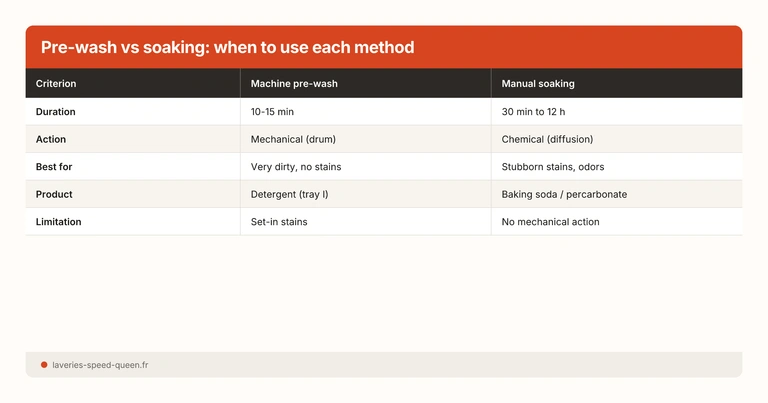
Prewash (automated machine cycle, 10-15 minutes) and soaking (manual static bath, 30 minutes to several hours) are two pre-treatment techniques for heavily soiled laundry. Prewash is convenient but superficial; soaking is more effective on stubborn stains and odors. Key products: baking soda for deodorizing, sodium percarbonate for whitening and disinfecting, detergent at half dose for machine prewash. Neither method replaces a full wash cycle.
At a glance
Prewash = short machine cycle - 10-15 minutes of water + detergent before the main program. Ideal for heavily soiled laundry without a specific stain.
Soaking = manual static bath - 30 min to 4 hours with the right product. More effective on stubborn stains and odors.
Baking soda for deodorizing - 2 tbsp per liter, cold water, 30 min to 2 h. Safe for all fabrics and colors.
Sodium percarbonate for whitening - 1 tbsp per liter, lukewarm water at 40 °C, 1 to 4 h. Reserved for whites and colorfast items.
Do not soak for more than 12 h - beyond that, colors bleed, fibers weaken, and bacteria multiply.
Prewash and soaking: two methods, two logics
Prewash and soaking share the same goal: prepare laundry for the main wash by loosening the toughest soil first. But they work in very different ways.
Machine prewash
Prewash is a mini wash cycle built into your machine program. When you turn on the “prewash” option (or choose a program that includes it), the machine runs a short cycle (10-15 minutes) with water and a small dose of detergent before the main cycle.
How it works: the machine fills the drum with water (15-25 liters depending on the model), releases detergent from drawer I (prewash), rotates slowly for 10-15 minutes, then drains dirty water. Laundry then enters the main cycle with fresh water and fresh detergent.
The benefit: coarse soil (mud, dust, food residue, dried sweat) is flushed out in the first water. The main cycle then works on laundry that is already partly cleaned, which can improve the final result significantly.
The limit: 10-15 minutes of agitation in water is not enough to remove deeply set stains or chemical buildup. Prewash works for surface soil, not deep stains.
Manual soaking
Soaking is a long static bath in a container (basin, sink, bathtub) with a cleaning product. Laundry stays submerged for 30 minutes to several hours so the product can work through chemical diffusion.
How it works: the soak product (baking soda, sodium percarbonate↗, detergent, vinegar) progressively penetrates fibers through molecular diffusion. It attacks soil from inside by dissolving the chemical components of stains (proteins, grease, pigments, limescale). The action is chemical, not mechanical. No scrubbing needed.
The benefit: long contact time lets the product act deeply on soil that mechanical action alone cannot dislodge. Soaking is the go-to method for protein stains (blood, milk, egg), embedded odors, and yellowed laundry.
The limit: soaking provides no mechanical action. Laundry must still be machine-washed after soaking for complete cleaning.
| Feature | Machine prewash | Manual soaking |
|---|---|---|
| Duration | 10-15 minutes (automatic) | 30 min to 12 h (manual) |
| Main action | Mechanical (rotation) + chemical (detergent) | Chemical (product diffusion through fibers) |
| Best for | Surface soil (mud, dust, sweat) | Set-in stains, protein stains, stubborn odors |
| Water use | +15-25 L per cycle | 5-15 L (basin) |
| User effort | Automatic (machine button) | Manual (prepare bath, monitor duration) |
| Needs washing afterward? | Integrated into the program | Yes, machine wash required |
When to use prewash
Machine prewash is useful in specific situations. Turning it on for every normal load wastes water and energy without improving results.
Situations where prewash makes sense
Work clothes
Overalls, mechanic uniforms, restaurant aprons, construction gear. These items collect grease, mud, dust, and sweat in high amounts. Prewash removes the bulk of soil before the main cycle.
Heavily soiled sportswear
Muddy soccer or rugby kits, trail-running clothes, gardening wear. Mud and dirt cloud the wash water. Prewash flushes them out first so the main cycle can work more effectively.
Heavily stained kids' laundry
Bibs, bodysuits, and clothes with food, grass, or dirt marks. Kids often combine several stain types on one garment. Very dirty baby clothes benefit from a prewash.
Very dirty household laundry
Mop cloths, kitchen towels, cleaning rags. Prewash removes heavy residue before the main hygienic wash. Very dirty towels after prolonged use also benefit.
When prewash is unnecessary
Prewash adds no benefit in the following cases. It only lengthens the cycle and uses more water and energy:
- Lightly soiled everyday laundry - shirts, T-shirts, underwear worn for one office day. A normal cycle is enough.
- Standard bed linen - sheets and pillowcases changed at recommended frequency (weekly) do not need prewash.
- Delicate fabrics - silk, wool, lace. The extra cycle adds mechanical wear without real value.
How to turn prewash on
On most modern machines, prewash is enabled with a dedicated button or a program option. Key points:
- Add detergent to drawer I - this is the compartment marked “I” or “prewash.” Use about one-third of your normal dose. Put the rest in drawer II (main wash).
- Do not overdose - too much detergent in drawer I creates excess foam that is not fully rinsed before the main cycle, reducing overall effectiveness.
- Check compatibility - prewash is not available on all programs. Wool, silk, and delicate programs usually do not include it.
When to use soaking
Soaking is the best option when machine prewash is not enough: deep soil, specific stain types, and persistent odor issues.
Protein stains (blood, milk, egg)
blood, milk, egg, and vomit stains contain proteins that coagulate with heat, just like an egg hardens in a pan. Soaking in cold water (never lukewarm or hot) keeps proteins soluble so detergent can dissolve them progressively.
Protocol: cold water + liquid detergent (half dose) or grated Marseille soap↗. Soak for 1 to 2 hours. Stir occasionally.
Yellowed or grayed laundry
Yellowing in white laundry is caused by buildup of detergent residue, limescale, and sebum over repeated washes. A soak with sodium percarbonate is the most effective method to restore whiteness.
Protocol: lukewarm water (40-50 °C) + sodium percarbonate (2 tbsp per liter). Soak for 2 to 4 hours. For heavily yellowed items, extend up to 8 hours. See our guide on whitening yellowed laundry.
Stubborn odors
Odors from embedded sweat, mildew, or dampness sometimes survive a standard wash. Baking soda is an excellent deodorizer that neutralizes acids behind bad smells.
Protocol: cold or lukewarm water + baking soda↗ (2 tbsp per liter). Soak 30 minutes to 2 hours. Baking soda is safe for colors and all fabric types. Also see our guide on laundry that smells bad after washing.
Heavily soiled workwear
Mechanic overalls, kitchen aprons, and construction clothes often combine grease, oil, dust, and sweat in layered buildup. A single machine cycle, even with prewash, is sometimes not enough.
Protocol: lukewarm water (40 °C) + liquid detergent (normal dose) + 2 tbsp baking soda per liter. Soak for 2 to 4 hours. For grease or engine grime stains, add a few drops of dish soap.
Old or vintage fabrics
Older textiles (family tablecloths, vintage cotton nightwear, old household linen) are often yellowed by time and weakened by age. A gentle soak can refresh them without aggressive action.
Protocol: lukewarm water (30-35 °C) + grated Marseille soap (1 tbsp per liter). Soak for 1 hour. Do not use sodium percarbonate on very old fabrics. Weakened fibers may not tolerate oxidation.
Soaking products: which one to choose
Baking soda
Deodorizer and gentle cleaner. pH 8.3 (mildly alkaline). 2 tbsp/liter. Compatible with all fabrics and colors. Removes odors, softens hard water, loosens light soil. Complete baking soda guide.
Sodium percarbonate
Oxygen-based whitener and disinfectant. Releases hydrogen peroxide in warm water. 1 tbsp/liter at minimum 40 °C. Whites and colorfast colors only. Complete percarbonate guide.
Liquid detergent (half dose)
Versatile cleaner. Use half your regular dose in the soak bath. Effective on greasy soil and food residue. Rinse well after soaking.
White vinegar
Natural descaler and softener. 100 ml per liter of water. Dissolves embedded limescale, helps set colors on first wash, and neutralizes detergent residue. White vinegar guide.
Temperature by product
Sodium percarbonate only activates from 30-40 °C. In cold water, it does not release hydrogen peroxide and stays ineffective. Baking soda and white vinegar work at any temperature. For protein stains (blood, milk, egg), always soak in cold water. Lukewarm water coagulates proteins and sets the stain.
Soaking time: do not exceed limits
Soak duration is critical. Too short, and the product has no time to work. Too long, and the laundry gets damaged.
| Product / Situation | Minimum time | Optimal time | Absolute maximum |
|---|---|---|---|
| Baking soda (deodorizing) | 30 minutes | 1-2 hours | 12 hours |
| Sodium percarbonate (whitening) | 1 hour | 2-4 hours | 8 hours |
| Detergent (general cleaning) | 30 minutes | 30 min-1 hour | 2 hours |
| Protein stains (cold water) | 30 minutes | 1-2 hours | 4 hours |
| Very yellowed laundry | 2 hours | 4-6 hours | 12 hours |
Why over-soaking is a problem
Excessive soaking creates more problems than it solves:
- Color bleeding - even colorfast dyes can release pigments after many hours in stagnant water. The risk of cross-color transfer rises with time.
- Fiber weakening - natural fibers (cotton, linen) absorb water and swell. Prolonged swelling weakens the internal fiber structure and reduces tensile strength.
- Bacterial growth - lukewarm stagnant water is an ideal medium for bacteria. After 8-12 hours, laundry can start smelling musty, the opposite of the goal. Anaerobic bacteria (which grow without oxygen in stagnant water) produce foul-smelling sulfur compounds.
- Product residue - prolonged soaking in concentrated detergent can leave residue in fibers, especially thick fabrics (towels, sheets). These residues irritate sensitive skin and make fabric stiffer.
- Soaking for more than 12 hours - fibers weaken, colors bleed, bacteria multiply. Maximum 12 h for whites, 4 h for colors.
- Soaking in hot water - sets protein stains (blood, milk) and accelerates color bleeding. Cold water is safer for most soaking scenarios.
- Forgetting laundry in the bath - a 24 or 48 hour soak (weekend oversight) can ruin a garment. Set a reminder.
- Long soaks for wool or silk - 10 minutes maximum for these delicate fibers. Beyond that, wool felts and silk loses sericin.
- Mixing sodium percarbonate and vinegar - vinegar (acid) neutralizes sodium percarbonate (alkaline). Used together, they cancel each other out. Choose one or the other.
Baking soda pre-treatment before laundromat washing
The professional machines in our laundromats do not offer a soaking option or an accessible prewash drawer. But there is a simple workaround that gives a similar effect: baking soda pre-treatment.
The method
- Before leaving for the laundromat, sprinkle baking soda directly on the dirtiest areas (collars, underarms, visible stains).
- Let it sit for 15-30 minutes while you prepare your laundry.
- Bring the laundry as-is. No need to shake off the powder. It will dissolve and rinse out during the cycle.
Baking soda softens water, neutralizes acids (sweat, odors), and loosens surface soil. Combined with the power of professional machines (more water, stronger mechanical action, professional detergent), it is an effective pair.
The water-volume advantage in laundromats
Our professional laundromat machines use 50 to 60 liters of water per cycle, compared with 15 to 20 liters for a home washer. This higher volume creates a natural “soaking effect”: better immersion, better dilution of soil, and more effective rinsing of residues.
For very dirty laundry (workwear, muddy sportswear, moving-day loads), a professional machine cycle with baking soda pre-treatment is often as effective as home soaking plus washing, and much faster.
As an Amazon Associate, we earn a small commission on purchases made through the affiliate links in this article, at no extra cost to you. It helps us maintain this site and keep publishing free guides.
The higher water volume in our professional machines delivers deep cleaning, even on very dirty laundry. Our laundromats in Blagnac, Croix-Daurade and Montaudran are open 7 days a week, professional detergent included, payment contactless card or cash. See our prices.
Practical cases: which treatment for which laundry
Yellowed bed sheets
Soak with sodium percarbonate (2 tbsp/liter, water at 40-50 °C, 4 hours). Then wash at 60 °C. Results are often dramatic on white cotton. For satin sheets, see our dedicated guide.
Towels that smell musty
Soak with baking soda (3 tbsp/liter, cold water, 2 hours) to neutralize odors. Wash at 60 °C with a normal detergent dose. For stubborn cases, add 100 ml of white vinegar↗ in the softener drawer.
Smelly sportswear
Soak with baking soda (2 tbsp/liter, cold water, 1 hour). Baking soda neutralizes organic acids produced by sweat bacteria. Then wash as usual. For the full protocol, see sportswear care.
Stained bibs and baby bodysuits
Cold-water soak + grated Marseille soap (1 tbsp/liter, 1 hour). Marseille soap is gentle on sensitive skin and effective on food stains. Wash at 40 °C.
Tablecloths stained after a meal
White-vinegar soak (100 ml/liter, cold water, 30 minutes) for wine and fruit stains. Dish-soap soak (a few drops per liter, lukewarm water, 30 minutes) for greasy stains. Then machine wash at the usual temperature.
Prewash and soaking: quick recap
The choice between prewash and soaking depends on three factors: stain type, available time, and fabric.
- Surface soil (mud, dust, light sweat) -> machine prewash
- Deep stains (proteins, pigments) -> cold soak + wash
- Stubborn odors -> baking soda soak + wash
- Yellowed laundry -> sodium percarbonate soak + 60 °C wash
- Delicate laundry (wool, silk) -> very short soak (10 min max, cold water) or none
- At the laundromat -> baking soda pre-treatment before the professional cycle
Prewash and soaking are not everyday steps. They are tools to use when normal washing is not enough: truly dirty laundry, stubborn stains, or persistent odor issues. For regular laundry, a well-set normal cycle with the right detergent dose and the right temperature is more than enough.