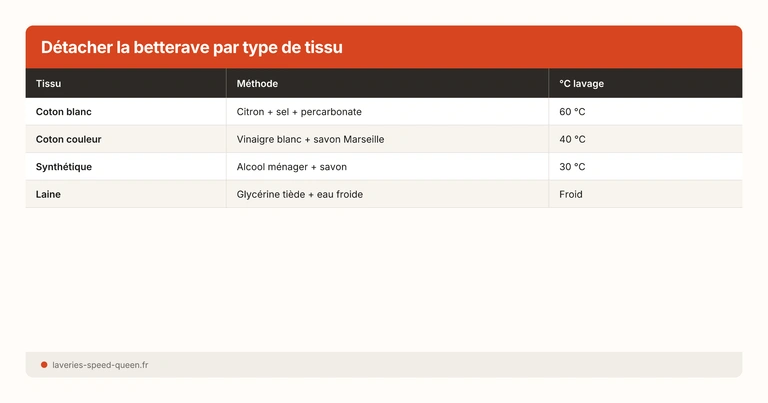
In short: beetroot stains intensely because of betalains — highly colourful water-soluble plant pigments. Good news: they dissolve in cold water. On a fresh stain, an immediate rinse with cold water is often enough. If a trace remains, white vinegar or lemon juice breaks down betalains in 15-20 minutes. For dried stains, switch to sodium percarbonate for soaking. Never rub and never use hot water.
The right reflexes
Cold water immediately — betalains are water-soluble, much of the pigment comes out with cold water in the first few minutes.
White vinegar or lemon — the acid breaks down betalains. 15-20 min on a fresh stain.
Percarbonate for dried stains — oxidises residual betalains through active oxygen release.
Zero hot water — heat sets betalains in the fibres.
Dab, do not rub — rubbing spreads the pigment and pushes it deeper into the fabric.
Why beetroot stains
Beetroot (Beta vulgaris) contains betalains — a family of plant pigments responsible for its intense red-purple colour. The dominant pigment is betanin, a nitrogen compound present at high concentration (300 to 600 mg/kg in cooked beetroot).
Betalains are chemically very different from anthocyanins (red wine, red fruit pigments) and tannins (coffee, tea pigments). Their distinguishing feature: they are extremely water-soluble. This is why beetroot juice soaks through textiles so easily and colours everything it touches.
This water solubility is paradoxically your best ally for stain removal. A water-soluble pigment dissolves easily… provided you act fast and use cold water. Hot water modifies betalain structure and makes them partially insoluble — that is the classic trap that turns an easy stain into a stubborn one.
Fresh stain: the immediate method (under 10 minutes)
If you act within minutes of contact, the success rate is 95% or higher. Betalains are still in solution in the juice — they have not yet formed stable bonds with the fibres.
Protocol
Blot the excess — dab with a clean cloth, paper towels or a tea towel. Do not rub: rubbing spreads pigment over a larger area and pushes it into the fibres.
Rinse with cold water from the back — run the stain under a stream of cold water with the back of the fabric facing up. Water pushes pigment out of the fibres instead of forcing it through more fabric.
Check the result — in most cases, the stain has disappeared or significantly faded. If a pinkish trace remains, move to acid treatment.
White vinegar or lemon — soak the area with a little pure white vinegar↗ or fresh lemon juice. The acid breaks down residual betalains. Leave for 15-20 minutes, then rinse.
Machine wash — wash at 30-40 °C with your usual detergent. Check the result before any tumble drying.
Dried stain: white vinegar + percarbonate
When the stain has had time to dry, betalains have adsorbed onto the fibres. They are no longer simply “in solution” but bonded to the textile. Treatment must be more aggressive.
Protocol
Pure white vinegar — apply directly to the dried stain. Vinegar rehydrates and begins breaking down betalains. Leave for 30 minutes.
Rub gently — with your fingertips or a soft sponge, rub the area to help vinegar penetrate. Rinse with cold water.
Sodium percarbonate — if a trace remains (common on stains dried for more than 24 hours), prepare a sodium percarbonate solution: 2 tablespoons per 2 litres of warm water (40-50 °C). Submerge the textile and soak for 2 to 4 hours.
Rinse and wash — rinse with cold water, then machine wash at 30-40 °C.
Very old stain (several days or tumble-dried)
For stains set by heat (dryer, ironing) or dried for several days, combine treatments:
- Pure glycerine↗ on the stain — leave for 1 hour to soften pigments.
- White vinegar — 30 minutes.
- Percarbonate soak — overnight.
The success rate drops to 40-60% on heat-set stains. This is why the golden rule is always to check for stain disappearance before the dryer.
By textile: adapting the method
White cotton
The easiest to treat. White vinegar or lemon as first treatment, then percarbonate if needed. A 60 °C wash is possible on white cotton and helps remove residues. For very old stains, you can also whiten the laundry.
Coloured cotton
White vinegar is fine — it does not discolour. Avoid pure lemon on dark colours (slight lightening risk). Percarbonate is usable on colourfast fabrics, but test on a hem.
White cotton tablecloth
Soak the stained area in pure lemon juice for 30 minutes. Rinse, then wash at 60 °C. For large tablecloths with several stains, a full percarbonate soak (2 tbsp per 5 L warm water) is more practical. Guide: tablecloth care.
Wool
Sensitive fibre: diluted white vinegar only (50/50 water-vinegar). No percarbonate. No aggressive rubbing. Dab gently and rinse. When in doubt, see our delicate textiles guide.
Silk
Silk cannot tolerate concentrated acids or percarbonate. Dab with cold water only. If the stain persists, take the garment to a specialist dry cleaner.
Synthetic (polyester)
Betalains adhere less to polyester than to cotton — synthetic fibres are non-polar. A quick cold-water rinse is often enough. White vinegar as backup if needed. Wash at 30 °C.
Mistakes to avoid
- Rubbing a fresh stain — you spread betalains over a larger area and push them into the fibres. Dab instead.
- Using hot water — heat modifies betalain structure and sets them in the fibres. Always use cold water.
- Putting bleach on coloured fabric — bleach discolours the fabric around the stain, which is worse than the stain itself.
- Tumble drying without checking — heat sets betalain residues. Always verify complete disappearance before mechanical drying.
- Waiting several days — betalains dry and set progressively. The longer you wait, the harder the stain removal.
- Using salt alone as treatment — salt absorbs liquid but does not break down pigments. It is first aid, not treatment.
- Mixing vinegar and percarbonate — the acid neutralises the base. Use them at separate stages of treatment.
- Rubbing dry with a cloth — without water or product, rubbing only spreads and embeds the pigment.
As an Amazon Associate, we earn a small commission on purchases made through affiliate links in this article — at no extra cost to you. This helps us maintain this site and produce free guides.
Our laundromats in Blagnac, Croix-Daurade and Montaudran have professional machines with detergent included. The higher water volume (50-60 litres) helps dilute and extract pigments better than a domestic machine. Payment contactless card or cash. See our prices.
Sources and references
- Stain removal: solutions for all stains
- Remove a red wine stain (anthocyanins vs betalains)
- Remove a red fruit stain
- Remove a coffee stain (tannins)
- Remove a tomato sauce stain (lycopene)
- White vinegar and laundry: uses and limits
- Sodium percarbonate: usage guide
- Washing temperatures by textile
- Delicate textile care