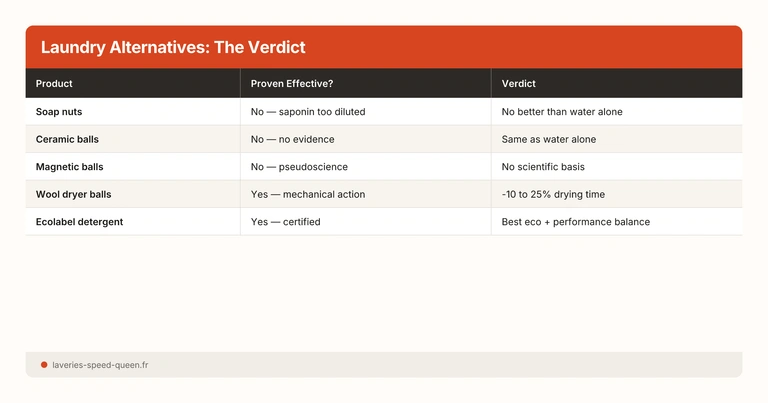
In short: Soap nuts contain a natural surfactant (saponin), but in too low a concentration to clean properly in a washing machine. Ceramic and magnetic laundry balls have no proven effectiveness — independent tests rate them equal to water alone. However, wool dryer balls genuinely work: they reduce drying time by 10-25 % and cut static cling. For an effective eco wash, choose an EU Ecolabel-certified detergent or Marseille soap.
At a Glance
Soap nuts: very limited effectiveness -- saponin is too diluted in 40-60 litres of water to tackle stains.
Ceramic balls: unproven -- no independent study confirms an effect beyond water alone.
Magnetic balls: pseudoscience -- water does not 'restructure' under a domestic magnet.
Wool dryer balls: they work -- proven mechanical action, 10-25 % less drying time.
Certified eco detergent: best compromise -- cleans effectively with a controlled environmental impact.
Soap Nuts: Promise vs Reality
Soap nuts (Sapindus mukorossi) contain a natural surfactant — saponin — that foams on contact with water. The problem is concentration: too low to clean effectively in a washing machine.
What Soap Nuts Are
Soap nuts are the dried husks of the fruit of the soap berry tree (Sapindus mukorossi), native to India and Nepal. The husk contains saponin, a glycoside surfactant. On contact with water, saponin lowers surface tension — the same mechanism as synthetic surfactants in conventional detergent.
In theory, a perfect natural detergent: biodegradable, free from synthetic allergens, renewable. In practice, the detail matters.
Why They Clean Poorly
The fundamental problem is dilution. A pouch of 4-6 half-shells releases about 1-2 grams of saponin into 40-60 litres of water. The final concentration is around 0.003-0.005 %. For comparison, a dose of conventional detergent delivers 10-15 grams of surfactants — a concentration 5-10 times higher.
On lightly soiled laundry
Soap nuts give an acceptable result on clothes worn once, barely stained, in soft water. The saponin is enough to carry away light perspiration and dust. This is the use case behind most positive online reviews.
On common stains
Grass, grease, tomato sauce, coffee, red wine: independent consumer tests show that soap nuts perform no better than hot water alone. At such low concentration, saponin lacks the detergent power to dislodge these soils.
Independent Test Results
Results are consistent:
- Which? / consumer associations: soap nuts score very low on detergent power, close to water alone on standardised stains (grass, grease, blood, coffee).
- Hohenstein Institute (Germany): soap nuts show measurable surfactant activity but insufficient for standard domestic washing.
The online review bias
Positive soap nut reviews are explained by a perception bias: on lightly soiled laundry (worn one day at the office), water alone already cleans adequately. The user attributes the result to the soap nuts, when hot water + drum agitation do most of the work. The real test is on a grease or sauce stain: there, the difference from real detergent is stark.
The Carbon Footprint: Not So Green
The ecological argument deserves scrutiny.
Soap nuts come exclusively from South Asia (India, Nepal). Sea freight to Europe represents a significant carbon footprint. Packaging, distribution and logistics add to the impact. Compared to a locally made soap or detergent produced domestically, the carbon benefit is debatable.
Another problem is rarely mentioned: growing Western demand has pushed up the price of soap nuts on local Indian markets. Populations who used them traditionally have switched to imported industrial detergents, often less eco-friendly. This documented rebound effect undermines the “natural and ethical” marketing narrative.
Soap Nuts: Verdict
| Criterion | Promise | Reality |
|---|---|---|
| Cleaning power | Cleans like detergent | Comparable to water alone on stains |
| Ecology | 100 % natural, biodegradable | India-to-Europe shipping, local rebound effect |
| Cost | Cheaper than detergent | GBP 0.12-0.20/wash — comparable to eco detergent |
| Scent | Natural | Neutral to slightly vinous — no freshness |
| Hypoallergenic | No synthetic allergens | True — the only undisputed advantage |
Ceramic Laundry Balls: No Proof of Effectiveness
Ceramic laundry balls (or “wash pearls”) claim to change the pH of the water to improve cleaning. Independent tests disprove this claim.
The Claimed Mechanism
Ceramic ball manufacturers claim the clay beads inside the casing release “effective micro-organisms” (EM) or alter the water pH to make it “more cleansing”. Some models contain clay, tourmaline or zeolite beads.
What the Tests Say
Consumer tests are categorical: ceramic laundry balls show no significant difference from a water-only wash, without any product. pH measurements show a tiny variation (0.1-0.2 units) with no impact on cleaning power.
The chemistry is clear: for effective cleaning, you need surfactants (molecules that lift grease and soil from fibres). Ceramic beads contain no surfactants and do not generate any. The marginal pH change does not compensate for the absence of detergent.
EM beads (effective micro-organisms)
The idea that micro-organisms can survive in dry fired-clay beads, then reactivate in wash water to 'clean' laundry, has no microbiological basis. The bacteria and yeasts in EM preparations do not survive desiccation in ceramic.
Tourmaline beads
Tourmaline is a piezoelectric mineral that generates a weak electric field under pressure. The claim that it 'energises water' has no scientific validity in a washing context. The energy released is infinitesimal and has no effect on soils.
Magnetic Laundry Balls: Pseudoscience
Magnetic balls are based on the claim that magnets can “restructure water molecules” to improve cleaning. This is false.
Why It Is False
Water (H2O) is a covalent molecule whose structure is determined by chemical bonds between oxygen and two hydrogen atoms. A domestic magnetic field (a few hundred gauss) cannot alter this structure. You would need fields of several tesla (hospital MRI) to observe a measurable effect on water — and even then, the effect vanishes instantly when the field is removed.
Marketing claims about “magnetised water” that “cleans better” are pseudoscience. No peer-reviewed scientific publication demonstrates a cleaning benefit from water exposed to a domestic magnetic field.
Independent Tests Confirm
Results are identical to those for ceramic balls: no difference from water alone on standardised stain test panels. The consensus across independent testing bodies is unanimous.
Wool Dryer Balls: The Ones That Work
Unlike the products above, wool dryer balls↗ have proven effectiveness through a simple, verifiable mechanical mechanism.
How They Work
Wool (or rubber) dryer balls are 6-8 cm diameter spheres placed in the tumble dryer with the laundry. Their action is purely mechanical:
Laundry separation
The balls bounce between garments and prevent them from clumping into a mass. Laundry stays aerated, hot air circulates between items. Result: more even and faster drying.
Reduced drying time
Tests show a 10-25 % reduction in drying time depending on load. On a towel load (dense, slow to dry), the gain is more pronounced. The mechanism is simple: better air circulation = faster evaporation.
Reduced static cling
Wool balls absorb some residual moisture, which reduces the dry friction that causes static. Wool is hygroscopic -- it regulates moisture naturally. Rubber balls do not have this effect.
Mechanical softening
The repeated impact of the balls on fibres physically softens them -- like a textile massage. The result is comparable to a light fabric softener, with zero chemical residue on the laundry. A genuine softener alternative for the dryer.
Wool vs Rubber Dryer Balls
| Criterion | Wool balls | Rubber balls |
|---|---|---|
| Drying time reduction | 10-25 % | 10-20 % |
| Anti-static effect | Yes (moisture absorption) | No |
| Softening | Good | Average |
| Noise | Quiet | Noisy (hard bounces) |
| Lifespan | 500-1,000 cycles | 1,000+ cycles |
| Price | GBP 6-12 (set of 6) | GBP 4-8 (set of 4) |
| Scent addition | Yes (essential oil on ball) | No |
Wool dryer balls are recommended by consumer associations as an alternative to fabric softener for the dryer. They work on a verifiable mechanical principle, with no placebo effect or pseudoscientific marketing.
Full Comparison: Everything That Claims to Replace Detergent
Here is an honest summary table of all “natural” alternatives to conventional detergent, with the level of evidence for their effectiveness.
| Product | Claimed mechanism | Proven effectiveness | Cost/wash | Verdict |
|---|---|---|---|---|
| Soap nuts | Saponin (surfactant) | Very weak (dilution) | GBP 0.12-0.20 | Insufficient on stains |
| Ceramic balls | pH modification | None (= water alone) | GBP 0.01 (amortised) | Unproven |
| Magnetic balls | Water restructuring | None (pseudoscience) | GBP 0.01 (amortised) | Unproven |
| Wool dryer balls | Mechanical action | Yes (proven) | GBP 0.01 (amortised) | Effective (drying only) |
| Marseille soap | Anionic surfactant | Yes (real detergent) | GBP 0.04-0.08 | Effective, low footprint |
| Ecolabel detergent | Biodegradable surfactants | Yes (certified) | GBP 0.08-0.16 | Best eco/effectiveness compromise |
| Standard detergent | Surfactants + enzymes | Yes (benchmark) | GBP 0.08-0.20 | Effectiveness benchmark |
Genuinely Eco Alternatives That Actually Clean
If your goal is to reduce the environmental impact of your laundry without sacrificing effectiveness, here are the documented options.
Marseille Soap (Locally Made)
Marseille soap is a real anionic surfactant — it cleans. Local production limits the carbon footprint. Make sure to buy genuine Marseille soap↗ (olive oil or coconut oil based, not animal fat or palm oil).
EU Ecolabel-Certified Detergent
The EU Ecolabel sets strict criteria for surfactant biodegradability, phosphate-free formulation, reduced packaging and minimum wash performance. It is an independent label (European Commission), not a private brand label. An Ecolabel detergent cleans as well as a standard product with a reduced environmental impact.
Sodium Percarbonate (Whitener / Disinfectant)
Sodium percarbonate breaks down into water, oxygen and sodium carbonate — three harmless products. It whitens and disinfects without chlorine. It is an ideal complement to an eco detergent, not a substitute (it contains no surfactants).
Correct Detergent Dosing
The most effective eco action is often the simplest: dose your detergent correctly. Over-dosing by 50 % (very common) means 50 % more product in wastewater with no washing improvement.
At a Speed Queen Laundromat
At the laundromat, the alternative-detergent question does not arise: professional detergent is built into the cycle and dosed automatically. This dosing is calibrated by chemists for optimal results on all textile types, with no over-dosing.
Paradoxically, it is the most eco-friendly solution per wash: no over-dosing (the number-one cause of household detergent waste), no individual packaging, and consistent effectiveness every cycle.
Mistakes to Avoid
- Assuming 'natural' means 'it cleans' -- natural is not a guarantee of effectiveness. Water is natural, but it does not remove grease stains without a surfactant.
- Trusting marketing testimonials -- consult independent tests (Which?, consumer associations), not reviews on the vendor's own site.
- Confusing laundry balls with dryer balls -- wool dryer balls work (tumble dryer). Ceramic or magnetic laundry balls do not (washing machine).
- Using soap nuts on heavily soiled laundry -- reserve them for lightly soiled items in soft water, where their effect is at best marginal but at least harmless.
- Ignoring the total carbon footprint -- a 'natural' product imported from India can have a higher carbon footprint than a locally produced detergent.
As an Amazon Associate we earn a small commission on purchases made through the affiliate links in this article — at no extra cost to you. This helps us maintain this site and produce free guides.
At Speed Queen laundromats, detergent is dosed automatically — no over-dosing, no under-dosing, guaranteed effectiveness every cycle. It is the simplest eco action: precise professional dosing. Check our prices.
Sources and References
- Which? / consumer associations, comparative tests on detergent alternatives, consulted March 2026
- Hohenstein Institute (Germany), technical report on soap nut wash performance, consulted March 2026
- ADEME, guidance on eco-friendly household cleaning ingredients, consulted March 2026
- European Commission, EU Ecolabel for laundry detergents — criteria, consulted March 2026