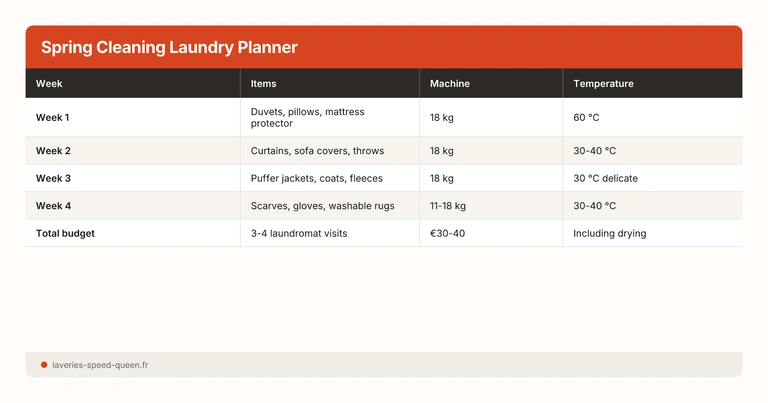
In short: spring cleaning for textiles means around twenty items to wash - duvets, pillows, curtains, rugs, puffer jackets, throws. Spread over 3-4 weekends, it stays manageable. At the laundromat, 18 kg machines take the bulky items that home washers cannot handle. Total budget: 30-40 EUR (3-4 loads with drying), often less than one dry-cleaner visit for a single duvet.
Quick Overview: Checklist by Category
Bedding - duvets, pillows, mattress protectors, winter sheets. Priority 1: dust mites built up all winter.
Home textiles - curtains, sofa covers, throws, weighted blankets, rugs. Everything that traps dust without frequent washing.
Winter clothing to store - puffer jackets, coats, wool sweaters, fleece. Always wash before storing to prevent moths and set-in marks.
Accessories - scarves, gloves, beanies, backpacks, caps, trainers. The usual spring-cleaning blind spots.
The common trap is trying to do everything in one day. That usually means fatigue and rushed drying. Plan across several weekends - results are better, and you avoid overloading drying racks (or your tumble dryer).
Week 1: Bedding First
Bedding is the top priority. During winter, duvets and pillows collect sweat, dead skin and dust mites. Spring is the right moment to reset everything before switching to lighter bedding.
What to wash
- Winter duvet - wash before storing it for 6 months. First check whether it is machine washable (how to check). Synthetic duvets usually run well in 18 kg machines; feather duvets need a delicate cycle with dryer balls↗ (feather duvet guide). For the full process: how to wash a duvet.
- Pillows - often overlooked, but they should be washed 2 to 4 times per year. An unwashed pillow can double in weight over 2 years (mites and sweat buildup). See the pillow guide for settings by filling type.
- Mattress protector - washable at 60 C and one of the best anti-mite barriers. Spring is the perfect time for a deep wash. If mites are a concern, our dust mite protocol covers temperatures and frequency.
- Winter sheets - flannel, heavy jersey and brushed cotton. Wash before storage, then switch to lighter sheets. For standard frequency guidance: sheet washing frequency.
18 kg machine = 1 duvet per cycle
A double duvet almost fills an 18 kg drum on its own. Do not add other items: the filling needs space to move and rinse properly. Result: a cleaner, fluffier duvet with no detergent residue. Capacity details:
what machine size for a duvet
.
Drying: the critical step
Drying bulky items is usually the bottleneck. A poorly dried duvet can develop mold in 24-48 hours. In a laundromat, a commercial dryer (large drum, strong airflow) dries a duvet in 30-45 minutes. At home, expect 6-8 hours on a rack, with odor risk if ventilation is weak, especially in small flats. Our laundromat duvet guide details timing by method.
Week 2: Home Textiles
Home textiles - curtains, covers, throws - are often neglected in day-to-day laundry. Most households wash them only once or twice a year. Spring cleaning is the ideal checkpoint.
What to wash
- Curtains and sheers - true dust filters, especially in city apartments. Take them down, check labels (most run at 30-40 C), and use an 18 kg machine to avoid compressing them. Full details in the curtain guide.
- Sofa and cushion covers - if removable and machine washable (always check labels). A sofa gets daily contact for hours, so at least seasonal washing makes sense.
- Throws and blankets - including weighted blankets, which often need large-capacity machines. Shake them outdoors before washing to remove pet hair and dust. If pet hair is a recurring issue, our pet hair laundry guide covers pre-wash and in-wash solutions.
- Machine-washable rugs - bath rugs, textile doormats, and small decorative rugs. Check label and dry weight: a rug above 10 kg dry may exceed 18 kg when wet. See the rug washing guide for what is safe in a machine.
Curtains: temperature matters
Most modern curtains contain polyester or synthetic blends. Wash at 30 C max to avoid shrinkage and permanent creases. Pure cotton curtains can handle 40 C. If unsure, choose 30 C - it is always the safer option (prevent shrinkage ).
Tip: anti-lint sorting
Do not mix terry towels with curtains or dark clothing: terry releases lint that sticks to smooth fabrics. Run one “smooth textiles” cycle (curtains, covers) and one “terry textiles” cycle (towels, bath rugs).
Week 3: Winter Clothes Before Storage
Storing dirty clothes is the fastest way to attract moths and lock in stains. Every winter item should be washed - or at least aired - before storage until autumn.
What to wash
- Puffer jackets - they lose insulation if stored compressed and dirty. Wash at 30 C on delicate, then dry with tennis balls to restore loft. Full method in the puffer jacket guide.
- Coats and parkas - often too bulky for 7-8 kg home machines. An 18 kg laundromat machine is usually ideal. Follow care labels: some technical coats require cold cycles. See the coats and parkas guide.
- Wool and cashmere sweaters - classic delicate textiles. Wash at 30 C max, wool cycle, low spin (400-600 rpm). Dry flat to prevent shoulder deformation.
- Fleece and ski gear - fleece should be washed at 30 C without softener (softener clogs fibers and reduces breathability). For full ski gear care: ski clothing guide.
Moths: washing is your best prevention
Textile moths lay eggs on natural fibers (wool, cashmere, silk) that are dirty - sweat and sebum attract them. A garment washed and fully dried before storage is your best protection, more effective than moth balls. Add a lavender sachet in storage bags for extra protection.
Storage: basic rules
- Dry completely - no residual moisture. A dryer can help (drying guide).
- Use breathable covers - avoid airtight plastic bags that trap leftover humidity. Non-woven garment covers are usually best.
- Avoid hangers for knits - sweaters, cardigans and wool knits should be folded to prevent shoulder stretching.
Week 4: Accessories
Winter accessories usually end up in a drawer or basket and get forgotten. Use spring cleaning to wash, sort and store them properly.
What to wash
- Scarves and shawls - wool: delicate 30 C or hand wash. Acrylic or polyester: regular 30 C cycle. Check care symbols if unsure.
- Gloves and beanies - most are machine washable inside a mesh laundry bag. Group them in one bag so nothing gets lost in the drum.
- Backpacks and gym bags - empty every pocket, turn the bag inside out, zip it closed. Wash at 30 C on delicate. Full details in the backpack guide.
- Caps and hats - rigid-brim caps are not always machine safe. See the cap guide to know when machine wash is safe and when hand wash is required.
- Trainers - remove laces and insoles, cold 30 C cycle, no tumble dryer (shape damage risk). Full process: shoe washing guide.
Use mesh laundry bags for small items
Gloves, beanies, thick socks, small scarves: group them in one or two closed mesh laundry bags. This prevents a glove getting stuck in the door seal and protects delicate items from drum agitation.
Summary Calendar
| Week | Items | Recommended machine | Temperature |
|---|---|---|---|
| 1 - Bedding | Duvet, pillows, mattress protector, winter sheets | 18 kg (duvet only) + 9 kg (pillows, sheets) | 30-40 C (duvet), 60 C (mattress protector) |
| 2 - Home | Curtains, sofa covers, throws, rugs | 18 kg (curtains, rugs) + 9 kg (covers, throws) | 30 C (curtains), 30-40 C (covers, throws) |
| 3 - Winter | Puffer jackets, coats, wool sweaters, fleece | 18 kg (puffers, coats) + 9 kg (sweaters, fleece) | 30 C (all, delicate cycle for wool) |
| 4 - Accessories | Scarves, gloves, bags, caps, trainers | 9 kg (grouped in mesh bags) | 30 C |
Spring Cleaning Budget at a Laundromat
Week 1 - Bedding
1 x 18 kg machine (duvet) + 1 x 9 kg machine (pillows, sheets) + drying = around 12-15 EUR.
Week 2 - Home
1-2 x 18 kg machines (curtains, rugs) + drying = around 10-18 EUR.
Week 3 - Winter
1 x 18 kg machine (puffer jackets) + 1 x 9 kg machine (sweaters) + drying = around 10-15 EUR.
Week 4 - Accessories
1 x 9 kg machine (everything in mesh bags) + partial drying = around 5-8 EUR.
Estimated total: 35-55 EUR for the full spring textile clean, spread over 4 weekends. With the Speed Queen loyalty card (-20 percent), the budget drops to 28-44 EUR. For comparison, dry cleaning is often 25-45 EUR for one duvet and 15-30 EUR per coat.
Machine-by-machine detail: laundromat prices in 2026.
Mistakes to Avoid
- Storing textiles while still damp - mold can appear in 24-48 hours in closed spaces (closets, storage covers). Dry everything fully before storage, even if it feels "almost dry".
- Mixing everything in one machine - one duvet alone in 18 kg, curtains separate from terry towels (lint), wools in a separate delicate cycle. Sorting takes 5 minutes and prevents avoidable damage.
- Forgetting mattress protectors - this is the item most exposed to mites and sweat, yet often skipped. Wash at 60 C at least twice a year.
- Overloading to save time - an overloaded machine washes and rinses poorly. Laundry can come out with detergent residue and bad odors. Respect machine capacity.
- Ignoring care labels - a synthetic curtain at 60 C can shrink by 10-15 percent. A wool sweater at 40 C can felt permanently. 30 seconds of checking can save hours of regret. See our care symbol guide.
Use spring cleaning to maintain your washer too
If you have a home washing machine, spring cleaning is also the right time to clean your washer: an empty 90 C cycle with white vinegar helps remove detergent residue and drum bacteria. Clean machine = fresher-smelling laundry.
Two-Weekend Spring Cleaning Calendar
To keep things practical, here is a two-weekend plan that covers major household textiles without burning out.
Weekend 1 - Bulky items: start with duvets, pillows and blankets. Take them to the laundromat (18 kg machine). During the wash, remove curtains at home. Wash curtains in the next cycle or the next day.
Weekend 2 - The forgotten items: wash sofa cushion covers, throws, machine-washable rugs and bedspreads. Also wash mattress protectors at 60 C. Finish by sorting out worn towels and sheets to recycle as cleaning cloths.
Between those weekends, run your home washer for seasonal everyday loads: sort winter clothes for storage, wash them properly, and store them in breathable covers. Bring out spring clothes stored since autumn and refresh them with a short 30 C cycle.
As an Amazon Associate, we earn a small commission from qualifying purchases made through affiliate links in this article, at no extra cost to you. This helps us maintain this site and publish free practical guides.
Spring cleaning in Toulouse or Blagnac? Our laundromats in Blagnac, Croix-Daurade and Montaudran offer 9 and 18 kg machines - detergent and softener included. Clean duvets, curtains and puffer jackets in one visit. Payment contactless card or cash. See our prices.
Sources and References
- How to wash a duvet in a machine
- How to wash pillows in a machine
- Dust mite laundry protocol
- How often to wash sheets
- How to wash curtains
- How to wash a rug in a machine
- How to wash a weighted blanket
- How to wash a puffer jacket
- How to wash a coat or parka
- Delicate fabrics: complete guide
- How to wash ski gear
- How to wash a backpack in a machine
- How to wash trainers in a machine
- How to wash a cap
- Laundry care symbols guide
- How to clean your washing machine
- Complete drying guide
- How to wash an awning or shade sail
- Laundromat prices in 2026