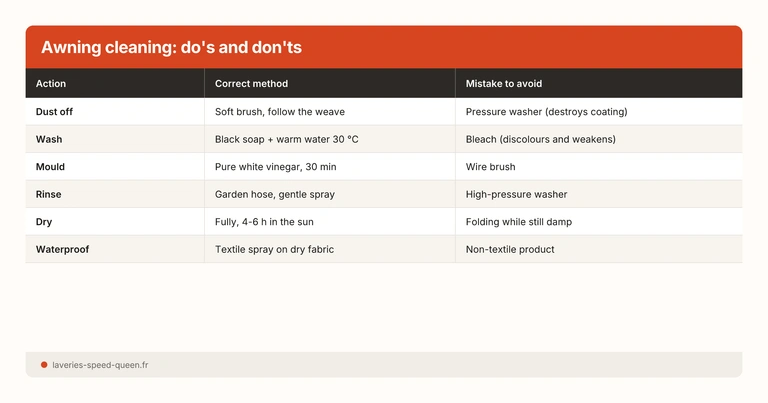
In short: clean an awning or shade sail with black soap + a soft brush, treat mold with white vinegar, rinse with a garden hose and let it dry completely before folding. Never use a pressure washer (destroys the coating), never use bleach (discolors the fabric), and never fold the fabric while still damp (mold guaranteed).
Why Pressure Washers Destroy Awnings
It is the first thing many homeowners try — and the worst. A pressure washer damages retractable awnings and shade sails in three distinct ways.
Damage From High-Pressure Jets
- Waterproof coating stripped off — the protective layer that makes water bead off is a film applied on the fibers. A jet at 100-150 bar tears it off in large patches. The fabric permanently loses its water resistance.
- Fibers distorted — the jet forces water through the weave, pushing threads apart. The fabric warps locally and loses its tension.
- Dirt pushed deeper — paradoxically, the high-pressure jet drives some surface dirt into the fiber structure, making final cleaning harder.
- Seams weakened — awning seams are the most vulnerable points. High pressure can rupture them, especially on an aging awning.
The Effective Alternative: a Garden Hose
A standard garden hose delivers 2-4 bar of pressure — more than enough to rinse the soapy solution and carry away residue. If you have an adjustable nozzle, use the “rain” or “soft spray” setting, never the “concentrated jet.”
Full Awning Cleaning Process
What You Need
Soft brush — clothes brush, soft-bristle broom or car brush (soft bristles). No wire brush.
Liquid black soap — 2 tablespoons per 5 L of warm water. Alternative: grated Marseille soap (1 tablespoon).
White vinegar — undiluted in a spray bottle for moldy areas.
10 L bucket — for the soapy solution.
Garden hose — for rinsing. With an adjustable nozzle if possible.
Textile waterproofing spray — if the fabric is older than 2 years or if water no longer beads on the surface.
Stable step ladder — to safely reach the top of the awning.
Step-by-Step Cleaning
Phase 1: Dry Dusting
Fully extend the retractable awning. With the soft brush, sweep the entire surface starting from the top and working down. The goal is to remove the layer of dust, pollen, dead leaves and cobwebs before wetting the fabric. If you wet a dusty fabric directly, the dust turns into mud that works its way into the fibers.
For a shade sail, detach it if possible and lay it flat on a clean surface (lawn, patio) so brushing is easier.
Phase 2: Washing With Black Soap
Prepare the solution in the bucket: 5 L of warm water (30-35 degrees C, not hot) + 2 tablespoons of black soap. Dip the brush and scrub in sections of about 50 cm. Work in the direction of the weave, not in circles. Pay extra attention to the folds — that is where the most dirt accumulates when the awning is retracted.
Let the solution sit for 10-15 minutes on heavily soiled areas before rinsing. Black soap is a natural surfactant that lifts greasy grime (pollution, barbecue residue, sticky pollen) without attacking the fabric.
Phase 3: Mold Treatment
If green, black or gray stains persist after soaping, they are mold or algae. Soap alone will not eliminate them — you need an acid.
Green stains (algae)
Undiluted white vinegar in a spray bottle. Leave for 30 min, brush, rinse. Repeat if needed. Algae are the easiest to treat.
Black stains (old mold)
White vinegar + baking soda: sprinkle baking soda, spray vinegar, let it fizz for 15 min, brush, rinse. Combined mechanical + chemical action.
Diffuse gray stains
Sodium percarbonate: 1 tablespoon per liter of warm water. Apply, leave for 1 hour, brush, rinse. Test on a hidden corner — percarbonate can lighten dark fabrics.
Prevention
After treatment, apply a preventive anti-mold textile product. A white vinegar treatment twice a year (spring + fall) significantly limits mold regrowth.
Phase 4: Rinsing
Rinse thoroughly with a garden hose. The goal is twofold: remove all soap residue (which would attract dirt) and flush out dead mold and vinegar. Start from the top of the fabric and work downward.
Rinsing time: allow 5-10 minutes of gentle spraying for a 3x2 m awning. It takes longer than you would think — insufficient rinsing is the main cause of watermarks after cleaning.
Phase 5: Complete Drying
NEVER fold an awning while damp
This is the number one cause of mold on retractable awnings. A folded damp fabric creates a warm, dark, humid environment — perfect conditions for mold. Leave the awning fully extended in the sun for at least 4-6 hours after cleaning. If the sky is overcast, wait until the next day. It is better to delay folding by a day than to treat mold again a month later.
Shade Sails: Special Considerations
Shade sails are cleaned the same way as retractable awnings, with a few differences.
HDPE Sails (Mesh, Permeable)
High-density polyethylene (HDPE) shade sails are the most common type. They have an open weave that lets air through — which naturally limits mold. Cleaning is simpler:
- Detach the sail and lay it flat
- Dry-brush to remove dust and debris
- Wash with black soap + warm water
- Rinse with a garden hose
- Let it dry flat, flipping it to dry both sides
Small HDPE sails (3x3 m or smaller) can go into a domestic washing machine at 30 degrees C, delicate cycle, no spin. But a laundromat’s 18 kg machine is better suited for medium-sized sails.
Waterproof Polyester Sails
These sails behave like a retractable awning: they trap water, develop mold if poorly dried, and require periodic re-waterproofing. Follow the full protocol described above.
Sails With Built-In Cables or Tensioners
Never machine-wash a sail with metal cables or sewn-in rings. The metal would damage the drum and the sail itself. Clean in place or lay flat in the yard.
Re-Waterproofing: When and How
When to Re-Waterproof
Do the water drop test: pour a few drops of water on the clean, dry fabric. If the water beads and slides off, the waterproofing is intact. If the water is absorbed into the fabric, it is time to re-waterproof.
On average, an awning fabric needs re-waterproofing every 2-3 years depending on exposure (sun, rain, pollution).
How to Re-Waterproof
Clean first — applying waterproofing over a dirty fabric traps the dirt under the protective layer.
Dry completely — the waterproofing product does not bond to a damp surface.
Apply with a sprayer — spray evenly from 20-30 cm away, in parallel lines, with no missed zones.
Two coats — first coat, 2 hours drying, then a second coat for optimal protection.
24 hours drying — do not fold the awning or expose it to rain for 24 hours after application.
Budget — expect around 15-25 USD for 1 L of waterproofing spray (covers roughly 5-8 square meters of fabric).
Annual Maintenance Calendar
| Period | Action | Duration | Products |
|---|---|---|---|
| March-April (end of winter) | Full clean + mold treatment + re-waterproofing if needed | 2-3 h (+ drying) | Black soap, vinegar, waterproofer |
| May-June | Monthly dry brushing | 15-20 min | Soft brush |
| July-August | Dry brushing + light rinse if pollen/pollution | 20-30 min | Brush + garden hose |
| September-October (end of season) | Full clean before winter storage | 2-3 h (+ drying) | Black soap, vinegar |
| November-February | Awning retracted, protected with a cover if possible | — | Protective cover |
Winter Storage: Preparing for Off-Season
The end-of-season clean (September-October) is the most important of the year, because it determines the state of the fabric come spring. An awning or sail stored dirty and damp will spend the winter developing mold and odors.
Retractable Awning: Winter Folding Protocol
After the full clean (soap + rinse + drying), verify the fabric is perfectly dry — run your hand over the folds, which hold moisture longer than the flat surface. Retract the awning normally. If your awning has a full cassette (enclosed housing), it protects the fabric from UV and weather all winter. If it is a semi-cassette or open model, add a waterproof protective cover (20-40 USD at any hardware store) to keep rain and dust off the fabric.
Also check the articulated arms and mounting hardware. Rust that sets in over winter stains the fabric in spring when rainwater runs over oxidized metal. A quick spray of WD-40 on the joints prevents this corrosion.
Shade Sail: Removal and Storage
Unlike a retractable awning, a shade sail should be taken down for winter in most cases. The fixings (carabiners, turnbuckles) suffer from frost and the stitching from low-angle winter UV. After cleaning and complete drying, fold the sail without compressing it and store it in a breathable fabric bag (not an airtight plastic bag, which traps residual moisture). Store in a dry, frost-free location — a garage or utility room works well. Take the opportunity to inspect the grommets and attachment seams: replace worn components before spring rather than discovering a problem at setup time.
Outdoor Textiles That Can Go in the Machine
Some outdoor textiles — unlike the awning itself — wash very well in a machine, especially in an 18 kg machine for large items.
Outdoor cushion covers
Removable cushion covers from patio furniture can be machine-washed at 30-40 degrees C. Check the care label. Large covers benefit from an 18 kg laundromat machine.
Outdoor tablecloths and napkins
Cotton or polyester garden tablecloths wash in a standard machine at 40-60 degrees C.
Tents and lightweight tarps
Small camping tents can be washed in a large-capacity machine at 30 degrees C on a delicate cycle.
Lounger covers
Fabric covers come off and wash in the machine. Take advantage of a laundromat visit to handle all your outdoor textiles in one go.
When to Call a Professional
Some situations go beyond what a homeowner can handle. Call a professional if the fabric is punctured or torn at the seams — cleaning could make the damage worse. Likewise, if mold has penetrated deep into the fabric (black stains that persist after two vinegar treatments), professional treatment with industrial textile antifungals will be more effective.
Retractable awnings mounted high up (above the first floor) also pose a safety concern. Working on a step ladder with a hose and a bucket of soapy water at 3-4 meters off the ground is risky. In that case, a professional with a lift or a telescopic cleaning system is the sensible solution.
The cost of professional cleaning (80-200 USD depending on size) is also justified when the fabric is premium (Sunbrella, Dickson) and you want to preserve the manufacturer’s warranty — some warranties require maintenance in accordance with the manufacturer’s instructions.
Mistakes to Avoid
- Using a pressure washer — destroys the waterproof coating, warps the fibers, drives dirt in. Use a garden hose on a gentle setting instead.
- Applying bleach — irreversibly discolors dyed fabrics and weakens acrylic fibers. White vinegar is equally effective against mold.
- Folding while still damp — the number one cause of mold. Let it dry in the sun for at least 4-6 hours before folding.
- Scrubbing with a stiff or wire brush — scratches the coating and can tear the fabric. Only use soft-bristle brushes.
- Skimping on rinsing — soap residue attracts dirt and creates watermarks. Rinse for at least 5-10 minutes.
- Waterproofing over dirty or damp fabric — the product will not bond and it traps dirt underneath. Clean and dry completely first.
As an Amazon Associate, we earn a small commission on purchases made through the affiliate links in this article — at no extra cost to you. This helps us maintain this site and produce free guides.
Need to wash outdoor cushion covers, curtains or other bulky outdoor textiles? Our laundromats in Toulouse and Blagnac feature 9 and 18 kg machines with detergent included. Perfect for handling all your outdoor textiles in a single visit. Payment by card or contactless. See our prices.
Sources and References
- Dickson Constant — Awning fabric maintenance (lien externe)
- ADEME (French Environment Agency) — Sustainable home maintenance guide (lien externe)
- Sunbrella — How to clean awning fabric (lien externe)