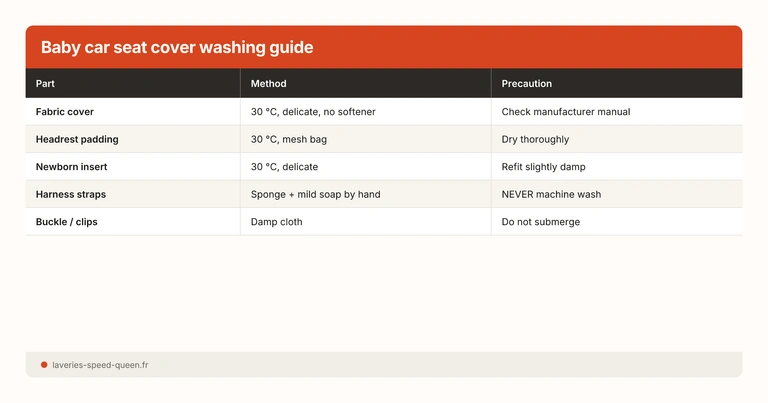
In short: A baby car seat cover is machine washable at 30 °C on a delicate programme, with a mild fragrance-free detergent and no fabric softener. Air dry — refit the cover slightly damp for a better fit. The harness straps never go in the machine — damp sponge and mild soap only, to preserve their safety strength.
At a Glance
30 °C, delicate programme — most car seat covers are machine washable. Check the manual.
Mild, fragrance-free detergent — baby's skin is fragile. No harsh enzymes, no synthetic fragrances.
Zero fabric softener — reduces fabric breathability and can irritate the infant's skin.
Harness: never in the machine — damp sponge only. Machine washing weakens the safety fibres.
Refit slightly damp — the cover moulds better to the seat shape and the elastics reposition correctly.
Why Regular Washing Matters
A baby car seat accumulates biological residue (milk, spit-up, sweat) that combines with the heat of the car interior to create a favourable bacterial environment.
The car seat is one of the most heavily used pieces of baby equipment. Between daily commutes, spit-ups, snacks on the go and summer sweating, the cover accumulates a significant amount of soiling in just a few weeks.
The heat of a car parked in the sun accelerates bacterial growth: a car seat can reach 60 °C in summer in a closed vehicle. At this temperature, milk and saliva residue become an ideal culture medium for bacteria. Regular cover cleaning is therefore not just a matter of appearance — it is a hygiene issue for a baby whose immune system is still immature.
What accumulates on the cover
Breast milk or formula, spit-up (acidic), sweat (salt), puree and baby food, biscuit crumbs, nappy residue, sebum and skin cells. Every journey adds another layer of organic matter.
The risk if you don't wash
Bacterial growth in the fabric, persistent odours, embedded stains that become permanent, and for babies with atopic skin, risk of irritation from prolonged contact with soiled fabric.
Before Washing: Remove the Cover Correctly
Take photos of the cover in place before removing it — reassembly will be much easier.
Photograph the Setup
This is the most important and most often ignored piece of advice. Take 4-5 photos of the seat with the cover in place, showing:
- How the harness loops are threaded.
- Where the elastics are hooked.
- The position of Velcro strips and fastenings.
- The location of the insert and headrest if present.
Without these photos, reassembly can quickly become a puzzle. Each brand has a different fastening system, and installation manuals are not always clear about cover repositioning.
Remove Elements Separately
Main cover
Unfasten Velcro and elastics. Slide the fabric along the harness straps without forcing. On most models (Cybex, Joie, Maxi-Cosi), you need to remove the dorsal harness buckle first to free the cover.
Headrest and insert
The padded headrest and newborn insert are usually removable and washable separately. Check if they have their own care label.
Sun canopy
If the seat is a baby carrier (Group 0+) with a canopy, it is often washable too. Remove rigid frames before washing if they are detachable.
Pre-Treating Common Stains
Baby stains are essentially biological stains (proteins, fats, acids). The golden rule: cold water to avoid cooking the proteins.
Milk Stains (Breast or Formula)
Milk contains proteins (casein) and fats. Heat cooks the proteins and fixes them permanently in the fibre. Always treat with cold water. For detailed treatment, see our guide to removing milk stains.
Method: rinse immediately in cold water. Apply Marseille soap↗ or a baking soda paste to the stain. Leave for 15 minutes. Rub gently with a soft brush. Machine wash.
Vomit Stains (Spit-Up)
Baby vomit is acidic (gastric acid) and contains partially digested proteins. The smell is persistent if the residue is not treated quickly. For details, see our guide to removing vomit stains.
Method: remove solid residue with paper towels. Rinse in cold water. Sprinkle generously with baking soda↗ — it neutralises the acidity and absorbs the odour. Leave for 20 minutes, brush off, then wash.
Baby Food and Puree Stains
Fruit and vegetable stains (carrots, squash, berries) are coloured and require quick treatment. For berry stains, see our guide on removing berry stains.
Method: rinse in cold water. Apply Marseille soap. For carrot or squash stains (beta-carotene), placing the cover in the sun after washing helps fade the stain — UV light degrades the pigment.
Sweat and Sebum Stains
In summer, baby’s sweat leaves yellowish marks, especially on light-coloured covers. This is an accumulation of sebum and sweat salts. See our guide on sweat stains and yellow marks.
Method: baking soda paste (baking soda + water) applied to the yellowed area, left for 30 minutes. The baking soda neutralises sweat acids.
Machine Washing: The Protocol
30 °C, delicate programme, mild fragrance-free detergent, no fabric softener. This is the baseline protocol for all baby car seat covers.
Temperature and Programme
Nearly all car seat manufacturers recommend 30 °C on a delicate (or “wool”) programme. A few brands allow 40 °C — check your manual. Never exceed the stated temperature.
Why 30 °C matters:
- No shrinkage: the synthetic fabrics of car seat covers are cut to fit the seat precisely. Even slight shrinkage alters the tension at the harness anchor points.
- Colour preservation: coloured covers (often grey, black or navy) lose less colour at low temperatures.
- Elasticity preserved: the integrated elastics (edges, loops) maintain their tension at 30 °C.
Shrinkage is a safety issue
Unlike a garment that is simply less comfortable if it shrinks, a shrunken car seat cover alters the harness geometry. The straps may end up misaligned with the child’s shoulders, or the crotch buckle may be off-centre. Strictly respect the manufacturer’s maximum temperature.
Detergent Choice
Baby’s skin is 30% thinner than adult skin and its barrier function is immature during the first months. Detergent choice matters.
Recommended detergent
Mild liquid detergent, fragrance-free, dye-free, hypoallergenic. Detergents labelled 'sensitive skin' or 'baby' are suitable. Liquid detergent rinses out better than powder, leaving fewer residues in the fibres.
To avoid
Powder detergent (residue), scented detergent, detergent with aggressive protease enzymes, and especially fabric softener — its chemical film reduces breathability and irritates fragile skin. For more on baby laundry, see our complete guide.
For a full analysis of detergent choice, see our article how to choose a detergent and our dedicated guide to washing baby clothes.
Why No Fabric Softener
Fabric softener deposits a film of cationic surfactants on the fibres. On a car seat cover, this film creates two problems:
- Reduced breathability: the fabric wicks sweat less effectively. In summer, baby sweats more in a seat with a softener-coated cover.
- Skin irritation: the synthetic fragrances in softener are recognised allergens. Prolonged contact (journey duration) with baby’s fragile skin increases the risk of reaction.
The Harness and Straps: Never Machine Wash
This is the most important safety point in this article. The harness straps must never go in the washing machine.
Harness straps are certified safety components. They are designed to withstand considerable forces in the event of a frontal collision. Machine washing can compromise this strength in several ways:
- Mechanical agitation (drum tumbling) creates micro-friction that abrades the harness fibres.
- Detergent products (protease enzymes, bleaching agents) can degrade the polyester or nylon fibres of the harness.
- High-speed spinning subjects the straps to torsional forces they are not designed to withstand.
- Tumble dryer (heat) can alter the mechanical properties of the harness fabric.
No car seat manufacturer recommends machine washing the harness. Cybex, Joie, Britax and Maxi-Cosi manuals all specify: “damp sponge only”.
How to Clean the Harness Correctly
Prepare
Get a soft sponge, warm water and a little Marseille soap (or mild baby soap). No chemicals, no bleach, no solvents.
Clean
Wipe the soapy damp sponge along the full length of the straps, both sides. Focus on stained areas (at the shoulders and around the crotch buckle). No aggressive scrubbing.
Rinse and dry
Rinse with a clean damp cloth to remove the soap. Air dry. Do not use a hairdryer or radiator — concentrated heat can weaken the fibres.
The Harness Buckle (Crotch Clasp)
The harness buckle (the central locking mechanism) accumulates crumbs, baby food and sticky residue. If it becomes difficult to click in or release, it needs cleaning.
Method: rinse the buckle under warm water to flush out residue. Use a toothpick or cotton bud for crevices. Never use lubricant (oil, WD-40) — the buckle must remain dry for reliable locking. If the buckle no longer functions properly after cleaning, contact the manufacturer for a replacement.
Drying and Refitting
Air dry the cover and refit it while slightly damp for an optimal fit.
Air Drying
Lay the cover flat or on a drying rack, in the shade. Direct sun can fade coloured sections and deteriorate the elastics. Do not tumble dry the cover unless the manufacturer says otherwise — heat risks causing shrinkage.
For thick covers (winter covers, covers with built-in padding), drying may take 24 to 48 hours. Plan the wash for a time when you don’t need the car seat for a day or two.
Refit While Slightly Damp
This is the trick experienced parents know: refit the cover when it is still slightly damp (not wet, just a little pliable to the touch). The fabric is more supple, the elastics stretch better and the cover moulds to the seat shapes more easily.
If you wait until the cover is completely dry, it can be stiffer and refitting more laborious — especially on models with numerous harness loops.
Check systematically after refitting:
- The harness slides freely through the loops (pull the straps to check).
- The elastics are correctly hooked under the seat.
- The cover does not crease at the seat base (a crease can be uncomfortable for baby).
- The harness buckle clicks in and releases normally.
Recommended Washing Frequency
Once a month with normal use, immediately after any accident (vomit, nappy, significant spit-up).
| Situation | Frequency | Comment |
|---|---|---|
| Normal daily use | Once a month | Removes accumulated sweat and sebum |
| After vomit / spit-up | Immediately | Gastric acidity degrades the fabric if it dries |
| After nappy leak | Immediately | Bacterial risk — quick wash required |
| Summer / hot weather | Every 2 weeks | Increased sweating in a hot car |
| Winter / light use | Every 6-8 weeks | Less sweating, less soiling |
Brand-by-Brand Summary
Each manufacturer has its specifics. Here are the main recommendations from the most common brands.
| Brand | Washable cover | Max temperature | Tumble dryer | Harness |
|---|---|---|---|---|
| Cybex | Yes | 30 °C | No | Sponge only |
| Joie | Yes | 30 °C | No | Sponge only |
| Maxi-Cosi | Yes | 30 °C | No | Sponge only |
| Britax Romer | Yes | 30 °C | No | Sponge only |
| Chicco | Yes | 30 °C | No | Sponge only |
| Nuna | Yes | 30 °C | No | Sponge only |
Note: these recommendations are indicative. Always check the manual specific to your model. Ranges evolve and instructions may vary between models within the same brand.
Mistakes to Avoid
- Machine washing the harness — the safety straps cannot withstand mechanical agitation. Damp sponge only.
- Exceeding 30 °C (or the manufacturer's temperature) — shrinkage alters the harness geometry = safety risk.
- Using fabric softener — irritating chemical film on baby's skin, reduced fabric breathability.
- Tumble drying (unless authorised) — risk of shrinkage and elastic deformation.
- Using bleach or harsh stain remover — bleach degrades fibres and leaves residue that irritates skin.
- Refitting the cover when fully dry and stiff — refitting is harder and the fit is worse than when slightly damp.
As an Amazon Associate, we earn a small commission on purchases made through the affiliate links in this article — at no extra cost to you. This helps us keep this site running and produce free guides.
At Speed Queen laundromats, the professional detergent is automatically dosed and the professional rinse effectively removes residue — ideal for baby laundry. Delicate 30 °C programme available. Check our prices or discover our laundromats in Toulouse and Blagnac.
Sources and References
- ANSES, Safety of chemical products in textile articles, accessed 23 March 2026
- European Commission, Regulation (EC) No 1223/2009 on cosmetic products — contact allergens, accessed 23 March 2026
- Cybex, Sirona Z2 i-Size User Manual, care instructions, accessed 23 March 2026
- Joie, i-Spin 360 User Manual, care instructions, accessed 23 March 2026
- Maxi-Cosi, Car seat care FAQ, accessed 23 March 2026
- How to wash baby clothes: complete guide
- Fabric softener: useful or not?
- Detergent residue: sensitive skin solutions
- Remove a milk stain
- Remove a vomit stain
- How to choose a detergent