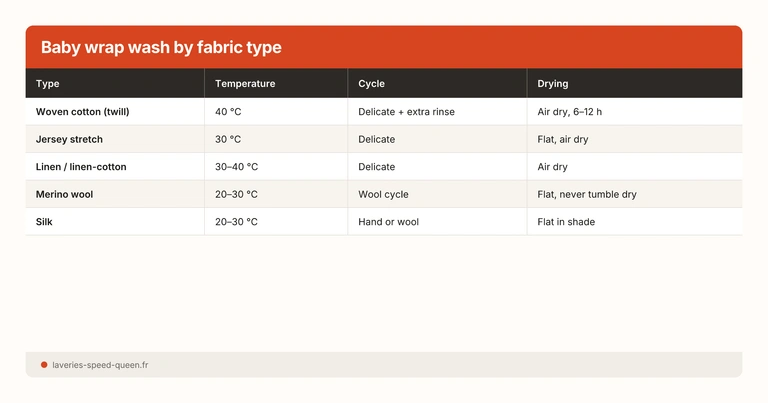
A baby carrier wrap is in direct contact with your baby’s skin for hours — face, hands, body. It accumulates sweat, spit-up and dust. Woven cotton: 40 °C on a delicate cycle. Stretch jersey: 30 °C on a delicate cycle. In both cases: mild fragrance-free detergent, no fabric softener (it makes the fabric slippery and irritates skin), extra rinse, air dry. Wash once a month with normal use, more often after staining. And above all: always wash a new wrap before the first use.
At a Glance
Woven cotton: 40 °C, delicate programme — preserves the twill cross weave that gives the wrap its flexibility.
Stretch jersey: 30 °C, delicate programme — elastane degrades above 30 °C.
No fabric softener — reduces fabric grip (knots slip) and irritates baby's skin.
Air dry only — never tumble dry. Lay flat for jersey, line or flat for woven cotton.
First wash mandatory — remove manufacturing finishes before first contact with baby.
Why Proper Washing Is Essential
A baby carrier wrap is not just a clothing accessory. It is a textile that spends several hours a day in intimate contact with your baby’s skin — face pressed against the fabric, hands gripping, body enveloped. During carrying, baby sweats, sometimes spits up, and puts hands to mouth after touching the fabric.
The wrap therefore accumulates sweat from both bodies (parent and baby), dead skin cells, sebum, sunscreen or milk residue, environmental dust and allergens (pollen, dust mites). Without regular washing, it becomes a potential vector for skin irritation, especially for babies prone to eczema or sensitive skin.
The paradox of the baby carrier wrap: it must be perfectly clean (direct contact with baby’s skin), but it must not be washed too aggressively (the fabric must remain flexible, grippy and strong). Finding the right balance is the purpose of this guide.
The Different Types of Wraps and Their Fabrics
Before washing, you need to identify the wrap type. Washing protocols differ significantly.
Woven Wrap (Cotton Twill Cross)
This is the most common and most versatile type. The fabric is a twill cross weave — a diagonal weave that allows the fabric to stretch diagonally while remaining strong in the warp and weft directions. This weave is what allows carrying a baby from 3.5 to 15 kg without deformation.
Woven cotton is relatively resilient to washing: it handles 40 °C without issue, does not deform in the machine and dries well in the air. It also softens over time — each wash and each carry contributes to “breaking in” the fabric.
Stretch Jersey Wrap
Thinner, more stretchy, the jersey wrap is often recommended for newborns. It typically contains a cotton-elastane blend (95/5 or 97/3). The elastane provides the stretch.
The problem: elastane is heat sensitive. Above 30 °C, the elastane fibres begin to degrade — the wrap gradually loses its stretch and no longer returns to its original shape. This is why washing at 30 °C maximum is imperative.
Linen or Linen-Cotton Blend Wrap
Less common, linen wraps are valued in summer for their coolness. Linen is strong but creases easily. It washes at 30-40 °C on a delicate programme. Linen tends to become softer and more supple with successive washes — this is an advantage.
Merino Wool or Silk Wrap
These premium wraps require hand washing or a wool programme at 20-30 °C. See our guide on washing wool without shrinking for specific precautions. Wool felts from 30-40 °C with agitation.
| Wrap type | Temperature | Programme | Max spin | Drying |
|---|---|---|---|---|
| Woven cotton (twill) | 40 °C | Delicate | 800 rpm | Air dry (line or flat) |
| Stretch jersey (cotton-elastane) | 30 °C | Delicate | 600 rpm | Air dry flat only |
| Linen or linen-cotton | 30-40 °C | Delicate | 800 rpm | Air dry (line or flat) |
| Merino wool | 20-30 °C | Wool | 400 rpm | Flat on towel |
| Silk or silk-cotton | 30 °C | Delicate / hand | 400 rpm | Flat in shade |
The First Wash: Mandatory Before Use
Every new baby carrier wrap must be washed before the first carry. This is not optional — it is a matter of health for your baby and functionality for the wrap.
Why the First Wash Is Necessary
New wraps contain manufacturing finishes — chemicals applied during production to give the fabric its stiffness and “new” appearance in the shop. These residues include stiffening agents, unfixed dyes, and sometimes residual formaldehyde used as a preservative during transport.
On an adult garment, these residues are a minor inconvenience. On a wrap in contact with a baby’s face for hours, they are a risk of skin and respiratory irritation. ANSES classifies formaldehyde as a skin and respiratory irritant (lien externe).
The First Wash Softens the Fabric
Beyond hygiene, the first wash has a major functional benefit: it softens the fabric. A new woven cotton wrap is stiff — difficult to tie, the folds do not form easily, the fabric does not “flow” through the hands. After the first wash, the weave begins to relax and tying comfort improves considerably.
Some experienced babywearers even do two consecutive washes before first use to accelerate the breaking-in. This is particularly useful for thick cotton wraps (grammage above 250 g/m2).
First Wash Protocol
Remove packaging and labels
Remove all ties, swing tags and plastic packaging. Leave the composition label sewn into the fabric — it is essential for future washes.
Wash alone at 40 °C
Wash the wrap alone (or with laundry of the same colour) at 40 °C on a delicate programme. The first wash releases excess dyes — do not mix with white or light-coloured laundry.
Extra rinse
Activate the extra rinse to remove as many finish residues and detergent traces as possible. The wrap will touch baby's face.
Air dry
Lay flat for jersey, on a line for woven cotton. Never tumble dry. Iron on medium if the fabric is too creased — ironing also contributes to softening.
Temperature and Programme: The Rules by Fabric
Woven Cotton: 40 °C, Delicate Programme
Woven cotton in twill cross is the most tolerant fabric. It handles 40 °C well without risk of deformation or significant shrinkage (3-5% maximum at the first wash, negligible thereafter).
The delicate programme is recommended over the standard cotton programme: the reduced agitation preserves the diagonal weave structure that is the key to the wrap’s strength and flexibility. A standard cotton programme with vigorous agitation can weaken the warp threads of the twill over time.
Spin: 800 rpm maximum. Too vigorous a spin compresses the weave and can create permanent creases in thick wraps.
Stretch Jersey: 30 °C, Mesh Laundry Bag
The jersey wrap requires more care. The presence of elastane (3-5% of the fabric) imposes a maximum temperature of 30 °C. Above this, the elastic fibres gradually denature — the wrap loses its stretch and can no longer support baby correctly.
- Never above 30 °C for stretch jersey — elastane degrades irreversibly above this temperature. The wrap loses its elasticity and can no longer support baby correctly.
- Mesh laundry bag mandatory — stretchy jersey wraps easily around other clothes in the machine, creating tangles that deform the fabric.
- Spin limited to 600 rpm — too powerful a spin stretches the jersey irreversibly, especially along its length.
Linen and Blends: 30-40 °C
Pure linen or linen-cotton blends wash at 30-40 °C on a delicate programme. Linen tends to crease more than cotton — a steam iron after drying is often needed to get a smooth, pleasant fabric for tying.
Linen has an advantage: it softens progressively with washes. A new linen wrap may feel stiff and rough; after 5-10 washes, it becomes remarkably soft and comfortable. This breaking-in is slower than with woven cotton.
Detergent and Fabric Softener: The Essential Rules
Mild Fragrance-Free Detergent
The carrier wrap is in direct contact with baby’s face during carrying — nose, mouth, cheeks. Detergent residues are therefore inhaled and in contact with mucous membranes, not just skin.
Detergent choice follows the same criteria as for all baby laundry.
- Fragrance-free: synthetic fragrances are recognised contact allergens. In prolonged contact with nasal mucous membranes, they increase the risk of respiratory irritation.
- Dye-free: no benefit, risk of irritation.
- Free from MIT/MCIT preservatives: these preservatives (methylisothiazolinone, methylchloroisothiazolinone) are the leading contact allergens in Europe.
- Reduced dosing: dose at the manufacturer’s recommendation or slightly below. The wrap is a long textile (4-5 metres for a woven wrap) — sufficient water is needed to rinse the full length.
Marseille soap↗ flakes (2 tablespoons for a 7 kg machine) are an excellent option — naturally hypoallergenic and leave no irritating residues. See our Marseille soap for laundry guide.
Why Fabric Softener Is Banned on Carrier Wraps
Fabric softener is strongly advised against for carrier wraps, and not just for hygiene reasons. Three reasons.
1. Fabric grip decreases. Fabric softener deposits a film of cationic surfactants on the fibres. This film makes the fabric softer to the touch, but also more slippery. Yet fabric grip is what allows the wrap’s knots to hold under baby’s weight. A softened wrap slips more easily — knots loosen, tightening loses precision, carrying is less secure.
2. Baby’s skin is irritated. The chemical film from softener is in prolonged contact with baby’s skin. Cationic surfactants are recognised skin irritants, and softener fragrances are contact allergens.
3. Absorption decreases. The softener film reduces cotton’s absorption capacity. The wrap absorbs less sweat — baby and parent sweat more during carrying.
Safe alternative: 2 tablespoons of white vinegar in the softener compartment. White vinegar softens fibres without leaving any chemical residue, does not reduce fabric grip, and evaporates completely during drying.
Washing Frequency
The washing frequency of a carrier wrap depends on intensity of use and conditions.
| Situation | Recommended frequency |
|---|---|
| Daily carrying (1-2 h/day), no stains | Once a month |
| Intensive carrying (3+ h/day) | Every 2-3 weeks |
| After spit-up or stain | As soon as possible |
| Summer / hot weather (sweating) | Every 2 weeks |
| During illness (stomach bug, cold) | After each episode at 40 °C |
| Occasional use (1-2 times/week) | Every 4-6 weeks |
Tip between washes: air the wrap out after each carry. Drape it over a chair back or drying rack overnight — natural airing removes much of the moisture and light odours. This is the best way to space out washes without compromising hygiene.
Stain Removal: Common Situations
Spit-Up and Milk
Spit-up is the most frequent source of stains on carrier wraps. Milk casein (breast or formula) coagulates with heat. The absolute rule: cold water first.
- Rinse the area immediately under cold running water.
- Rub with Marseille soap.
- Leave for 10-15 minutes.
- Wash the full wrap in the machine following the fabric protocol.
For dried stains, soak the area in warm water with a teaspoon of sodium percarbonate for 30 minutes before washing.
Sweat and Odours
The wrap absorbs sweat from the parent (chest, shoulders, back) and baby. Sweat stains are often invisible but create a rancid odour over time. If the wrap smells of sweat despite normal washing, soak for 2 hours in a baking soda solution (2 tablespoons per litre of warm water) before washing.
Food Stains (Puree, Baby Food)
When baby starts weaning, puree and baby food stains become common. Scrape off the excess with the back of a spoon, rinse in cold water, then treat with Marseille soap before machine washing.
Dyed wraps
Some artisan wraps are hand-dyed (shibori, tie-dye, plant dyes). These wraps require washing at 30 °C maximum with an enzyme-free detergent — enzymes degrade natural dyes. White vinegar in the rinse helps fix colours. Check the specific manufacturer’s recommendations for artisan dyes.
Drying: Air Dry Only
Drying a carrier wrap is a critical step. The tumble dryer is banned for all wrap types, without exception.
Why No Tumble Dryer
- Woven cotton: the heat contracts the warp threads of the twill. The diagonal weave loses its flexibility, the wrap becomes stiffer and harder to tie. Shrinkage can reach 10-15% (versus 3-5% with air drying).
- Stretch jersey: the heat degrades the elastane. The wrap permanently loses its stretch — it no longer supports baby correctly.
- Linen: linen handles tumble dryer heat poorly. The fibres become brittle and rough.
How to Dry Correctly
Woven cotton: hang on a washing line or lay flat on a drying rack. The washing line is fine because woven cotton is structurally strong — the weight of water does not deform the weave. Avoid prolonged direct sunlight (gradual colour fading). Allow 6-12 hours depending on season and fabric thickness.
Stretch jersey: dry flat only. The weight of the water stretches the jersey vertically if the wrap is hung on a line. Spread on a drying rack or clean towel, turning after 3-4 hours. Allow 4-8 hours.
Linen: dry on a line or flat. Linen dries relatively quickly. Iron with steam while the fabric is still slightly damp — dry ironing is less effective on linen.
Ironing After Drying
Ironing a carrier wrap is optional but beneficial. It softens the fabric, removes false creases and makes tying easier. Medium iron (150 °C) for cotton, hot steam iron for linen, low iron (110 °C) for jersey. Never iron a wool or silk wrap — use a fabric steamer at a distance.
Common Mistakes to Avoid
- Washing a new wrap above 40 °C — first-wash shrinkage will be excessive. The first wash must respect 40 °C for cotton, 30 °C for jersey.
- Using fabric softener — the wrap slips, knots come undone, baby's skin is irritated. White vinegar is the only safe alternative.
- Tumble drying — shrinkage, loss of elasticity (jersey), increased stiffness (cotton). Air drying is the only option.
- Ignoring milk stains — milk set by heat or time becomes nearly impossible to remove. Rinse immediately in cold water.
- Washing too often — weekly washing is excessive for daily 1-2 hour carrying. Air out between carries and wash monthly unless stained.
When to Replace the Carrier Wrap
A well-maintained carrier wrap lasts several years and can serve multiple children. But it has a limited lifespan.
- Pulled or frayed threads: a pulled thread on a woven wrap does not immediately compromise safety, but if they multiply, the weave weakens. Replace if pulled threads are numerous or on tension zones (shoulders, knots).
- Loss of elasticity (jersey): a jersey wrap that no longer returns to its original shape after stretching has lost its elastane. It no longer supports baby correctly — replace it.
- Recurring mould stains: a wrap stored damp can develop mould. If stains return despite washing, spores are established in the fabric. Replace.
- Persistent odour despite washing: a sign that the fibres are saturated with organic residue. Try a final sodium percarbonate soak. If the odour persists, replace.
As an Amazon Associate, we earn a small commission on purchases made through the affiliate links in this article — at no extra cost to you. This helps us keep this site running and produce free guides.
Need to wash the carrier wrap and all the baby laundry at the same time? Our laundromats in Blagnac, Croix-Daurade and Montaudran have 9 to 18 kg machines with detergent included and professional rinsing. Ideal for a deep clean without residue. Payment by contactless card or cash. View our prices.