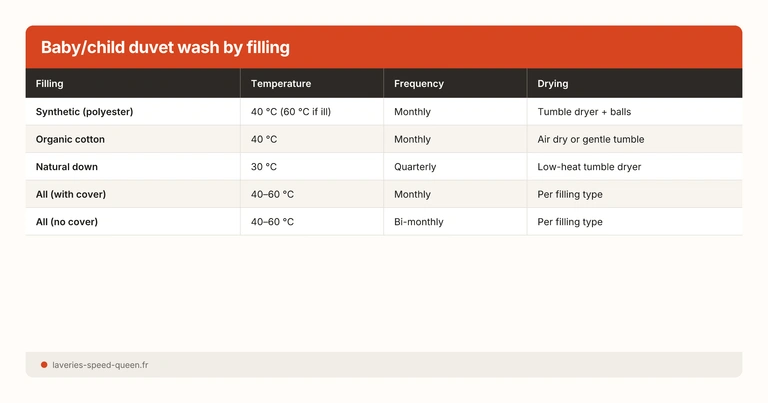
A baby or child’s duvet is in contact with their skin for 10 to 12 hours every night. It accumulates sweat, dead skin cells, dust mites and sometimes soiling (spit-up, bedwetting). Wash it once a month at 40 °C on a delicate programme (60 °C during illness or allergy flare-ups). Use fragrance-free detergent, skip the fabric softener, and always run an extra rinse. Dry completely in the tumble dryer with tennis balls. Baby duvets (75x120 cm) fit in a 7 kg domestic machine — larger sizes need a 9 kg machine at a laundromat.
At a Glance
40 °C on a delicate programme — routine maintenance. 60 °C for disinfection (illness, dust mites).
Monthly wash — with a duvet cover. Fortnightly without. Immediately if soiled.
Fragrance-free detergent, no softener — the filling retains residue longer than a sheet.
Complete drying is mandatory — damp filling means mould within hours. Check the centre.
7-8 kg machine for a child duvet — 9 kg minimum for 140x200 cm sizes.
Why Regular Washing Is Essential
A child spends on average 10 to 12 hours per night under their duvet. During that time, their body produces sweat (children sweat more than adults during sleep), sheds dead skin cells and sebum, and creates a warm, humid environment that is the perfect breeding ground for dust mites.
Dust mites feed on skin flakes and thrive at 20-25 °C with 60-80% humidity — exactly the conditions inside a duvet during sleep. A duvet left unwashed for 3 months can harbour hundreds of thousands of dust mites and their droppings, which are the primary source of household allergens.
For children with dust mite allergies, regular duvet washing is a recognised therapeutic measure — allergists recommend monthly washing at 60 °C minimum to significantly reduce the allergen load.
Beyond dust mites, the duvet also accumulates bacteria from sweat and saliva, cream residue (moisturiser, sunscreen, eczema treatment) and environmental dust. Regular washing keeps the textile clean and preserves a healthy sleep environment for your child.
Synthetic vs Natural: Which Filling for Children
The filling type determines both the washing protocol and the anti-allergen performance of the duvet.
Synthetic (Polyester): The Recommended Choice
Synthetic polyester fibre duvets account for 85-90% of children’s duvets sold, and for good reason.
Advantages of synthetic
Naturally hypoallergenic (non-organic fibres provide no food for dust mites). Washable at 60 °C without risk. Fast drying. Affordable (15-40 EUR). Lightweight and easy to handle.
Limitations of synthetic
Less breathable than down or cotton. Shorter lifespan (3-5 years vs 5-10 years for down). The filling flattens faster with repeated washing. Retains odours more than natural fibres.
Synthetic is the best choice for allergic children: it washes at 60 °C (the temperature that kills dust mites), dries in 45-60 minutes in the tumble dryer, and does not retain moisture. A monthly wash at 60 °C keeps the allergen level very low.
Organic Cotton Duvet
Organic cotton duvets are popular for their breathability and natural feel. They wash at 40-60 °C but dry more slowly than synthetic (cotton absorbs more water). Organic cotton is hypoallergenic but, being a natural fibre, it can support mould growth if not dried properly.
Natural Down Duvet
Down duvets are rare for babies and young children but exist in premium ranges. Down offers an excellent warmth-to-weight ratio but comes with washing constraints.
- Temperature limited to 30-40 °C — above this, the keratin in the feathers degrades.
- Special down detergent required — enzymes in standard detergents attack the feathers.
- Very long drying time — 90-120 minutes in the tumble dryer, with tennis balls essential.
- High mould risk if drying is incomplete.
For a full guide on washing down duvets, see our dedicated article: washing a feather duvet.
| Criterion | Synthetic (polyester) | Organic cotton | Natural down |
|---|---|---|---|
| Max wash temperature | 60 °C (standard) | 40-60 °C | 30-40 °C |
| Anti-allergen | Excellent | Good | Moderate |
| Drying time (tumble dryer) | 45-60 min | 60-90 min | 90-120 min |
| Lifespan | 3-5 years | 4-6 years | 5-10 years |
| Average price | 15-40 EUR | 30-60 EUR | 60-120 EUR |
Temperature and Programme by Situation
40 °C: Routine Maintenance
For regular washes of a duvet without visible soiling, 40 °C on a delicate programme is the right choice. This temperature effectively removes sweat, sebum and dead skin without prematurely wearing out the filling.
The delicate or synthetics programme is recommended: the gentle agitation preserves the distribution of filling within the duvet compartments. A standard cotton programme can cause the filling to migrate toward the edges, creating cold spots in the centre.
60 °C: Disinfection
Switch to 60 °C in the following situations.
- Illness (gastroenteritis, flu, bronchiolitis): 60 °C eliminates viruses and pathogenic bacteria.
- Dust mite allergy: 60 °C kills dust mites and denatures their allergens. Monthly washing at this temperature is recommended by allergists.
- Bedwetting: urine requires a high-temperature wash to eliminate bacteria and odours.
- Vomiting: same rationale as illness — disinfection takes priority.
- Check the label before washing at 60 °C — most synthetic children's duvets can handle it, but some models with special treatments (stain-resistant, water-repellent) are limited to 40 °C.
- Natural down: never above 40 °C — the feathers break and lose their loft. To disinfect a down duvet, use the freezer (24 h in an airtight bag) alongside a 30-40 °C wash.
- Do not wash at 90 °C — unless the label specifically says so. 90 °C prematurely destroys the filling of any duvet, regardless of composition.
The Machine Capacity Question
Baby Duvet (75x120 cm, 60x120 cm)
Baby duvets are small and light (300-500 g). They fit perfectly in a 5-7 kg domestic machine. The drum provides enough space for the duvet to move freely and for water to circulate through the filling.
Toddler Duvet (100x140 cm)
The standard size for toddler beds (70x140 cm). Weight: 500-800 g. A 7-8 kg machine is sufficient. The duvet occupies about 60-70% of the drum, leaving enough room for effective washing and rinsing.
Older Child Duvet (140x200 cm)
For 90x190 or 90x200 cm beds. Weight: 800-1,200 g, but 30-50 litres of volume when wet. A domestic 7-8 kg machine (52-58 litre drum) is borderline. The duvet gets compressed, water circulates poorly, rinsing is incomplete.
For this size, a 9 kg machine minimum is recommended. At a laundromat, 9-11 kg machines offer an 80-110 litre drum — enough for the duvet to move freely. See our complete guide to washing a duvet in the machine.
It's about volume, not weight
Machine capacity is measured in kilograms, but the limiting factor for duvets is volume, not weight. A child’s duvet weighing 800 g is well below the 7 kg capacity, but it takes up considerable space in the drum. If the duvet fills more than 80% of the drum, the wash will be poor — switch to a larger machine.
Washing Frequency by Age and Situation
| Situation | With duvet cover | Without duvet cover |
|---|---|---|
| Normal use (3-10 years) | Once a month | Every 2 weeks |
| Baby (18 months-3 years) | Once a month | Every 2 weeks |
| Allergic child (dust mites) | Once a month at 60 °C | Every 2 weeks at 60 °C |
| During illness | Immediately at 60 °C | Immediately at 60 °C |
| Bedwetting | As soon as it happens at 60 °C | As soon as it happens at 60 °C |
| Summer / hot weather | Every 2-3 weeks | Every week |
Practical tip: have two duvets in rotation. While one is being washed and dried (allow at least half a day), the other is ready for bedtime. This is especially important during bedwetting or illness, when washes become more frequent.
The duvet cover acts as a protective barrier between the child and the filling. It captures the majority of sweat and skin flakes. Wash the cover weekly — it is much easier than washing the whole duvet. A clean cover lets you space out duvet washes to once a month.
Detergent and Products: The Rules for Children
Hypoallergenic Fragrance-Free Detergent
The same criteria as for all baby laundry apply to the duvet.
- Fragrance-free: synthetic fragrances are contact allergens. In prolonged contact with the body during sleep, they increase the risk of irritation.
- Free from MIT/MCIT preservatives: the leading contact allergens in Europe.
- Strict dosing: the thick filling of the duvet retains detergent residue. Overdosing creates a surfactant film in contact with skin for 10-12 hours every night.
Extra Rinse — Always
The extra rinse is not optional for children’s duvets. The filling, whether polyester wadding or cotton, acts as a sponge that holds on to detergent. A single standard rinse is not enough to flush out all the surfactants. The extra rinse uses 10-15 litres more water but ensures a residue-free filling.
No Fabric Softener
Fabric softener is banned for children’s duvets. It deposits a chemical film on the filling that irritates skin, reduces fabric breathability (the child sweats more), and can compromise the anti-dust-mite treatments on some duvets. White vinegar↗ (2 tablespoons in the softener compartment) is the only safe alternative.
Stain Removal for a Child’s Duvet
Bedwetting Stains
Urine is acidic and contains urea that converts to ammonia. The longer the stain dries, the more the odour sets in.
- Remove the duvet cover and sheets immediately.
- Rinse the area in cold water (hot water fixes the ammonia odour).
- Sprinkle with baking soda↗, leave for 30 minutes.
- Rub with Marseille soap↗.
- Wash the full duvet at 60 °C.
For mattresses, see our clean a mattress guide. For mattress protection, our article on washing a mattress protector covers best practices.
Spit-Up Stains (Baby)
Same principles as for milk stains: cold water first (heat coagulates proteins), Marseille soap, then machine wash.
Yellowed Sweat Stains
Yellow marks appear on light-coloured duvets, especially around the head and neck area. Treat with sodium percarbonate: soak for 1-2 hours in a solution of 1 tablespoon per litre of water at 40 °C, then machine wash. See our guide on sweat stains and yellow marks.
Drying: The Most Important Step
Drying a child’s duvet is the critical step — damp filling develops mould and bacteria within hours.
Tumble Dryer: The Recommended Method
The tumble dryer is the safest method for children’s duvets: it ensures uniform, rapid drying of the filling.
- Delicate programme (low heat) to preserve the filling.
- 2-3 clean tennis balls in the drum: they redistribute the filling by bouncing against the duvet. Without balls, the filling clumps into corners and seams.
- Check the centre after the cycle: press the filling firmly between your hands, especially in the thickest areas. If you feel the slightest coolness, run another 15 minutes of drying.
| Duvet type | Tumble dryer (delicate) | Air drying |
|---|---|---|
| Baby synthetic (75x120) | 30-45 min | 4-8 hours |
| Child synthetic (100x140) | 45-60 min | 8-12 hours |
| Child synthetic (140x200) | 60-90 min | 12-24 hours |
| Natural down (any size) | 90-120 min | 24-48 hours |
Air Drying: Precautions
If you do not have a tumble dryer, lay the duvet flat on a drying rack or several parallel washing lines. Do not hang it from a single edge — the weight of the water compresses the filling downwards.
Turn the duvet every 3-4 hours. Choose a sunny, windy day — sunlight has a mild antibacterial effect and wind speeds up evaporation. Indoors, ensure good ventilation (windows open or a fan). Air drying can take 12-24 hours for a child’s duvet — do not put it back on the bed until the centre is completely dry.
Never put a damp duvet back on the bed
Filling that is still damp inside a closed bed (room at 20 °C, sheets underneath) develops mould within 6-12 hours. Mould spores are a recognised respiratory allergen — they can trigger or worsen a child’s asthma. When in doubt, extend the drying time. One night with a spare duvet is better than a health risk.
Washing a Child’s Duvet at the Laundromat
For 140x200 cm duvets that do not fit in a domestic machine, the laundromat is the most practical and cost-effective solution.
The Advantage of Professional Drum Size
9 to 11 kg machines at the laundromat offer an 80-110 litre drum — 50 to 100% more than a 7 kg domestic machine. The duvet moves freely, water circulates through the entire filling, and rinsing is thorough. The result is significantly better than a wash in an undersized machine where the duvet is compressed.
The Advantage of a Professional Tumble Dryer
Laundromat tumble dryers are more powerful and larger than domestic models. The large-capacity drum lets the duvet spread out during drying — the filling dries more evenly and faster.
Maintenance Between Washes
- Air out the duvet for 15-30 minutes in the morning with the window open. Fresh air and lower humidity reduce dust mite populations.
- Shake the duvet daily to redistribute the filling and remove dust.
- Wash the cover weekly — it is the first barrier against allergens.
- Mattress protector: use an anti-dust-mite mattress protector for a complete barrier on the mattress side.
When to Replace a Child’s Duvet
- Filling has gone flat: the duvet no longer regains its volume after washing and drying. It no longer insulates against the cold.
- Recurring mould: stains keep returning despite washing. Spores are embedded in the filling.
- Persistent odour: despite 60 °C washes and percarbonate soaks, the smell remains.
- Wrong size: the child has grown — the duvet should overhang the bed by 20-30 cm on each side.
- After 50-80 washes: synthetic filling compresses irreversibly beyond this point.
As an Amazon Associate, we earn a small commission on purchases made through the affiliate links in this article — at no extra cost to you. This helps us keep this site running and produce free guides.
The child’s duvet won’t fit in your machine? Our laundromats in Blagnac, Croix-Daurade and Montaudran have 9 to 18 kg machines with detergent included, professional rinsing and high-capacity tumble dryers. Ideal for a complete wash and dry in under 2 hours. Payment by contactless card or cash. View our prices.