In short: beach towels should be washed at 40 °C on a cotton cycle (60 °C for musty smell). Rule number one: shake out the sand BEFORE the machine — otherwise sand damages the drum and clogs the filter. No fabric softener (it reduces absorption by 30-50%) — replace it with 100 ml of white vinegar in the rinse cycle to keep them fluffy. Rinse in fresh water after the sea to remove salt.
At a Glance
Shake out the sand outdoors — twice: when leaving the beach, then before the machine. Sand scratches the door glass and clogs the filter.
Rinse in fresh water if the towel touched seawater. Salt crystallizes in the fibers and stiffens them.
40 °C cotton cycle — 60 °C only for musty smell. Microfiber: 30-40 °C maximum.
Zero fabric softener — it deposits a greasy film that reduces absorption. Replace with 100 ml of white vinegar in the rinse cycle.
Wash after every use — sweat, sunscreen, salt and bacteria build up fast in the humidity.
Why Beach Towels Need Special Treatment
Beach towels are not regular bath towels. They face three aggressions that indoor towels never encounter: sand, sea salt and sunscreen. These three elements change the fabric’s behavior and require an adapted washing approach.
Sand is a mineral abrasive. Its grains, even fine ones, are made of silica — the same material as glass. Introduced into a washing machine, it scratches the inside of the door glass, gets into the door seal, settles in the drain filter and can damage the pump. Over time, residual sand in the drum also scratches other clothes washed after the towel.
Sea salt (sodium chloride, at approx. 35 g/L in seawater) crystallizes as it dries within the fabric fibers. These crystals make the towel rough, stiff and brittle. Salt also attracts ambient moisture (it is hygroscopic), which explains why a beach towel air-dried without pre-rinsing always feels slightly damp and smells musty.
Sunscreen is an oily emulsion that penetrates deep into cotton fibers. Chemical UV filters (oxybenzone, octocrylene) and mineral oils leave greasy residues that yellow over time and reduce the fabric’s absorption capacity. A standard 30 °C wash is not always enough to remove them — hence the recommendation of 40 °C minimum.
Step 1: Shake Out the Sand — The Non-Negotiable Rule
This is the first thing to do, and also the most commonly skipped. The instinct is to stuff the towel in the beach bag, bring it home and throw it straight in the machine. That is exactly what you should not do.
At the Beach (First Shake)
Shake the towel vigorously before folding it. Dry sand comes off easily — wet sand sticks to fibers and becomes much harder to remove once compacted by folding. If the towel is wet, let it dry for a few minutes in the sun before shaking: the sand will release much better.
Before the Machine (Second Shake)
At home, shake the towel again outdoors (balcony, garden, window). Even if you shook it at the beach, there is always sand trapped in the terry cotton loops. Visually check that no visible grains remain, especially in the hems and corners.
Sand and your machine: a towel with residual sand may seem harmless, but silica grains are harder than the door glass. They also settle in the drain filter and can cause pump blockage. Clean the filter after washing beach towels if you suspect residual sand.
Tip: The Mesh Bag
For families returning from the beach with 4 or 5 sandy towels, a mesh bag (laundry bag style) is a practical solution. Place the towels in the bag at the beach. When you get home, shake the whole bag — the sand falls through the mesh without you having to handle each towel individually.
Step 2: Rinse Salt in Fresh Water
If the towels were in contact with seawater (even indirectly, for example laid on sand dampened by waves), a fresh water rinse is necessary before machine washing.
Sea salt does not fully disappear in the machine wash — it dissolves, yes, but some redeposits on the fibers during the cycle if the concentration is high. Pre-rinsing removes the bulk of the salt and avoids this problem.
How to Rinse
Run each towel under the outdoor shower (if you are at a campsite or holiday rental), under the garden hose, or simply under the shower at home. A 30-second rinse per towel is enough. The goal is not to wash, but to dissolve and flush out the salt crystals before the machine cycle begins.
If you are on holiday and the wash is not immediate, rinse in fresh water anyway and let them dry. The towel will be stiff (residual salt traces), but the worst will be gone and the next machine wash will be more effective.
Step 3: Machine Wash — Exact Settings
Cycle and Temperature
Use the cotton cycle at 40 °C. Beach towels made of terry cotton are robust textiles that handle the normal agitation of a cotton cycle. Unlike delicate fabrics that require a dedicated cycle, terry towels need sufficient agitation for water to penetrate deep into the loops and dislodge sunscreen, residual salt and bacteria.
40 °C is the standard temperature. It is enough to remove sweat, body oils, sunscreen and common bacteria. Go up to 60 °C in two cases:
- The towel has a musty smell (mildew developed after staying damp in a bag for too long).
- The towel has not been washed for more than a week after use (advanced bacterial growth).
To understand the impact of each temperature level, check our washing temperatures guide.
Detergent
Use a standard detergent (liquid or powder). For towels, powder is even preferable to liquid: the oxygen-based bleaching agents it contains help dislodge sunscreen residues and maintain brightness on white towels.
The dosage should match the load: beach towels are bulky and absorb a lot of water, which dilutes the detergent. Follow the “full load” dosage even if you only put in 3 or 4 towels — their volume fills the drum.
Fabric Softener: The Answer Is No
This is the most important point for towel care, whether beach or bath. Fabric softener is the enemy of terry towels.
Fabric softener works by depositing cationic surfactants (positively charged surfactants) on the fabric fibers. This deposit makes the fabric feel softer — but it also forms a waterproofing film that prevents the cotton loops from absorbing water. After 5 to 10 washes with softener, a terry towel loses 30 to 50% of its absorption capacity.
The result: a towel that feels soft but spreads water instead of absorbing it. That is exactly the opposite of what you want from a beach towel.
The alternative: white vinegar↗. Pour 100 ml of white vinegar into the rinse compartment of your machine. White vinegar (8% acetic acid) dissolves detergent and limescale residues deposited on the fibers, restoring softness and fluffiness without waterproofing them. The vinegar smell disappears completely during drying.
Spin Speed
1000-1200 rpm — terry towels are robust textiles that handle standard spin speeds. Good spinning reduces drying time, which is particularly useful when you are on holiday and drying happens on a clothesline.
Do Not Overload the Drum
Beach towels are bulky. Three to four large terry towels fill a 7-8 kg drum. If the drum is too full, water and detergent do not circulate properly between the layers of fabric — the towels in the center remain partially dirty.
For XL towels or family loads (5+ towels), large-capacity laundromat machines are the solution. Our 10 to 18 kg machines let you wash all the family’s towels in a single cycle, with enough space for water to circulate effectively.
Terry Cotton vs Microfiber: Two Fabrics, Two Approaches
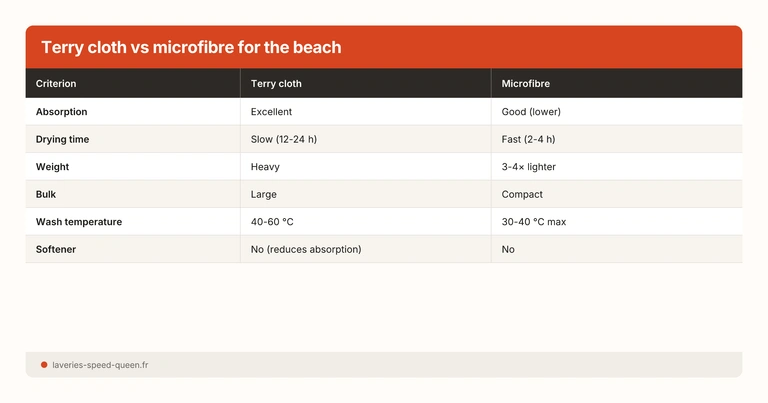
Terry cotton
The classic. Looped surface that absorbs 5 to 7 times its weight in water. Very soft to the touch, comfortable for lying on. Downside: heavy (500-800 g), dries slowly (6-12 h outdoors), bulky in a bag. Washing: 40-60 °C cotton cycle, tumble dryer OK.
Microfiber
Ultra-lightweight (150-300 g) and compact (folds into a pouch). Dries 3 times faster than cotton. Absorbs 3 to 4 times its weight in water (less than cotton). Less pleasant feel (slightly 'plastic'). Washing: 30-40 °C delicate cycle, no tumble dryer.
Wash temperature
Terry cotton: 40 °C standard, 60 °C for odor. Handles heat well. Microfiber: 30-40 °C maximum. Above that, heat deforms the ultra-fine synthetic fibers (polyester/polyamide) and reduces the quick-dry performance.
Fabric softener
Banned for both. On terry cotton, it reduces absorption. On microfiber, it clogs the microscopic gaps between fibers that enable capillary action. Same alternative for both: white vinegar in the rinse cycle.
The Cotton-Polyester Blend
Some beach towels are a cotton-polyester blend (often 80/20 or 70/30). These towels combine some of cotton’s fluffiness with improved drying speed thanks to the polyester. They wash like pure cotton: 40 °C cotton cycle. The polyester does not significantly alter washing behavior at this ratio.
Drying: Sun, Air or Tumble Dryer
Drying is an important step for beach towels — poor drying is the number one cause of musty smell.
Sun Drying (The Best Option)
The sun offers a double advantage: it dries the towel and disinfects via UV rays that destroy some bacteria and mold on the surface. Hang towels fully spread out (not folded in half on the line) to maximize the exposed surface. Full sun drying takes 2 to 4 hours in summer.
Note: prolonged intense sun exposure (more than 6 hours) can fade the colors of colored towels. Remove them as soon as they are dry.
Tumble Drying
The tumble dryer is an excellent option for terry cotton towels. The drum rotation and moderate heat lift the loops of the cotton, restoring volume and fluffiness to the towel. Use the moderate heat setting (not high — excessive heat stiffens the fibers).
For microfiber, avoid the tumble dryer or use an air-only (no heat) cycle. Heat damages the ultra-fine synthetic fibers and reduces the quick-dry capability that makes microfiber worthwhile.
Avoid: Drying in a Pile
Never leave a damp beach towel balled up in a bag, basket or on the bathroom floor. Trapped moisture + ambient heat = bacterial growth and mildew within 4 to 6 hours. This is the number one cause of musty smell on beach towels.
If you cannot wash immediately, at least hang the towel so it can air-dry.
How to Keep Beach Towels Fluffy
Over repeated washes, terry towels become rough and stiff. This is not inevitable — it results from three correctable issues.
Limescale
Hard water (high in calcium) deposits calcium carbonate crystals between the cotton loops. These deposits stiffen the fibers. Solution: add 100 ml of white vinegar to the rinse compartment with every wash. The acetic acid dissolves limescale and makes fibers soft again.
Detergent Residues
Over-dosing detergent leaves unrinsed residues in the fibers, which stiffen them during drying. Follow the recommended dosage and do not hesitate to set a double rinse if your machine offers it.
Air Drying Without Movement
A towel dried motionless on a line, with no wind, will have flattened, stiff loops. The tumble dryer solves this (the rotation lifts the loops). Alternatively, shake the towel vigorously after spinning and before hanging — this separates the stuck loops and significantly improves the final result.
Regeneration Cycle (For Very Rough Towels)
If your towels are already stiff after months of softener or hard water:
- Soak the towels 4 hours in a basin with 200 ml of white vinegar per 5 liters of warm water.
- Wash at 60 °C with a half dose of detergent (baking soda in the drum can reinforce the action).
- Add another 100 ml of white vinegar to the rinse compartment.
- Tumble dry on moderate heat.
This treatment dissolves accumulated deposits and restores fluffiness in a single cycle. Repeat once per season if your water is very hard.
Washing Frequency
The rule is simple: after every beach use. Unlike a bath towel used in a clean environment (you just stepped out of the shower), a beach towel accumulates in a single use:
- Sweat — beach heat makes you perspire, even lying down.
- Sunscreen — oils, UV filters, fragrances.
- Sea salt — if in contact with the sea or sea spray.
- Sand — even after shaking, some remains.
- Bacteria — transferred from skin, sand and water.
Left damp in a bag between uses, this combination creates an ideal environment for bacterial growth. That is why the recommended washing frequency is stricter than for other household textiles.
For more on keeping fluffy towels every day, check our dedicated guide.
Removing Sunscreen Stains
Sunscreen is the most common stain on beach towels. UV filters (avobenzone, octocrylene) combined with the oils in the formula create yellow or orange marks that resist standard washing.
Pre-Wash Treatment
- Sprinkle baking soda↗ on the stain and leave for 30 minutes. Baking soda absorbs grease.
- Rub with damp Marseille soap↗ directly on the stain. Marseille soap (olive oil-based, no additives) is an excellent natural degreaser.
- Wash in the machine at 60 °C with a powder detergent containing oxygen-based bleaching agents.
Old Stains (Yellowed)
Yellowed, set-in sunscreen stains are very difficult to remove completely. Soak the towel for 12 hours in warm water with sodium percarbonate↗ (2 tablespoons per 5 liters). Sodium percarbonate releases active oxygen that breaks down organic residues without damaging the fabric.
Mistakes to Avoid
- Washing with sand in the machine — sand scratches the door glass, clogs the drain filter and can damage the pump. Always shake twice before washing.
- Not rinsing after the sea — salt crystallizes in the fibers and makes them rough and brittle. A 30-second fresh water rinse is all it takes.
- Using fabric softener — the deposited film reduces absorption by 30-50%. Use white vinegar in the rinse cycle instead.
- Leaving the towel damp in a ball — mildew within 4-6 hours. Hang up immediately, even without washing.
- Washing microfiber above 40 °C — heat deforms the ultra-fine fibers and cancels the quick-dry effect.
- Overloading the drum — 3-4 large terry towels = a full load (7-8 kg). Beyond that, the wash is ineffective.
Holiday Care: When No Machine Is Available
On holiday, machine washing is not always immediate. Here is how to manage towels between laundromat visits.
- Rinse in fresh water after every use (beach shower, garden hose) to remove salt and sand.
- Dry completely in the sun — a dry towel does not develop mildew.
- Do not fold until completely dry — moisture trapped in folds ferments.
- Accumulate dry towels and wash them all together as soon as a machine is available (laundromat, rental).
Laundromats are particularly useful on holiday: large-capacity machines let you wash a full week of beach towels in a single cycle, which is impossible in the small machine of a holiday rental.
As an Amazon Associate, we earn a small commission on purchases made through the affiliate links in this article — at no extra cost to you. This helps us maintain this site and produce free guides.
All the family’s beach towels in one load? Our laundromats offer 10 to 18 kg machines, ideal for large terry towel loads. Cotton cycle 40-60 °C, powerful spin. Payment by contactless card or cash. Check our prices.
Sources and References
- Washing temperatures — complete guide
- Fabric softener: useful or not?
- White vinegar for laundry: uses and limits
- Baking soda for laundry
- Detergent dosage guide
- How often to wash clothes
- Fluffy towels: how to keep them
- Clean the drain filter
- Absorption properties of terry cotton — loop structure and capillarity (textile engineering)
- Effect of cationic surfactants on cotton absorption — wettability studies (Journal of Surfactants and Detergents)