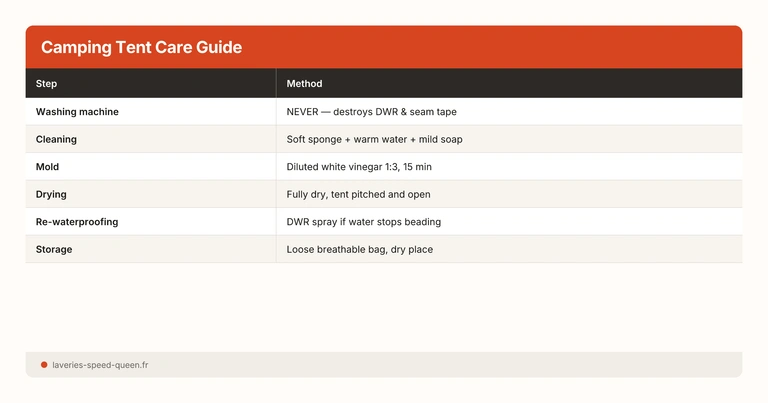
In short: a camping tent should never go in a washing machine — the drum destroys the waterproofing (DWR) and seam tape. Clean it while pitched, using a sponge and warm water with mild soap. Treat mold with diluted white vinegar. Dry completely before any storage. At the laundromat, wash your sleeping bags and camping clothes — not the tent.
At a Glance
NEVER in a washing machine — the drum friction strips off the waterproof coating and seam tape.
Soft sponge + warm water + mild soap — diluted Marseille soap or a specialized outdoor cleaner.
Mold = diluted white vinegar — 1 part vinegar to 3 parts water, leave for 15 min.
Complete drying is mandatory — this is the most important anti-mold measure.
Store in a loose bag — not in the compression sack. Cool and dry location.
Why a Washing Machine Destroys a Tent
A camping tent is not a simple piece of fabric. It is a technical assembly of multiple layers and treatments that make it waterproof and wind-resistant. Here is why the washing machine is incompatible with this structure.
The DWR Coating (Durable Water Repellent)
The fly and groundsheet of any quality tent are treated with a DWR coating — a chemical surface treatment that makes water bead up instead of soaking into the fabric. In a washing machine, the drum’s mechanical friction wears this coating off within about ten minutes. The tent comes out of the machine “clean” but permeable.
The Polyurethane (PU) or Silicone Lining
Beneath the outer fabric, a PU or silicone lining ensures waterproofing under heavy rain. This lining is a thin plastic layer bonded to the fabric. The machine’s mechanical agitation peels this lining off in patches, creating leak zones impossible to detect until the next rainfall.
Seam Tape
Every seam in the tent is covered by a heat-sealed adhesive tape that prevents water from passing through the needle holes. Machine washing peels off these tapes. Once detached, they do not re-stick — you would need to replace them by hand with an iron and new seam tape, a meticulous job that takes several hours.
Don't trust the forums
You sometimes read on outdoor forums that a “gentle cold cycle” is fine for a tent. This is false. Even a wool cycle at 20 °C with minimal spin involves mechanical agitation in the drum. Manufacturers (MSR, Hilleberg, Vaude, Decathlon/Quechua) all prohibit machine washing in their care instructions.
The Correct Cleaning: Step by Step
Equipment Needed
- Soft sponge (never the abrasive side)
- Mild soap without detergent: very diluted Marseille soap↗, or a specialized cleaner (Nikwax Tech Wash, Grangers Performance Wash)
- Soft-bristle brush (for seams and moldy areas)
- Garden hose (not a pressure washer)
- Large space to pitch and dry the tent
Step 1 — Pitch the Tent
Cleaning is done with the tent pitched and taut. This is the only way to access all surfaces without creating folds that trap water and soap. Set up the tent in the garden, on a terrace or in a garage if the weather does not cooperate. Open all vents for airflow.
Step 2 — Remove Debris
Remove dead leaves, dirt, sand and insects. Sand is particularly abrasive — it acts like sandpaper on the coating when you scrub. Shake the tent vigorously, sweep the interior floor with a small soft brush, and vacuum the seams with a handheld vacuum if needed.
Step 3 — Wash with Mild Soap
Prepare a bucket of warm water (25-30 °C) with a small amount of liquid Marseille soap or specialized outdoor cleaner. Dip the sponge, wring it lightly, and gently scrub the dirty areas.
The fly (exterior)
Clean from top to bottom. Focus on the lower areas that were in contact with mud, tree resin or bird droppings. Scrub in the direction of the fabric weave, not in circles.
The groundsheet
The dirtiest area. The groundsheet accumulates dirt, sand, spilled food and moisture. Scrub with a bit more vigor than the fly — the groundsheet is designed to resist abrasion.
The mesh panels
The fine mesh of mosquito netting traps dust and pollen. Rinse thoroughly with clean water. Do not scrub — the fabric is delicate and tears easily.
Seams and zippers
Seams accumulate dirt in their folds. Use a soft-bristle brush (toothbrush type) to clean along the seams. Check the condition of the seam tape while you are at it.
Step 4 — Rinse Thoroughly
Rinsing is just as important as washing. Soap residue left on the fabric degrades the DWR coating over time. Rinse the tent with a garden hose (normal pressure, not a concentrated jet) going over each panel. Let the water flow top to bottom.
Step 5 — Dry Completely
This is the most important step of the entire process. A tent stored while still damp will develop mold within days, with a musty smell that is nearly impossible to eliminate and permanent black stains on the fabric.
Leave the tent pitched and open until completely dry — interior AND exterior. In dry weather, allow 2 to 4 hours. In overcast conditions, a full day may be needed. Check by running your hand over the fabric: if it feels cool to the touch, it is still damp.
Drying after camping in the rain
If you must take down your tent in the rain (morning departure, no choice), pack it wet in its bag but unfold it and dry it as soon as possible — ideally within 24 hours. After 48 hours folded and damp, mold starts growing.
Treating Mold on a Tent
Mold is the number one problem with poorly stored tents. It manifests as black or gray spots, a musty smell, and in advanced cases, degradation of the fabric itself.
Identify the Type of Mold
Surface mold (black or gray spots): visible but has not yet penetrated the fibers. Effectively treated with white vinegar↗.
Deep mold (spots + persistent smell + weakened fabric): the fungal hyphae have penetrated the fibers. Treatment can remove the visible stains but the smell and weakening are often irreversible.
The White Vinegar Protocol
- Prepare a mix of 1 part white vinegar to 3 parts warm water.
- Apply to the moldy areas with a sponge or spray bottle.
- Leave for 15 to 20 minutes.
- Gently scrub with a soft-bristle brush.
- Rinse thoroughly with a garden hose.
- Dry completely.
For stubborn mold, increase the concentration (neat vinegar on the stain). The acetic acid in vinegar kills most common household mold species and breaks down the black pigments. The vinegar smell disappears completely when dry.
Is tent mold dangerous?
Common tent molds (Aspergillus, Cladosporium, Penicillium) are not dangerous for a healthy person. However, sleeping in a heavily moldy tent can irritate the airways and trigger allergic reactions in sensitive individuals. If mold covers more than 20% of the surface, consider replacing the tent.
Re-Waterproofing After Cleaning
Cleaning, even gentle cleaning, gradually wears down the DWR treatment. If water no longer beads on the fly (it soaks into the fabric instead of forming droplets), it is time to re-waterproof.
Simple Beading Test
Spray water on the fly. If the water forms beads that roll off, the DWR is functional. If the water spreads and wets the fabric (wetting out), the DWR is worn.
Applying Waterproofing Spray
- The tent must be clean and completely dry.
- Pitch the tent and tighten it.
- Apply the spray (Nikwax Tent & Gear SolarProof, Grangers Tent + Gear Repel, or equivalent) in a uniform layer on the fly and groundsheet.
- Let dry for 24 hours before use or storage.
- The waterproofing typically lasts 10 to 20 camping nights, depending on rain intensity.
| Product | Type | Application | Durability |
|---|---|---|---|
| Nikwax Tent & Gear SolarProof | Pump spray | Pitched tent, uniform spray | 10-20 nights |
| Grangers Tent + Gear Repel | Aerosol spray | Pitched tent, 25 cm distance | 10-15 nights |
| Gear Aid Seam Grip | Seam sealant gel | Fine brush along seams | 20-30 nights |
Seam Maintenance (Seam Sealing)
Seam tape naturally peels over time due to UV, and folding/unfolding cycles. Check its condition at every cleaning.
If tape peels off:
- Carefully remove the detached tape.
- Clean the seam with a cloth dampened with isopropyl alcohol (to degrease).
- Apply a seam sealant product (Gear Aid Seam Grip WP or equivalent) along the seam.
- Let dry for 8 to 12 hours before folding the tent.
This maintenance work adds years of life to a tent. Unsealed seams are the leading source of leaks — well before fabric wear itself.
Between-Season Storage
Storage is the most neglected aspect of tent care, yet it is the factor that most determines lifespan.
Loose storage bag
NEVER store your tent in its compression stuff sack. That sack creates permanent creases that weaken the PU coating. Use a large cotton bag, a mattress cover or an old knotted bedsheet. The tent should be loosely folded, not compressed.
Cool and dry location
Store in an indoor closet — not the garage (humidity), the attic (summer heat accelerates PU hydrolysis) or the cellar (humidity). Ideal: 15-20 °C, relative humidity < 60%.
Different fold each time
Do not fold the tent the same way every time. Repeated creases in the same spot weaken the PU coating and create leak lines. Vary the fold direction with each storage.
Poles stored separately
Store poles flat, relaxed, not folded in their compact bag. The internal elastic cord under constant tension loses its elasticity. Poles force-bent for months develop a 'memory crease' that weakens them.
What You Can Wash at the Laundromat After Camping
The tent itself is banned from the machine, but the rest of your camping gear washes perfectly well at a laundromat.
Sleeping bag
Front-load 18 kg machine required, 30 °C, delicate cycle. Down-specific detergent if it is feather-filled. Dry with dryer balls. Check our complete sleeping bag guide.
Hiking clothes
Technical garments (Gore-Tex, softshell) wash at 30 °C without fabric softener. For sportswear, use a delicate cycle. Ski gear: same protocol.
Washable hiking shoes
Canvas/mesh shoes go in the machine at 30 °C in a laundry bag. Leather shoes are hand-cleaned only. See our guide on washing shoes.
Lifespan and Replacement
A well-maintained tent lasts between 5 and 15 years depending on quality and usage frequency. Here are the signs it is time to replace rather than clean:
- The PU coating is sticky (tacky feel on the inside of the fly): advanced hydrolysis, irreversible.
- Multiple leaks despite recent re-waterproofing: the fabric is porous, the treatment no longer holds.
- Persistent musty smell after vinegar cleaning: fungal hyphae have degraded the fibers deep down.
- Fabric tears easily when pulled: UV has weakened the fibers beyond repair.
- Poles snap regularly: metal fatigue, replacement is possible but often a sign of overall aging.
Mistakes to Avoid
- Washing the tent in a machine — destroys the DWR, PU lining and seam tape in a single cycle.
- Using regular laundry detergent — harsh surfactants and bleaching agents degrade waterproof coatings.
- Pressure washer (Karcher) — the pressure perforates fibers and strips DWR. Garden hose only.
- Storing the tent while still damp — mold guaranteed within 48-72 hours, musty smell nearly impossible to remove.
- Storing in the compression sack — permanent creases weaken the PU coating and create leak zones.
- Prolonged direct sunlight drying — UV degrades nylon and polyester. Dry in the shade or limit sun exposure to 2-3 hours.
Maintenance During a Trip
During an extended camping trip (a week or more), a few care habits prevent the tent from getting so dirty that a full cleaning is needed when you return.
Sweep the interior of the tent every morning with a small broom or soft brush to remove sand, dirt and plant debris. These abrasive particles wear down the waterproof coating if they stay on the floor and get stepped on. Air the tent by opening all vents for 1-2 hours each day, ideally late morning once the dew has dried.
If mud stains appear on the outer fabric, clean them immediately with a damp cloth and plain water — no soap on site, as rinsing will be insufficient. Unrinsed soap attracts dirt and can degrade the water-repellent treatment. The proper soap cleaning will be done back home.
As an Amazon Associate, we earn a small commission on purchases made through the affiliate links in this article — at no extra cost to you. This helps us maintain this site and produce free guides.
Back from camping? Wash your sleeping bags, hiking clothes and towels at our laundromats. Front-load 18 kg machines for sleeping bags, 30-40 °C cycles for technical fabrics. Detergent included, payment by contactless card or cash. Prices.