In short: Wash curtains at least twice a year (more often if near a kitchen or if you smoke). Delicate cycle at 30-40 °C, no high spin. Large curtains need an 18 kg machine for a proper wash and rinse. Remove all hooks and rings before washing. Tumble-dry on low or hang while still damp to avoid creasing.
At a Glance
Check the care label — some lined curtains cannot go in the machine.
Match the cycle to the fabric — delicate for sheers, normal for thick cotton. Always confirm on the label.
18 kg machine for large curtains — curtains need room to move.
Careful drying — never store curtains while still damp, and match the method to the fabric.
Which Curtains Are Machine-Washable?
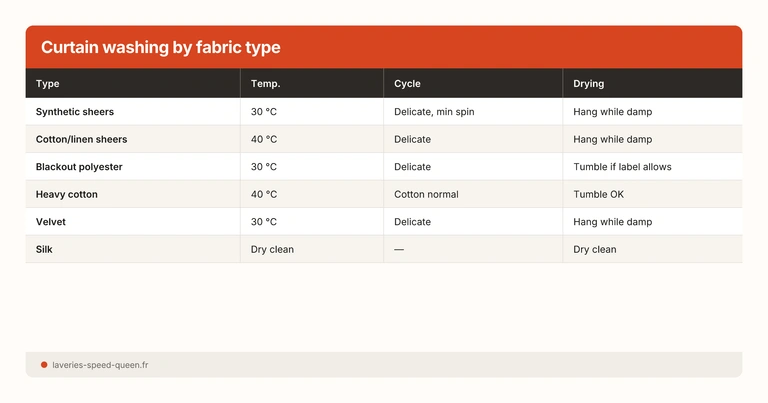
Most curtains can be machine-washed at 30 to 40 °C, but silk should go to a dry cleaner and large panels often need an 18 kg drum.
| Curtain Type | Machine-Washable? | Recommended Temperature | Drying |
|---|---|---|---|
| Synthetic sheer | Yes | 30 °C | Hang damp |
| Cotton/linen sheer | Yes | 40 °C | Hang damp |
| Blackout polyester curtain | Yes | 30 °C (fragile lining) | Tumble-dry OK if label allows |
| Thick cotton curtain | Yes | 40 °C | Tumble-dry OK |
| Linen curtain | Yes, delicate cycle | 40 °C | Hang (linen shrinks in the dryer) |
| Velvet curtain | Check label | 30 °C delicate cycle or dry clean | Hang |
| Eyelet curtain (metal rings) | Yes, in a mesh bag | 30 °C | Hang |
| Heavy double-layer curtain | Depends on weight and label | 30 °C or dry clean | Hang |
| Silk curtain | No (dry clean) | — | — |
Curtains with glued lining
Some blackout curtains have a thermal lining that is glued (not sewn) to the fabric. Machine washing can peel this lining off. If the lining comes away when you tug it, opt for surface cleaning or dry cleaning instead. See our guide to delicate textiles for more.
Preparation
Always remove hooks and rings, then shake curtains before washing — a single piece of metal hardware can scratch the drum and snag the fabric.
Take them down carefully — remove hooks, rings, and rods. Metal hardware damages both the fabric and the machine.
Shake outdoors — remove surface dust before washing. This prevents overloading the machine's filter.
Spot the stains — pre-treat soiled areas (smoke residue, cooking grease) with a little Marseille soap.
Fold accordion-style — don't scrunch into a ball. Accordion folding ensures a more even wash and less creasing.
Eyelet curtains
Plastic or metal eyelets can scratch the drum and damage the fabric. Fold the curtains so that the eyelets sit on the inside of the fold, or place the curtain in a large mesh laundry bag.
Washing by Curtain Type
Match the cycle to the material: sheers at 30 °C delicate, thick cotton at 40 °C, and linen at 40 °C max with no tumble-drying.
Sheer Curtains
Sheers are thin and fragile. An overly aggressive wash creases them permanently or stretches them out of shape.
Delicate cycle
Use a delicate cycle as indicated on the label. Synthetic sheers are heat-sensitive. Avoid the wool cycle (too slow an agitation for long sheers, which may tangle).
Minimal spin
Use minimal spin, or no spin at all. Sheers dry quickly on their own, and a high spin creates permanent creases that are impossible to remove.
Yellowed sheers
White sheers yellow over time. Pre-treat locally and run a gentle cycle following the care label.
Blackout and Heavy Curtains
Polyester blackout curtains are sturdy and easy to care for.
18 kg machine recommended
A pair of large blackout curtains (240 cm drop) easily weighs 3 to 5 kg. Use an 18 kg machine so they have room to move. Normal cycle as per the care label. Tumble-drying is fine if the label allows it. To choose the right machine, estimate the total weight.
Loading Large Curtains
How to load curtains into the machine
Fold the curtains accordion-style lengthwise, then loosely roll them into a cylinder. Place them in the drum, spreading them evenly. The curtains should fill the drum without being compressed: if you have to force the door shut, use a larger machine. A curtain that’s packed in too tightly won’t wash or rinse properly and will come out heavily creased.
Linen Curtains
Linen is a natural fibre that shrinks easily. Stick to the recommended temperature and skip the tumble dryer.
Gentle cycle, no tumble dryer
Linen shrinks in the tumble dryer. Wash on a gentle cycle as per the label, moderate spin, and hang immediately to dry. The weight of the water is enough to smooth linen naturally — that slightly rumpled drape is part of linen’s characteristic look.
Drying
Hang sheers, linen, and velvet while still damp for 12 to 24 hours, and reserve the tumble dryer for polyester or cotton only if the care label allows it.
Curtain drying depends on the fabric. For detailed guidance, see our drying guide.
Hang to dry (sheers, linen, velvet)
Sheers, linen, and velvet should always be hung to dry — never tumble-dried. See the perfect-drape tip below.
Tumble dryer (polyester, cotton)
Polyester and cotton curtains can go in the dryer if the label allows. Remove them while still slightly damp and hang immediately to finish drying without creases.
The perfect-drape trick
The best time to re-hang your curtains is while they are still damp (not soaking — just damp). The weight of the water pulls the fabric downward and removes creases naturally. As they dry, they settle into a perfect drape.
Washing Frequency
In practice, wash curtains every 6 months under normal conditions, and every 2 to 4 months if you smoke, have an open kitchen, or keep pets.
Curtains are one of those bulky textiles worth washing regularly — combine a laundromat visit with your duvets and throw blankets to handle everything in one session. If pet hair is the main problem, also see our dedicated guide to removing pet hair from laundry.
| Situation | Recommended Frequency |
|---|---|
| Normal use, living room | Every 6 months. A good time is before or after a house move. |
| Kitchen (cooking fumes, grease) | Every 3 months |
| Smokers | Every 2-3 months |
| Pet owners | Every 3-4 months |
| Bedroom (dust) | Every 3-4 months |
Sofa Covers and Cushions
Sofa covers and decorative cushions collect dust, sweat, crumbs, food stains, and pet hair on a daily basis. They are among the most heavily used household textiles — and the least frequently washed. Regular cleaning improves both the hygiene and the appearance of your living room.
Check Whether the Cover Is Removable
Before anything else, check that the sofa cover can actually be removed. Depending on the model, it may be held on by a zip, Velcro, an elastic band, or a combination of the three. If the cover is not designed to be taken off (fabric stretched and stapled to the frame), surface cleaning with a damp sponge and Marseille soap↗ is the only option. Always check the care label sewn inside the cover — it shows the maximum temperature, cycle, and any drying restrictions.
For decorative cushions, most have a zipped cover that can be washed separately. Remove the filling (foam, feathers, or synthetic fibre) before washing — the filling has its own care requirements.
Pre-Treatment
Sofa covers accumulate a variety of dirt that needs treating before they go in the machine:
- Vacuum thoroughly — go over the cover before removing it to clear dust, crumbs, and hair trapped in the fabric.
- Spot-treat stains — rub food spills, drink marks, or sweat patches with damp Marseille soap. Leave for 10 to 15 minutes.
- Pet hair — if you have a dog or cat, a lint roller or rubber brush pass is essential before washing. Large amounts of hair can clog the machine filter and redeposit on the fabric during the cycle. See our guide to removing pet hair from laundry for a thorough method.
Cycle and Temperature
The washing temperature depends on the fabric:
- Cotton: 40 °C, normal cycle. Cotton washes well and recovers its shape after drying.
- Linen or linen-cotton blend: 30 °C, delicate cycle. Linen shrinks easily at high temperatures.
- Polyester or synthetic blend: 30 °C, synthetic or delicate cycle.
- Velvet: 30 °C, delicate cycle, cover turned inside out. Avoid mixing with fabrics that shed lint.
Machine Capacity: Watch the Volume
This is the critical point for sofa covers. A 3-seater sofa cover typically weighs 3 to 4 kg. Add the seat and back cushion covers, and you easily reach 5 to 6 kg for a complete sofa. For a corner sofa, expect 6 to 8 kg of covers. These volumes often exceed the usable capacity of domestic machines (5 to 8 kg), especially since the cover needs room to tumble and rinse properly. At a laundromat, a 9 kg machine is enough for a 2-seater cover. For a 3-seater with all cushions, or a corner sofa, use an 18 kg machine to ensure an effective wash and rinse.
Drying
Lay the cover flat on a drying rack or clean surface — do not hang it from one edge (the weight of the water stretches the fabric). For cotton covers, you can put them back on the sofa while slightly damp: they will finish drying in the exact shape of the seat, which avoids shrinkage and creasing. Tumble-drying is possible for cotton if the label allows it, but at moderate heat — linen or blended covers should not go in the dryer.
Washing Frequency
Wash sofa covers 2 to 4 times a year under normal use. If you have pets that climb on the sofa, increase to once every 2 months to remove hair, dander, and odours. Decorative cushion covers, which see less wear, can be washed 1 to 2 times a year.
Mistakes to Avoid
- Washing all curtains together — separate fine sheers from heavy curtains; they need different settings
- Forgetting to remove hooks — they scratch the drum and tear the fabric
- High spin on sheers — causes permanent creases that are impossible to iron out
- Tumble-drying linen — risk of shrinkage
- Storing while still damp — leads to mould and musty odours
Laundromat Cost
Expect from €4.90 for a 9 kg machine and from €9.80 for an 18 kg machine, with detergent included in both cases.
Small sheers / light curtains
9 kg machine: from €4.90. Enough for 2-3 lightweight sheers. Detergent included.
Large curtains / heavy curtains
18 kg machine: from €9.80. Ideal for a pair of large blackout or velvet curtains. Detergent included.
Curtains and Indoor Air Quality
Curtains play an often-underestimated role in your home’s air quality. Positioned in front of windows, they act as the first filter between outdoor air and your living space. Over the months, they accumulate fine dust, pollen, pollution particles, and allergens.
For allergy sufferers, curtains that haven’t been washed in 6 months can trigger or worsen symptoms. The fibres trap dust-mite allergens, grass pollen (peak season in spring), and fine particles. Washing regularly (2 to 4 times a year) significantly reduces the concentration of allergens in indoor air.
At a laundromat, 18 kg machines are sized to handle even the longest curtains (260 cm drop and above) without compressing them. The higher water volume (50 to 60 litres) rinses particles trapped deep in the fibres far more thoroughly.
As an Amazon Associate, we earn a small commission on purchases made through affiliate links in this article — at no extra cost to you. This helps us maintain this site and produce free guides.
Time to freshen up your curtains? Our laundromats in Blagnac, Croix-Daurade and Montaudran have 18 kg machines perfect for large curtains. Detergent included, payment contactless card or cash. See our prices.
Curtains and Indoor Air Quality
Curtains act as passive filters: they capture dust, pollen, pet dander, and pollution particles circulating in the room. In an urban home, a curtain left unwashed for a year can accumulate enough particles to worsen asthma or allergy symptoms — especially in bedrooms, where heating or air conditioning redistributes those particles through the night.
For sensitive individuals (asthma, allergic rhinitis, eczema), washing bedroom curtains every 3 months significantly reduces the allergen load in the room. Combine this with vacuuming the curtain poles and window frames, where dust also builds up.
During pollen season (March to June in southern regions), sheers capture pollen grains that drift in through open windows. One extra wash at the end of pollen season clears this reservoir. For a full allergen management protocol covering bedding and household textiles, see our guide on dust-mite allergies and laundry.