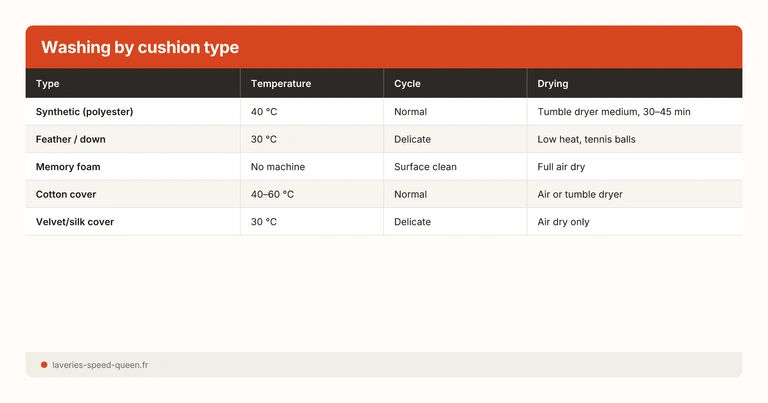
In short: remove the cover and wash it separately at 40-60 degrees C. Synthetic cushion: 40 degrees C, normal cycle, in pairs to balance the drum. Feather cushion: 30 degrees C, delicate cycle, tennis balls in the dryer. Memory foam cushion: NEVER in the machine — surface cleaning only. Complete drying is essential to prevent internal mold.
At a Glance
Cover first — remove it and wash separately. It collects the most dirt.
In pairs in the drum — two cushions balance the load during spinning.
Synthetic = 40 degrees C normal — polyester filling handles regular washing well.
Feather = 30 degrees C delicate — gentle cycle and tennis balls in the dryer, just like feather duvets.
Memory foam = NEVER in the machine — surface cleaning only (vinegar + baking soda).
Why Wash Your Cushions Regularly
Cushions — whether bedding or sofa — are silent accumulations of contaminants. Even with a cover, they eventually absorb whatever passes through the fabric.
What builds up inside a cushion:
- Dust mites — A 2-year-old cushion can contain 10% of its weight in dead dust mites and their droppings. Dust mites feed on dead skin cells and thrive in warm, humid environments. For allergy sufferers, this is a major trigger.
- Sweat and body oils — The body produces roughly 200 to 500 mL of sweat per night. Some of it passes through the pillowcase and cover to reach the filling.
- Dead skin cells — An adult sheds about 1.5 g of dead skin per day, some of which ends up in the cushion.
- Dust and pollen — Airborne particles settle and gradually work their way into the filling.
Regular washing removes these contaminants and extends the cushion’s lifespan. A well-maintained cushion lasts 2 to 3 times longer than a neglected one.
The Cover: Your First Line of Defense
The removable cover is the first thing to wash — and the most important. It is in direct contact with your skin or your linens, and it intercepts the majority of the dirt.
Cover Washing Guide
| Cover fabric | Temperature | Cycle | Notes |
|---|---|---|---|
| Cotton / cotton-polyester | 40-60 degrees C | Normal | 60 degrees C for allergy sufferers (kills dust mites) |
| Linen | 40-60 degrees C | Normal | Wrinkles easily — iron or accept the natural crinkle |
| Velvet | 30 degrees C | Delicate | Turn inside out, mesh bag recommended |
| Silk | 30 degrees C | Delicate / hand wash | Silk-specific liquid detergent, no strong spin |
| Synthetic (polyester) | 40 degrees C | Normal | Dries quickly, skip the fabric softener |
Frequency: wash cushion covers monthly for decorative cushions, every 2 weeks for bedding cushions (in contact with your face).
Bedding cushions vs decorative cushions
Bedding cushions (the ones you sleep on or rest your head against) deserve more frequent care than decorative cushions. They have prolonged contact with skin, absorb more sweat and harbor more dust mites. For bedding cushions, follow the same rules as for pillows: cover washed every 2 weeks, cushion washed every 3 months.
Synthetic Cushion: The Easiest to Wash
Cushions filled with polyester fibers (hollowfiber, siliconized balls) are the most washing-tolerant. This is the most common filling for sofa cushions and a large share of bedding cushions.
The Protocol
- Remove the cover and wash it separately
- Check the seams — a failing seam releases filling into the drum
- Load in pairs — two cushions balance the drum. If you only have one, add towels.
- Cycle: normal, 40 degrees C
- Detergent: liquid, standard dose. No fabric softener — it leaves a film on fibers that reduces loft.
- Spin: normal (800-1000 rpm). Polyester drains water well.
Drying
Tumble drying is recommended for synthetic cushions — it restores loft and ensures complete drying all the way to the center.
- Temperature: medium
- Duration: 30-45 minutes in 2-3 segments of 15 minutes
- Between segments: take the cushion out, shake it vigorously to redistribute the filling, then put it back
Check that the center is completely dry by pressing the cushion firmly between your hands. If even the slightest coolness remains, run another 10-minute cycle.
Feather and Down Cushion: Delicate Washing
Feather or down cushions require more caution — the principle is the same as for feather duvets and feather pillows.
The Protocol
- Remove the cover and wash it separately
- Check the seams — a feather leak in the drum is hard to clean up
- Load in pairs — even more important for feather, as the cushion is lighter and less stable in the drum
- Cycle: delicate or wool, 30 degrees C
- Detergent: liquid, reduced dose. Never use fabric softener — it glues the feather barbs together and destroys loft
- Spin: gentle, 600 rpm maximum. Too strong a spin breaks feathers and compacts them into hard lumps.
Drying
Drying is the critical step for feather cushions. A poorly dried cushion develops internal mold that produces a musty smell and destroys the filling.
- Temperature: low (delicate dryer cycle)
- Duration: 45-60 minutes in 3-4 segments of 15 minutes
- Tennis balls: place 2-3 clean tennis balls (or dryer balls↗) in the drum. They strike the cushion with each rotation, breaking up wet feather clumps and redistributing the filling.
- Check: press firmly on the center. Damp feathers form compact lumps that are easy to detect by touch.
Tennis balls: why they work
During the dryer’s rotation, the tennis balls bounce off the cushion and deliver repeated mechanical impacts. These impacts break apart feather clumps that have been compacted by water and spinning, allowing hot air to reach the center of the filling. Without balls, feathers stay in compact lumps that dry on the surface but remain damp in the center — ideal conditions for mold.
Memory Foam Cushion: NEVER in the Machine
- Viscoelastic foam cannot handle immersion — it absorbs water like a sponge but cannot release it. Internal drying is virtually impossible without the foam breaking down.
- The cell structure disintegrates — drum agitation and centrifugal force during spinning tear the foam cells apart, destroying the cushion's support properties.
- Mold risk — a machine-washed memory foam cushion stays damp at the center for days, creating ideal conditions for mold and bacteria.
How to Clean a Memory Foam Cushion
Cleaning is done exclusively on the surface (spot cleaning):
- Remove the cover and wash it in the machine normally
- Spray a mix of cold water + white vinegar↗ (50/50) on the stained area
- Blot with a clean, absorbent cloth — do not rub, do not saturate with water
- Sprinkle baking soda↗ over the entire surface to absorb moisture and odors
- Let it air-dry completely (24-48 hours), in a well-ventilated area, lying flat
- Vacuum the dry baking soda
For tough stains (blood, urine), apply a small amount of diluted Marseille soap↗ with a cloth, blot, then rinse by blotting with a damp cloth. Keep the amount of water to a minimum.
Sofa Cushion: The Special Case
Sofa cushions vary enormously in size, filling and washability. The golden rule: separate the cover from the stuffing.
Removable Cover
Most modern sofas have removable cushion covers (rear zipper or underside zipper). Remove it and machine-wash according to the fabric (see the cover table above).
Filling
Polyurethane foam (most common)
Does not go in the machine. Clean the surface: spray white vinegar, blot, apply baking soda. If the foam is very dirty, submerge it in the bathtub with warm water and a little detergent, press (do not wring), rinse thoroughly and air-dry for at least 48 hours.
Polyester fiber
Can go in the machine at 30-40 degrees C if it fits in the drum. Delicate cycle. This is often the case with thin decorative cushions. For large cushions, use a high-capacity machine at a laundromat.
Feather / down
Same protocol as bedding feather cushions: 30 degrees C, delicate, tennis balls in the dryer. Sofa feather cushions are often thick — an 11-18 kg laundromat machine is preferable.
Foam + fiber blend
The trickiest. If foam is wrapped in a layer of fiber, it generally cannot go in the machine (the foam in the center will not dry). Surface clean or seek professional cleaning.
Drying: The Absolute Rule
Incomplete drying is the top cause of deterioration in washed cushions. Moisture trapped at the center of the filling creates an anaerobic (oxygen-free) environment where mold and bacteria thrive.
Signs of a Poorly Dried Cushion
- Musty smell appearing a few days after washing
- Gray or greenish stains on the filling or cover
- Loss of loft — the filling is clumped and does not bounce back
How to Verify Complete Drying
- Press firmly on the center of the cushion between your hands. Any coolness or moisture means drying is not finished.
- Smell the center — a damp cushion gives off a slightly earthy odor.
- Weigh the cushion (if you have a scale) — a dry cushion weighs the same as before washing. If it is heavier, water remains.
When in doubt, keep drying. Too much drying harms nothing; too little drying can ruin the cushion.
Recommended Washing Frequency
| Cushion type | Cover | Inner cushion | Note |
|---|---|---|---|
| Bedding cushion (case + pillow) | Every 2 weeks | Every 3 months | In contact with the face — hygiene priority |
| Decorative cushion (sofa, bed) | Monthly | 2-3 times per year | Less direct skin contact |
| Floor cushion | Monthly | Every 2-3 months | Floor contact = more dust |
| Outdoor cushion (patio) | After each rain exposure | 2-3 times per season | Outdoor humidity promotes mold |
The Laundromat for Thick Cushions
Sofa cushions and large floor cushions are often too bulky for a domestic 7-8 kg machine. The filling, squeezed into a drum that is too small, does not get properly agitated or rinsed — detergent residue stays trapped inside.
The 11-18 kg machines available at a laundromat provide the volume the cushion needs to move freely in the drum. Rinsing is more thorough (50-60 liters of water versus 15-20 liters in a domestic machine) and tumble drying on a professional dryer is faster and more even.
Tip: take advantage of a laundromat visit to wash your cushions, pillows and duvet all at once. One trip for all the bedding.
As an Amazon Associate, we earn a small commission on purchases made through the affiliate links in this article — at no extra cost to you. This helps us maintain this site and produce free guides.
Our laundromats in Toulouse and Blagnac have 9 to 18 kg machines and professional dryers with detergent included. Perfect for thick cushions, pillows and duvets. Payment by card or contactless. Check our prices.
Sources and References
- Dust mite accumulation in cushions and pillows (Dermatophagoides)
- Viscoelastic foam: open cell structure and water retention — incompatibility with machine washing