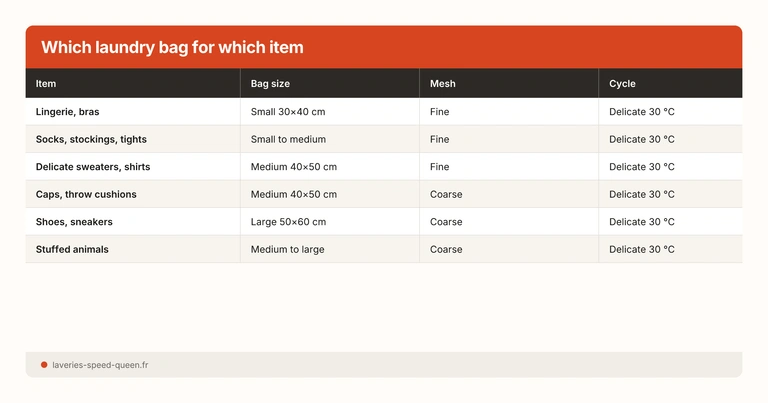
In short: a mesh laundry bag protects delicate items from friction, snagging, and deformation in the machine. Small (30x40 cm) for lingerie. Medium (40x50 cm) for delicate garments and caps. Large (50x60 cm+) for shoes and cushions. Fine mesh for delicates, coarse for bulky items. Never overfill.
At a glance
Protects against three threats — friction, snagging, and deformation inside the drum.
Three standard sizes — small (lingerie), medium (garments), large (covers, shoes).
Two mesh types — fine for very delicate items, coarse for bulky items.
Do not overfill — the bag must let water circulate, otherwise it prevents proper washing.
Essential at the laundromat — commercial machines have greater mechanical force.
Why mesh laundry bags exist
A washing machine drum is designed to create friction. It is this mechanical agitation, combined with hot water and detergent, that lifts dirt from fabric. But this friction is not selective: it treats a heavy pair of jeans and a lace bralette with the same force.
A mesh laundry bag↗ creates a protected zone inside the drum. The item placed in the bag still goes through the wash cycle (water, detergent, temperature), but with mechanical friction reduced by 50 to 70 % depending on mesh fineness.
In practice, the bag protects against three types of stress:
- Friction: direct rubbing between the item and the drum or other clothes is dampened by the mesh.
- Snagging: zippers, underwires, hooks, and buttons catch easily on knit fabrics or lace. The bag isolates these elements.
- Deformation: during the spin (800-1400 RPM), centrifugal force pulls items in every direction. The bag limits stretching.
What goes in which bag: guide by category
Lingerie and bras
Small bag (30x40 cm), fine mesh. One bra per bag so it keeps its shape. Fasten the hooks before placing in the bag. See our guide to washing lingerie.
Socks and stockings
Small to medium bag, fine mesh for stockings and tights (very fragile). A dedicated sock bag keeps pairs together — no more orphan socks. Sort by colour before bagging.
Shoes and trainers
Large bag (50x60 cm), coarse mesh. Remove insoles and laces (wash them separately). The bag protects the drum as much as the shoes. See our guide to washing shoes.
Stuffed animals
Medium to large bag depending on size, coarse mesh. The bag protects seams, eyes, and glued parts. Delicate cycle 30 °C. See our guide to washing stuffed animals.
Caps and bucket hats
Medium bag, coarse mesh. The bag holds the brim's shape during the cycle. See our guide to washing caps and our article on hats and beanies.
Decorative cushion covers
Large bag, coarse mesh. Close the zippers on the covers and place them in the bag — loose zips snag everything. See our guide to washing cushions and covers.
Wool and cashmere jumpers
Medium bag, fine mesh. Turn the jumper inside out before putting it in the bag. Wool cycle 30 °C, spin 400 RPM. See our guide to washing wool without shrinking.
Lace or embroidered garments
Size-appropriate bag, fine mesh. Lace and embroidery are the first victims of snagging in the machine. The bag isolates these fragile elements from the zippers and buttons of other clothes.
Bag sizes: the reference table
| Size | Dimensions | Suitable items | Recommended mesh |
|---|---|---|---|
| Small | 30 x 40 cm | Lingerie, socks, stockings, small accessories | Fine |
| Medium | 40 x 50 cm | Wool jumper, silk shirt, cap, small cushion | Fine or coarse depending on the item |
| Large | 50 x 60 cm | Shoes, cushion covers, large stuffed animals | Coarse |
| Extra large | 60 x 90 cm | Light blanket, duvet cover, curtain | Coarse |
The two-thirds rule
The item placed in the bag should fill no more than two thirds of the available space. The remaining third is the room needed for water to circulate inside the bag. A bag filled to 100 % no longer protects — it prevents proper washing and rinsing.
Fine mesh vs coarse mesh: which to choose
Choosing the mesh type is just as important as choosing the bag size. The two types serve different functions.
| Criterion | Fine mesh (< 2 mm) | Coarse mesh (3-5 mm) |
|---|---|---|
| Mechanical protection | Maximum — friction greatly reduced | Good — friction moderately reduced |
| Water circulation | Reduced — slightly less effective wash | Good — wash and rinse nearly normal |
| Best for | Lingerie, silk, stockings, lace, cashmere | Shoes, jeans, stuffed animals, cushions |
| Prevents snags | Yes — almost impossible to catch | Yes — but a fine hook can pass through |
| Retains small parts | Yes — underwires, small buttons stay in the bag | No — small pieces can escape |
An often-overlooked detail: the closure
The bag closure (zip or drawstring) is the weak point. A cheap zipper opens under the centrifugal force of the spin and releases the contents mid-cycle. Choose bags with a double zip (two sliders) or a protective flap that covers the zipper and prevents accidental snagging. Drawstring bags are more reliable but less convenient to open.
What NOT to do with a mesh laundry bag
- Overfill the bag — a stuffed bag no longer protects and stops water from circulating. Clothes come out poorly washed and poorly rinsed.
- Mix incompatible items — a pair of jeans with metal buttons and a lace bralette in the same bag: the buttons damage the lace through the mesh.
- Forget to close the closure — the bag opens in the drum and releases its contents, cancelling all protection.
- Use a torn or stretched bag — a bag whose mesh is deformed no longer protects. Replace it.
- Leave laundry in the bag after washing — items compressed in a damp bag develop creases and odours. Remove them immediately.
Mesh laundry bag for lingerie: detailed guide
Lingerie is the most common and most important use of the mesh laundry bag. Bras in particular are complex garments with underwires, hooks, elastic straps, and structured cups — all elements that suffer from friction and centrifugal force.
Bras
- Fasten the hooks before placing in the bag — open hooks catch on the mesh and other clothes.
- One bra per bag — so it keeps its 3D shape. Two stacked bras deform each other.
- Fine mesh — underwires can pierce a coarse mesh and escape into the drum (risk of machine damage).
- Delicate cycle, 30 °C, spin 600 RPM max — see our full guide to washing lingerie.
Knickers and boxers
- Several knickers of the same type (cotton, synthetic) can go in the same medium bag — without packing.
- The bag is mainly useful for lace knickers or those with fragile embellishments. Plain cotton knickers do not always need a bag.
Tights and stockings
- Small bag, fine mesh mandatory — tights are the most fragile textile in the machine. One zip rubbing against a pair of tights snags them instantly.
- Fold the tights in half or quarters before placing in the bag — they tangle less.
Mesh laundry bag for shoes
Shoes in the machine create two problems: they damage the drum (impacts) and they deform under centrifugal force. The bag solves both.
- Large bag, coarse mesh — shoes need good water contact to be properly washed.
- Remove insoles and laces — wash them separately for a thorough clean.
- Delicate cycle 30 °C, spin 400-600 RPM — no higher, or both drum and shoes suffer.
- Add towels to the drum — they cushion impacts and reduce noise.
For a complete guide: washing shoes in the machine.
Mesh laundry bag at the laundromat
At the laundromat, the mesh laundry bag is even more important than at home. Commercial machines have 12-18 kg drums with higher spin force than domestic machines. Friction is more intense, centrifugal forces are higher.
Bring your own bags — laundromats generally do not supply mesh laundry bags.
Double the protection in a large drum — in an 18 kg machine, a small delicate item experiences more movement than in a 7 kg home machine.
Protect lingerie and wool above all — these are the most vulnerable items to the mechanical force of commercial machines.
Close all bag zips — the higher centrifugal force in laundromat machines can open weak closures.
If it’s your first visit to a laundromat, see our guide first time at the laundromat.
Maintaining your mesh laundry bag
The bag itself needs maintenance. A dirty or damaged bag no longer does its job.
Washing the bag
- In the machine at 40 °C with the rest of your laundry, open and empty.
- Every 2-3 weeks if you use it every wash, monthly otherwise.
- Without fabric softener — softener leaves a film on the mesh that reduces water permeability.
When to replace
- The mesh is torn or stretched: items pass through or are no longer protected.
- The zipper no longer closes properly: the bag will open in the drum.
- The seams are coming undone: the bag will fail mid-cycle.
- The bag has had more than a year of intensive use: mesh stretches naturally with repeated washing.
Alternatives to the mesh laundry bag
The bag is not the only protection tool for the machine. For some uses, other solutions exist.
| Solution | Use | Advantage | Limitation |
|---|---|---|---|
| Closed pillowcase | Lingerie emergency fix | Available everywhere | Mesh too coarse, less effective |
| Bra-specific bag | Bras only | 3D shape holds cups | One item per bag |
| Padded shoe bag | Shoes in the machine | Cushions impacts + protects drum | Bulkier, more expensive |
| Guppy Friend | Captures microplastics | Reduces synthetic microfibre release | Does not protect against snagging |
The Guppy Friend deserves a mention: it is not a mechanical protection bag but a bag designed to capture plastic microfibres released by synthetic clothes during washing. Its purpose is environmental, not textile protection.
The recommended bag kit
To cover most household needs, a kit of 3 to 5 bags is enough:
2 small fine-mesh bags — one for lingerie, one for socks and stockings.
1 medium fine-mesh bag — for wool jumpers, delicate shirts, scarves.
1 large coarse-mesh bag — for shoes, cushions, stuffed animals.
1 bra-specific 3D bag (optional) — if you regularly wash structured bras with moulded cups.
Budget: a kit of 5 good-quality bags costs between 8 and 15 euros. It is a minimal investment that significantly extends the life of your delicate garments.
As an Amazon Associate, we earn a small commission on purchases made through the affiliate links in this article — at no extra cost to you. This helps us maintain this site and produce free guides.
At the laundromat, commercial machines exert greater mechanical force — a mesh laundry bag is even more important. Bring yours to our laundromats in Blagnac, Croix-Daurade and Montaudran to protect your delicates. Payment by contactless card or cash. See our prices.
Sources and references
- Washing lingerie and bras
- Washing shoes in the machine
- Washing stuffed animals
- Washing wool without shrinking
- Washing hats and beanies
- Microplastics and synthetic laundry
- First time at the laundromat
- Delicate fabrics guide
- Mechanical friction in the machine: 50-70 % abrasion reduction with a fine-mesh bag (manufacturer data)