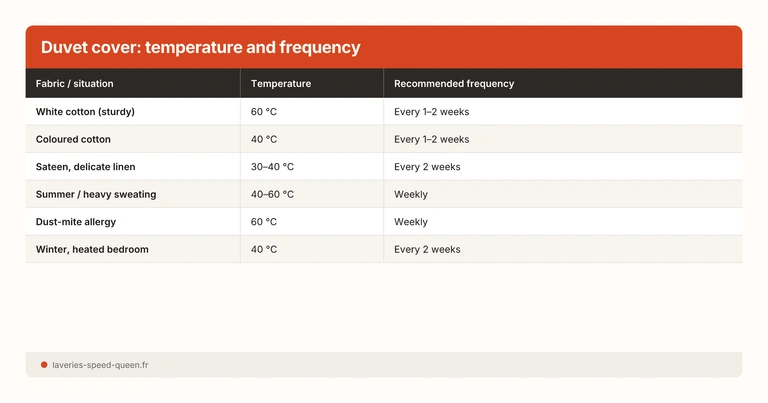
In short: a duvet cover should be washed far more often than the duvet itself: every 1 to 2 weeks for daily use is a good rhythm. For temperature, the rule is straightforward: 60 °C for sturdy white cotton if the label allows, 40 °C for standard colors, and 30 to 40 °C for more delicate fabrics.
Quick answer
Standard frequency — every 1 to 2 weeks.
White cotton — up to 60 °C if the label allows.
Colors — 40 °C is usually the best compromise.
Sateen, delicate linen, fragile dyes — 30 to 40 °C.
The cover does not replace the duvet — it protects, but it does not eliminate the need to wash the inner duvet at a longer interval.
Why the cover is washed far more often than the duvet
The cover is the real front line of your bedding. It takes direct contact with skin, sweat, cosmetics, hair, dust, and nighttime friction. The inner duvet, on the other hand, stays protected most of the time.
The classic mistake
Many people focus on the duvet, when the routine care really comes down to the cover. It is the same logic as with a pillowcase: the outer piece needs a much tighter wash schedule than the inner filling.
Optimal frequency by season
Washing frequency should not stay the same year-round. Sweat, room temperature, and sleep habits vary with the seasons.
Spring and fall: the standard rhythm
In mild seasons, washing every 2 weeks is a solid rhythm for most households. Sweating is moderate, temperatures are comfortable, and the cover stays fresh long enough.
Summer: increase the frequency
In summer, nighttime sweating rises significantly — even with a lightweight duvet. Heat also promotes dust mites and bacteria in the fabric. Switch to a wash every week from June to September. If you sweat heavily, changing the cover every 5-7 days is recommended. To understand the link between washing and allergens, check our dust mite and laundry guide.
Winter: the thick-duvet trap
In winter, people tend to think sweating decreases. That is often wrong: thick duvets and heating create a warm, humid microclimate under the sheets. If you use a thick winter duvet, maintain a wash every 2 weeks. If your room is heavily heated (above 20 °C), switch to weekly.
| Situation | Recommended frequency | Why |
|---|---|---|
| Standard daily use | Every 1 to 2 weeks | Normal buildup of sweat, sebum, and dust |
| Heavy sweating / summer | Once per week | The cover absorbs moisture and odors faster |
| Allergies / dust mites | Once per week | A tighter schedule helps limit allergen load |
| Pet on the bed | Once per week | Hair, saliva, and dust change the exposure level |
| Guest bedroom | After each stay or before next use | Frequency depends on visits, not the calendar |
| Young child | Once per week | Spit-ups, nighttime accidents, heightened sensitivity |
Temperature by fabric: the reference table
The right benchmark depends first on the fabric and color stability. The typical mistake is washing everything at 60 °C “just to be safe,” when some covers neither need nor tolerate it.
| Cover type | Recommended temp | Spin speed | Key note |
|---|---|---|---|
| Sturdy white cotton | 60 °C if allowed | 1000-1200 rpm | Useful for deeper hygiene or a white that needs sharper maintenance |
| Colored cotton | 40 °C | 800-1000 rpm | Best compromise between cleaning and preserving dyes |
| Cotton sateen | 30 °C | 600-800 rpm | Gentler to preserve the silky feel and sheen |
| Washed linen | 40 °C | 800 rpm | Linen handles use well but shrinks at high temperatures |
| Microfiber (polyester) | 40 °C | 800-1000 rpm | No fabric softener — it clogs microfibers and reduces absorption |
| Percale cotton | 40 °C | 800-1000 rpm | Tight, durable weave, but colors fade at 60 °C |
| Silk or very delicate fabric | Follow the label (often 30 °C max) | 400-600 rpm | Never improvise a 60 °C wash on a fine textile |
For a complete guide to washing temperatures for all textiles, check our temperature reference. If your white cover has yellowed over time, sodium percarbonate is the most effective product to restore a bright white — also see our guide to whitening yellowed laundry.
Why the duvet cover bunches up in the machine
A poorly prepared duvet cover can twist on itself, trap other items, and come out poorly rinsed. It is not serious, but it is annoying and avoidable.
The explanation is simple: the cover is a large fabric bag. When water enters, air gets trapped inside and the cover inflates like a balloon. The drum rotation then wraps the cover around itself, trapping other articles inside. The result: uneven rinsing, unbalanced spinning, and laundry that comes out still soapy.
The solution: tie the corners
The most effective technique to prevent bunching:
- Turn the cover inside out — the seams will be protected.
- Tie each corner of the cover with a simple knot (not too tight). This prevents the cover from inflating with air and folding over on itself.
- Close all buttons or the zipper — otherwise the rest of the drum load slips inside.
- Alternative: toss 2-3 tennis balls into the drum. They break up fabric clumps during agitation and stop the cover from forming a compact ball.
Close the cover
Closing buttons or the zipper limits the 'net effect' that traps the rest of the laundry.
Tie the corners
A simple knot on each corner prevents the cover from inflating and rolling over itself. This is the single most effective step.
Do not pack the drum
Bedding needs space to tumble, unfold, and rinse properly.
Avoid mismatched loads
A delicate cover with thick towels or a bath mat is rarely a good idea.
Anti-wrinkle tips
Excessive wrinkling is the second most common issue after bunching. Here are the causes and fixes.
Remove from the drum immediately
Wrinkles form mainly during cooling of the fabric in the drum. A cover that sits in the machine 30 minutes after the cycle ends will come out far more wrinkled than one removed immediately. If you use a tumble dryer, the same principle applies: take the cover out as soon as the cycle finishes.
Shake before drying
Before hanging or tumble drying, shake vigorously to unfold and de-wrinkle. Two or three sharp snaps are enough. This simple step reduces wrinkling by at least 50%.
Do not overload the drum
Overloading is the number one cause of wrinkling. A double duvet cover + a fitted sheet + 2 pillowcases is the maximum for a 7-8 kg machine. If you add towels or other items, the whole load will come out wrinkled. For large bedding loads, bigger machines make a real difference — check our guide on what capacity to choose for a double duvet.
Do not spin too fast
Spinning at 1200 rpm on cotton sateen or linen guarantees deep-set creases. Reduce spin to 800 rpm maximum for fabrics that wrinkle easily. The fabric will be slightly wetter but far less wrinkled. For sateen covers, 600 rpm is preferable.
The tumble dryer: friend or foe?
The tumble dryer can reduce wrinkling if used correctly. The drum movement and heat relax fibers. But a dryer that is too hot or a cycle that is too long has the opposite effect: the fabric stiffens and creases set. Use a moderate heat program and remove the cover when it is still slightly damp — the final 10% of drying happens on the line, crease-free. Check our drying guide for best practices.
Signs you need to wash it sooner
- Smell at bedtime or on waking — freshness is already gone.
- Traces of sebum or cosmetics — especially near the face area.
- Allergies or skin irritation — when your nose or skin reacts, do not wait.
- Pet on the bed — even if the cover 'looks' clean. Check our pet hair guide.
- Visible yellowing — a sign of sweat and sebum buildup. Sodium percarbonate can help restore whiteness.
Duvet cover, sheets, and inner duvet: who gets washed when?
These three items do not follow the same schedule. And that is exactly why lumping them all onto one vague bedding page leads to fuzzy advice.
- The cover: every 1 to 2 weeks;
- Sheets and pillowcases: often at the same pace or more frequently for pillowcases ( full guide);
- The inner duvet: far less often, usually 1 to 2 times per year (duvet guide).
The right detergent dose
Overdosing detergent is a common cause of stiff, poorly rinsed covers that retain odors. Contrary to intuition, more detergent does not mean cleaner — unrinsed detergent residue builds up in fibers, stiffens the fabric, and can irritate sensitive skin.
For a single duvet cover in a 7-8 kg machine: use half the dose recommended on the packaging. Detergent manufacturers often overstate the suggested amounts. For a complete guide, check our detergent dosage article. If you have sensitive skin, also see our guide on detergent residue.
When the inner duvet itself needs washing
When the cover is no longer enough and the inner duvet needs a real wash, the logic changes completely: large capacity, temperature by filling type, controlled spin, and extended drying.
Do not confuse the two tasks
Washing a duvet cover is a bedding linen routine. Washing the inner duvet is a bulky-item wash with real constraints around filling type. For that, follow our full guide to washing a duvet. If you need a larger machine for your cover or duvet, use our laundry weight calculator to check the required capacity.
Methodology and sources
This article deliberately separates cover care from inner-duvet care. Competing SERP pages often mix the two, producing vague advice on frequency and temperature. The goal here is to provide a realistic bedding linen routine, then redirect to the right guide when the topic shifts to inner filling.
- Sleep Foundation, How Often Should You Wash Your Sheets?, consulted March 2026
- Good Housekeeping Institute, How to Wash Bed Linen, consulted March 2026
- Internal references: how often to wash sheets, how to wash a duvet, washing temperature guide
Sources and references
- How often to wash your sheets
- How to wash a duvet
- Washing temperature guide
- Dust mite allergy and laundry
- Sodium percarbonate and laundry
- Whitening yellowed laundry
- Detergent dosage guide
- Drying guide
- Remove pet hair from laundry
- Detergent residue and sensitive skin
As an Amazon Associate, we earn a small commission on purchases made through the affiliate links in this article — at no extra cost to you. This helps us maintain this site and produce free guides.
For complete bedding care, also see how often to wash your sheets and how to wash a pillow. And if you have reached the stage where the duvet itself needs machine washing, continue with our duvet washing guide. Our laundromats in Blagnac, Croix-Daurade and Montaudran have 18 kg machines for bulky bedding and duvets.