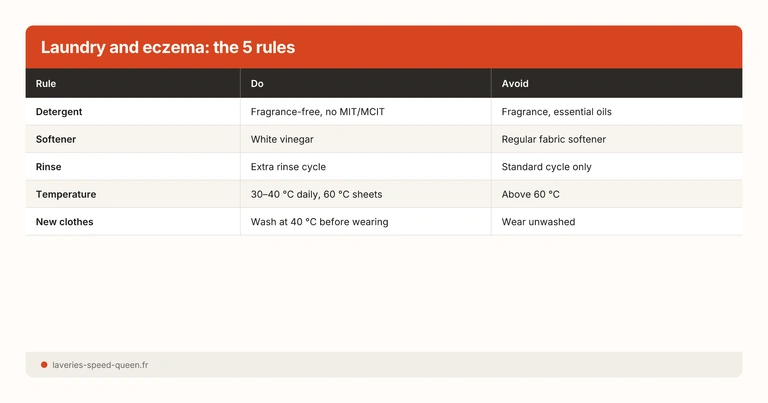
Eczema (atopic dermatitis) affects 15-20% of children and 2-10% of adults. Laundry detergent is one of the most common triggers, but also one of the easiest to fix. The main irritants are synthetic fragrances, preservatives (MIT/MCIT) and detergent overdosing that leaves residue in fibers. The solution rests on three pillars: a fragrance-free, dye-free detergent, a systematic extra rinse cycle, and eliminating conventional fabric softener. In professional laundromat machines, the rinse water volume (50-60 liters) naturally reduces residue to a minimum.
At a Glance
Fragrance-free, dye-free detergent — check the INCI list, not the marketing. No MIT/MCIT, no essential oils.
Systematic extra rinse — reduces detergent residue in fibers by 30-50%.
No conventional fabric softener — the film it deposits on fibers is a major irritant. Alternative: white vinegar.
30-40 degrees C for everyday items — 60 degrees C only for sheets and towels (dust mites).
Wash new clothes first — manufacturing finishes (formaldehyde, dyes) irritate atopic skin.
Why Detergent Irritates Skin
To understand how to adapt your washing routine, you first need to identify what in a detergent can trigger or worsen contact dermatitis. Atopic skin is not “allergic to everything” — it reacts to specific, identifiable, avoidable components.
Surfactants: The Heart of Detergent
Surfactants are the cleaning agents in detergent. They work by encapsulating fats and dirt in micelles (micro-bubbles) that are flushed away during rinsing. Without surfactants, detergent does not clean.
The problem for sensitive skin: surfactants do not distinguish between “dirty” sebum and the skin’s natural lipid barrier. If surfactant residue remains in fibers after rinsing, it continues its degreasing action on contact with the skin. It dissolves the protective lipid layer of the epidermis — exactly what atopic skin needs least, since the skin barrier is already compromised.
Anionic surfactants (sodium lauryl sulfate, sodium laureth sulfate) are the most aggressive but also the most effective cleaners. Non-ionic surfactants (ethoxylated fatty alcohol, glucoside) are gentler and often found in hypoallergenic detergents. Professional laundromat formulations typically use an optimized blend that cleans effectively while minimizing residue.
Fragrances: 26 Regulated Allergens
Synthetic fragrances are the leading cause of contact dermatitis from household products. EU Regulation (EC) No 648/2004 requires manufacturers to individually list 26 allergenic fragrance substances when their concentration exceeds 0.01% in leave-on products (or 0.1% in rinse-off products).
Among the most common in detergents:
| INCI substance | Common source | Irritant potential |
|---|---|---|
| Limonene | Citrus, essential oils | High (oxidizes into an allergen on contact with air) |
| Linalool | Lavender, coriander | Moderate to high |
| Citral | Lemongrass, verbena | High |
| Geraniol | Rose, geranium | Moderate |
| Coumarin | Tonka bean, cinnamon | Moderate |
| Cinnamal | Cinnamon | High |
The “natural” and “eco” detergent trap: many contain lavender, lemon or tea tree essential oils as a “natural” fragrance. Yet limonene (lemon) and linalool (lavender) are among the most common contact allergens. “Natural” does not mean “hypoallergenic.”
MIT and MCIT Preservatives
Methylisothiazolinone (MIT) and methylchloroisothiazolinone (MCIT) are biocides used as preservatives in liquid detergents. They prevent bacterial growth in the bottle. The problem: these substances are potent skin sensitizers.
The MIT allergy epidemic in the 2010-2015 period led to regulatory restrictions in Europe. MIT is now banned in leave-on cosmetics but remains allowed in detergents (rinse-off products). It remains the second leading cause of cosmetic contact dermatitis, after fragrances.
Powder detergents have a clear advantage here: their dry formulation does not require antimicrobial preservatives. No MIT, no MCIT, no formaldehyde releasers. This is a strong argument for atopic skin.
Dyes and Optical Brighteners
Dyes (CI + number) serve no cleaning function. They color the detergent for marketing. Optical brighteners are fluorophores that deposit on fibers and absorb UV light to re-emit blue light, creating the illusion of whiter whites. Both categories remain in fibers after washing and are in permanent contact with the skin.
For atopic skin, these residues are potential irritants with no benefit — eliminate them.
Choosing a Hypoallergenic Detergent: Reading the Label
The term “hypoallergenic” has no strict legal definition. It means the manufacturer has reduced allergenic risk, without absolute guarantee. The only way to verify is to read the INCI ingredient list.
What to Look for on the Label
Reassuring labels
Fragrance-free (not 'naturally fragranced'), dye-free, MIT/MCIT-free, no optical brighteners, dermatologically tested, hypoallergenic. Fewer ingredients on the INCI list is better.
Misleading claims
'Natural fragrance' (often contains limonene/linalool), 'with essential oils' (contact allergens), 'gentle on skin' (no regulatory value), 'suited for sensitive skin' (unverified). Only the INCI list is reliable.
Useful certifications
Ecocert fragrance-free, EU Ecolabel, Dermatest 'excellent'. These certifications impose verifiable standards. Note: an eco label does not guarantee fragrance-free — always check the ingredients.
Powder or Liquid?
For atopic skin, powder detergent has several advantages:
- No preservatives (MIT, MCIT, formaldehyde releasers) — the dry formula does not need them.
- Better rinsing — powders dissolve and rinse out more easily than viscous gels.
- More precise dosing — the measuring scoop is easier to use than liquid bottle caps.
On the other hand, powders dissolve less well below 30 degrees C and can leave white residue if the machine is overloaded or the cycle is too short. Solution: dissolve the powder in the detergent drawer with a little warm water before starting the cycle.
Marseille soap in the machine
Marseille soap flakes are a simple option for atopic skin: no fragrance, no preservatives, no dyes. Use about 2 tablespoons of flakes for a 5-7 kg machine.
The Rinse: The Most Effective Single Measure
Rinsing is often underestimated. Yet it is the phase of the cycle that determines how much detergent residue stays in the fibers — and therefore how many irritants come into contact with your skin.
Why Residues Persist
A domestic washing machine uses an average of 15 to 20 liters of water per rinse cycle. This volume is enough to remove most of the detergent, but residues remain in fibers, particularly deep in thick textiles (towels, sheets, jeans) and in areas where the laundry is compressed by the load.
Consumer testing shows that an extra rinse cycle reduces surfactant residues by 30 to 50% compared to a single rinse. On healthy skin, the difference is imperceptible. On atopic skin, it can make the difference between a comfortable day and an eczema flare-up.
How to Optimize Rinsing
Activate extra rinse on your machine — most modern machines offer this option. It adds a full rinse cycle (10-15 minutes and 15-20 liters of additional water).
Do not overload the machine — a machine that is too full prevents water from circulating freely between textiles. Result: residues stay trapped deep in the load. Fill to 80% of capacity maximum.
Dose detergent correctly — overdosing is the leading cause of residue. The more detergent you add, the more rinsing is needed to flush it out. Follow the manufacturer's recommended dose strictly, or slightly less.
The advantage of professional water volume — at a laundromat, machines use 50-60 liters of water per rinse cycle, 2.5 to 3 times more than a domestic machine. This volume dilutes and flushes residues much more effectively.
Fabric Softener: Why to Stop
Fabric softener is the single most problematic laundry product for atopic skin. Its very mechanism is the source of the problem.
How Fabric Softener Works
Fabric softener contains cationic compounds (quaternary ammoniums) that bond to textile fibers through electrostatic attraction. These molecules remain on the fabric after drying — that is their purpose: to soften the feel by coating fibers with a smooth layer.
But this layer also contains the softener’s fragrances (often more concentrated than those in the detergent) and cationic residues that are recognized contact irritants. On healthy skin, this goes unnoticed. On atopic skin with a compromised barrier, these molecules penetrate the epidermis more easily and trigger an inflammatory response.
The Alternative: White Vinegar
White vinegar is a safe alternative for atopic skin. Add 2-3 tablespoons in the softener compartment of your machine. The acetic acid neutralizes alkaline detergent residues, softens fibers by removing limescale deposits, and evaporates completely during drying. It leaves no residue on the fabric and causes no skin irritation.
- Conventional fabric softener = permanent chemical film — cationic compounds and fragrances stay in the fibers after drying. On atopic skin, this causes irritation and itching.
- Intense fragrance capsules — long-lasting fragrance capsules deposit micro-capsules that release scent for days. This is the exact opposite of what atopic skin needs.
- Softener on towels — fabric softener reduces towel absorption by making them hydrophobic. White vinegar is more effective and risk-free for keeping towels soft.
Washing Temperature for Atopic Skin
Washing temperature directly influences two important factors for eczema: rinsing effectiveness and dust mite elimination.
30-40 Degrees C: Everyday Items
For everyday clothing (underwear, t-shirts, trousers, pajamas), wash at 30 to 40 degrees C. This temperature range is sufficient for effective cleaning with a modern detergent, while preserving textile fibers. Preserved fibers are softer to the touch and release fewer microparticles — an important point for irritated skin.
60 Degrees C: Sheets and Towels
Sheets, pillowcases and towels should be washed at 60 degrees C at least once a week. This temperature is necessary to kill dust mites, which are a major eczema aggravating factor. House dust mites (Dermatophagoides pteronyssinus and D. farinae) are destroyed above 55 degrees C.
Above 60 Degrees C: Unnecessary and Counterproductive
Washing at 90 degrees C provides no additional benefit for eczema management. Dust mites are already dead at 60 degrees C. However, high temperatures degrade textile fibers (shrinkage, microparticle release) and consume significantly more energy.
New Clothes: Always Wash Before Wearing
New clothes contain manufacturing residues that are particularly irritating for atopic skin.
Manufacturing finishes
Textiles are treated with anti-wrinkle agents, color fixatives and stiffening agents during production. These chemicals remain on the fabric until the first wash.
Residual formaldehyde
Formaldehyde is used as an anti-wrinkle and anti-mold agent in textiles. It is classified as a skin and respiratory irritant. A 40 degrees C wash removes the majority of residual formaldehyde.
Unfixed dyes
Excess dyes (unfixed) migrate during the first wash. On atopic skin, these free molecules are potential contact allergens. A first wash with an extra rinse eliminates them.
Wash every new garment at 40 degrees C with an extra rinse before first wear. This is even more important for baby clothes.
Second-hand clothes too
Second-hand clothes have been in contact with unknown detergents and fabric softeners, and potentially with fragrance residues, softener residues or dry-cleaning chemicals. Wash them before first wear with your hypoallergenic detergent and a double rinse.
Fabrics to Prefer
Fabric choice is just as important as detergent choice. Some fibers are naturally better tolerated by atopic skin.
| Fabric | Skin tolerance | Notes |
|---|---|---|
| Organic cotton (tight weave) | Excellent | Breathable, soft, withstands frequent washing. Grown without pesticides = fewer chemical residues. |
| Silk | Excellent | Very soft, thermoregulating. Naturally hypoallergenic protein fiber. Requires delicate washing. |
| Bamboo (bamboo viscose) | Good | Soft and breathable. Note: the viscose conversion process uses chemical solvents. |
| Linen | Good | Naturally antibacterial. Gets softer with each wash. Slightly rough at first. |
| Fine merino wool | Variable | Fine wool (under 18 microns) is well tolerated. Thick wool scratches and irritates. Depends on individual sensitivity. |
| Polyester | Poor | Does not breathe, traps sweat, static charge. May worsen itching through friction. |
| Nylon / Acrylic | Poor | Same issues as polyester. Avoid direct skin contact. |
At the Laundromat: The Professional Rinse Advantage
Professional laundromat machines offer a significant advantage for atopic skin, thanks to three factors.
Higher water volume
50 to 60 liters of water per rinse cycle, versus 15-20 liters in a domestic machine. This volume dilutes detergent residues 2.5 to 3 times more effectively, reducing the irritants that stay in fibers.
Auto-dosed professional detergent
Dosing is pre-programmed in the machine, eliminating the risk of overdosing — the leading cause of excessive residue. The professional detergent is formulated for complete rinsing in a single cycle.
Mechanical action of a large drum
A 9-18 kg drum gives laundry more room to spread during rinsing. Each item is exposed to the water flow more evenly, ensuring a uniform rinse across the entire load.
As an Amazon Associate, we earn a small commission on purchases made through the affiliate links in this article — at no extra cost to you. This helps us maintain this site and produce free guides.
Need an optimal rinse for sensitive skin? Our laundromats in Toulouse and Blagnac use professional machines with auto-dosed detergent and high-performance rinsing (50-60 liters). Payment by card or contactless. Check our prices.
Common Mistakes That Worsen Eczema
- Overdosing detergent — more detergent does not clean better. The excess stays in fibers and irritates skin. Follow the recommended dose or slightly below.
- Using scented pods — 3-in-1 pods often contain micro-capsules designed to release fragrance for days. This is the opposite of what eczema needs.
- Believing 'natural' = hypoallergenic — essential oils (lavender, tea tree, lemon) are potent contact allergens. Read the INCI list, not the marketing.
- Skimping on rinsing — a quick or eco cycle uses less water. For atopic skin, the extra rinse is non-negotiable.
- Forgetting sheets and towels — these spend the most time against your skin. Wash at 60 degrees C weekly with an extra rinse.
- Not washing new clothes — manufacturing finishes remain on fibers and directly irritate atopic skin.
Sources and References
- European Regulation (EC) No 648/2004 on detergents — EUR-Lex (lien externe)
- National Eczema Association — Laundry tips for sensitive skin (lien externe)
- British Association of Dermatologists — Contact dermatitis from detergents (lien externe)