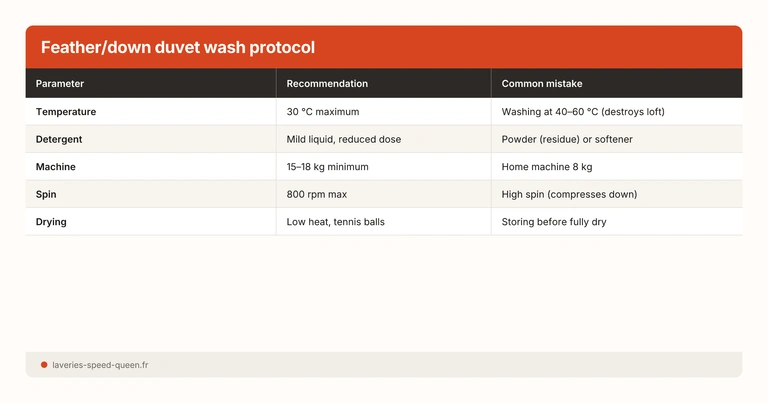
In short: A feather or down duvet should be machine-washed at 30 °C, with mild liquid detergent, no fabric softener, in a minimum 15-18 kg machine. The critical point is not washing, it is drying. Poorly dried down clumps, loses loft, and can develop mould. Tennis balls and fully complete drying are essential.
Quick Answer
Temperature: 30 °C max — heat damages down loft.
Mild liquid detergent, reduced dose — no powder, no fabric softener, no bleach.
15-18 kg machine minimum — wet down expands heavily, so you need space.
Drying is the critical step — tennis balls + 100% complete drying required.
Can You Really Wash a Feather Duvet in a Machine?
Yes, and it is often better than dry cleaning. Most feather and down duvets sold today are designed for machine washing. The wash-tub symbol on the label (usually 30 °C) confirms it.
Dry cleaning uses solvents (perchloroethylene) that can weaken down filaments over time and reduce insulation. Water washing, at the right temperature with the right detergent, is gentler on natural filling, as long as you follow a proper method.
ALWAYS Check the Label
If the care label shows a crossed-out wash-tub symbol, the duvet is NOT machine washable. This is uncommon on recent models, but some older or high-end duvets (for example eider down or mixed feather-silk filling) may prohibit it. In that case, use a down-care specialist rather than a standard dry cleaner. See
our guide to checking whether your duvet is machine washable
.
Why Down Needs Different Care
Down is not a standard textile. Each down cluster is a three-dimensional structure that traps warm air. That is what makes a duvet insulating and light. This structure is fragile and behaves differently from cotton or synthetic filling.
Heat sensitivity
Above 30-40 °C, down filaments weaken and lose their ability to trap air. Loft drops irreversibly. That is why nearly all manufacturers cap washing at 30 °C.
Fabric softener sensitivity
Fabric softener leaves a greasy coating on down filaments, making them stick together. Result: less loft, less insulation, and more clumps. Fabric softener is the number one enemy of down.
High wet volume
Down absorbs a lot of water and expands significantly. A 2 kg dry duvet can weigh 5-6 kg when wet and fill most of a 10 kg drum. That is why 15-18 kg machines are recommended.
Down vs Feathers: What Changes for Washing
The terms “down” and “feathers” are often used interchangeably, but they are different fillings and do not react the same way during washing.
Down
Down comes from the chest area of geese or ducks. These are three-dimensional clusters without a hard shaft, trapping a large volume of air relative to weight. Down gives a duvet its loft and high insulation.
During washing: down is more delicate. When wet, it expands strongly and needs significant drum space. A 100% down duvet generally needs a 15-18 kg machine, even for single size. Drying also takes longer because clusters retain moisture deep inside.
Feathers
Feathers have a rigid shaft with barbs on each side. They are heavier and less insulating than down, but mechanically more robust.
During washing: feathers tolerate agitation better and dry faster. However, they form dense clumps more easily because shafts can interlock. Tennis balls are even more important when drying feather-filled duvets.
Mixed Duvets (Most Common Case)
Most duvets sold in France and Europe use a blend, for example “70% down / 30% feathers.” The down percentage determines loft and price: more down means a lighter, puffier, and more expensive duvet. The washing method stays the same: 30 °C, mild liquid detergent, no fabric softener.
Why You Should NEVER Use Fabric Softener on Down
Fabric softener is the worst product for down. Once you understand the mechanism, you will avoid this mistake permanently.
Fabric softener works by depositing a cationic film (positively charged fatty molecules) on fibres. On cotton, that can feel softer. On down filaments, the same film does the opposite: it glues filaments together, stopping clusters from fully opening.
What fabric softener does to down in practice
The greasy film from fabric softener creates three harmful effects on natural filling:
• Loss of loft — stuck clusters can no longer expand, so the duvet gradually flattens.
• Loss of insulation — without trapped air between clusters, the duvet keeps much less warmth.
• Hard-to-reverse clumping — glued clusters form dense lumps that are difficult to separate, even with dryer balls.
If you have already used fabric softener, run an extra wash cycle with water only (30 °C) to rinse out as much residue as possible. For alternatives, see
our article on whether fabric softener is actually useful
.
Choosing the Right Machine: The 2/3 Rule
Machine size is the most underestimated factor. The duvet should fill no more than two thirds of the drum. The remaining third is needed for water and detergent circulation.
Practical test
Roll your duvet and place it in the drum. If it fills more than two thirds, the machine is too small. Here are practical size benchmarks:
| Duvet size | Typical weight (down) | Minimum machine | Recommended machine |
|---|---|---|---|
| Single (140 × 200 cm) | 800 g - 1.2 kg | 10-12 kg | 15 kg |
| Double (200 × 200 cm) | 1.2 - 1.8 kg | 15 kg | 18 kg |
| King size (240 × 220 cm) | 1.5 - 2.2 kg | 18 kg | 18 kg |
| All-seasons duvet (2 duvets) | — | Wash each duvet separately | |
For a double feather duvet, a 15-18 kg machine is close to essential. A domestic 8-10 kg machine is generally too small: the duvet stays compressed, washing is superficial, and rinsing is incomplete.
Full Step-by-Step Method
Before washing
- Inspect the duvet — seams intact, no holes, no heavily worn areas. A small tear means feathers everywhere in the drum.
- Pre-treat stains — gently rub with a little liquid detergent diluted in cold water. Leave for 10 minutes.
- Remove the duvet cover — wash the cover separately (it tolerates higher temperatures).
Washing settings
| Setting | Recommended value | Why |
|---|---|---|
| Temperature | 30 °C (40 °C max if label allows) | Protects down filaments |
| Cycle | Delicate, wool, or duvet cycle | Gentle movement, suitable cycle profile |
| Detergent | Mild liquid detergent, reduced dose (2/3 of normal dose) | Rinses out better from thick filling |
| Fabric softener | ❌ None | Coats filaments, destroys loft |
| Spin speed | 800 rpm maximum | Limits filling compression |
| Rinsing | Double rinse if available | Removes detergent residue from down |
| Machine size | 15-18 kg minimum (double) | Duvet must tumble freely in the drum |
Drying: the step that decides the result
Drying matters more than washing. Poor drying causes irreversible clumps, mould, odour, and loft loss. Drying must be fully complete before you put the cover back on or store the duvet.
Tennis balls are essential
2-3 clean tennis balls (or dedicated dryer balls) strike the filling while the drum turns. They break clumps, redistribute down, and help warm air reach the centre.
Low to medium heat
50-60 °C maximum. High heat weakens down during drying just as it does during washing. In a laundromat, choose a low or medium setting.
Several short cycles, not one long cycle
Run 2-3 cycles of 20-25 minutes rather than one 70-minute cycle. Between cycles, remove the duvet, shake it hard, and redistribute filling by hand.
Check the centre before storage
Press the middle firmly. Any cool feeling means it is not finished. The core is always the last part to dry. At Speed Queen, wash + dry takes about 1 hour. At home, drying alone often takes 3+ hours.
Why tennis balls are essential for down drying
Tennis balls are not a gimmick. With down, they are a genuine technical tool. Wet down naturally forms compact clumps inside duvet boxes. Without mechanical action during drying, these clumps harden and become difficult to redistribute once dry.
Use 2 to 3 clean tennis balls (or dedicated wool/rubber dryer balls↗). Put them in the dryer with the duvet. As the drum rotates, the balls strike the filling, break clumps, separate down clusters, and let warm air reach the centre.
This reproduces the manual beating used by traditional down makers to restore loft. In a dryer, the effect is continuous and regular. The result is visible immediately: a duvet dried with balls regains volume, while one dried without balls often stays flat and uneven.
Best laundromat method: run a first 20-to-25-minute drying cycle with balls, then remove the duvet, shake it hard, and manually redistribute filling. Start a second cycle. This two-pass method improves even drying and maximum loft. At Speed Queen laundromats, professional drying plus tennis balls often gives a near-like-new result.
NEVER store a damp down duvet
Damp down filling can develop mould within hours. Musty odour can set into feathers and may require a full new wash to remove. If you are unsure the centre is dry, run another 15-minute cycle.
Restoring Loft After Washing
Loft recovery depends on drying quality and mechanical action during drying. Use this full protocol to restore original volume.
During drying (most important)
- Tennis balls: place 2-3 clean tennis balls in the dryer. They strike the filling each rotation, breaking clumps and redistributing clusters.
- Short cycles: run 2-3 cycles of 20-25 minutes instead of one long cycle. Between cycles, remove the duvet and shake it vigorously in all directions.
- Manual redistribution: between cycles, feel each stitched section. If you detect a clump, massage it between your fingers to separate clusters. Spread filling evenly.
- Low heat: 50-60 °C max. Excessive heat weakens down filaments and reduces long-term loft.
After drying
- Shake again: once fully dry (check the centre), shake vigorously 10-15 times. Tap sections that still look flat.
- Air exposure: lay the duvet out on a bed or rack for 2-3 hours. Ambient air helps clusters fully open.
- Moderate sun: 1-2 hours of sunlight (no more) helps deodorize and finish drying. UV light also has a mild disinfecting effect.
If loft does not come back
If the duvet stays flat after drying and shaking, the filling is often still damp (run another cycle) or fabric softener was used (run a clear-water cycle to remove residue). If the down is genuinely worn out (duvet older than about 10 years), filling may be at end of life and no longer recover full loft.
Laundromat vs Dry Cleaner vs Home
| Option | Cost | Time | Risk for down |
|---|---|---|---|
| 18 kg laundromat machine | €10-€18 (wash + dry) | about 1 hour at Speed Queen | Low (soft water, large drum) |
| Dry cleaner / dry cleaning | €20-€40 | 3-7 days | Moderate (solvents can weaken feathers long term) |
| Home machine (≥12 kg) | about €2 (water + detergent + electricity) | 4-5 hours (wash + dry) | Moderate (drum often too small, drying often incomplete) |
| Home machine (<10 kg) | — | — | High (drum too small, poor wash and drying quality) |
Common Mistakes
- Using fabric softener — number one enemy of down. It glues filaments and can permanently destroy loft.
- Washing at 60 °C — even when the duvet looks "very dirty," down cannot handle this temperature. 30 °C is enough for hygiene when the cycle is complete.
- Forcing the duvet into a small machine — down will not move properly, washing is superficial, and rinsing remains incomplete.
- Partially drying then storing — mould is almost guaranteed. Down must be fully dry at the centre before storage.
- Skipping tennis balls in drying — without them, down forms dense clumps that are much harder to fix later.
- Using powder detergent — it dissolves poorly in thick filling and can leave white residue on feathers.
Methodology and Sources
This guide is based on care recommendations from major down-duvet manufacturers (Dodo, Drouault, Castex), GINETEX labelling standards, and day-to-day professional laundromat operations. Temperatures and durations are practical benchmarks: always follow your duvet care label first.
Sources and References
- Dodo, Can you machine wash your duvet? Our advice, accessed March 15, 2026
- GINETEX, Textile care symbols, accessed March 15, 2026
- EDFA (European Down and Feather Association), Down care recommendations, accessed March 15, 2026
- Speed Queen, Technical documentation for 18 kg washers and professional dryers
- Drouault, How to care for down duvets: our advice, accessed March 23, 2026
- How to wash a duvet: complete guide
- How to check if your duvet is machine washable
- Duvet at the laundromat: cost, drying, and frequency
- Is fabric softener really useful?
- What machine capacity for a double duvet?
- Complete tumble-drying guide
As an Amazon Associate, we earn a small commission from purchases made through affiliate links in this article, at no extra cost to you. This helps us keep the site running and publish free guides.
Down can be machine-washed if you follow the right method. For best results, our Speed Queen laundromats in Toulouse and Blagnac offer 18 kg machines and professional dryers suitable for feather and down duvets. Also see our complete duvet-washing guide.