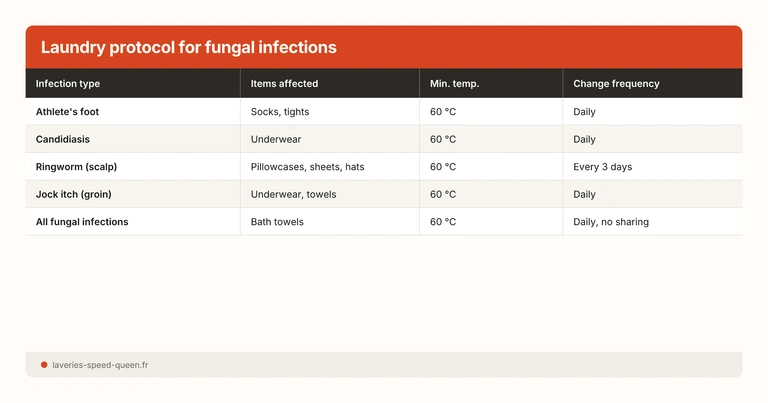
In short: laundry contaminated by a fungal infection (athlete’s foot, candidiasis, ringworm) must be washed at 60 degrees C minimum on a standard cycle. Separate infected items from the rest of the family’s laundry, do not share towels, and dry completely without delay. Maintain this protocol throughout medical treatment plus 2 weeks after symptoms disappear. Regular detergent is sufficient at 60 degrees C — no special disinfectant needed.
At a Glance
60 degrees C minimum, standard cycle — fungi survive at 40 degrees C.
Separate contaminated laundry — socks, underwear, towels washed apart.
Complete drying mandatory — fungi thrive in damp environments.
Protocol during treatment + 2 weeks after — to prevent reinfection.
Quick Answer: Why Laundry Matters During a Fungal Infection
Because the fungi responsible for skin infections — dermatophytes and Candida yeasts — survive on textiles and can cause reinfection even if medical treatment is followed correctly.
Infected skin continuously sheds fungal spores that land on everything it touches: socks, underwear, bath towels, sheets. If these textiles are not washed at a high enough temperature, the spores remain viable and recontaminate the skin at every contact. This is one of the most common reasons fungal infections “keep coming back” despite properly followed antifungal treatment.
What Science Says About Fungal Resistance to Washing
Fungi are more heat-resistant than common bacteria. Here is what studies show:
Dermatophytes
Dermatophytes (Trichophyton, Microsporum, Epidermophyton) cause athlete’s foot, nail infections, groin infections (jock itch) and scalp infections (ringworm). Their spores, called arthrospores, are particularly resistant:
- At 40 degrees C, a significant proportion of spores survive the wash cycle.
- At 60 degrees C, the vast majority of spores are destroyed during a standard 30-minute wash cycle.
- Complete drying is an essential complement because dermatophytes require moisture to germinate.
Candida Yeasts
Candida albicans, responsible for candidiasis (vulvar, oral, cutaneous), is slightly less heat-resistant than dermatophytes but has other characteristics:
- Candida can form biofilms on textiles, making it harder to remove by mechanical washing action alone.
- At 60 degrees C, the combined effect of heat and detergent surfactants effectively destroys the colonies.
- Candida yeasts multiply rapidly in warm, moist environments — fast drying of laundry is therefore critical.
Temperature is the decisive factor
Regular detergent is sufficient at 60 degrees C because the real antifungal work is done by heat. Surfactants dislodge spores from fibers, and the temperature destroys them. Going up to 60 degrees C transforms an ordinary wash into an effective antifungal protocol — with no additional product needed.
Complete Washing Protocol by Infection Type
Athlete’s Foot
Athlete’s foot is the most common fungal infection. It affects the spaces between the toes, the sole and sometimes the nails. Priority items:
Critical items: socks, tights, foot towels, bath mats, slippers.
Specific protocol:
- Change socks every day — twice a day if sweating is significant.
- Wash all socks at 60 degrees C. White cotton socks handle this temperature without issue. For technical sports socks, check the label — most polyesters tolerate 60 degrees C.
- The bath mat should be washed at 60 degrees C at least once a week during the infection.
- Dry socks completely — never store them still damp in a drawer.
Often overlooked: shoes. Shoes do not go in the machine at 60 degrees C, but they harbor the same fungi. Sprinkle them with antifungal powder or baking soda↗, and alternate pairs to let them dry completely between wearings.
Candidiasis (Vulvar, Cutaneous)
Candidiasis affects moist areas of the body: skin folds, vulvar area, armpits. Items to treat:
Critical items: underwear, panties, boxers, bath towels, washcloths, sheets if the affected area contacts the bedding.
Specific protocol:
- Change underwear every day — this is the standard even without an infection, but the reminder is useful.
- Prefer cotton underwear during treatment — it handles 60 degrees C washing better and is less favorable to fungal growth than synthetic fabrics.
- Bath towels should be changed every 2 days maximum during the infection.
- Sheets should be changed every 3-4 days if the candidiasis affects the torso or thighs.
Ringworm (Scalp, Body)
Ringworm is a highly contagious fungal infection, common in children. It affects the scalp, skin and sometimes nails. The textile protocol is stricter due to its high contagiousness.
Critical items: pillowcases, sheets, hats, scarves, combs and brushes (not machine-washable but must be disinfected), bath towels.
Specific protocol:
- Change the pillowcase every day if ringworm affects the scalp.
- Do not share any head items: hats, caps, combs, brushes, hair ties.
- Wash all textiles in contact with the infected area at 60 degrees C minimum.
- Ringworm is contagious enough to justify strict separate washing of the infected person’s laundry throughout treatment.
Which Items to Wash at Which Temperature
| Item | Temperature | Change frequency |
|---|---|---|
| Socks, tights | 60 degrees C | Daily |
| Underwear (cotton) | 60 degrees C | Daily |
| Underwear (lace, silk) | 30-40 degrees C + percarbonate | Daily |
| Bath towels | 60 degrees C | Every 2 days |
| Washcloths | 60 degrees C | Daily |
| Sheets, pillowcases | 60 degrees C | Every 3-4 days |
| Bath mat | 60 degrees C | Once a week minimum |
| Pajamas | 60 degrees C | Every 2 days |
Drying: The Step Everyone Underestimates
Complete drying of laundry is as important as the wash temperature. Fungi are organisms that depend on moisture to survive, germinate and multiply. Laundry washed at 60 degrees C but poorly dried or put away still damp recreates a favorable environment.
Drying Rules During a Fungal Infection
Tumble dryer: the best option
The tumble dryer guarantees fast, complete drying. The cycle heat reinforces elimination of any remaining viable spores. Start drying immediately after washing.
Air drying: possible but strict
If drying outdoors, choose a ventilated spot with direct sunlight. UV rays have a mild antifungal effect. Do not bring laundry in until it is completely dry to the touch.
What to avoid absolutely
Never leave damp laundry in the drum after washing. Do not dry contaminated laundry in a poorly ventilated room. Never put away an item that is still warm or slightly damp.
Speed = safety
The faster the laundry dries, the less time fungi have to survive or grow. The gap between the end of washing and the start of drying should be as short as possible.
Do Not Share: The Most Important Rule
Sharing towels, washcloths, socks and underwear is the primary transmission route for skin fungal infections within a household.
- Never share bath towels — every household member should have their own during the entire infection.
- Do not share socks or slippers — dermatophytes spread easily through foot contact.
- Do not share washcloths — direct contact with infected skin.
- Do not walk barefoot on shared rugs — wear flip-flops in the shared bathroom if you have athlete's foot.
- Do not mix infected laundry with family laundry — even in the dirty laundry hamper.
The Bathroom: Primary Transmission Zone
The bathroom combines all the factors that favor fungi: humidity, warmth, contact surfaces. During an active fungal infection:
- Bath mat: one per person, washed at 60 degrees C weekly.
- Towels: hung separately to dry between uses, never stacked while damp.
- Flip-flops or slides: wear them in the shower and on tile floors if you have athlete’s foot — especially in multi-person households.
- Surfaces: regularly clean the shower/bathtub floor and tiles with a household antifungal cleaner.
Protocol Duration
The enhanced washing protocol does not stop when symptoms disappear. Here are the milestones:
During Medical Treatment
- Separate washing at 60 degrees C for all items in contact with the infected area.
- Daily change of socks, underwear and washcloths.
- Towel change every 2 days.
- Sheet change every 3-4 days.
After Symptoms Disappear
- Continue the protocol for 2 additional weeks. Fungi can persist on the skin without causing visible symptoms. Stopping the textile protocol prematurely is one of the most common causes of recurrence.
- After these 2 weeks, you can resume normal washing — but keep the habit of washing socks and underwear at 60 degrees C regularly as good general hygiene practice.
When to See Your Doctor Again
If the fungal infection returns despite complete treatment and a properly followed textile protocol, consult your doctor. Some recurring infections require oral antifungal treatment (not just topical) or a mycological examination to precisely identify the fungus involved.
Laundry does not replace medical treatment
The textile protocol is an essential complement to the antifungal treatment prescribed by your doctor — it does not replace it. The cream, powder or oral treatment eliminates the fungus on the skin. Washing at 60 degrees C prevents reinfection through laundry. Both are necessary for lasting recovery.
Items That Cannot Handle 60 Degrees C
Some delicate textiles cannot withstand 60 degrees C. Here are the alternatives:
Lace, Silk, Fine Lingerie
- Wash at the maximum temperature allowed by the care label (often 30-40 degrees C).
- Add 2 tablespoons of sodium percarbonate↗ to the drum — it releases active oxygen that boosts antifungal action.
- Dry completely and quickly.
- During treatment, prefer cotton underwear that can handle 60 degrees C.
Wool, Cashmere
- Wash on a wool cycle at 30-40 degrees C with sodium percarbonate.
- Flat drying in a dry, well-ventilated area is important — do not let wool dry in a ball.
- If possible, avoid wearing these materials in direct contact with the infected area during treatment.
Shoes
Shoes cannot go in the machine at 60 degrees C but harbor the same fungi. In the meantime:
- Alternate pairs to allow at least 24 hours of drying between wearings.
- Sprinkle the insides with antifungal powder or baking soda.
- Prefer shoes made of breathable materials (canvas, leather) rather than closed synthetic ones.
The Laundromat Protocol
A laundromat is a practical solution when you need to quickly treat large volumes of contaminated laundry, or if your domestic eco program does not actually reach 60 degrees C.
1. Separate contaminated laundry
Transport it in a dedicated bag. Do not mix it with the rest of your laundry in the same basket.
2. Select the 60 degrees C program
Choose the standard cotton cycle at 60 degrees C. Professional laundromat machines reliably reach the displayed temperature.
3. Run a complete drying cycle
Transfer directly to the dryer. A full drying cycle at high heat ensures elimination of residual moisture.
4. Leave with laundry ready to put away
The laundry comes out dry and treated. Put it away directly in a clean bag or dry closet with no intermediate step.
Preventing Recurrence
Recurrence is the main challenge with skin fungal infections. A few habits significantly reduce the risk:
- Cotton or natural fiber socks: they absorb sweat better than synthetics.
- Change socks daily: even without an infection, this is the foundation of prevention.
- Dry feet thoroughly after showering, paying attention between the toes.
- Do not walk barefoot in locker rooms, pools or communal showers — fungi persist there.
- Air out shoes: never wear the same pair two days in a row while still damp.
- Wash towels at 60 degrees C regularly, even without an active infection.
Where This Guide Stops
This guide covers laundry contaminated by fungal infections. If your concern is laundry from a person with a viral or bacterial illness, see our guide on sick person’s laundry. For the right temperatures for each textile type, see a wash temperature guide.
Methodology and Sources
- British Mycological Society, Fungal skin infections
- NHS UK, Athlete’s foot — Prevention, updated 2025
- Textile Research Journal, Survival of dermatophytes on textiles at different wash temperatures, 2023
Sources and References
- NHS - Athlete’s foot prevention (lien externe)
- CDC - Fungal diseases (lien externe)
- American Academy of Dermatology - Ringworm (lien externe)
As an Amazon Associate, we earn a small commission on purchases made through the affiliate links in this article — at no extra cost to you. This helps us maintain this site and produce free guides.
Need to quickly treat contaminated laundry at 60 degrees C with complete drying? Find our laundromats in Toulouse and Blagnac. Professional machines reliably reach 60 degrees C and dryers guarantee complete drying in 20-30 minutes. Payment by card or contactless.