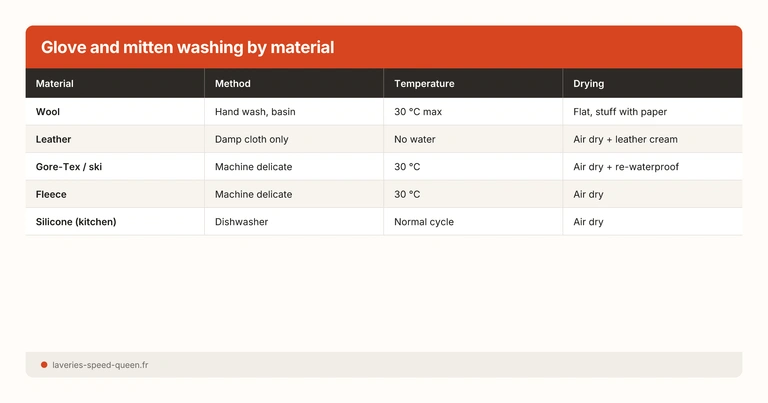
In short: every material has its own rules. Wool is hand washed at 30 °C (or wool cycle). Leather never tolerates water (damp cloth + cream). Ski/Gore-Tex gloves go in the machine at 30 °C with no softener. Fleece goes in the machine at 30 °C on a delicate cycle. Silicone kitchen gloves go in the dishwasher. For drying, stuff with paper and dry flat, away from heat.
Best Practices
Identify the material first — the care label determines the washing method. No label = gentlest treatment possible.
Leather = never water — leather deforms and cracks when dried. Damp cloth + conditioning cream only.
30 °C maximum for most gloves — wool, fleece, Gore-Tex, synthetic: all at 30 °C.
Stuff with paper for drying — holds the shape during air drying.
Never tumble dry leather — no radiator, no hairdryer either. Leather dries in open air, slowly.
By Material: The Complete Guide
Wool Gloves
Wool is a protein fiber (keratin) sensitive to heat, mechanical agitation and pH changes. Poorly washed wool gloves felt: the fiber scales open and tangle irreversibly, turning the knit into a compact, stiff fabric.
Recommended method: hand washing
- Fill a basin with lukewarm water (30 °C maximum — test with your hand, the water should be barely warm).
- Add a small amount of wool-specific detergent (or, alternatively, mild shampoo).
- Submerge the gloves and press gently. No rubbing, no wringing.
- Let soak for 10-15 minutes.
- Rinse at the same temperature (thermal shock felts wool just as much as heat).
- Press out excess water in a terry towel — lay the gloves on the towel, roll it up and press gently.
- Dry flat on a dry towel, in open air.
Machine possible? Only if your machine has a certified wool cycle (30 °C, minimal agitation, max 400 rpm spin). Place the gloves in a fine mesh laundry bag. The risk of felting remains.
For a complete wool guide, see our article on washing a wool sweater without shrinking.
Leather Gloves
Leather is a tanned animal skin that cannot tolerate water immersion. Water dissolves the tanning oils that keep leather supple, causing stiffening, deformation and cracking when it dries.
Method: dry cleaning (no water)
- Brush away dust and dry dirt with a soft brush (shoe brush type).
- Wipe with a slightly damp cloth (wrung out thoroughly) for stubborn marks. Never saturate leather with water.
- Leather cleaner — for deeper cleaning, use a leather cleaning milk or glycerine soap. Apply with a soft cloth in circular motions.
- Condition — after cleaning, apply a leather cream or balm (beeswax, mink oil, Saphir cream) to rehydrate and soften. Let absorb for 30 minutes, then buff with a soft cloth.
Leather gloves soaked by rain?
If your leather gloves got drenched by rain, do not dry them on a radiator or with a hairdryer. Stuff them with newspaper to absorb moisture and hold the shape. Let them dry slowly at room temperature (24-48 h). Once dry, condition generously with leather cream — drying evaporated some of the tanning oils.
Ski Gloves and Waterproof Gloves (Gore-Tex, Membrane)
Modern ski gloves are multi-layer technical products: a water-repellent outer layer, a waterproof-breathable membrane (Gore-Tex, Dryedge, etc.) and an insulating interior (Thinsulate, Primaloft, down). Washing must clean without clogging the membrane.
Method: machine at 30 °C
- Close all fastenings — Velcro, zips, drawstrings.
- Turn gloves inside out — the interior (in contact with sweat) should be exposed.
- Delicate cycle at 30 °C — mild liquid detergent, no fabric softener (softener clogs the membrane’s micropores and ruins breathability).
- Gentle spin — 600 rpm maximum.
- Air dry — stuff with paper towels and dry flat. No tumble dryer (heat can delaminate heat-sealed seams).
- Re-waterproof — once dry, apply a specific waterproofing spray↗ (Nikwax TX.Direct or Grangers type). This spray restores the outer layer’s water repellency.
For the rest of your ski equipment, check our guide on washing ski gear.
Mild liquid detergent
Use a neutral liquid detergent, without harsh enzymes or bleaching agents. Gore-Tex specific detergents (Nikwax Tech Wash, Grangers Performance Wash) are ideal but not essential — a standard mild detergent works.
No fabric softener
Softener deposits a waxy film on fibers that clogs the waterproof-breathable membrane's micropores. Result: the glove no longer breathes and sweat builds up inside. Guide: is fabric softener useful?
Re-waterproof after washing
Washing strips the DWR surface treatment. Without re-waterproofing, water saturates the outer layer instead of beading. Spray applies on clean, dry fabric, then reactivate with heat (tumble dryer low 10 min or iron through a cloth).
Heated gloves
Heated ski gloves (with built-in battery) require removing the battery and cables before any washing. Wash only the textile part. Check the manufacturer's instructions — some models are not machine washable.
Fleece Gloves
Fleece is a knitted polyester that is sturdy and easy to care for. It is the simplest material to wash on this list.
Method: machine at 30 °C
- Turn gloves inside out.
- Delicate or synthetic cycle at 30 °C.
- Mild liquid detergent. No fabric softener — it clogs fleece fibers and reduces softness and insulating power.
- Moderate spin (800 rpm max).
- Air dry. Tumble dryer is tolerated on low heat but alters texture over time.
Fleece is covered in our delicate fabrics guide (fleece section).
Cotton Gloves
Cotton gloves (liners, thin gloves) are the simplest to maintain. Cotton handles high temperatures and mechanical agitation.
Method: machine at 40 °C (60 °C for white gloves)
- Wash with your regular cotton laundry.
- Standard detergent, softener optional.
- Drying: air or tumble dryer, your choice.
Kitchen Gloves
Kitchen gloves come in several materials, each with its own specifics.
Silicone gloves
Silicone handles extreme temperatures (-40 °C to +230 °C) and detergents. Wash in the dishwasher (normal cycle) or by hand with dish soap and hot water. Air dry. The simplest care possible.
Cotton gloves (pot holders)
Cotton pot holders and thick gloves go in the machine at 60 °C. They absorb cooking grease — pre-treating stained areas with dish soap improves results. Tumble drying possible.
Aramid (Kevlar) gloves
Yellow cut-resistant aramid gloves wash in the machine at 40 °C, normal cycle. Do not bleach — bleach degrades aramid fibers. Air dry.
Neoprene kitchen gloves
Professional neoprene kitchen gloves (insulating, heat-resistant) are hand washed with mild soap and lukewarm water. They do not go in the machine. Same principle as wetsuit neoprene.
Gardening Gloves
Gardening gloves are often the most abused gloves in the household — dirt, mud, sap, resin, fertilizer. Fortunately, most are sturdy and easy to maintain.
By Glove Type
- Cotton or polyester gloves (the most common) — machine at 40 °C, normal cycle. Brush off dried dirt before washing to avoid clogging the machine. Guide: mud and dirt stains.
- Latex or nitrile-coated gloves — machine at 30 °C, delicate cycle. The coating handles machine washing but not high temperatures. Turn inside out so the interior gets properly rinsed.
- Thick leather gloves (rose pruning type) — wipe with a damp cloth to remove dirt. Dry brush. Leather cream if the leather stiffens. Not machine washable.
- Fine leather gloves (precision work type) — same treatment as dress leather gloves (see leather section above).
Sap and resin stains
Gardening gloves stained with tree sap or resin do not clean with water. Apply rubbing alcohol (70%) or vegetable oil on the stain to dissolve the resin, then wash normally. Full guide: removing sap or resin stains.
Disposable Gloves: Why They Cannot Be Washed
Disposable latex, nitrile or vinyl gloves are designed for single use. Their thickness (0.1-0.2 mm) does not withstand washing — invisible micro-perforations form, making the glove porous to contaminants.
Furthermore, washing does not reliably disinfect a disposable glove. Microorganisms infiltrate the micro-tears and remain trapped in the material. For sanitary or food use, discard and replace after each use.
If you want a reusable alternative, thick reusable nitrile gloves (household cleaning type) wash by hand with soap and hot water, and can be reused dozens of times.
Drying: Universal Rules
Whatever the material, drying is a critical step for gloves. The tubular shape of the fingers retains moisture and dries slowly, which promotes odors and mildew if drying is poorly managed.
Drying Protocol
- Squeeze without wringing — press gently between your hands or in a terry towel. Never wring wool or leather gloves.
- Stuff with paper — fill each finger with newspaper or paper towels. This absorbs interior moisture and maintains shape during drying.
- Dry flat or hanging — lay gloves on a drying rack or dry towel, in a ventilated area. Wool gloves must dry flat (the weight of water would deform them if hung).
- Replace the paper if needed — after a few hours, if the paper is saturated, replace it with dry paper to speed up drying.
- Never tumble dry leather — heat stiffens and cracks leather irreversibly.
- Never use a radiator — direct heat deforms leather and felts wool. Even drying near a radiator (without contact) is risky.
- Never use a hairdryer — concentrates heat on one area and can melt synthetics or stiffen leather.
- Tumble dryer only for cotton, polyester and fleece on low heat. Not for wool, leather, Gore-Tex or membrane gloves.
Recommended Washing Frequency
| Glove type | Frequency | Notes |
|---|---|---|
| Everyday gloves (wool, fleece) | 2-4 times per winter | More often if worn daily or if odor is noticeable. |
| Ski gloves | 2-3 times per season | After heavy sweating days. Re-waterproof after each wash. |
| Leather gloves | Clean 2-3 times per year | Condition 3-4 times per year. No water washing. |
| Kitchen gloves (silicone) | After every use | Dishwasher or hand wash, no constraints. |
| Kitchen gloves (cotton) | After every greasy use | Every 1-2 weeks for normal use. |
| Gardening gloves | After every heavy session | Brush off dirt between washes. |
| Sport gloves | After every use | Sweat = bacteria = odor. At minimum, dry between sessions. |
Special Case: Mittens
Mittens follow the same rules as gloves for the corresponding material. The only practical difference concerns drying: the single chamber of mittens dries faster than the five separate fingers of a glove, but retains more moisture at the bottom. Stuff generously with paper and turn the mittens inside out mid-drying so air circulates inside.
Hand-knitted wool mittens (Icelandic or Norwegian style) are often made of untreated pure wool — they felt even more easily than factory gloves. Wash exclusively by hand at 30 °C.
Summary Table by Material
| Material | Machine? | Temperature | Drying |
|---|---|---|---|
| Wool | Hand (or wool cycle) | 30 °C max | Flat, air dry |
| Leather | NEVER | Damp cloth | Air dry, paper inside |
| Gore-Tex / ski | Yes (delicate) | 30 °C | Air dry, paper inside |
| Fleece | Yes (delicate) | 30 °C | Air dry |
| Cotton | Yes | 40-60 °C | Air dry or tumble dryer |
| Silicone (kitchen) | Dishwasher | 60-65 °C | Air dry |
| Gardening (cotton/poly) | Yes | 40 °C | Air dry or tumble dryer |
| Disposable (latex/nitrile) | NOT WASHABLE | — | — |
Mistakes to Avoid
- Washing leather gloves with water — leather deforms, stiffens and cracks when it dries. Damp cloth only.
- Hot water on wool — wool felts irreversibly above 30 °C. Cold or lukewarm water only.
- Softener on Gore-Tex or fleece — clogs the membrane micropores (Gore-Tex) or fleece fibers. Reduces breathability and insulation.
- Tumble dryer for leather or wool — heat is destructive for both materials. Air dry, be patient.
- Reusing washed disposable gloves — washing creates micro-perforations. The glove is no longer a reliable barrier.
- Forgetting to re-waterproof ski gloves — after washing, water repellency is reduced. Without treatment, the gloves absorb water instead of repelling it.
The Laundromat for Your Winter Laundry
Gloves and mittens are easy to wash by hand or in a home machine. But the rest of your winter wardrobe — puffer jacket, duvet, scarf — often needs a large-capacity machine that only a laundromat can offer. A puffer jacket needs room in the drum for the filling to be properly washed and rinsed.
As an Amazon Associate, we earn a small commission on purchases made through the affiliate links in this article — at no extra cost to you. This helps us maintain this site and produce free guides.
Our laundromats have professional 9 to 18 kg machines for your bulky winter items. Payment by contactless card or cash. Check our prices.
Sources and References
- Wash a wool sweater without shrinking
- How to wash ski gear
- Delicate fabrics: silk, cashmere, lace, fleece
- Is fabric softener useful?
- Remove sap or resin stains
- Remove mud and dirt stains
- How to wash a puffer jacket
- Washing temperatures guide by fabric
- Gore-Tex membrane properties — PTFE micropores, DWR treatment and recommended care
- Tanned leather care — role of tanning oils, rehydration and crack prevention