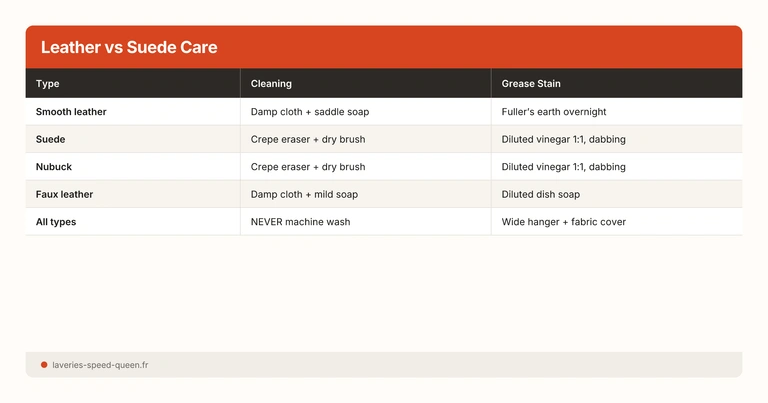
In short: Leather and suede should never be machine washed or put in a laundromat — water and agitation irreversibly destroy tanned hide. Smooth leather is maintained with a damp cloth + saddle soap, suede with a crepe eraser + brush. Grease stains are treated with fuller’s earth (absorbent powder). Condition leather 2-3 times a year and waterproof suede with spray. Store on a wide hanger, no plastic garment bags.
At a glance
Never machine wash — not at home, not at the laundromat. Water destroys collagen fibers and tanning oils.
Smooth leather = damp cloth — saddle soap or makeup remover milk. Wipe, don't soak.
Suede = crepe eraser + brush — work dry. Suede can't handle prolonged moisture.
Grease stain = fuller's earth — absorbent powder left overnight. Brush off the next morning.
Wide hanger + fabric cover — leather needs to breathe. No plastic, no radiator, no direct sun.
Why leather can’t be washed with water
Leather is tanned animal hide — it’s not a textile. Its structure is fundamentally different from a woven fiber (cotton, polyester, wool). Understanding this structure explains why water and machines are destructive.
Collagen. The hide is made of interwoven collagen fibers. Tanning (vegetable or chrome) stabilizes these fibers by creating cross-links that prevent decomposition. Large amounts of water swell the collagen fibers — they absorb up to 3 times their weight in water. This swelling distorts the three-dimensional structure of the hide.
Tanning oils. During leather manufacturing, oils and fats are incorporated to soften the hide (conditioning, greasing). Washing with soap and water emulsifies and extracts these oils. Without them, the leather stiffens, cracks, and loses its suppleness — irreversibly.
Mechanical agitation. The tumbling of a washing machine drum subjects leather to stresses that tanned hide simply cannot withstand. Forced folds, twisting, friction against the metal drum — the result is deformed, cracked, and ruined leather.
That’s why even the gentlest cycles (wool, silk) are destructive for leather. The volume of water and contact time alone are enough to damage the structure.
- NEVER machine wash leather — not on normal, not on delicate, not on cold. Leather is not a washable textile.
- NEVER put leather in a laundromat machine — professional machines are even more vigorous than home machines.
- NEVER soak leather in water — even a basin of soapy water destroys tanning oils.
- NEVER dry leather on a radiator or in a dryer — heat rapidly dries out leather and causes irreversible cracking.
Smooth leather: cleaning and care
Smooth leather (cowhide, lambskin, calfskin) is the most common for jackets, bombers, and coats. Its care is straightforward if you respect two principles: minimal water and regular conditioning.
Routine cleaning (every 2-4 weeks)
- Dust with a soft dry cloth (microfiber or cotton) after each extended wear.
- Clean with a slightly damp cloth (wrung out as much as possible) with a drop of saddle soap (glycerin soap for leather) or Marseille soap (an accessible alternative).
- Wipe dry immediately with a dry cloth — never leave moisture on leather.
- Air dry, away from any heat source.
Saddle soap: the key tool
Saddle soap (also called glycerin leather soap) is formulated specifically for leather. It contains glycerin↗ that cleans without drying out, unlike regular soaps which are too degreasing. It’s the product used by equestrians to maintain saddles and harnesses — leathers subjected to conditions far harsher than a jacket.
Makeup remover milk: the accessible alternative
If you don’t have saddle soap, makeup remover milk is an excellent substitute for routine smooth leather cleaning. It’s a gentle emulsion (water, oil, mild surfactants) designed to remove impurities from delicate skin — exactly what leather needs. Apply with cotton, wipe with a dry cloth. Avoid alcohol-based makeup removers or micellar water — they’re too degreasing.
Conditioning leather (2-3 times a year)
Leather naturally dries out — tanning oils evaporate over time, especially in heated indoor environments (dry air). Unconditioned leather cracks, stiffens, and ages prematurely.
- Clean the jacket before conditioning (saddle soap or makeup remover milk).
- Apply a leather conditioning balm or colorless wax in a thin layer with a soft cloth. Circular motions.
- Let absorb for 15-30 minutes.
- Buff with a clean cloth in quick motions.
Products based on beeswax or lanolin are the most natural and effective for conditioning leather.
Stain removal on smooth leather: by stain type
Grease stain (oil, butter, dressing)
Immediately sprinkle fuller's earth (absorbent clay) or talc. The powder absorbs grease by capillary action. Leave overnight (8-12 hours). Brush gently. Repeat if needed. Never rub greasy leather with water.
Water stain (ring mark)
Paradoxically, a water stain on leather is treated with water. Evenly dampen the entire surface (not just the stain) with a damp cloth. The water redistributes mineral salts. Dry away from any heat. The ring disappears.
Ink stain
Blot with a cotton pad dampened with 70% rubbing alcohol (not 90% — too harsh for leather). Test on a hidden area. If the stain persists, apply makeup remover milk and let sit 10 min. For stubborn stains, use a professional.
Mold
Mold appears if leather is stored in a damp place. Brush off visible spores with a soft brush. Blot with a cloth dampened with water + white vinegar (50/50). Let dry. Condition the leather after treatment — vinegar is drying.
Suede and nubuck: dry care
Suede and nubuck are leathers with a sanded surface whose raised fibers create a velvet-like feel. This open surface makes them more vulnerable to stains than smooth leather — but also easier to treat mechanically.
The essential tool: the crepe eraser
The crepe eraser (suede eraser) is a block of natural rubber that rubs away surface stains without damaging suede fibers. It’s the equivalent of a pencil eraser for leather.
- Wait until the stain is dry — never work on wet suede.
- Rub the eraser on the stain in light circular motions. The rubber particles carry away the dirt.
- Brush with a crepe brush or brass brush (fine bristles) to lift the crushed fibers and restore the velvety texture.
Specific stains on suede
Grease stain: Fuller’s earth↗ (same method as on smooth leather). The powder penetrates well into suede’s open fibers. Leave overnight, brush.
Water stain: Evenly mist with distilled water from a spray bottle. The salts redistribute. Dry flat, away from heat. Brush once dry.
Stubborn stain: Blot with a cloth dampened with white vinegar↗ diluted (1 part vinegar to 1 part water). Vinegar lifts ground-in dirt without attacking the leather. Let dry, brush.
Mud stain: Let dry completely. Brush off dried mud with a stiff-bristle brush. Run the crepe eraser over the residue. Brush to lift fibers. The same logic as for mud stains on textiles applies: always dry.
Suede soaked by rain
If your suede jacket gets soaked by rain, don’t panic. Blot excess water with a bath towel (blot, don’t rub). Dry flat (not on a hanger — the weight of wet leather distorts the shoulders), away from any heat. Once dry, brush vigorously in all directions to lift the flattened fibers. Apply a waterproofing spray.
Waterproofing: preventive protection
Waterproofing is the best strategy for protecting leather and suede. It creates an invisible barrier that repels water and dirt.
Smooth leather
- Wax: natural waxes (beeswax, carnauba) waterproof while conditioning. Apply 2-3 times a year.
- Waterproofing spray: convenient and quick. Spray from 20-30 cm away, let dry 10 minutes. Reapply at the start of the rainy season.
Suede and nubuck
- Silicone waterproofing spray: essential for suede. Silicone or fluoropolymer products (like Saphir, Famaco) protect the open fibers without altering the velvety feel.
- Frequency: after each deep cleaning and at the start of each wet season (fall, winter).
Storage: the essential rules
Poor storage causes more damage to leather than daily wear. The three enemies of stored leather are moisture (mold), heat (drying), and light (fading).
Wide hanger
Use a wide-shouldered hanger (wood or thick plastic, at least 5 cm wide at the shoulders). A wire hanger distorts leather shoulders — the jacket's weight concentrates pressure on a narrow point. Heavy cowhide jackets need reinforced hangers.
Breathable cover (cotton or non-woven)
Never a plastic garment bag (from the dry cleaner). Plastic traps moisture and promotes mold. Leather needs to breathe. Use a cotton or non-woven cover that protects from dust while allowing air circulation.
Cool, dry location
Ideal temperature: 15-20 °C (60-68 °F). Relative humidity: 40-60%. Avoid attics (too hot in summer), basements (too damp), and closets against poorly insulated exterior walls (condensation). A ventilated interior dressing room is ideal.
Out of the sun
UV rays fade leather and dry out its surface. Don't hang a leather jacket near a sunny window. If your wardrobe gets direct sun, keep the cover closed at all times.
When to go to a professional
Professional leather cleaning isn’t ordinary dry cleaning. Leather specialists use specific techniques and products (adapted solvents, color touch-up, professional conditioners).
Take your jacket to a leather professional in these cases:
- Old, set-in stain that home methods haven’t removed.
- Widespread mold (not just a few spots).
- Very dry leather with visible cracking — the professional can rehydrate and soften.
- Discoloration or color change — professional color touch-up.
- Dirty or damaged lining — some craftspeople can replace the lining.
- Exotic leather (reptile, ostrich) — these leathers require specialized expertise.
Professional leather cleaning costs between 30 and 80 dollars/euros depending on the garment and its condition. It’s a worthwhile investment for a quality jacket that can last 20 years with proper care.
Mistakes to avoid
- Machine or laundromat washing — irreversible destruction. Leather is not a washable textile.
- Drying on a radiator or in a dryer — heat rapidly dries out leather, causing cracking and stiffening.
- Using colored shoe polish without testing — polish that's too dark or low quality can tint leather unexpectedly. Test on a hidden area.
- Storing in a plastic garment bag — plastic traps moisture and promotes mold. Use cotton or non-woven covers.
- Wearing leather in heavy rain without waterproofing — untreated leather absorbs water like a sponge. Waterproof before the rainy season.
- Cleaning wet suede — wet suede is fragile. Wait until completely dry before brushing or erasing.
Summary: 4 common scenarios
Scenario 1 — Seasonal cleaning of a cowhide leather jacket: Dust with a dry cloth, clean with saddle soap (damp wrung-out cloth), wipe dry immediately, air dry, apply conditioning balm, buff. 30 minutes.
Scenario 2 — Vinaigrette stain on a leather jacket: Blot excess with paper towels (don’t rub). Sprinkle fuller’s earth, leave overnight. Brush the next morning. Clean with makeup remover milk. Result: stain gone in 90% of cases.
Scenario 3 — Rain mark on a suede jacket: Re-dampen evenly with a mist spray. Dry flat, away from heat. Brush vigorously once dry. Apply waterproofing spray↗.
Scenario 4 — Leather jacket not worn for 2 years (mild mold): Brush off spores, blot with diluted white vinegar, dry. Condition generously with leather balm. If cracking or widespread mold, take to a leather professional.
Conditioning to protect: preventive leather care
Leather is a skin — it needs hydration to stay supple and resilient. Well-conditioned leather repels water better, resists stains, and develops a beautiful patina instead of cracking.
Apply a leather conditioning balm (beeswax, lanolin-based balm) every 3-6 months depending on use. Work the product in small amounts with a soft cloth, in circular motions. Let absorb for 30 minutes, then buff with a clean cloth. This simple step adds years to a leather jacket’s lifespan.
For suede, preventive care means a waterproofing spray applied every 2-3 months. Untreated suede absorbs water like a sponge and stains irreversibly. A good waterproofing spray (15-20 dollars/euros at a shoe repair shop) creates an invisible barrier that beads water without altering suede’s velvety feel.
As an Amazon Associate, we earn a small commission on purchases made through affiliate links in this article — at no extra cost to you. This helps us maintain this site and produce free guides.
Leather and suede can’t go in the machine — but your other textiles can. Our laundromats have professional machines from 9 to 18 kg with detergent included, ideal for puffer jackets, duvets, and curtains. Payment by contactless card or cash. Check our prices.
Sources and references
- Dry cleaning and alternatives (leather cleaning)
- Tough stain solutions for all stains
- Remove a mud or dirt stain
- Delicate fabrics care guide
- Laundry care labels and symbols
- Washing temperature guide
- Collagen structure in leather — type I collagen fibers, cross-links from chrome and vegetable tanning
- Water absorption and desorption in leather — collagen fiber swelling and extraction of conditioning oils