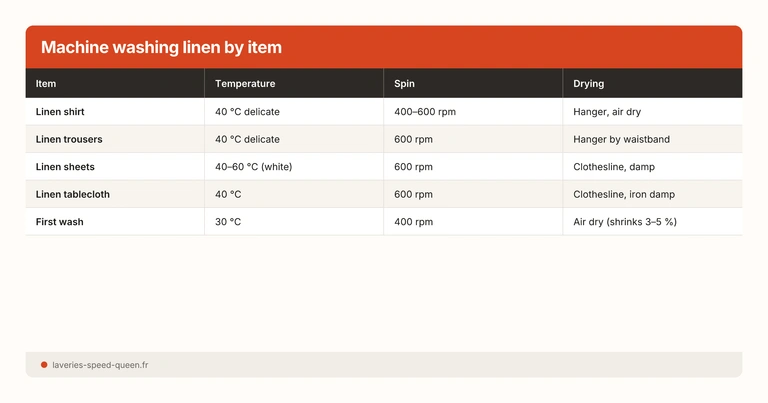
In short: machine-wash linen at 40 °C maximum (30 °C for the first wash), on a delicate cycle, with spin capped at 600 rpm. Air-dry whenever possible. The weight of water naturally smooths wrinkles. Always iron linen while damp with a hot iron (200 °C). Linen shrinks only moderately (3-5% on first wash, then stabilizes) and gets softer with every wash. Skip fabric softener: white vinegar works better.
Quick answer
40 °C max — use 30 °C for the first wash to limit initial shrinkage (3-5%).
600 rpm spin — high spin creates deep creases that are very hard to remove.
Air-dry — hang while damp on a wide hanger. Water weight helps smooth fibers.
Damp ironing at 200 °C — linen only smooths properly with heat plus moisture.
No fabric softener — linen softens naturally over time. White vinegar is enough.
Do not overload — linen needs drum space so it does not get compressed.
Linen properties: a fiber that gets better over time
Linen is a plant-based fiber extracted from the stem of Linum usitatissimum. It is one of the world’s oldest textiles and offers standout performance for both clothing and household textiles.
Exceptional strength
Linen is around 30% stronger than cotton at equal weight. Its long, uniform fibers (50-80 cm) handle high tension without breaking. That is why linen sheets can last for decades. They get softer over time without losing strength.
Higher moisture absorption
Linen can absorb up to 20% of its weight in water before it feels damp to the touch (versus about 8-10% for cotton). This makes it ideal for towels, kitchen cloths, and summer bedding because it moves moisture away efficiently.
Wrinkling: the trade-off
Linen fibers are rigid and low-elasticity (2-3% elongation at break, compared with 7-8% for cotton). When linen is folded, compressed, or spun, the fibers deform and stay that way instead of springing back. That is what creates linen’s signature creases.
This wrinkling is not a manufacturing defect. It is an intrinsic property of the fiber. No detergent trick can remove it completely. But a good wash and dry routine can reduce it a lot.
Linen gets softer: patience pays off
New linen often feels stiff and slightly rough. That is normal. With each wash, water and detergent surfactants loosen the fibers without damaging them. After 5 to 10 washes, linen develops the soft, fluid hand feel it is known for. Unlike cotton, which wears out with repeated washing, linen usually improves.
First wash: special precautions
The first wash of a new linen item is the most critical step. This is when most shrinkage occurs (3-5% for standard linen, 1-2% for pre-shrunk/sanforized linen).
30 °C maximum — on first wash, hot water speeds shrinkage by releasing residual weaving tension.
Delicate cycle — less mechanical agitation means less stress on still-new fibers.
400 rpm spin — a lower first spin reduces mechanical stress.
No mixing — wash linen alone for the first cycle. Unstabilized dyes can bleed, especially dark shades (navy, black).
After the first wash, measure the item and compare with original dimensions. If shrinkage is above 5%, the linen was likely not pre-shrunk in manufacturing. Expect similar shrinkage on the second wash. By the third wash, dimensions usually stabilize.
Washing temperature: the right setting
The washing temperature for linen depends on the type of item and soil level.
| Item | Temperature | Cycle | Note |
|---|---|---|---|
| Shirt / blouse | 30-40 °C | Delicate | Turn inside out, close buttons |
| Pants / skirt | 30-40 °C | Delicate | Zippers closed, pockets emptied |
| Summer dress | 30 °C | Delicate | Laundry mesh bag recommended for details |
| Sheets / duvet cover | 40-60 °C | Gentle cotton | 60 °C for occasional disinfection |
| Tablecloth / napkins | 40-60 °C | Gentle cotton | |
| Kitchen towels | 60 °C | Normal cotton | Linen dish towels are highly durable |
General rule: 40 °C is the standard setting for linen. Go down to 30 °C for bright colors, brand-new garments, and delicate pieces. Go up to 60 °C only for heavily stained table linen, sheets you want to sanitize, and kitchen towels.
Cycle and spin: the two key factors
The cycle
Select a delicate or gentle cotton cycle. Avoid intensive cotton programs with strong mechanical action. Linen does not need aggressive agitation, and extra friction increases wrinkling.
Do not mix linen with heavy or abrasive textiles (jeans, thick terry towels). These rub against linen fibers and can create surface wear (light pilling, fuzzy appearance). Wash linen with lightweight pieces or alone.
Spin: the deciding factor
Spin is the main reason linen wrinkles in the machine. Centrifugal force presses wet fabric against the drum at high pressure, creating deep creases that even steam ironing struggles to remove.
- 600 rpm: best compromise. Linen comes out damp but with moderate wrinkles that are easier to smooth while drying.
- 400 rpm: ideal for highly wrinkle-prone items (dresses, dress shirts). Linen comes out very wet, so drying time is longer.
- 800 rpm and above: avoid. Wrinkles become deep and persistent.
Pro trick: skip spin entirely
For linen pieces that must be very smooth (event tablecloth, formal shirt), professionals often remove spin completely. Linen comes out soaked, then is hung immediately on a wide hanger. Water weight pulls fibers downward and smooths the fabric naturally. After air-drying, little to no ironing is needed.
Drying: make air your ally
Drying matters as much as washing for the final look. Good drying can offset a slightly strong spin. Bad drying can ruin an otherwise perfect wash.
Air-drying (recommended)
- Take linen out immediately after the cycle. Do not leave it compressed in the drum.
- Shake each item to release spin-created creases.
- Hang on a wide hanger (shirts, dresses) or a flat rack (tablecloths, sheets).
- Smooth by hand the most wrinkled areas.
- Dry in the shade. Direct sun can yellow white linen and fade dyed linen.
Linen dries faster than cotton because it releases moisture more easily. Expect around 2-4 hours outdoors in dry weather, or 4-8 hours indoors.
Tumble dryer (backup option)
A tumble dryer is possible but not ideal for routine use. Heat and drum rotation create wrinkles and increase cumulative shrinkage.
If you must use a dryer:
- Use delicate / low heat only.
- Remove linen while still slightly damp (do not dry fully).
- Hang or iron immediately. If linen cools in the dryer drum, wrinkling gets worse.
Ironing: the damp-linen method
Linen often needs ironing, but results improve dramatically with the right technique.
Why iron linen while damp?
Linen fibers are held rigid by internal hydrogen bonds. Water temporarily breaks those bonds, making fibers more flexible. The iron’s heat dries the fabric while flat, and new hydrogen bonds form in that flatter shape. Result: linen finishes smooth and crisp.
When dry, those bonds resist ironing. You can smooth the surface temporarily, but deep creases return as soon as the fabric cools. That is why dry-ironing linen is mostly wasted effort.
The protocol
- Linen should be damp. Either iron just after drying or mist with water.
- Set iron to high heat (200 °C, linen/cotton setting). Linen tolerates high heat very well.
- Iron inside out for dark colors to avoid shine marks.
- Use firm pressure. Linen needs pressure to flatten properly.
- For shirts: collar first, then cuffs, sleeves, front, and back. Use long, continuous passes instead of many short strokes.
Is steam alone enough? A handheld steamer is useful for quick refreshing, but it does not replace an iron for a crisp finish. Steam softens fibers on the surface, but without pressure deep wrinkles remain.
By item: practical guide
Linen shirt
Turn inside out, close buttons. Delicate cycle at 30-40 °C, 600 rpm spin. Dry immediately on a wide hanger. Iron damp at 200 °C, starting with the collar. Linen shirts are naturally relaxed. A light wrinkle effect is normal and often desired.
Linen pants
Close fasteners, empty pockets. Delicate cycle at 30-40 °C, 600 rpm spin. Hang by the waistband (clip on belt loops). Press crease lines on the right side with a damp pressing cloth for a sharp finish.
Linen dress or skirt
Laundry mesh bag recommended. Delicate cycle at 30 °C, 400 rpm spin. Dry on a hanger with the fabric panels hanging freely. Long dresses benefit most from no-spin drying because water weight smooths them naturally.
Sheets and duvet covers
Linen bedding is a long-term investment. Wash at 40 °C (60 °C occasionally for sanitizing). Spin at 600 rpm. Fold duvet covers before rack-drying or use a wide clothes horse. Ironing is optional. Many linen-sheet owners prefer the natural, unpressed look.
Tablecloth and napkins
Pre-treat stains (wine, grease, coffee) before washing. Use 40-60 °C depending on soil level. White linen handles sodium percarbonate well for whitening. Damp ironing is essential for a crisp table finish.
Linen dish towels
The most resilient linen items. Machine-wash safely at 60 °C on a normal cotton cycle. Linen holds odors less than cotton, a major advantage in kitchen use. No ironing needed.
Best detergent choice for linen
Detergent choice affects both lifespan and appearance.
Mild liquid detergent: best option. Liquid formulas dissolve fully and are less likely to leave white residue in the weave (a common issue with powder on dark linen).
Marseille soap: excellent for linen. Its natural surfactants are fiber friendly. Works well as flakes in the detergent drawer. Marseille soap is especially useful for linen tablecloths.
Avoid: powder detergents (residue trapped in weave), optical brighteners (possible yellowing in sun on white linen), and fabric softener (reduces absorbency and blocks natural softening).
Tip: add one cup of white vinegar to the softener compartment. It softens fibers, removes hard-water residue, and helps preserve colors without the downsides of chemical softeners.
Long-term care: making linen last
Linen is an investment. A quality linen shirt often costs around $90 to $220, and linen bed sheets can range from $170 to $450. Proper care extends lifespan substantially.
Wash frequency
Linen has natural antibacterial properties and resists odors better than cotton. A linen shirt can usually be worn 2 to 3 times before washing (unless there is visible sweat). Linen sheets are typically washed every 2 weeks (often less frequent than cotton). Table linens should be washed after each use.
Storage
Store linen loosely folded in a dry, ventilated space. Avoid plastic covers that trap moisture and limit airflow. Wide hangers (wood or velvet) are better than thin wire hangers that can mark shoulders.
Stain removal
Linen removes stains similarly to cotton because both are cellulosic fibers. All methods from our stain-removal guides apply: white vinegar↗, sodium percarbonate, Marseille soap↗, glycerin↗. Linen’s open weave absorbs stains quickly but often releases them well during treatment.
Preventing yellowing on white linen
White linen can yellow over time, especially when stored away from light. To prevent or correct yellowing, use an occasional soak (every 2 to 3 months) in a sodium percarbonate solution (2 tbsp per liter of water at 40 °C) for 2 hours. Active oxygen whitens fibers without harsh damage. See our full guide on whitening yellowed laundry.
Mistakes to avoid
- Spin above 600 rpm — creates persistent deep creases. 600 rpm is the upper limit, 400 rpm is ideal.
- Dry ironing — linen only relaxes when damp. Dry ironing is ineffective and wastes time.
- Using fabric softener — cationic agents coat fibers, block natural softening, and reduce absorbency by around 20-30%.
- Leaving linen in the machine after the cycle — linen compressed for hours wrinkles much more than linen removed immediately.
- Drying in direct sun — UV light yellows white linen and fades colors. Dry in shade.
- Twisting linen to wring it — twisting causes permanent fiber distortion. If hand-washing, press gently between two towels instead.
- Mixing with heavy textiles — jeans, terry towels, and garments with hard fasteners cause mechanical abrasion.
Recap: 4 common scenarios
Scenario 1 - New linen shirt (first wash): Turn inside out, delicate cycle at 30 °C, 400 rpm spin, dry immediately on a hanger. Measure after drying and expect about 3-5% shrinkage.
Scenario 2 - Linen sheets (regular use): Gentle cotton cycle at 40 °C, 600 rpm spin, air-dry. Ironing optional. Linen bedding usually reaches peak softness after 10 plus washes.
Scenario 3 - White linen tablecloth stained with wine: Pre-treat the stain with white vinegar, wash at 40-60 °C, add percarbonate if residue remains. Iron while damp at 200 °C for a crisp finish.
Scenario 4 - Linen pants badly wrinkled after washing: Mist generously with water and iron inside out at 200 °C. For very deep creases, re-soak in lukewarm water and hang dry without spinning.
As an Amazon Associate, we earn a small commission from qualifying purchases made through affiliate links in this article, at no extra cost to you. This helps us keep the site running and publish free laundry guides.
Large linen items (tablecloths, sheets, blankets) benefit from the drum space of professional machines. Our 18 kg machines include detergent, so linen has enough room to move without compression. Payment contactless card or cash. See our prices.
Sources and references
- Washing temperatures guide
- White vinegar for laundry: uses and limits
- Sodium percarbonate: complete guide
- How to whiten yellowed laundry naturally
- Fabric softener: useful or not?
- How often to wash sheets
- Delicate fabrics care guide
- Marseille soap for laundry
- European Confederation of Flax and Hemp (CELC) - physical and mechanical properties of flax fiber
- Ginetex - care symbols and guidance for plant-based fibers