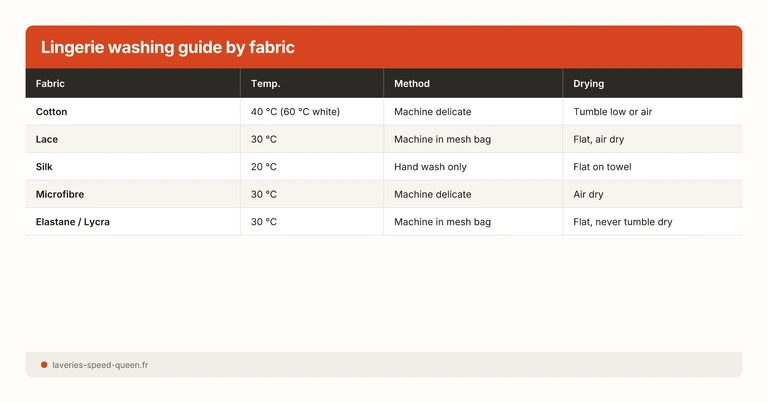
In short: lingerie is machine-washable as long as you follow three rules — mesh laundry bag (protects underwires and lace), 30 °C maximum on a delicate cycle, and no tumble dryer (heat destroys elastane). Fasten bra hooks before washing, use a gentle detergent without fabric softener, and dry flat. Recommended frequency: every 3-4 wears for bras, after every wear for underwear.
At a Glance
Mesh laundry bag required — protects underwires, straps and lace from drum friction.
30 °C max, delicate cycle — preserves elastane and fragile fibres.
Fasten hooks before washing — open hooks snag and damage other fabrics.
Zero fabric softener — it destroys elasticity and waterproofs fibres.
Dry flat, never tumble dry — heat warps cups and destroys elastane.
Why Lingerie Needs Special Care
Underwear combines some of the most fragile materials in textiles: elastane (Lycra, Spandex) for stretch, lace for aesthetics, metal or plastic underwires for support, and fine fibres (silk, microfibre) for comfort.
Elastane is the key component. Present in virtually all modern underwear (5-20 % of the fabric), it provides the stretch that ensures support and comfort. But this fibre is sensitive to heat (it loses elasticity above 40 °C), harsh chemicals (bleach, fabric softener) and mechanical friction (fast spin, no mesh bag).
Bra underwires don’t break in the machine — it’s the fabric holding them in place that wears down from friction. When that fabric gives way, the wire pokes through the cup. A mesh laundry bag↗ drastically reduces that friction.
By Fabric: Tailoring Your Wash
Each fabric has its own requirements. Here’s how to handle the main types of lingerie.
Cotton
The toughest lingerie fabric. Handles up to 40 °C (60 °C for plain white without elastane). White vinegar works as a natural softener substitute. Still prefer 30 °C if the garment contains elastane (check the label). Cotton is ideal for everyday wear: hypoallergenic, absorbent and easy to care for.
Lace
Fragile — lace can't handle friction or high temperatures. In the machine: mesh bag required, 30 °C, 400 rpm spin maximum. By hand: cold water, gentle detergent, press without wringing. Synthetic lace (polyamide) is tougher than cotton or silk lace, but the mesh bag is still essential.
Silk
A natural protein fibre, silk is the most delicate. Hand-wash recommended: cold water (20 °C max), mild shampoo or silk-specific detergent. In the machine: silk programme only, spin disabled, mesh bag. Never wring, never expose to direct sunlight. Dry flat on a towel.
Microfibre (Polyamide / Polyester)
Soft, durable and quick-drying, microfibre is the easiest lingerie fabric to maintain. 30 °C in the machine, mesh bag as a precaution, no fabric softener (it clogs microfibres and reduces absorbency). Microfibre retains odours more than cotton — a white vinegar rinse eliminates them.
Satin (Polyester or Silk)
Polyester satin is machine-safe at 30 °C in a mesh bag. Silk satin should be hand-washed. In both cases, avoid powder detergents (the granules are abrasive on smooth surfaces). Satin wrinkles little but can snag on zips — the mesh bag is essential.
Sports Lingerie (Polyester + Elastane)
Sports bras and underwear often contain 15-20 % elastane. Wash after every use (sweat is acidic). 30 °C, gentle detergent, no softener. Rinse with white vinegar once a month to neutralise bacteria embedded in the fibres. See our sportswear care guide.
Machine vs Hand: When to Choose What
Hand-washing isn’t always necessary. Here’s how to decide.
Machine Washing (With a Mesh Bag)
Suitable for: cotton, microfibre, polyamide, synthetic lace, polyester satin and the majority of underwired bras. This is the most convenient method and delivers excellent results as long as the three rules (mesh bag, 30 °C, delicate cycle) are followed.
Hand Washing
Recommended for: natural silk, antique or very fine lace, lingerie with applied beads or embroidery, and any item whose label shows the hand-wash symbol. Fill a basin with cold water, add a dose of gentle liquid detergent, submerge the items, press gently (no rubbing or wringing), rinse in cold water and roll in a towel to drain.
Mesh Laundry Bag: The Right Model
Invest in zip-closure mesh laundry bags (not drawstring — the cord wraps around straps). For bras, rigid shell-shaped bags maintain cup shape during the cycle. Expect to spend $3-5 / £3-5 for a quality bag that will last years. One bra per bag to prevent underwires from knocking together.
Recommended Washing Frequency
Frequency depends on the type of underwear and skin contact.
| Lingerie Type | Frequency | Why |
|---|---|---|
| Knickers / briefs / boxers | After every wear | Mucous membrane contact, bacteria, sweat |
| Everyday bra | Every 3-4 wears | Moderate sweat, rotation needed |
| Sports bra | After every use | Heavy sweat, bacteria |
| Nightgown / pyjamas | Every 3-5 wears | Skin contact, night sweating |
| Tights / stockings | After every wear | Extended skin contact, foot perspiration |
Why rotate your bras? Elastane needs 24-48 hours of rest to recover its shape after being worn. If you wear the same bra two days running, the elastic fibres stay stretched and lose their ability to spring back. Having 3-4 bras in rotation significantly extends their lifespan.
Drying: The Absolute Rule
Drying is the step where lingerie is most often damaged. The rule is simple: never tumble-dry lingerie.
Why the Tumble Dryer Destroys Lingerie
A domestic tumble dryer reaches 55-70 °C. At that temperature, elastane gradually loses its elasticity — this is known as thermal denaturation. After 10-15 dryer cycles, a bra that once fitted perfectly offers no support at all. Underwires, heated by the drum, permanently warp the cups. Lace shrinks and stiffens.
To understand the tumble-dryer-forbidden symbols on care labels, see our dedicated guide.
Proper Drying Methods
Bra flat — lay it on a towel, cups facing up, and reshape the cups with your fingers.
Bra on a hanger — hang from the centre (between the cups), never by the straps, which stretch under the weight.
Knickers on a drying rack — clip by the waistband, not the sides (prevents stretch marks).
In the shade — UV rays yellow white fabrics and degrade elastane. Dry indoors or in the shade.
Away from radiators — direct heat has the same effect on elastane as a tumble dryer.
Underwires: Specific Care
Bra underwires are made of metal (plastic-coated steel) or rigid plastic. They aren’t fragile in themselves — it’s their channel (the fabric tunnel surrounding them) that wears out.
Preventing the wire from poking through:
- The mesh laundry bag reduces the friction that wears down the channel.
- A reduced spin (400-600 rpm) limits the twisting that shifts the wire.
- If the channel starts to wear (thinning fabric, small opening), repair it immediately with a few stitches. A wire that pokes through is hard to re-insert and can damage the cup.
If a wire does poke through: remove it, push it back into the channel and sew the opening with tight stitches. A dab of fabric glue on the seam prevents any recurrence.
Delicate Cycle at a Laundromat
Professional machines at self-service laundromats offer low-temperature programmes suited to lingerie. The main advantage: the larger water volume and more thorough rinse cycle remove detergent residue better than domestic machines — an important point for underwear in contact with skin and mucous membranes.
At a laundromat, group all your lingerie in mesh bags and run a 30 °C cycle. The larger capacity (8-10 kg) lets you wash several weeks’ worth of lingerie in one go, which is more cost-effective than running small loads in a domestic machine.
Detergent and Products: The Right Choice
Your choice of detergent directly affects how long your lingerie lasts.
Gentle liquid detergent — Go for formulas labelled “wool and silk” or “delicate fabrics”. They contain milder surfactants and fewer harsh enzymes. Powder detergents are not recommended: undissolved granules at 30 °C can lodge in lace mesh.
No fabric softener — Fabric softener deposits a waxy layer (quaternary cationic agents) on fibres. On elastane, this layer prevents the fibre from stretching and returning to its original shape. On cotton, it reduces absorbency. On lace, it softens the threads and accelerates wear. If you want softness, add half a glass of white vinegar to the softener compartment.
No bleach — Bleach yellows white fabrics containing elastane and weakens lace. To whiten white lingerie, use sodium percarbonate in a soak (2 tbsp in 2 L of warm water, 2 hours maximum).
Stains on Lingerie: How to Treat Them
Underwear is exposed to specific stains: sweat, menstrual blood, deodorant marks.
Sweat (yellow marks) — The combination of sweat and deodorant (aluminium salts) creates stubborn yellow marks. Apply a paste of baking soda↗ and water, leave for 30 minutes, then rinse. For white lingerie, a short soak in sodium percarbonate bleaches the marks away.
Menstrual blood — Rinse immediately in cold water (never hot — the proteins in blood coagulate). Fresh blood disappears in cold water 90 % of the time. If the stain has dried, use hydrogen peroxide (3 %) on light fabric, or Marseille soap↗ on coloured fabric.
Deodorant marks — Gently rub with undiluted white vinegar↗ before washing. The white residue from deodorant is aluminium salts that dissolve in acid.
Mistakes to Avoid
- Washing without a mesh bag — underwires snag, straps tangle in the drum, lace frays.
- Using fabric softener — it destroys elastane elasticity and waterproofs cotton.
- Tumble drying — the heat denatures elastane within a few cycles. Overheated underwires warp the cups.
- Washing above 40 °C — elastane loses its stretch and colours fade faster.
- Spinning above 600 rpm — mechanical twisting shifts underwires and warps cups.
- Hanging by the straps — the weight of a wet bra permanently stretches the straps.
- Folding bras in half for storage — cups lose their shape. Store them flat, one behind the other, cups nested.
Storing Bras: Extending Their Lifespan
Storage affects bra lifespan as much as washing. Moulded cups (push-up, T-shirt bra) lose their shape if folded in half or crushed in a drawer.
The right method: store bras flat in a drawer, one behind the other like files in a cabinet. Nested cups keep their shape. Bras without underwires (bralettes, triangles) can be folded, but flat — never balled up.
Knickers fold in three (waistband to crotch, then in half) and stand upright in the drawer — this vertical storage method lets you see everything at a glance.
Lifespan: When to Replace
A well-maintained bra lasts 6 to 12 months of regular use (worn 2-3 days per week). Signs it’s time to replace:
- The band under the cups no longer springs back to position (worn-out elastane).
- You’re using the tightest hook even though the bra isn’t new (the band has stretched).
- Underwires poke through or bend.
- Straps slip despite being tightened.
- Lace is fraying or the fabric is pilling.
Proper care (mesh bag, 30 °C, no tumble dryer) extends this lifespan by 30-50 % compared to washing without precautions.
Even with impeccable care, lingerie has a finite lifespan. Elastics lose their tension, underwires bend and fibres wear out. Knowing the signs of wear prevents you from wearing underwear that no longer does its job.
A bra worn 2-3 times a week and washed correctly lasts roughly 6-12 months. Replacement signs: straps slip despite adjustment, the underband rides up at the back, the fabric is stretched between the cups, or the wires pierce the fabric. If you own 5-6 bras in rotation, each will last longer because the elastics get time to rest between wears.
For knickers and briefs, replacement is recommended every 6-12 months of regular use. Waistband elastic that buckles, fabric that pills or loses its colour are reliable indicators.
As an Amazon Associate, we earn a small commission on purchases made through affiliate links in this article — at no extra cost to you. This helps us maintain this site and produce free guides.
The professional machines at our laundromats in Blagnac, Croix-Daurade and Montaudran offer a delicate cycle at 30 °C ideal for lingerie. Bring your mesh bags and group all your lingerie into a single load — the larger capacity (8-18 kg) lets you wash 3-4 weeks’ worth of underwear in one cycle. Payment contactless card or cash. See our prices.
Sources and References
- Fabric softener: useful or not?
- White vinegar and laundry: uses and limits
- Sportswear care guide
- Care label symbols explained
- Preventing shrinkage in the wash
- Sweat stains and yellow marks
- Mechanical properties of elastane — thermal denaturation above 40 °C
- Silk fibre — sensitivity to alkalis and proteolytic enzymes
- Cationic agents in fabric softeners — adsorption on fibres and impact on elasticity