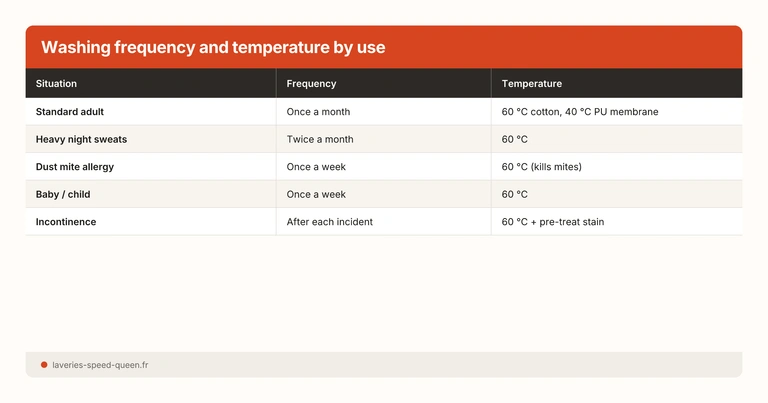
A mattress protector should be machine-washed once a month as routine (weekly for allergies, babies or incontinence). The temperature depends on the type: 60 C for cotton and terry (kills dust mites and bacteria), 40 C for models with a waterproof polyurethane membrane. Normal cotton programme, moderate spin, low-heat tumble drying or flat air-drying. For large sizes (king size and above), 18 kg laundromat machines are ideal.
At a Glance
Standard frequency -- once a month for adults, once a week for allergies/babies/incontinence.
60 C for cotton/terry -- kills dust mites and bacteria. The benchmark hygiene temperature.
40 C for PU membranes -- preserves the waterproofing. Excessive heat delaminates the membrane.
Low-heat drying -- tumble dry at 40 C max or air-dry flat. Never high heat.
Don't overload -- the protector needs room to tumble and rinse properly.
Why Regular Washing Matters
The mattress protector is the most neglected layer of bedding — yet it accumulates the most invisible contaminants. Unlike the fitted sheet you wash regularly and the duvet cover you change every 1-2 weeks, the mattress protector often stays in place for months. This is a hygiene mistake with real consequences.
Night sweating. An adult produces 200-500 mL of sweat per night on average, depending on room temperature and duvet type. Some of this moisture passes through the fitted sheet and accumulates in the protector. Over weeks, this creates a warm, damp environment ideal for dust mites and bacteria.
Dust mites. House dust mites (Dermatophagoides pteronyssinus) are microscopic arachnids that feed on dead skin cells. A mattress can harbour between 100,000 and 10 million mites. The protector is their prime hunting ground: it traps the skin flakes that pass through the sheet and the moisture they need. Their droppings are the leading cause of allergy triggered by bedding.
Sebum and dead skin. Skin renews constantly. Every night thousands of dead cells shed and migrate to the lower layers of bedding. Sebum (skin oil) accompanies them, creating an invisible film that gradually yellows the protector and feeds bacteria.
Accidents and stains. Urine stains (children, incontinence), blood stains (menstruation), yellow sweat marks — the protector absorbs everything the sheet doesn’t catch. Without regular washing, these stains set and become permanent bacterial hotspots.
Wash Frequency by Use Case
The ideal frequency depends on your situation. A healthy adult without allergies doesn’t have the same needs as a baby or someone with allergic asthma.
| Situation | Recommended Frequency | Why |
|---|---|---|
| Adult, standard use | Once a month | Removes normal build-up of sweat, sebum and dead skin |
| Heavy night sweating | Twice a month | Excess moisture accelerates dust-mite proliferation |
| Dust-mite allergy / asthma | Once a week | A 60 C wash kills mites and removes their allergenic droppings |
| Baby / toddler bed | Once a week | Frequent incidents (nappies, spit-up). Enhanced hygiene required. |
| Incontinence (adult) | After every incident + once a week | Urine contains ammonia and bacteria that generate odours |
| Guest room / holiday rental | After every stay | Hygiene for the next user, even after a short visit |
Airbnb hosts and holiday rentals
If you manage a holiday rental, washing the mattress protector after every guest is a non-negotiable hygiene standard. With a tight turnover schedule, 18 kg laundromat machines let you process all the bedding for a property in a single cycle. See our
Airbnb concierge and laundromat guide
.
Temperature and Programme by Protector Type
Not all mattress protectors wash the same way. Temperature and programme depend on the fabric and whether a waterproof membrane is present.
Cotton Terry (No Membrane)
The cotton terry protector is the most common and easiest to care for. It’s a simple absorbent fabric with no waterproof layer, washed exactly like a thick towel.
- Temperature: 60 C (ideal for hygiene). Some heavy-duty cotton models even tolerate 90 C for deep sanitising.
- Programme: Normal cotton, 1,000-1,200 rpm spin.
- Detergent: Powder preferred (better whitening action than liquid thanks to oxygen-based agents).
- Drying: Tumble dry on cotton programme, or air-dry.
Cotton with Waterproof PU Membrane
This is the most popular type: a cotton side (comfort) and a polyurethane side (waterproofing). The PU membrane is sensitive to heat.
- Temperature: 40 C maximum (some models limit to 30 C — check the label).
- Programme: Delicate cotton or synthetics, moderate spin (800 rpm max).
- Detergent: Liquid preferred (powder can leave residue on the membrane). No fabric softener — it clogs the membrane pores and reduces waterproofing.
- Drying: Tumble dry on low heat (40 C max) or air-dry flat. Never high heat.
Fabric softener destroys waterproofing
Fabric softener deposits a thin waxy layer (cationic agents) on fibres to make them feel soft. On a waterproof protector, this layer clogs the micropores of the PU membrane and progressively reduces its seal. After a few washes with softener, your “waterproof” protector no longer is. Use white vinegar (500 mL in the softener compartment) as an alternative.
Quilted Fleece (Polyester or Cotton-Polyester Blend)
Quilted fleece protectors are thick, warm and very absorbent. They’re often used in winter or for children’s beds.
- Temperature: 40-60 C depending on composition (check the label). 100% polyester stays at 40 C.
- Programme: Synthetics or delicate cotton, moderate spin.
- Drying: Tumble dry on low heat. Fleece dries slowly in the air due to its thickness — make sure it is completely dry before putting it back on the mattress.
Bamboo or Tencel (Lyocell)
These natural and semi-synthetic fibres are soft, temperature-regulating and increasingly popular. They’re also more delicate than cotton.
- Temperature: 30-40 C maximum.
- Programme: Delicate, low spin (600-800 rpm).
- Drying: Air-dry flat only. The tumble dryer can shrink and distort these fibres.
Cotton terry
60 C, normal cotton programme. The toughest. Tumble dryer OK. Cared for like towels.
Waterproof PU
40 C max, no softener. Low-heat drying only. Heat delaminates the membrane.
Quilted fleece
40-60 C depending on composition. Slow drying. Check it is fully dry before putting back.
Bamboo / Tencel
30-40 C, delicate programme. Air-dry only. Sensitive to heat and fast spin.
Pre-Treating Stains Before Washing
Certain common mattress-protector stains need pre-treatment to come out completely in the wash.
Urine Stain
Urine contains urea, ammonia and salts that create a yellow stain and a persistent odour if not treated quickly.
- Rinse immediately in cold water to flush out as much as possible.
- Blot with undiluted white vinegar↗ — it neutralises ammonia (responsible for the smell) and disinfects.
- Sprinkle baking soda↗ over the damp area and leave for 30 minutes (it absorbs moisture and neutralises odours).
- Machine-wash at 60 C if the fabric allows.
For a more detailed protocol, see our complete urine stain removal guide.
Blood Stain
Blood contains haemoglobin, a protein that coagulates with heat. The absolute rule is cold water — never hot.
- Rinse in cold water immediately.
- Rub with Marseille soap↗ on the damp stain.
- For dried stains, soak in cold water with sodium percarbonate (1 tablespoon per litre) for 1 hour.
See our detailed blood stain removal guide.
Yellow Sweat Marks
Yellow marks are caused by the oxidation of sebum and sweat. Sodium percarbonate is the most effective product:
- Dissolve 2 tablespoons per litre of water at 40 C.
- Submerge the protector and soak for 2-4 hours.
- Machine-wash at 60 C.
For badly yellowed white protectors, see our guide to whitening yellowed laundry.
Washing Mistakes to Avoid
- Overloading the drum -- a mattress protector needs space to tumble and rinse properly. Fill the drum to two-thirds maximum. A crammed protector comes out poorly washed with detergent residue.
- Using softener on a waterproof model -- the cationic agents in softener clog the PU membrane micropores and destroy waterproofing within a few washes.
- High-heat drying -- temperatures above 60 C delaminate the PU membrane, warp elastics and can shrink cotton by 5-8%. Stay at 40 C max in the dryer.
- Putting a still-damp protector back on -- residual moisture between protector and mattress creates a perfect environment for mould. Make sure it is bone-dry to the touch.
- Ignoring the care label -- maximum temperatures vary widely between models. A PU protector washed at 60 C instead of 40 C can lose its waterproofing in a single wash.
Large Sizes: A Challenge for Home Machines
A 140x190 cm mattress protector weighs roughly 1.5-2.5 kg dry, depending on type. A 180x200 cm (king size) model can reach 3-4 kg. On paper, that’s well within the capacity of a 7-8 kg home machine.
But dry weight is misleading. The problem with large protectors isn’t the weight — it’s the volume. A king-size protector unfolded takes up a huge amount of drum space, even once folded. In a 7-8 kg home machine it fills almost the entire drum, leaving insufficient room for effective tumbling.
The result: the protector “sticks” to the drum walls during the spin, creating an imbalance (the machine vibrates excessively), and some areas are neither properly washed nor properly rinsed. Detergent residue stays trapped in compacted zones, which can irritate sensitive skin and generate odours over time.
The Solution: Large-Capacity Laundromat Machines
The 18 kg machines available at our laundromats offer a 110-litre drum — nearly three times the capacity of a home machine. A king-size protector has all the room it needs to tumble, wash and rinse properly. You can even add the fitted sheet, pillowcases and duvet cover to process all the bedding in a single cycle.
The rinse-water volume (50-60 litres per cycle) guarantees complete removal of detergent residue — a significant advantage for people with sensitive skin or allergies.
Lifespan and Signs of Replacement
A quality mattress protector lasts 3-5 years with proper care (monthly wash at the right temperature, appropriate drying). Several signs indicate it’s time to replace it.
Loss of waterproofing. If you notice stains on the mattress despite the protector being in place, the PU membrane is damaged. This can result from washes at too high a temperature, use of softener, or simply normal wear.
Stretched elastics. When the protector no longer stays on the mattress and shifts during the night, the elastics are worn. This is often the first sign of end-of-life.
Excessive pilling. A fleece or cotton protector that pills heavily has weakened fibres. The fabric is less absorbent and less comfortable.
Persistent odours. If the protector smells despite a 60 C wash, bacteria are deeply embedded in the fibres. The bacterial biofilm is too established to be removed by a standard wash.
Irreversible yellowing. Yellowing that resists sodium percarbonate and sun bleaching indicates chemical degradation of the fibres. The protector can no longer fulfil its hygiene role.
As an Amazon Associate we earn a small commission on purchases made through the affiliate links in this article — at no extra cost to you. This helps us maintain the site and produce free guides.
Large mattress protectors and pads are hard to wash properly in a home machine. Our laundromats in Blagnac, Croix-Daurade and Montaudran have professional 18 kg machines, ideal for all your bedding in a single cycle. Detergent included, payment by contactless card or cash. See our prices.
Sources and References
- How to wash a duvet cover: frequency and temperature
- Dust-mite allergy and laundry
- How to remove urine stains
- How to remove blood stains
- Sodium percarbonate: usage guide
- How to whiten yellowed laundry naturally
- Detergent residue and sensitive skin
- Airbnb concierge and laundromat
- How to clean a mattress: full guide