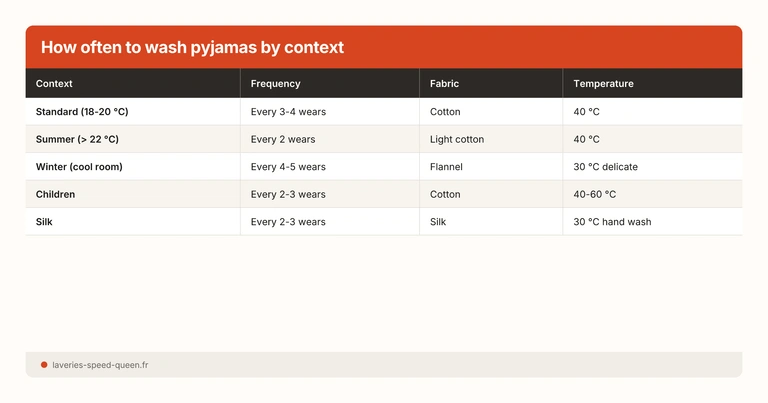
In short: wash pyjamas every 3-4 wears — not after every single night. Night sweating (0.3-0.5 L) is mostly water that evaporates. Adjust by season: every 2 wears in summer (warm room), 4-5 in winter. By fabric: cotton at 40 C, flannel at 30 C delicate, silk by hand. Signs it’s time to wash: smell, sticky feel, yellowing around the collar.
At a Glance
Baseline: 3-4 nights -- sufficient under normal conditions (room 18-20 C, evening shower). No need to wash every morning.
Summer: every 2 wears -- sweating is 2-3 times higher when the room exceeds 22 C.
Winter: 4-5 wears -- sweating is lower and the room is cool. Thick flannel stays fresh longer.
Cotton 40 C, flannel 30 C, silk by hand -- the right temperature for the fabric preserves the pyjamas and kills bacteria.
Two pyjamas in rotation -- alternating lets you wash both together at the end of the week without a half-empty machine.
The Real Frequency: Every 3-4 Wears
According to a YouGov survey (2024), one in five people wears their pyjamas for over a week without washing them. At the other extreme, 15% wash after every single night. Both extremes are problematic: the first for hygiene, the second for needless fabric wear and water waste.
The recommendation from dermatologists and microbiologists converges on an interval of 3-4 nights under normal conditions. Here’s why that number is right.
What Accumulates in One Night
During sleep the body keeps working: the skin renews, sweat glands release water, sebaceous glands produce sebum. In one night, pyjamas accumulate:
- Sweat: 0.3-0.5 litres (on average). This sweat is very dilute — 99% water, 1% salt, urea and minerals. Most of it evaporates through the fabric overnight.
- Dead skin cells: the skin renews continuously. You shed about 1.5 grams of dead skin per night — some ends up in the pyjamas (the rest in the sheets and duvet).
- Sebum: sebaceous glands produce a thin protective oil layer. Sebum is the main cause of yellowing around the collar and underarms.
- Bacteria: normal skin flora (staphylococci, micrococci) transfers to the fabric. After 3 nights the bacterial load is measurable but remains within normal hygiene limits.
Why 3-4 Nights — Not 1 or 7
After 1 night, pyjamas are virtually clean — sweat has mostly evaporated, bacteria are negligible. Washing at this point is wasteful.
After 3-4 nights, the build-up of sebum, dead skin and bacteria starts to change the feel of the fabric (slightly less fresh) and produce a detectable close-range odour. This is the threshold where washing delivers a real hygiene benefit.
After 7+ nights, the bacterial load becomes significant, accumulated sebum yellows the fabric (irreversible if untreated), and the smell is noticeable. People with sensitive skin or prone to acne may develop irritation from prolonged contact with bacteria-laden and sebum-rich fabric.
An evening shower changes everything. If you shower or bathe before putting on your pyjamas, you start with a much lower bacterial and sebum load. Pyjamas put on a clean body stay fresh longer than pyjamas put on after a full day without a shower. The evening shower is the factor that lets you comfortably stretch to 4 nights.
Adjusting by Season
Night sweating isn’t constant — it varies considerably with room temperature.
Summer (Room above 22 C)
In summer, especially during heatwaves, night sweating can reach 1 litre per night. The body uses perspiration for cooling even at rest. Pyjamas absorb much more sweat, which accelerates bacterial growth.
Recommended summer frequency: every 2 wears. Some people prefer sleeping without pyjamas in summer — that’s a solution, but the sheets then absorb all the sweat and should be washed more often (every 5 days instead of weekly).
Mid-Season (Room 18-22 C)
This is the standard case. Sweating is moderate (0.3-0.5 L/night) and largely evaporates. Frequency: every 3-4 wears.
Winter (Room below 18 C)
Sweating is reduced. Pyjamas (often in thick flannel) stay dry and fresh longer. Frequency: every 4-5 wears. Exception: if you sleep under a heavy duvet and the trapped heat makes you sweat, revert to 3-4 wears.
Washing by Fabric
Cotton (the most common)
40 C on a standard cotton cycle. Cotton is the most popular pyjama fibre -- soft, breathable, absorbent. Stands up well to repeated washing. Standard detergent, normal spin. Tumble drying is possible but accelerates shrinkage (3-5% on the first hot cycle).
Flannel (brushed cotton)
30 C on a delicate cycle. Flannel is cotton whose surface has been brushed to create a downy feel. This surface is fragile: heat and agitation cause pilling. Turn inside out, liquid detergent, no tumble dryer. Dry flat or on a hanger.
Silk
Hand-wash at 30 C max. Silk is a protein fibre (fibroin) that degrades in hot water and loses its sheen with friction. Use a silk-specific detergent or liquid Marseille soap. No wringing -- drain by rolling in a towel. Dry flat, out of direct sun.
Polyester / microfibre
30 C on a synthetics cycle. Polyester pyjamas (often marketed as 'satin' or 'microfibre') dry quickly but retain odours more than cotton. Wash slightly more often (every 2-3 wears). No softener -- it clogs microfibre pores.
The Case of Cotton Jersey
Cotton jersey (knitted, stretchy fabric) is the most common material for nightshirts and casual pyjama sets. Jersey is softer than woven cotton but also more elastic — it stretches over time.
To preserve elasticity: wash at 30-40 C, avoid the tumble dryer (heat relaxes knitted fibres), dry flat rather than hanging (the weight of the water stretches jersey).
Children: A Higher Frequency
Children need their pyjamas washed more often for several reasons:
- Higher metabolism: children have a proportionally higher basal metabolic rate than adults, increasing relative sweating.
- Night-time accidents: bedwetting is common up to age 5-7. Even a minor incident justifies an immediate wash.
- Runny noses, drooling: young children produce more nasal and saliva secretions during sleep.
- Movement: children move a lot during the night, raising sweat output through mechanical effort.
Benchmarks by Age
- Baby (0-2 years): change the sleep sack or pyjamas after every night (very sensitive skin, frequent spit-up, nappy leaks). See our baby sleep sack washing guide.
- Child (3-10 years): every 2 wears (high sweating, possible accidents, playtime in bed before lights out).
- Teenager (11+): every 2-3 wears (puberty increases sebum and sweat production, with more pronounced body odour).
Signs It’s Time to Wash
Don’t rely solely on counting nights — learn to recognise the physical signs:
Smell
The first sign. Sniff the collar and underarms. If you detect any odour (even faint, even not unpleasant), bacteria have reached a level that warrants washing. The absence of a strong smell doesn’t mean the pyjamas are clean — but any odour, however subtle, means it’s time.
Feel
Clean pyjamas feel fresh and smooth (cotton) or downy (flannel). When sebum and sweat build up, the fabric becomes slightly sticky, heavier, or loses its softness. This change in feel is a reliable indicator, often noticeable before smell.
Yellowing
Yellow traces appear around the collar, underarms and waistband — areas in prolonged contact with skin. The yellowing is caused by oxidised sebum. It’s reversible if treated promptly (60 C wash with powder detergent) but becomes permanent if sebum sets into the fibres. See our guide on sweat stains and yellow marks for detailed treatments.
The “Put-On” Test
The most subjective but most telling test: when you slip on your pyjamas, do you feel the freshness of clean fabric or a sensation of already-worn cloth? If the pyjamas no longer deliver that fresh feeling, it’s time to wash.
Real Hygiene Impact: What the Research Says
It’s tempting to think that week-old pyjamas are a health hazard. The reality is more nuanced.
Measured Bacterial Load
A study from the University of Manchester (published 2022) measured bacterial load on cotton pyjamas worn for different durations:
- After 1 night: bacterial load virtually identical to unworn (non-sterile) pyjamas.
- After 3 nights: measurable load, comparable to a t-shirt worn for 4 hours during the day.
- After 7 nights: load 10-100 times higher than at night 3. Bacteria have colonised the fabric and are actively reproducing.
- After 14 nights: established bacterial biofilm. Risk of skin irritation for those with sensitive skin.
These results confirm the 3-4 night threshold as the balance point between hygiene and washing economy.
Actual Risks of Unwashed Pyjamas
Pyjamas worn too long don’t cause infection in a healthy person with intact skin. The risks apply to:
- Sensitive or atopic skin: prolonged contact with bacteria and sebum can trigger or worsen eczema, back acne or irritation.
- Dust-mite allergies: dead skin cells accumulated in pyjamas feed dust mites. For allergy sufferers, regularly washed pyjamas reduce exposure. See our article on dust-mite allergy and laundry.
- Fungal infections: fungi (Candida, dermatophytes) thrive in moisture and warmth. A sweat-damp pyjama worn continuously increases the risk of cutaneous mycosis, especially in skin folds (groin, under the breasts).
Optimising Your Washing Routine
Two Pyjamas in Rotation
The most practical solution: own two pyjamas (one for summer, one for winter, or two identical). Wear the first for 3-4 nights, switch to the second. At the end of the week, wash both together — one machine, an optimised load.
This rotation doubles the lifespan of each pair (half as many washes per pyjama) and avoids a half-empty machine just for one pyjama.
Group with Similar Items
Pyjamas wash well alongside other nightwear (sheets, pillowcases) when wash temperatures are compatible (40 C for cotton). See our guide to wash frequency for coordinating the whole family’s laundry rhythm.
Air Them in the Morning
A simple habit that prolongs freshness: in the morning, don’t fold your pyjamas immediately. Spread them on the bed or hang on a hanger for 30 minutes to an hour. Residual moisture from night sweating evaporates, slowing bacterial growth. A pyjama aired each morning stays fresh for one extra wear compared to one folded straight under the pillow.
Mistakes to Avoid
- Washing after every night -- wastes water and energy and wears the fabric prematurely. Pyjamas aren't underwear -- they're worn on a clean body in a controlled environment.
- Wearing for more than a week without washing -- after 7 nights the bacterial load is 10-100 times higher than the 3-night threshold. Accumulated sebum yellows collars irreversibly.
- Flannel in the tumble dryer -- heat and friction cause rapid pilling. Dry flannel flat or on a hanger.
- Silk in the machine -- even on a delicate cycle, drum agitation damages silk fibres. Hand-wash only.
- Storing damp pyjamas -- under the pillow or in a drawer while still clammy from sweat. Air for at least 30 minutes before putting away.
- Ignoring collar yellowing -- oxidised sebum sets into fibres if untreated. Regular 40 C washes with powder detergent prevent the problem.
By Profile: Summary Table
| Profile | Frequency | Recommended Fabric | Temperature |
|---|---|---|---|
| Adult — summer | Every 2 wears | Lightweight cotton, jersey | 40 C |
| Adult — winter | Every 4-5 wears | Flannel, fleece | 30 C delicate |
| Adult — mid-season | Every 3-4 wears | Cotton, jersey | 40 C |
| Child (3-10 years) | Every 2 wears | Cotton | 40-60 C |
| Baby (0-2 years) | After every night | Organic cotton | 60 C |
| Teenager | Every 2-3 wears | Cotton, jersey | 40 C |
| Sensitive skin / eczema | Every 2 wears | Organic cotton, undyed | 60 C |
Washing Pyjamas: The Exact Settings
Standard Cotton
- Programme: normal cotton (no need for delicate — cotton is tough).
- Temperature: 40 C. Sufficient to remove bacteria and sebum. Go to 60 C only if the wearer is ill or if the pyjamas have a persistent odour.
- Detergent: standard (liquid or powder). Powder is better for white pyjamas (built-in oxygen bleaching agents).
- Spin: 1,000-1,200 rpm (standard).
- Drying: tumble dryer possible (moderate heat), but air-drying is kinder to the fabric.
Flannel
- Programme: delicate (reduced agitation to limit pilling).
- Temperature: 30 C (flannel pills faster in hot water).
- Detergent: liquid (powder catches on brushed fibres and accelerates pilling).
- Spin: 600-800 rpm.
- Drying: flat or on a hanger. No tumble dryer. See our guide on preventing fabric pilling.
Silk
- Programme: hand-wash (30 C max).
- Detergent: silk-specific or liquid Marseille soap↗. No standard detergent (too alkaline a pH damages silk).
- Spin: none. Drain by rolling in a towel.
- Drying: flat, in the shade. No hanger (wet silk stretches under its own weight).
As an Amazon Associate we earn a small commission on purchases made through the affiliate links in this article — at no extra cost to you. This helps us maintain the site and produce free guides.
Sheets, pillowcases, pyjamas — all your family’s nightwear in one large-capacity machine. Our laundromats in Blagnac, Croix-Daurade and Montaudran offer 10 to 18 kg machines for combining loads. Cotton programme at 40-60 C. Payment by contactless card or cash. See our prices.
Sources and References
- Clothing wash frequency — full chart
- Wash temperatures guide
- Sweat stains and yellow marks: prevention and treatment
- Fabric pilling: how to remove and prevent
- Dust-mite allergy and laundry
- Washing a baby sleep sack
- Laundry care symbols explained
- Night sweating — thermoregulation during sleep (Sleep Medicine Reviews)
- Bacterial load on worn textiles — colonisation and biofilm (Journal of Applied Microbiology)
- National Sleep Foundation — impact of clean bedding on sleep quality (2023 Sleep in America Poll)