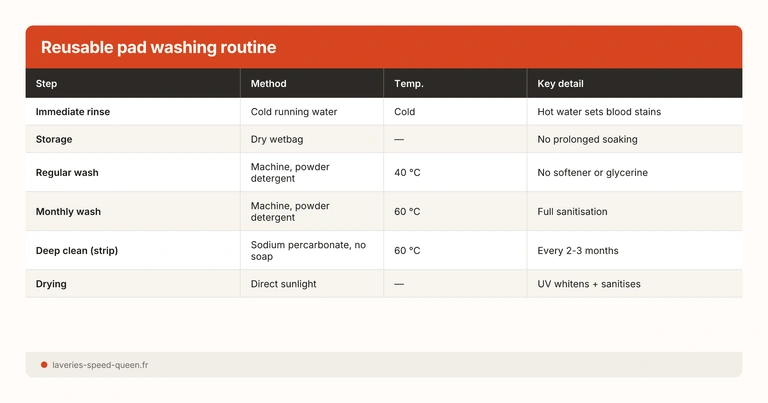
In short: rinse in cold water immediately after use, store in a wet bag (no soaking), machine-wash at 40-60 C with powder detergent and no softener or glycerine, dry in the sun (UV = natural bleaching + disinfection). If absorbency drops, strip-wash with sodium percarbonate.
At a Glance
Rinse in cold water immediately -- hot water cooks blood proteins and sets the stain.
No prolonged soaking -- store dry in a wet bag, not in water.
40-60 C in the machine -- standard powder detergent, no softener, no glycerine.
Sun-drying is ideal -- UV bleaches stains and disinfects naturally.
Strip wash with percarbonate -- every 2-3 months if absorbency drops.
Why Reusable Pads Need a Different Wash Approach
Reusable sanitary pads combine several technical layers: an absorbent fabric (cotton, bamboo or microfibre), a waterproof layer (PUL — polyurethane laminate) and sometimes a stay-dry top layer. The washing goal is twofold: remove blood and bacteria while preserving fibre absorbency.
The main threat isn’t poor hygiene — a 40 C wash with the right detergent handles bacteria. It’s progressive build-up: the accumulation of detergent residue, softener or body oils that waterproof the fibres and reduce absorbency. It’s exactly the same mechanism as with cloth nappies.
Step 1: Immediate Cold-Water Rinse
The post-use rinse is the single most important step in the entire routine. It determines the final cleanliness and the lifespan of your pads.
Why Cold Water Is Non-Negotiable
Blood contains haemoglobin, a protein. Like all proteins (egg, milk), hot water coagulates and sets it into the fibres — the same thing that happens when you try to remove a blood stain with hot water. Cold water keeps the proteins in solution so they rinse away easily.
How to Rinse Effectively
- Hold the pad under cold running water.
- Gently squeeze the absorbent area to expel blood.
- Continue until the water runs clear — 30-60 seconds is enough.
- Lightly squeeze out excess water without wringing.
This rinse removes 80-90% of fresh blood. The machine handles the rest.
Rinsing away from home
At work or on the go you can’t always rinse immediately. Fold the used pad onto itself (absorbent side to absorbent side) and place it in a small travel wet bag. Rinse in the evening when you get home. The blood will have dried, but a cold rinse (extended to 2-3 minutes if needed) will lift the vast majority of the stain.
Step 2: Storage Between Washes
After rinsing, pads need to wait for the next machine cycle. How you store them directly affects odour and lifespan.
The Wet Bag: The Recommended Approach
A wet bag (waterproof PUL pouch) contains odours and residual moisture while allowing slight air circulation. Place rinsed pads inside, close the bag and keep it in the bathroom or next to the machine.
What NOT to Do
- Don’t soak in water — prolonged soaking (over 30 min) encourages anaerobic bacteria, produces ammonia odours and degrades fibres and elastics.
- Don’t store for more than 3 days — beyond that, bacteria and mould develop even on rinsed pads.
- Don’t store in a fully sealed plastic bag — the total absence of air accelerates bacterial fermentation and bad smells.
Step 3: Machine Washing
Machine washing is the most effective and hygienic method for reusable pads, provided you get three things right: temperature, detergent and programme.
Temperature: 40 C Routine, 60 C Monthly
- 40 C for regular washes — kills common bacteria and preserves fibres.
- 60 C once a month — deeper sanitising, removes resistant bacteria and embedded organic residue.
- Don’t routinely exceed 60 C — excessive heat stiffens bamboo, damages microfibre and degrades PUL (the waterproof layer).
For a breakdown of what each wash temperature achieves, see our full guide.
Detergent: Powder, No Softener, No Glycerine
Standard powder detergent
The best choice. Powder contains more active cleaning agents per dose than liquid, typically contains no glycerine, and rinses more completely. Dose normally based on your water hardness.
Liquid detergent (glycerine-free)
Acceptable if the formula contains neither glycerine nor built-in softener. Check the ingredients: glycerine often appears as 'glycerin' or 'glycerol'. Avoid all-in-one liquid detergents.
Detergent with built-in softener
Avoid completely. Softening agents (quats, cationic compounds) deposit a film on fibres that waterproofs them. Absorbency drops progressively until the pad is useless. A strip wash is needed to restore it.
Marseille soap / DIY detergent
DIY soap-based detergents contain fatty acids that accumulate in the fibres over time and reduce absorbency. If you use them, plan for more frequent strip washes (monthly). See our article on homemade detergent.
Programme and Options
- Long normal cycle (not a quick wash) — wash time and especially rinse time matter for removing all residues.
- Fill the drum to two-thirds — add small items (towels, underwear, tea towels) so mechanical friction is effective.
- No softener in the dispenser — even with the right detergent, softener on top cancels everything.
Can You Wash Them with Other Laundry?
Yes. After the initial cold rinse, reusable pads wash like any cotton item. Detergent and temperature kill bacteria — the same principle applies to underwear, sheets and kitchen towels. There is no hygiene risk.
Step 4: Drying — Sun If Possible
Sun-drying is the ideal method for reusable pads, for two reasons:
UV Bleaches Residual Stains
Ultraviolet rays break down the organic pigments in blood (haemoglobin degrades to biliverdin, then bilirubin, which UV decomposes). Two to four hours of direct sun is enough to fade residual stains that the wash didn’t fully remove. It’s the same effect people have used for centuries to bleach sheets on the grass.
UV Disinfects Naturally
UV-B rays (280-315 nm) damage bacterial DNA and destroy most surface micro-organisms. It’s not a substitute for washing, but a welcome complement.
Alternatives to Sun
- Indoor air-drying — on a drying rack in a ventilated room. Slower but perfectly acceptable. See our tips for drying laundry indoors.
- Tumble dryer on low heat — acceptable for cotton pads. Avoid for microfibre (heat degrades microfibres) and check that the PUL layer is dryer-safe (some brands advise against it).
For a full drying guide, see our dedicated article.
Step 5: Strip Washing with Percarbonate
Strip washing is the periodic deep-clean that restores absorbency when it starts to decline. It’s the most important maintenance step after routine washing.
When to Strip Wash
- Pads absorb less well than they used to.
- They smell despite proper 40-60 C washing.
- You accidentally used softener or a detergent containing glycerine↗.
- As preventive maintenance: every 2-3 months.
The Strip-Wash Protocol
- Run a long 60 C cycle without detergent.
- Add 2 tablespoons of sodium percarbonate directly to the drum.
- Let the cycle complete fully.
- Run an extra cold rinse to flush out all residue.
Sodium percarbonate (2Na2CO3 3H2O2) releases active oxygen on contact with hot water. This oxygen breaks down organic residue, body oils and bacterial biofilms without harming fibres. It’s the same product used for strip-washing cloth nappies.
- Never use bleach -- it degrades fibres, weakens elastics and can damage the PUL layer.
- Never use softener as a 'fix' -- it worsens build-up instead of solving it.
- Never soak in vinegar long-term -- the acidity degrades PUL over time. An occasional rinse is fine.
Care by Material
Each absorbent material has its own care characteristics. Knowing yours helps optimise lifespan and absorbency.
Organic cotton
The most common and hardiest material. Handles 60 C without issues, sun or low-heat tumble dry. Unbleached organic cotton may retain a slight yellowish tint after washing -- that's normal. Absorbency increases over the first 3-4 washes (natural cotton oils are removed). Lifespan: 4-5 years.
Bamboo (bamboo viscose)
Very absorbent (60% more than cotton) but more fragile. Wash at 40 C routinely, 60 C occasionally. Bamboo becomes stiff if washed too hot too often. Tumble dryer not recommended (weakens fibres). Sun-drying is ideal. Lifespan: 3-4 years.
Microfibre
Highly absorbent and quick-drying, but heat-sensitive. Wash at 40 C maximum. No tumble dryer (microfibres distort under heat). Microfibre is the most prone to softener build-up -- strip wash more often if needed. Lifespan: 3-4 years.
PUL (waterproof layer)
PUL (polyurethane laminate) is the membrane that prevents leaks. It does not tolerate temperatures above 60 C, bleach or high-heat tumble drying. Wash inside-out to protect the laminated surface. If the PUL delaminates or loses its seal, the pad must be replaced.
Wash Frequency and Organisation
How Many Pads for a Full Cycle
The number depends on your flow and how often you wash:
| Flow | Washing every 2 days | Washing every 3 days | Daily changes |
|---|---|---|---|
| Light | 6 pads | 8 pads | 3-4 per day |
| Medium | 8 pads | 12 pads | 4-5 per day |
| Heavy | 10-12 pads | 15 pads | 5-6 per day |
Typical Organisation Over a Cycle
- Day 1-2: use, rinse after each change, store in the wet bag.
- Day 2-3: run a machine wash at 40 C with other laundry.
- Day 3: dry (sun if possible, otherwise indoor air).
- Rotating stock: while the first batch dries, use the second.
Special Cases and Troubleshooting
Residual Stains Despite Washing
Blood sometimes leaves a pinkish trace even after washing, especially on light fabrics. This isn’t a hygiene issue — bacteria are killed by detergent and temperature. To treat the residual stain:
- Sun: 2-4 hours of direct exposure. The most effective method.
- Percarbonate: soak for 30 min in 1 tbsp per litre of warm water, then wash.
- Hydrogen peroxide (3%, from a pharmacy): a few drops on the stain, wait 10 min, rinse. Test on a corner first — it can bleach dark fabrics.
Persistent Odour
If pads smell despite correct washing:
- Check your detergent — does it contain glycerine or built-in softener?
- Check the temperature — 30 C is too low for menstrual products. Move to 40-60 C.
- Check the dose — under-dosing is the most common mistake. Follow the manufacturer’s guidelines for your water hardness. See our guide on detergent dosing.
- Run a strip wash with percarbonate.
- If the problem persists, the pad may be at end-of-life (bacterial biofilm too deep).
See also our guide on laundry that smells bad after washing for general causes.
Progressive Absorbency Loss
Absorbency loss is the number-one sign of build-up. Fibres are coated in a film of residue (softener, glycerine, hard-water minerals) that prevents water from penetrating.
- Immediate fix: strip wash with percarbonate (protocol above).
- Prevention: powder detergent without glycerine, no softener, minimum 40 C.
- If strip washing no longer works: the pad has likely reached end-of-life (150-250 cycles).
Environmental and Financial Impact
Cost Comparison
A reusable pad costs 8-15 EUR and lasts 3-5 years (150-250 cycles). A person uses roughly 10,000-15,000 disposable products over a lifetime, costing 5,000-7,500 EUR. A stock of 10 reusable pads (100-150 EUR) replaced every 4 years totals 750-1,125 EUR over 30 years — savings of 80-85%.
Environmental Impact
A disposable pad takes 500-800 years to decompose in landfill. It contains plastics (polyethylene, polypropylene), chemical super-absorbents (sodium polyacrylate) and bleaching residues. Reusable pads eliminate this waste, even accounting for wash water and energy — the carbon footprint is reduced by 70-90% over their lifespan.
Mistakes to Avoid
- Rinsing in hot water -- cooks blood proteins and sets the stain permanently.
- Soaking for hours -- breeds bacteria, causes odours and degrades fibres.
- Using fabric softener -- waterproofs the absorbent fibres and renders the pad useless.
- Washing at 30 C only -- not enough to eliminate bacteria and organic residue.
- Using bleach -- degrades fibres, weakens elastics and attacks PUL.
- Storing for more than 3 days without washing -- mould and bacteria develop even on rinsed pads.
- High-heat tumble drying -- damages microfibre, bamboo and PUL.
As an Amazon Associate we earn a small commission on purchases made through the affiliate links in this article — at no extra cost to you. This helps us maintain the site and produce free guides.
Our laundromats in Blagnac, Croix-Daurade and Montaudran have professional machines with 40 C and 60 C cycles. The large water volume (50-60 litres) ensures a thorough rinse of detergent residue — essential for preserving the absorbency of your reusable products. Payment by contactless card or cash. See our prices.
Sources and References
- How to wash cloth nappies: routine and care
- Sodium percarbonate and laundry
- How to remove blood stains
- Detergent dosing for the washing machine
- Complete drying guide
- Laundry that smells bad after washing
- Wash temperatures: full guide
- Blood protein coagulation by heat — haemoglobin denatures from 56 C, fixing pigment to fibres
- Photochemical degradation of bilirubin by UV — the mechanism behind solar bleaching of blood stains
- Fibre waterproofing by cationic compounds (quats) in textile softeners