In short: A medium-sized rug (up to 2 x 3 m) can be washed in an 18 kg machine at 30 °C on a delicate cycle. Watch the wet weight: a rug that weighs 3-4 kg dry can reach 8-10 kg once soaked. Remove the non-slip underlay before washing. Wool, silk or long-fringed rugs do not go in the machine — professional cleaning only.
At a Glance
Check the type — cotton and synthetic are fine, thick wool and Oriental rugs are not.
Right cycle — delicate with moderate spin for most rugs. Check the care label if one exists.
Flat drying preferred — the tumble dryer warps most rugs (exception: small 100 % cotton bath mats if the label allows it).
Which Rugs Are Machine-Washable?
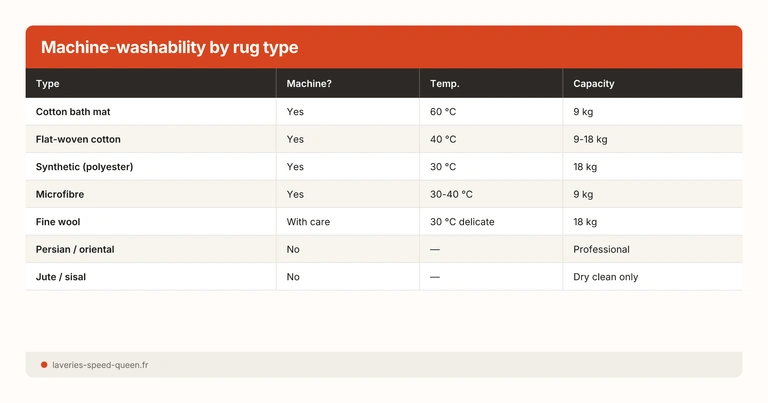
Cotton, synthetic and microfibre rugs are generally machine-washable between 30 and 60 °C, while jute, sisal and Persian rugs must stay out of the drum.
| Rug Type | Machine-Washable? | Recommended Temperature | Machine |
|---|---|---|---|
| Cotton bath mat | Yes | 60 °C | 9 kg |
| Flat-weave cotton rug | Yes | 40 °C | 9-18 kg depending on size |
| Synthetic rug (polyester, polypropylene) | Yes | 30 °C | 18 kg |
| Microfibre rug | Yes | 30-40 °C | 9 kg |
| Fine wool rug | With caution | 30 °C delicate cycle | 18 kg |
| Persian / Oriental rug | No | — | Professional cleaning |
| Shaggy / high-pile rug | Small ones only | 30 °C delicate cycle | 18 kg |
| Rubber-backed non-slip rug | With caution | 30 °C | 9 kg |
| Jute / sisal rug | No | — | Dry cleaning only |
| Outdoor rug (polypropylene) | Yes | 30 °C | 18 kg |
Fibre-by-Fibre Guide (Maximum Temperature)
Stick to 40 °C maximum for synthetic fibres, 30 °C for wool, and avoid the machine entirely for jute or sisal.
| Dominant Fibre | Max Recommended Temperature | Cycle | Notes |
|---|---|---|---|
| Cotton | 60 °C (if the label allows) | Cotton / normal | Suitable for bath mats and small, sturdy rugs. |
| Synthetic (polyester, PP) | 40 °C max | Delicate / synthetic | Limit the spin to preserve shape. |
| Wool | 30 °C | Wool / very gentle | Only small rugs clearly labelled as washable. |
| Jute / sisal | DO NOT machine-wash | — | High risk of warping and delamination. |
Rugs that should never go in the machine
Persian, Oriental or handmade (hand-knotted) rugs warp and lose their colours in the machine. Jute and sisal rugs disintegrate with prolonged water contact. Very large rugs (over 2 m) are too heavy once wet.
Preparation
Before washing, vacuum the entire rug and then test the colour on a hidden area with a damp cloth to avoid colour bleeding inside the drum.
Vacuum thoroughly — remove dust, crumbs and pet hair before washing.
Pre-treat stains — rub soiled areas with damp Marseille soap. See our stain removal guide for stubborn cases.
Test colour fastness — rub a hidden corner with a damp white cloth. If colour transfers, the rug is likely to bleed.
Fold or roll — never force a rug into the machine. It should fit without being compressed.
Machine Washing
Wash at 30-40 °C with a moderate spin, because a 5 kg dry rug can reach up to 10 kg once wet.
Right Cycle
Choose a gentle cycle with a moderate spin. See our temperature guide to match the setting to the fibre.
Moderate Spin
Too high a spin warps rugs. Rugs with non-slip backing prefer a low spin speed.
Weight and Loading
A wet rug weighs roughly double its dry weight. Dry-weight benchmarks for a 2 m² rug: flat-weave cotton 3-5 kg, synthetic 2-3 kg, shaggy/high-pile 4-6 kg, bath mat 1-2 kg. An 18 kg machine is often needed for a living-room rug. The rug must be able to move inside the drum — if you have to force the door shut, it is too big for the machine.
Weight Guide: Choosing the Right Capacity
A 160 x 230 cm rug often reaches 10 to 16 kg when wet, which means an 18 kg machine is essential to avoid an ineffective wash.
| Rug Dimensions | Typical Dry Weight | Possible Wet Weight | Recommended Machine |
|---|---|---|---|
| 120 x 170 cm | approx. 3 to 5 kg | approx. 6 to 10 kg | 18 kg recommended |
| 160 x 230 cm | approx. 5 to 8 kg | approx. 10 to 16 kg | 18 kg essential |
| 200 x 300 cm | approx. 8 to 12 kg | approx. 16 to 24 kg | Often too heavy for a standard machine |
Safety rule: if the rug is already difficult to handle dry, it will almost certainly be too heavy once soaked.
Targeted Stain Pre-Treatment (Before the Machine)
Treat stains locally 10 to 15 minutes before the cycle, then rinse with cold water to limit pigment and odour setting.
| Stain | Useful Product | Method | Key Point |
|---|---|---|---|
| Wine | Oxygen-based textile stain remover | Blot, apply for 10-15 min, rinse cold before washing | Do not rub hard (risk of spreading the pigment). |
| Mud | Warm water + Marseille soap | Let dry, brush off dry, then treat locally | Treating wet mud drives the stain deeper. |
| Pet accident | Enzyme-based textile cleaner | Blot, apply enzyme, allow full contact time, then wash | Avoid ammonia and very hot water, which set odours. |
Non-slip rugs: watch the rubber layer
Bath mats with rubber or latex non-slip backing deteriorate with repeated washing and heat. Follow the care label and replace the rug when the backing starts to crumble.
Drying
Allow 24 to 48 hours of flat drying for a medium rug, flipping it at least once so both sides dry evenly.
No tumble dryer for rugs
The tumble dryer warps rugs, melts synthetic fibres and peels off non-slip backings. Only small 100 % cotton bath mats without rubber backing can tolerate a cycle if the label allows it.
Flat Drying
The best method. Lay the rug flat on a drying rack or clean surface. Flip it after a few hours so both sides dry evenly.
Hanging
Possible for thin, lightweight rugs. Hang over a sturdy rail (the wet rug is heavy). Warning: thick rugs sag under their own weight when hung.
Car Floor Mats
Textile car floor mats are among the most heavily soiled textiles: mud, sand, gravel, road salt, crushed chewing gum, shoe marks and sometimes oil or brake fluid. Good news: removable textile mats wash very well in a machine. The key is knowing what is washable and what is not.
Removable Mats vs. Fixed Carpet
Only removable mats (the ones you can lift out of the vehicle by hand) are machine-washable. These are the textile mats placed on top of the original carpet, often held in place by clips or non-slip studs on the underside. The carpet bonded to the vehicle floor obviously cannot go in a machine — vacuuming and damp brushing is the only option for that.
Pre-Treatment: An Essential Step
Car mats accumulate abrasive debris (sand, gravel, small stones) that can damage the drum if not removed first. Before washing:
- Shake vigorously outdoors to dislodge the largest debris.
- Vacuum both sides thoroughly to remove fine sand embedded in the fibres.
- Brush dried mud off dry with a stiff brush. Do not wet the mud before brushing — water turns it into a paste that works deeper into the textile.
- Road salt: in winter, car mats absorb salt spread on the roads. Salt (sodium chloride, calcium chloride) leaves white marks on the fabric and can stiffen the fibres. Rinse thoroughly with cold water first to dissolve and flush out the salt before machine washing.
Cycle and Temperature
Textile car mats are usually made from tough synthetic carpet (polypropylene, polyamide or polyester). They handle a 40 °C normal cycle — no need for a delicate programme, these textiles are built to withstand harsh conditions. Use a moderate spin (800-1000 rpm) to speed up drying without warping the mat.
For stubborn stains (engine oil, grease, tar), pre-treat locally with Marseille soap↗ or a textile stain remover before washing. Our guide to removing grease stains covers effective methods for this type of soiling.
Machine Capacity
Car mats are relatively light. Two front mats weigh roughly 1.5 to 2 kg, and a full set of 4 (2 front + 2 rear) weighs between 3 and 4 kg depending on the vehicle. A 9 kg machine is more than enough for a complete set of 4 mats. If you want to wash the mats from two vehicles in one go, an 18 kg machine gives you all the room you need.
Drying and Precautions
Check the underside of the mat before choosing your drying method. Some mats have a rubber or latex backing that cannot withstand the dryer’s heat — it can melt or crack the non-slip layer. In that case, air-dry flat or hang over a sturdy rail. If the underside is entirely textile (no rubber layer), tumble drying at moderate heat is fine. Car mats usually dry in 12 to 24 hours in the open air. Make sure they are completely dry before putting them back in the vehicle — a damp mat in a closed cabin encourages mould and musty odours.
Maintenance Between Washes
- Vacuum 1 to 2 times a week — stops dust from embedding itself in the fibres
- Flip the rug — vacuum the underside occasionally, dust collects under the rug too
- Treat stains immediately — the longer a stain dries, the deeper it sets
- Air regularly — good ventilation keeps musty odours at bay
Mistakes to Avoid
- Rug too big for the machine — a compressed rug will not wash properly and can damage the machine
- Too much heat — melts synthetic fibres and shrinks wool
- Tumble dryer — warps and damages the vast majority of rugs
- Storing while still damp — mould is guaranteed within days
How Often to Clean by Rug Type
Not all rugs need the same washing frequency. An entrance rug, walked on daily with shoes, needs washing every 1-2 months. A living-room rug walked on in socks can wait 3-6 months. A decorative rug that sees little foot traffic only needs washing once a year.
Between washes, weekly vacuuming is the most effective way to extend the rug’s cleanliness. Use your vacuum’s brush attachment and pass in both directions (with and against the pile) to dislodge particles trapped in the fibres.
For spot stains, treat them straight away rather than waiting for the next full wash. A dab of white vinegar↗ on a fresh stain is often enough. For red wine stains or coffee stains, act within the first 30 minutes for the best chance of removal.
As an Amazon Associate, we earn a small commission on purchases made through affiliate links in this article — at no extra cost to you. This helps us maintain this site and produce free guides.
Your rug needs a proper clean? Our laundromats in Blagnac, Croix-Daurade and Montaudran have 18 kg machines that accept medium-sized rugs. Detergent included, payment contactless card or cash. First visit? See our prices.
Methodology and Sources
- For machine sizing, wet weight is factored in: a textile can reach 2 to 3 times its dry weight depending on fibre (wool up to approx. 30 % absorption, cotton up to approx. 25 %, synthetics approx. 2-5 %), so a 4 kg dry rug can reach around 8 to 12 kg wet; care symbols remain the primary decision framework (GINETEX / ISO 3758 (lien externe)).
Recommended Washing Frequency
Bath mats, in daily contact with moisture, should ideally be washed every 1 to 2 weeks. Living-room rugs in normal use should be washed every 3 to 6 months, provided you vacuum regularly between washes. If you have pets or young children, increase to every 2 to 3 months to maintain proper hygiene.