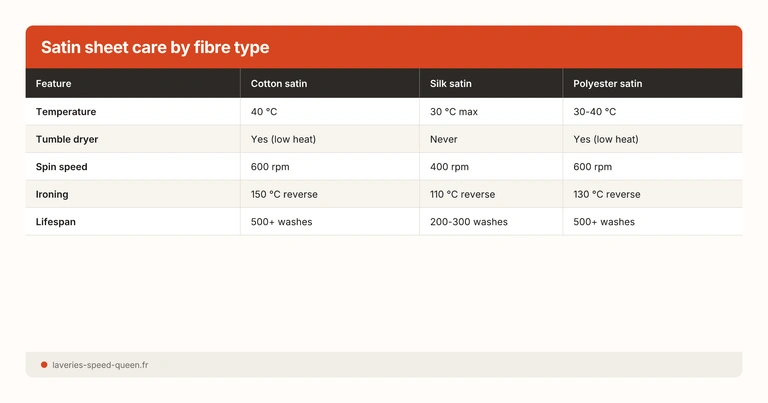
Satin is a type of weave, not a fibre. “Satin” sheets can be made from cotton, silk or polyester — three radically different fibres in terms of care. Cotton sateen: 40 C in the machine, the toughest. Silk satin: 30 C delicate or hand-wash, the most fragile. Polyester satin: 30-40 C synthetics, the most affordable. For all: low spin (600 rpm max), iron on the reverse, and wash weekly like any sheet.
At a Glance
Satin is not a fibre -- it is a weave. Check the label: cotton, silk or polyester changes everything about washing.
Cotton sateen: 40 C -- delicate cotton programme, 600 rpm spin, low-heat tumble dry OK.
Silk satin: 30 C max -- silk/delicate programme or hand-wash, 400 rpm spin, never tumble dry.
Polyester satin: 30-40 C -- synthetics programme, 600 rpm spin, low-heat tumble dry OK.
Always inside out -- protects the lustrous satin surface from friction and abrasion.
Cotton Sateen, Silk Satin, Polyester Satin: The Key Distinction
The most widespread confusion about satin sheets is the belief that “satin” refers to a material. It doesn’t. Satin is a weave type characterised by warp threads floating over several weft threads, creating a smooth, lustrous surface on one side and a matte finish on the other.
This same weave can be applied to three very different fibres:
Cotton Sateen
Cotton sateen (sometimes labelled “sateen” or “satin-weave cotton”) is 100% cotton woven in a satin weave. The result is a fabric that combines cotton’s breathability and durability with the softness and lustre of the satin weave.
It’s the most popular choice for quality bedding — the best balance of comfort, longevity and easy care. Cotton sateen sheets with a high thread count (300-600 threads per square inch) are particularly silky and resilient.
Key characteristics: breathable, thermoregulating, durable (500+ washes), absorbs moisture (8% of its weight). Tolerates wash temperatures up to 60 C.
Silk Satin
Silk satin is 100% silk woven in a satin weave — the “original” satin in the historical sense (the word “satin” comes from Zaitun, the old Chinese name for Quanzhou, from where silk was exported). It’s the most luxurious fabric but also the most delicate.
Silk has unique properties: it’s thermoregulating (cool in summer, warm in winter), hypoallergenic (sericin repels dust mites), and kind to skin and hair (its ultra-smooth surface reduces overnight friction, limiting sleep creases and frizz).
Key characteristics: thermoregulating, hypoallergenic, ultra-soft, but fragile (200-300 washes with care). Max 30 C. High price.
Polyester Satin
Polyester satin is 100% polyester (or a polyester-elastane blend) woven in a satin weave. It’s the budget alternative to silk satin — it mimics the visual appearance (lustre, smooth feel) without the care requirements.
However, polyester is a synthetic fibre that doesn’t share silk’s natural properties: it’s poorly breathable, traps heat and promotes night sweating. It also builds up static electricity more easily than natural fibres.
Key characteristics: affordable, durable (500+ washes), wrinkle-resistant, but poorly breathable and less comfortable. Machine-washes without special precautions.
| Characteristic | Cotton Sateen | Silk Satin | Polyester Satin |
|---|---|---|---|
| Fibre | 100% cotton | 100% silk | 100% polyester |
| Wash temperature | 40 C (60 C occasionally) | 30 C max | 30-40 C |
| Tumble dryer | Yes (low heat) | No (never) | Yes (low heat) |
| Breathability | Excellent | Excellent | Poor |
| Lifespan | 500+ washes | 200-300 washes | 500+ washes |
| Price (sheet set) | 60-150 EUR | 150-500 EUR | 20-60 EUR |
| Temperature comfort | Thermoregulating | Thermoregulating | Retains heat |
Washing Cotton Sateen: The Full Protocol
Cotton sateen is the toughest of the three and tolerates relatively standard care — as long as you take a few precautions to preserve the weave’s lustre.
Programme and Temperature
- Programme: delicate cotton (or a sheets programme if available). Standard cotton works too, but a delicate programme reduces mechanical agitation and protects the satin.
- Temperature: 40 C as routine. Go to 60 C once a month for a deep hygiene wash (dust mites, bacteria, sweat residue). Don’t wash at 60 C every time — heat accelerates wear of the satin weave.
- Spin: 600 rpm maximum. A 1,000-1,200 rpm spin compresses and creases satin, dulling the lustre and creating stubborn wrinkles.
Detergent
Use a liquid detergent by preference. Powder detergents can leave white residue in the tight satin weave — undissolved particles lodge between the floating threads and create a dull haze.
Dose correctly: overdosing leaves residue that dulls the satin; underdosing fails to clean properly (night-sweat odours).
No fabric softener — cationic agents settle on the satin surface, weighing it down and reducing both lustre and breathability. If sheets feel stiff, add 100 mL of white vinegar to the softener compartment.
Drying
Air-drying is always preferable for cotton sateen — it preserves lustre and avoids excessive creasing. Hang sheets inside out, in the shade (direct sun can dull dark colours), on a line or flat rack.
Tumble drying is acceptable on a low-heat delicate programme. Remove sheets slightly damp — completing the cycle in the dryer over-creases satin and makes ironing harder.
Ironing
Cotton sateen irons easily:
- Temperature: 150 C (cotton setting)
- Side: on the reverse — ironing on the right side flattens the floating threads and creates uneven sheen
- Steam: yes, steam is helpful on cotton for smoothing deep creases
- Moisture: iron while sheets are still slightly damp for the best result
Why always iron on the reverse?
The lustre of satin comes from the floating warp threads covering the surface of the right side. These threads reflect light uniformly. Direct iron contact crushes them unevenly, creating dull spots and shiny patches (localised glazing) instead of a uniform sheen. Ironing on the reverse acts on the weft threads without touching the right-side floats.
Washing Silk Satin: The Delicate Protocol
Silk satin requires a specific protocol to preserve fibroin — the structural protein of silk that gives it its sheen and suppleness.
Hand-Washing (Recommended Method)
Hand-washing is the safest method for silk satin sheets:
- Fill a basin (or the bathtub for a full sheet set) with cool water (20 C).
- Add a few drops of silk-specific liquid detergent or mild shampoo. Mix before submerging.
- Submerge the sheets turned inside out. Soak for 5-10 minutes, gently swirling the water.
- Rinse in cool water (same temperature) until the water runs clear. For the final rinse, add 1 tbsp of white vinegar↗ per litre to revive the sheen.
- Drain without wringing — lay flat on bath towels, roll gently and press.
Machine Washing (If the Label Allows)
- Programme: silk or delicate
- Temperature: 30 C maximum
- Spin: 400 rpm maximum (or no spin)
- Mesh laundry bag: mandatory — use a large bag so the sheets aren’t too compressed
- Detergent: silk-specific liquid, neutral pH. Never powder, never softener, never bleach
Drying Silk Satin
- Never tumble dry — heat denatures fibroin irreversibly
- Flat if possible — spread on a flat rack or clean towels
- Complete shade — UV fades silk. A few hours of sun is enough to dull the lustre
- No radiator — direct heat damages silk
Ironing Silk Satin
- Temperature: 110 C maximum (silk setting)
- Side: on the reverse, with a pressing cloth (thin cotton fabric between the iron and the silk)
- Steam: never directly on silk — water droplets create visible, permanent water marks. Use the damp pressing cloth
- Timing: iron while sheets are still slightly damp
See our full guide on ironing by fabric and temperature.
- Hot water on silk -- above 30 C, fibroin degrades. Sheen and suppleness are lost irreversibly.
- Tumble dryer for silk -- heat (60-80 C) denatures the protein. The fabric becomes brittle and dull.
- Powder detergent -- alkaline agents and protease enzymes destroy sericin and attack fibroin. Silk-specific liquid only.
- Steam directly on silk -- hot water droplets create visible, permanent water marks on the satin.
- Wringing to extract water -- wet silk loses 20% of its strength. Wringing creates deep creases and can tear the fragile fabric.
Washing Polyester Satin: The Simple Protocol
Polyester satin is the easiest of the three to care for. Its synthetic fibre stands up well to machine washing and drying.
Programme and Temperature
- Programme: synthetics or delicate. Cotton works too but the agitation is unnecessarily vigorous.
- Temperature: 30-40 C. Polyester doesn’t need high temperatures — dirt lifts easily at low heat. At 60 C polyester softens slightly and can lose its shape.
- Spin: 600 rpm maximum. Polyester naturally resists creasing (one of its advantages), but excessive spin compresses the satin weave and dulls the lustre.
Detergent
Liquid detergent by preference (same reason as cotton sateen — powder leaves residue). No softener — polyester already builds up static electricity and softener worsens the problem long-term by leaving a film on the fibres.
Drying
Tumble drying is fine on a low-heat programme. Polyester dries very quickly — remove sheets as soon as the cycle ends to avoid needless creasing. Air-drying works equally well and is faster than with cotton (polyester absorbs under 0.5% of its weight in water).
Ironing
Polyester satin rarely needs ironing — one of its advantages. If it does:
- Temperature: 130 C maximum (synthetics setting)
- Side: on the reverse
- Steam: possible but rarely needed
- Caution: never exceed 150 C — polyester melts at 260 C but starts to soften and glaze permanently from 170 C
Polyester satin and sweating
Polyester satin traps heat and promotes night sweating. If you sweat at night, wash polyester sheets twice a week rather than once. Polyester doesn’t develop odour immediately (unlike cotton, which absorbs and releases sweat), but bacteria grow faster on damp synthetic fibres. A 40 C wash with an antibacterial detergent is recommended.
Common Stains on Satin Sheets
Bed sheets are exposed to specific stains from nighttime use. Here’s how to treat them by satin type.
Moisturiser and Body Oils
Night creams, massage oils and balms leave greasy stains that build up over successive nights, especially on pillowcases.
- Cotton sateen: apply dish soap to the stain, massage in and leave for 15 minutes. Wash at 40 C. Dish soap is the most effective domestic degreaser.
- Silk satin: blot (don’t rub) with a cloth dampened with cold water and a few drops of mild soap. Hand-wash the entire sheet. If the stain resists, take it to a dry cleaner.
- Polyester satin: same method as cotton. Polyester retains grease — be thorough with the degreasing step before washing.
Makeup (Foundation, Mascara)
Makeup combines pigments and oils — it’s a composite stain. See our dedicated guide to removing makeup stains.
- Cotton sateen: dish soap + Marseille soap↗, then 40 C wash
- Silk satin: cold-water blotting only, then hand-wash or dry-clean
- Polyester satin: dish soap, then 30-40 C wash
Sweat (Yellow Marks)
Yellow marks are caused by sweat proteins oxidising in the fibres. See our guide on sweat stains.
- White cotton sateen: soak in sodium percarbonate (2 tbsp/litre at 40 C, 2-4 hours)
- Silk satin: blot with cold water + diluted white vinegar. Dry-clean if stains persist
- Polyester satin: baking soda↗ paste on the stain, 30 min, then wash
Cream / oil
Greasy stain. Dish soap (cotton, polyester) or cold-water blotting + mild soap (silk). Treat before machine-washing.
Makeup
Composite stain (pigment + oil). Dish soap + Marseille soap. On silk: dry-clean recommended. Makeup guide.
Sweat
Yellow marks = oxidised proteins. Percarbonate (white cotton), vinegar (silk), baking soda (polyester). Sweat guide.
Blood (menstruation)
Cold water immediately (never hot = coagulation). Marseille soap. Percarbonate for white cotton. Blood guide.
Wash Frequency: Same as Any Sheet
Satin has no special antibacterial properties — regardless of satin type, wash frequency is the same as for any sheet.
Recommended Frequency
- Sheets and duvet covers: once a week (twice in summer or if you sweat at night)
- Pillowcases: every 3-4 days (direct contact with face, sebum and hair)
- Mattress protector / pad: once a month (or immediately if stained). See our guide to washing a mattress protector.
For a complete frequency guide, see our article on how often to wash sheets.
Why change pillowcases more often?
A pillowcase is in direct contact with your face for 6-8 hours every night. It accumulates sebum, sweat, dead skin, makeup residue and night cream — an ideal cocktail for bacteria and dust mites. Changing every 3-4 days reduces the risk of acne, skin irritation and allergies.
Satin Sheets at the Laundromat
The professional machines in our laundromats are perfectly suited to washing cotton sateen and polyester satin sheets. Their large drum (up to 18 kg) lets you wash a full sheet set (duvet cover + fitted sheet + pillowcases) in a single cycle, with enough room for the linen to circulate freely.
The Advantage of Volume
Satin sheets, especially duvet covers, need space in the drum for a proper wash. In a 7-8 kg home machine, a double duvet cover fills nearly all the capacity — the linen is compressed, poorly agitated and poorly rinsed. In a professional machine (14-18 kg), the same bedding set has the room it needs for optimal washing and rinsing.
Silk Satin: Keep It at Home
For silk satin sheets, hand-washing at home remains the best option. Professional laundromat machines don’t have a dedicated silk programme and their drum power is too vigorous for this delicate fibre.
As an Amazon Associate we earn a small commission on purchases made through the affiliate links in this article — at no extra cost to you. This helps us maintain the site and produce free guides.
Wash your cotton sateen bedding in our large-format professional machines — up to 18 kg for a full sheet set with optimal drum space. Our laundromats in Blagnac, Croix-Daurade and Montaudran are open 7 days a week, detergent included, payment by contactless card or cash. See our prices.