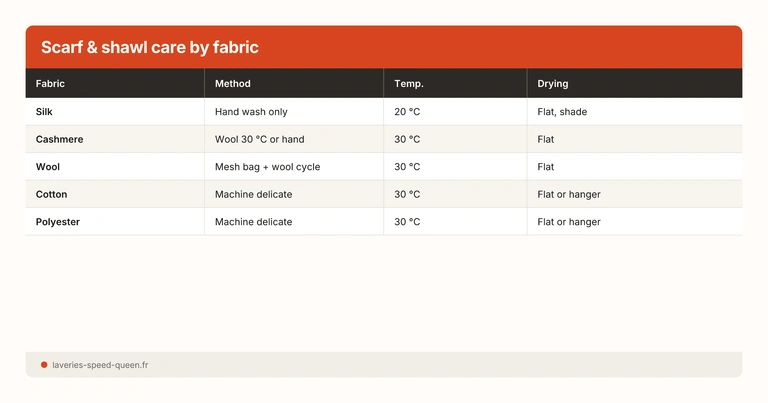
In short: every scarf and shawl material needs a specific approach. Silk: hand wash, cold water 20 °C, neutral pH detergent. Cashmere: wool cycle 30 °C or hand. Wool: mesh bag + wool cycle 30 °C. Cotton and polyester: machine 30 °C delicate cycle. Drying rule: always flat, never tumble dryer.
At a Glance
Check the label — the material dictates the method: hand for silk, machine possible for cotton and polyester.
30 °C maximum in the machine — even cotton does not need more for a lightly worn scarf.
Flat drying is mandatory — hanging a wet scarf deforms it under the weight of water.
No fabric softener on silk — it weighs down fibers and kills the natural sheen.
2-3 washes per season — scarves do not touch sweaty skin; airing is enough between washes.
Why Scarves Need Special Treatment
Scarves and shawls are thin textile items, often made of fine materials (silk, cashmere, delicate wool). Unlike a pair of heavy cotton jeans or a t-shirt, these accessories are vulnerable to three aggressions: mechanical drum friction, heat and harsh chemicals. To understand the basics of care symbols, check our dedicated guide.
The fiber fineness is the determining factor. A silk fiber measures 11 to 14 microns in diameter, cashmere 14 to 16 microns, versus 20 to 40 microns for regular wool and 12 to 20 microns for cotton. The finer the fiber, the more fragile it is against abrasion and deformation.
Washing by Material: The Reference Table
| Material | Method | Temperature | Detergent | Spin | Drying |
|---|---|---|---|---|---|
| Silk | Hand only | 20 °C (cold) | pH neutral or mild shampoo | Press in towel | Flat, shade |
| Cashmere | Hand or machine (mesh bag) | 30 °C max | Wool/silk detergent | 400 rpm max | Flat, shade |
| Classic wool | Machine (mesh bag) | 30 °C | Wool detergent | 600 rpm max | Flat, shade |
| Cotton | Machine | 30 °C delicate | Standard liquid detergent | 800 rpm | Flat or rack |
| Polyester | Machine | 30 °C delicate | Standard liquid detergent | 800 rpm | Flat or rack |
| Silk-cotton blend | Hand (treat as silk) | 20 °C | pH neutral | Press in towel | Flat, shade |
Universal rule: when in doubt about the composition, always treat the item according to the most delicate fiber in the blend.
Silk Scarf: Hand Washing Step by Step
Silk is a protein fiber secreted by the silkworm (Bombyx mori). Its fibroin structure gives it its sheen and softness but makes it vulnerable to alkalis (standard detergents), heat and friction.
Fill a basin with cold water (20 °C) — hot water opens the fibroin fibers and causes an irreversible dull appearance.
Add a neutral pH detergent or mild shampoo — a teaspoon is enough per basin. Standard detergents have an alkaline pH that attacks silk.
Submerge the scarf and agitate gently — make slow circular movements with your hand, without rubbing or wringing.
Soak for 5 minutes maximum — prolonged soaking weakens fibers and can cause colors to bleed.
Rinse in cold water — change the water 2-3 times until perfectly clear.
Squeeze in a terry towel — lay the scarf flat on the towel, roll it up and press gently. Never wring silk.
The Vinegar Rinse: Restoring Sheen
After the final rinse, add a tablespoon of white vinegar per liter of cold water. The mild acidity (pH approx. 3) neutralizes alkaline detergent residues and closes the fibroin fibers, restoring some of silk’s natural luster. This is not a myth: it is an acid-base neutralization mechanism.
Cashmere Scarf: Wool Cycle 30 °C
Cashmere comes from the undercoat of the Cashmere goat. Its fibers are exceptionally fine (14-16 microns) and soft, but this fineness makes them prone to felting — the irreversible process where fiber scales interlock under the effect of heat, humidity and friction. For more on preventing shrinkage, see our dedicated guide.
In the Machine
- Turn the scarf inside out.
- Place it in a closed mesh laundry bag — essential to limit friction.
- Select the wool or delicate cycle at 30 °C.
- Spin: 400 rpm maximum. Beyond that, centrifugal force distorts the stitches.
- Detergent: wool/silk specific or liquid detergent without protease enzymes (which break down cashmere’s keratin).
By Hand
Proceed as for silk (basin of cool-lukewarm water at 25-30 °C), but you can gently rub the dirtiest areas (collar, edges). Cashmere is a bit more resilient than silk to gentle handling.
Why cashmere pills
Pilling is inevitable at first: short fibers (under 34 mm) migrate to the surface and form little balls. This is a sign that the weakest fibers are being shed. After 4-5 washes, pilling decreases noticeably as only the longer, stronger fibers remain. Use a cashmere comb (not a fabric shaver) to remove pills without cutting healthy fibers. Check our guide on pilling for more.
Wool Scarf: Mesh Bag + Wool Cycle
Classic wool (merino, alpaca, mohair) is thicker than cashmere but still prone to felting. The wool cycle is designed to minimize agitation and control temperature.
- Mesh laundry bag required — reduces friction by 60-70% in the drum.
- 30 °C, wool cycle — agitation is reduced and rinse stages are gentle.
- Spin 600 rpm max — beyond that, stitches distort and fibers felt.
- Detergent without protease enzymes — proteases break down keratin, the protein that makes up wool.
- Never fabric softener — it weighs down fibers and reduces wool’s natural loft. See our analysis on fabric softener.
For very fine wool scarves (mohair, baby alpaca), treat like cashmere: hand or delicate cycle at 30 °C, 400 rpm spin.
Cotton or Polyester Scarf: Machine Wash
Cotton and polyester are the most resilient materials. A cotton or polyester scarf can go in the machine without risk, with a few precautions.
Cotton
Machine at 30 °C, delicate or short normal cycle. Cotton can handle up to 60 °C but for a lightly worn scarf, 30 °C is enough. Standard liquid detergent. Spin 800 rpm. Dry flat or on a rack — cotton is heavy when wet and can deform if hung.
Polyester
Machine at 30 °C, delicate cycle. Polyester dries very quickly and does not deform, but is sensitive to excessive heat (fibers soften at 230 °C). A mesh bag is recommended for lightweight polyester scarves that can catch on the drum.
Viscose / rayon
Caution: viscose looks like cotton but behaves like silk when wet. It loses 40-50% of its strength in wet state. Wash by hand or on a very delicate machine cycle (20-30 °C), 400 rpm spin. Flat drying mandatory — hung, it stretches irreversibly.
Blends (cotton-polyester, wool-acrylic)
Treat according to the most delicate fiber in the blend. A 70% cotton / 30% silk scarf washes like silk (hand, cold water). A wool-acrylic blend washes like wool (wool cycle, 30 °C). The care label is your guide.
Drying: Always Flat
This is the most important rule, regardless of material. Hanging a wet scarf on a line or hanger causes deformation under the weight of the water. The fibers stretch in the direction of gravity and the scarf loses its original shape — especially wool and cashmere knits.
The Flat Drying Method
- Squeeze gently — press the scarf in a dry terry towel, roll it up and press. Never wring.
- Lay it flat on a dry towel or flat drying rack (mesh drying net).
- Reshape — smooth the scarf with your hands to restore its original dimensions while still damp.
- Keep away from sunlight — UV degrades silk and yellows white wool. Dry in the shade or indoors.
- Flip it mid-drying — so air circulates on both sides.
For a complete drying techniques guide, see our drying guide.
- Never tumble dry — heat felts wool, shrinks fine cotton and dulls silk.
- Never hang by one corner — the weight of water stretches fibers and permanently deforms the scarf.
- Never direct sunlight — UV degrades silk and wool proteins, yellows white fibers.
- Never wring by hand — you break fibers and create permanent creases.
Ironing by Material
Not all scarves need ironing. Polyester and wool generally recover their shape after flat drying. Silk and cotton may retain creases.
Silk: Low Iron, Reverse, Damp
- Set the iron to low (110 °C, one-dot symbol).
- Iron on the reverse — direct contact on the right side leaves shiny marks.
- Iron the scarf while still slightly damp — dry silk is more brittle and creases again easily.
- No direct steam — droplets leave water marks on silk.
Cotton: Medium Iron
- 150 °C (two-dot symbol).
- Right side or reverse, cotton handles both.
- Steam is recommended for stubborn creases.
Wool and Cashmere: Steam from a Distance
- Do not press the iron directly on wool — heat combined with pressure felts the fibers.
- Use a garment steamer held 10-15 cm away, or an iron in steam mode held above the scarf without contact.
- Alternative: place a press cloth (damp cotton cloth) between the iron and the scarf.
For a comprehensive ironing approach, see our ironing temperature guide.
Washing Frequency: 2-3 Times Per Season
Scarves and shawls are not in direct contact with the body’s sweat zones (armpits, back). They mainly pick up dust, ambient odors, perfume and neck sebum. A wash every 4-6 weeks of daily use is enough, or 2 to 3 times per winter season.
Between Washes: Air Out
Hang the scarf on a wide hanger (not a thin wire that leaves marks) for a few hours in open air. Airing removes odors without mechanical or chemical stress. This is sufficient for normal use.
When to Wash Immediately
- Visible stain (makeup, perfume, food, coffee)
- Persistent odor despite airing
- End of season before storage
For a complete guide on how often to wash all clothes, see our dedicated article.
Stain Removal for Scarves
The most common stains on scarves are perfume, makeup (foundation, lipstick) and food.
Perfume Stains
Perfume contains alcohol and essential oils that leave a brown mark, especially after sun exposure (photochemical reaction). See our guide to removing perfume stains for a complete treatment.
- On cotton/polyester: dab with glycerin↗, leave for 30 min, wash.
- On silk: dab with a 50/50 water-white vinegar↗ mix, rinse immediately. Glycerin is safer if the stain is old.
Makeup Stains (Foundation, Lipstick)
Foundation is a pigmented oil-water emulsion. Lipstick contains waxes and greasy pigments.
- On cotton/polyester: apply neat dish soap on the stain, rub gently, rinse in cold water. See our full guide on removing makeup stains.
- On silk: dab (never rub) with a cloth dampened with cold soapy water (mild shampoo). Rinse thoroughly.
- On wool/cashmere: same technique as silk — gentle dabbing with shampoo, cold water rinse.
Food Stains (Sauce, Oil)
- Grease stains: sprinkle with fuller’s earth↗ or baking soda, leave to absorb for 30 min, brush gently, wash.
- Color stains (tomato sauce, curry): dab with cold water immediately, then treat as per our guides for tomato sauce stains or curry stains.
Long-Term Storage (Off-Season)
Storage is as important as washing. A silk scarf stored in a humid closet molds; a cashmere scarf attracts moths.
Wash before storing — sebum, perfume and dust residues attract moths and yellow fibers over months.
Store in acid-free tissue paper — tissue paper protects from dust and lets the fabric breathe (no airtight plastic).
Add a natural moth deterrent — lavender sachets, cedar wood or cloves. Moths are attracted to keratin (wool, cashmere, silk).
Store flat — do not hang knit scarves for months on end; they deform under their own weight.
Dry and dark location — humidity promotes mold; light yellows silk and wool.
Delicate Textiles at the Laundromat
Professional laundromat machines typically offer a delicate or wool cycle at 30 °C, suitable for wool, cashmere and fine cotton scarves. The advantage: a larger water volume (50-60 liters) provides better rinsing. For silk, stick to hand washing at home — safety first. See our guide on delicate fabrics for all fragile materials.
Mistakes to Avoid
- Machine washing silk — even on a delicate cycle, drum friction damages fibroin fibers.
- Using fabric softener on silk or cashmere — it weighs down fibers, kills sheen and loft.
- Wringing to squeeze out water — you break fibers and create permanent creases. Press in a towel instead.
- Tumble drying — heat felts wool, shrinks cashmere and dulls silk.
- Ironing silk at high temperature — above 110 °C, fibers burn and yellow.
- Storing in airtight plastic — trapped humidity promotes mold.
- Ignoring the care label — the label determines the washing method, not the fabric's appearance.
As an Amazon Associate, we earn a small commission on purchases made through the affiliate links in this article — at no extra cost to you. This helps us maintain this site and produce free guides.
Our laundromats have professional machines with a wool/delicate cycle at 30 °C, ideal for wool and cashmere scarves. Payment by contactless card or cash. Check our prices.
Sources and References
- Laundry care labels — complete guide
- Delicate fabrics: silk, wool and cashmere
- Prevent shrinking when washing
- Pilling: prevention and treatment
- White vinegar for laundry: uses and limits
- Complete drying guide
- Ironing temperature guide by fabric
- Silk fibroin structure — 11-14 micron protein fiber, vulnerable to alkaline pH and mechanical friction
- Wool felting — irreversible interlocking of keratin scales under heat + humidity + friction