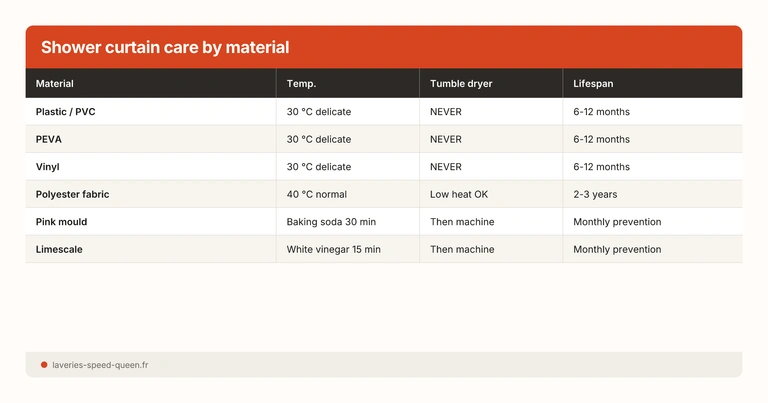
In short: a shower curtain can be machine washed — plastic/vinyl at 30 °C on delicate, polyester fabric at 40 °C. Treat mould with a baking soda paste (30 min) and limescale with white vinegar before washing. Add 2 bath towels to the drum for optimal mechanical cleaning. Recommended frequency: once a month.
At a Glance
Plastic/vinyl = 30 °C delicate cycle -- minimal spin, NEVER tumble dry.
Polyester fabric = 40 °C normal cycle -- low-heat tumble dryer OK.
Mould = baking soda paste -- 30 min on pink/black areas before washing.
Limescale = undiluted white vinegar -- spray 15 min before washing, dissolves calcium carbonate.
1 wash per month -- prevents mould growth and limescale build-up.
Why Your Shower Curtain Is a Bacteria Hotspot
The shower curtain is the most contaminated item in the bathroom. A University of Colorado study (2018, published in Microbiome) found that biofilms on shower curtains contain greater bacterial diversity than toilet surfaces. The reasons are straightforward: constant humidity, warmth, soap residue and dead skin cells — ideal conditions for microbial growth.
Pink Mould (Serratia marcescens)
The pink or orange stains at the bottom of your curtain are not technically mould. They are caused by Serratia marcescens, a Gram-negative bacterium that produces a pink-red pigment (prodigiosin). It feeds on soap residue and fatty acids in bath water. It poses no risk to healthy individuals but can cause urinary tract infections or wound infections in immunocompromised people.
Black Mould (Aspergillus, Cladosporium)
Black or grey-green patches are genuine fungal moulds. They appear when humidity persists beyond 48 hours (bathrooms without ventilation). Their spores are allergenic and can trigger asthma attacks in sensitive individuals.
Limescale
White or greyish deposits along the bottom of the curtain are limescale (calcium carbonate) left by hard water. Hard water is common in many areas, and the deposits form visibly within a few weeks. Limescale is not a hygiene issue but it makes the curtain stiff, opaque and visually dirty.
Plastic vs Fabric: Two Different Protocols
Plastic curtain (PVC, PEVA, vinyl)
The most common and cheapest option. Machine washable at 30 °C max, delicate cycle, minimal spin (400 rpm). NEVER tumble dry -- the plastic melts and warps. Hang it straight back on the rod to air dry. Lifespan: 6-12 months.
Polyester fabric curtain
More durable and more hygienic. Machine washable at 40 °C, normal cycle. Low-heat tumble dryer is acceptable. Handles anti-mould treatments better. Lifespan: 2-3 years.
Step 1 — Unhook and Prepare
- Remove the curtain from the rod.
- Detach the rings or hooks. Plastic rings can be washed in the drum inside a mesh laundry bag↗. Metal rings should be cleaned by soaking in a bowl of hot white vinegar↗ (5 minutes), then rinsed and wiped dry.
- Inspect the curtain — identify mould and limescale areas that need pre-treatment.
Step 2 — Pre-Treat Mould
Mould does not come off with a simple machine wash. Pre-treatment is essential for the wash to be effective.
The Baking Soda Method
- Make a thick paste: 3 tablespoons of baking soda + just enough water for a toothpaste consistency.
- Spread the paste over all mouldy areas (pink, black or orange stains).
- Leave for 30 minutes (1 hour for stubborn black mould).
- Scrub with a toothbrush or soft sponge. The stains should visibly lighten.
- Do not rinse — the curtain goes straight into the machine.
Baking soda is a mild abrasive (hardness 2.5 on the Mohs scale) that breaks up bacterial biofilms without scratching the plastic. Its alkaline pH (8.3) inhibits bacterial growth.
For Very Stubborn Mould
If baking soda alone is not enough (deep black mould), add white vinegar to the baking soda paste. The fizzing reaction (CO2 production) creates a mechanical action that helps lift the biofilm.
Baking soda + vinegar: the chemistry
The fizz from mixing baking soda and vinegar (NaHCO3 + CH3COOH produces CO2 + H2O + CH3COONa) creates micro-bubbles that work under the biofilm and lift it mechanically. The effectiveness is not chemical (the two products neutralise each other in terms of pH) but physical — it is the mechanical action of the bubbles that does the work.
Step 3 — Pre-Treat Limescale
Limescale (calcium carbonate) dissolves in acids. White vinegar (8% acetic acid) is the simplest and cheapest treatment.
- Spray undiluted white vinegar onto the limescale deposits — usually the bottom third of the curtain and the hems.
- Leave for 15 minutes. You will see small bubbles form on the thickest deposits — that is CO2 released by the acid + limescale reaction.
- Scrub lightly with a sponge. The softened limescale comes off easily.
- Do not rinse — the curtain goes into the machine.
For very thick deposits (6+ months without cleaning), apply vinegar, cover the area with cling film to prevent evaporation, and leave for 1 hour.
Step 4 — Machine Wash
Plastic Curtain (PVC, PEVA, Vinyl)
Temperature: 30 °C maximum -- anything higher warps the plastic and can cause it to stick to itself.
Delicate cycle -- plastic cannot withstand intense agitation.
Minimal spin -- 400 rpm max. High spin creates permanent creases in the plastic.
Add 2 bath towels -- they act as cleaning pads that scrub the curtain during the cycle.
100 ml white vinegar in the softener compartment -- removes limescale and soap residue during the rinse.
Polyester Fabric Curtain
Temperature: 40 °C -- polyester handles this well. 60 °C is possible if the label allows it.
Normal cycle -- fabric is more resilient than plastic.
Regular detergent + vinegar in the rinse -- no conventional softener (it leaves a greasy film that traps mould).
Low-heat tumble dryer OK -- polyester dries fast. Avoid high heat which creates stubborn creases.
The bath towel trick
Why add bath towels to the drum? A plastic shower curtain is light and slippery — it sticks to the drum walls instead of tumbling properly. The towels add weight and friction, creating a scrubbing effect that significantly improves cleaning. Same logic as dryer balls for duvets.
Step 5 — Drying
Plastic/Vinyl: NEVER Tumble Dry
PVC and PEVA begin to melt at 60-70 °C. Even a “low temperature” tumble dryer programme can reach 55-65 °C inside the drum. Air drying is the only option.
- Hang the curtain back on the rod immediately after washing.
- Spread it out fully (do not leave it bunched up).
- Open a window or turn on the extractor fan to speed drying.
- The curtain will be dry within 1-2 hours.
Polyester Fabric: Tumble Dryer OK at Low Heat
Polyester dries quickly. If using a tumble dryer, choose a low-temperature programme (40-50 °C max). Remove the curtain as soon as the cycle ends to avoid stubborn creases. Alternatively, hang it back on the rod — it will dry within 30 minutes to 1 hour.
Shower Curtain Rings
The rings are often forgotten during cleaning, yet they accumulate limescale and mould just like the curtain itself.
Plastic rings: place them in a mesh laundry bag and add them to the machine cycle with the curtain.
Metal rings (stainless steel, chrome): do not machine wash them (risk of scratching the drum and the curtain). Soak them in a bowl of hot white vinegar (not boiling) for 10 minutes. The limescale dissolves and the mould lifts off. Rinse and dry with a cloth.
Rusty rings: replace them. Rust stains both the curtain and the rod. If immediate replacement is not possible, soak in undiluted white vinegar for 1 hour — the vinegar dissolves surface rust.
Everyday Prevention
The best way to reduce cleaning frequency is to limit moisture and residue on the curtain after every shower.
Ventilate after every shower
Open a window or run the extractor fan for 15-20 minutes after each shower. Mould needs humidity above 70% to grow -- ventilation drops the level below that threshold within minutes.
Spread the curtain after showering
Do not leave the curtain bunched against the wall. Spread it across the full width of the rod so air circulates on both sides. Quick drying is the best mould prevention.
Weekly white vinegar spray
Spray a 50/50 water + white vinegar mix on the bottom third of the curtain once a week. The acid inhibits bacterial growth and dissolves nascent limescale. No need to rinse.
Curtain inside the tub
During the shower, the bottom of the curtain should be inside the bathtub or shower tray. Water running down the curtain carries soap residue towards the drain instead of accumulating at the bottom.
When to Replace Rather Than Wash
A shower curtain does not last forever. Here are the signs it is time for a replacement.
| Sign | Plastic | Fabric |
|---|---|---|
| Persistent mould after 2-3 washes | Replace | Replace |
| Cracked or stiff plastic | Replace | N/A |
| Uniform yellowing (UV) | Replace | Rare |
| Torn grommets | Replace | Repairable (sewing) |
| Lingering smell after washing | Replace | One last wash at 60 °C |
| Typical lifespan | 6-12 months | 2-3 years |
The Eco-Friendly Choice
Polyester fabric curtains are more durable (2-3 years vs 6-12 months), withstand more frequent and higher-temperature washes, and do not release PVC microplastics into the wash water. Over time, a fabric curtain at GBP 15-25 replaces 2 to 4 plastic curtains at GBP 5-10, for a similar total cost and lower environmental impact.
Mistakes to Avoid
- Tumble drying a plastic curtain -- PVC melts at 60-70 °C. The curtain warps, sticks to itself and is ruined beyond repair.
- Hot water (>40 °C) on plastic -- creates permanent creases and accelerates yellowing.
- Conventional fabric softener -- leaves a greasy film on the curtain that traps soap residue and encourages mould. Use white vinegar instead.
- Concentrated bleach -- weakens polyester fabric and cracks PVC. If you must use it, dilute heavily (1 tbsp per litre).
- Leaving the curtain bunched after showering -- moisture trapped in the folds is the number one cause of mould. Always spread it out.
- Never washing the curtain -- after 3 months without cleaning, bacterial biofilms are well established and much harder to remove.
As an Amazon Associate, we earn a small commission on purchases made through the affiliate links in this article — at no extra cost to you. This helps us maintain the site and produce free guides.
Looking for a professional-grade clean? Our self-service laundromats offer spacious drums ideal for large or bulky curtains, with programmes at 30-40 °C and detergent included.
Sources and References
- Kelley, S.T. et al. (2018). “Showerhead and shower curtain biofilms.” Microbiome, 6(1), 105.