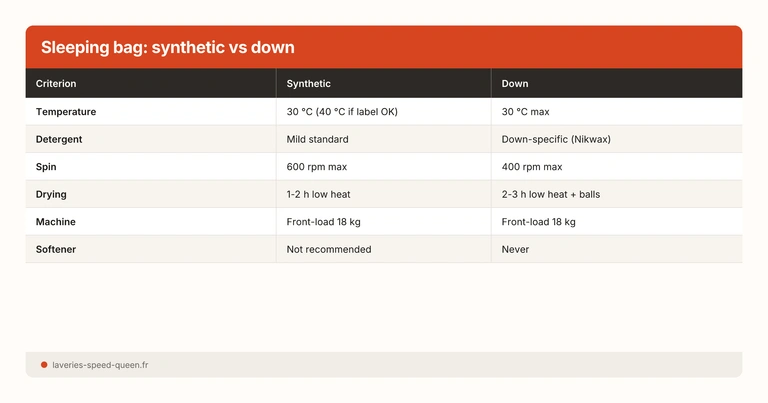
In short: Wash a sleeping bag in an 18 kg front-load machine (never a top-loader), at 30 °C on a delicate cycle. Down requires a specialist detergent (Nikwax Down Wash or equivalent); synthetic accepts a standard gentle detergent. Tumble drying with dryer balls is the critical step: allow 2-3 hours on low heat for down. Laundromat cost: roughly €16-19 all-in.
At a Glance
18 kg front-load machine required — the agitator in a top-loader tears the internal baffles.
30 °C delicate cycle — down is fragile; heat destroys its insulating properties.
Specialist down detergent — regular detergent strips the natural oils from down (not an issue for synthetic).
Dry with dryer balls — 2-3 hours on low heat, shake every 30 minutes.
Why a Commercial Machine Is Essential
The major outdoor equipment manufacturers are clear on this point. Patagonia, The North Face, Marmot, and Rab all explicitly recommend a large-capacity front-load machine for washing sleeping bags (source: respective care pages, accessed March 2026).
The reason is twofold:
Drum volume. A sleeping bag, even compressed, takes up considerable volume once wet. In a domestic 7-8 kg machine (52-58 litre drum), the bag is compressed to the point where water and detergent cannot circulate properly. Rinsing is incomplete and soap residue stays trapped in the filling. An 18 kg machine offers a 180-litre drum — enough space for the bag to move freely.
Tumbling action. Top-loading machines use a central agitator that spins and thrashes the laundry. This violent motion tears the baffles that compartmentalise the down inside the bag. Once the baffles are damaged, down migrates to the extremities and the bag permanently loses its insulating power.
Never use a top-loading machine
If you see a central pillar in the middle of the drum, never put your sleeping bag in it. That type of machine is designed for everyday laundry, not for technical items with internal baffles. All Speed Queen machines at our laundromats are front-loading.
Synthetic vs Down: Two Distinct Protocols
Before diving into the washing steps, it is essential to understand that synthetic and down fillings are not treated the same way. The washing protocol, detergent, drying process, and even storage differ significantly.
Synthetic: Easier and More Forgiving
A synthetic sleeping bag (PrimaLoft, Polartec, Thermolite) is simpler to maintain than its down equivalent. Hollow polyester fibres have no natural oils to preserve, they do not clump as easily when wet, and they dry much faster (1-2 hours versus 2-3 hours for down).
A standard gentle detergent (no fabric softener) works fine for synthetic. You can go up to 40 °C if the label allows, and the spin can be slightly more vigorous (600 rpm max versus 400 for down). The main risk is mechanical: the stitching on the internal baffles can give way if the machine is too small or the agitation too aggressive.
Down: Demanding but Not Impossible
Down (goose or duck) is a premium filling that requires specific precautions. The plumules are coated in natural oils that give them their loft and insulating power. A standard detergent — even a gentle one — contains surfactants that degrade these oils. That is why a specialist down wash (Nikwax Down Wash, Grangers Down Wash, Fibertec Down Wash) is mandatory, not just recommended.
Wet down forms dense, heavy clumps. If these clumps are not properly separated during drying, they stay balled up and the bag permanently loses its loft. That is why dryer balls↗ are essential — not merely useful.
Comparison Table
Down vs Synthetic: The Washing Differences
Down sleeping bag (feathers)
Natural filling (goose or duck down). More insulating for its weight, but more demanding to wash. Wet down clumps into dense masses that take 2-3 hours to dry. Requires a specialist down wash (Nikwax Down Wash, Grangers Down Wash) to preserve natural oils.
Synthetic sleeping bag (PrimaLoft, Polartec)
Hollow polyester fibre filling. Easier to care for: dries faster (approx. 1-2 hours), accepts a standard gentle detergent. Handles residual moisture better than down. Even with an imperfect wash, performance is less affected.
| Feature | Down | Synthetic |
|---|---|---|
| Wash temperature | 30 °C max | 30-40 °C |
| Detergent | Specialist down wash required | Standard gentle detergent |
| Spin speed | 400 rpm max | 600 rpm max |
| Drying time | 2-3 hours | 1-2 hours |
| Dryer balls | Essential | Recommended |
| Fabric softener | Prohibited | Prohibited |
Preparation Before Washing
Check the label — confirm that machine washing is permitted. Some ultralight high-end bags require hand washing.
Close all zips — main zip and inner zip. Metal teeth can puncture baffles during tumbling.
Turn the bag inside out — the outer fabric will be less exposed to abrasion in the drum.
Inspect the seams — repair any holes or tears before washing. Even a tiny hole will let down escape into the machine.
Pre-treat dirty areas — the collar, hood, and zip area often accumulate body oils. Rub with a little damp Marseille soap before the cycle.
The Washing Process Step by Step
Wash your sleeping bag on its own, in an 18 kg front-load machine, at 30 °C on a delicate cycle with a detergent suited to your filling.
Choose an 18 kg front-load machine — the bag needs room. A machine that is too small compresses the filling and prevents proper rinsing.
Add the right detergent — for down: Nikwax Down Wash or Grangers Down Wash (dose per the manufacturer). For synthetic: a reduced amount of gentle detergent.
No fabric softener — softener deposits a film on fibres that reduces down loft and synthetic breathability.
Run a delicate cycle at 30 °C — minimal spin (400 rpm for down, 600 rpm max for synthetic).
Run a second rinse — if your machine allows it, add an extra rinse cycle. Detergent residue in the filling is the leading cause of loft loss.
Detergent included at Speed Queen
At our laundromats, detergent is included and automatically dosed. For down, bring your own specialist down wash and select a cycle without detergent injection if available, or run the cycle normally — the professional detergent is mild and does not contain agents incompatible with down.
Drying: The Most Important Step
Poor drying ruins a good wash. Wet down forms dense clumps that, if not separated, will stay balled up and never loft again. Drying can take 2 to 3 hours for a down bag.
3-4 dryer balls
Place them in the dryer with the bag. They strike the filling and break up clumps of down. If you don't have dryer balls, clean tennis balls work too.
Low heat only
High heat damages down and can melt the technical fabrics of the bag (ripstop nylon). Choose a gentle or low-heat programme.
Dry in multiple passes
Every 30 minutes, take the bag out, shake it vigorously, and redistribute the filling by hand. Put it back in the dryer. Repeat until the bag feels light and fluffy.
Final touch test
Press different areas of the bag, especially the seams and extremities. If you feel cold or damp clumps, drying is not finished. A bag stored while still damp will develop mould.
Drying: Why It Is the Most Critical Step
Drying makes or breaks the entire wash. A poorly dried bag loses its loft, develops mould and odours, and can be permanently ruined. Here is why this step deserves as much attention as the wash itself.
Dryer Balls: How They Work
Dryer balls (or clean tennis balls) serve a precise mechanical function: they strike the filling as the drum rotates and break apart the clumps of down or synthetic fibres that form when the filling is wet. Without balls, down dries in compact masses that never fully re-loft. Use 3 to 4 balls for a sleeping bag.
Drying in Multiple Cycles
Do not expect the bag to be dry after a single cycle. The correct process is iterative:
- Run a first cycle of 30 to 45 minutes on low heat.
- Remove the bag, shake it vigorously, and redistribute the filling by hand, massaging the baffles.
- Put the bag back in the dryer with the balls and run another cycle.
- Repeat until the bag is light, fluffy, and free of cold or damp spots.
For down, expect 3 to 5 cycles (2-3 hours total). For synthetic, 2 to 3 cycles (1-2 hours).
Check the Centre of the Bag
This is the most common mistake: the bag feels dry on the surface, but the centre of the baffles is still damp. Press different areas of the bag, especially along the seams and in the back zone (the thickest part). If you feel cold clumps or damp resistance, drying is not complete. Never store a bag that is still damp: mould develops within days, and the smell is nearly impossible to eliminate.
Alternative: Air Drying
If you do not have access to a large enough dryer, air drying is possible but much slower. Lay the bag flat (never hang it — the weight of the wet filling stretches the baffles) in a dry, ventilated area. Turn it over and redistribute the filling every hour. Allow 2 to 3 days for complete drying indoors, less outdoors in dry weather.
Storage After Washing: The Essential Rules
Correct storage of a sleeping bag is just as important as its care. A poorly stored bag loses its loft even if it was perfectly washed and dried.
Never Compressed Between Seasons
The compression sack supplied with your sleeping bag is designed exclusively for transport on the trail. It should never be used for storage at home. Down compressed for months loses its loft permanently: the plumules flatten and never recover their original volume.
Loose Storage Sack
Every manufacturer provides (or sells separately) a large storage sack made of mesh, cotton, or breathable fabric. This sack lets the filling breathe and maintain its natural volume. If you no longer have the original sack, a large cotton bag or pillowcase works fine.
Dry, Ventilated Location
Store your bag in a dry cupboard, away from moisture and temperature swings. Avoid the garage, cellar, or uninsulated attic. Residual humidity in these spaces can create conditions for mould, even on a perfectly dried bag.
Air It Out Before the First Use of the Season
Before heading out on a hike, take your bag out of storage, shake it vigorously, and let it air for a few hours. Down needs time to reach its maximum loft after a period of storage.
Restoring Water Repellency (DWR)
The DWR (Durable Water Repellent) treatment is a hydrophobic coating applied at the factory to the outer fabric of the bag. After several washes, this treatment wears off and water begins to soak into the fabric instead of beading on the surface.
Reactivating the DWR
Good news: tumble dryer heat partially reactivates the existing DWR. After the bag is fully dry, run a final 10-minute cycle on medium heat to “wake up” the coating. If your bag is more than 2 years old or water no longer beads at all, apply a waterproofing spray (Nikwax TX.Direct, Grangers Performance Repel) according to the manufacturer’s instructions.
Frequency and Care Between Washes
A sleeping bag does not need washing after every use. Too many washes wear out the filling. The goal is to wash as little as possible while maintaining hygiene and performance. For other bulky items, see how to wash a puffer jacket or wash a down duvet.
Use a sleeping bag liner
This is the best investment. A silk or cotton liner protects the inside of the bag and is easy to wash. It eliminates direct contact with body oils, sweat, and sunscreen — the three main factors that degrade down.
Air out after every night
In the morning, open the bag and drape it over the tent or a rock to let overnight moisture evaporate. 30 minutes of dry air is enough. Never stuff it into its compression sack while still damp.
Store uncompressed
Between seasons, keep your bag in a large mesh or cotton sack (often supplied by the manufacturer). The compression sack is designed for transport only — prolonged compressed storage crushes the down and permanently reduces loft.
How Much Does It Cost
| Option | Price | Time | Risk |
|---|---|---|---|
| Laundromat (18 kg machine) | €16-19 (wash + dry) | approx. 2-3 hours | Low (suitable machine) |
| Specialist dry cleaner | €25-40 | 3-7 days | Low (but confirm they handle sleeping bags) |
| Home machine (7-8 kg) | approx. €3 (water + detergent) | 4-6 hours | High (torn baffles, incomplete drying) |
Most standard dry cleaners do not accept sleeping bags, or they treat them with dry cleaning solvents — a process that degrades the natural oils in down and reduces loft. Always verify that the dry cleaner offers wet cleaning (aqua cleaning) rather than solvent-based cleaning. To find the exact weight of your bag, check our laundry weight guide.
Mistakes to Avoid
- Top-loading machine — the central agitator tears the baffles and rips out the down.
- Regular detergent on down — it strips the natural oils and irreversibly reduces loft.
- Fabric softener — it deposits a film that blocks breathability and prevents the down from lofting.
- High spin (>600 rpm) — compresses the filling and can tear the fine baffle stitching.
- Storing a damp bag — mould is guaranteed within days; the smell is almost impossible to remove.
- Storing compressed between seasons — down permanently flattens. Use a large mesh sack.
As an Amazon Associate, we earn a small commission on purchases made through the affiliate links in this article — at no extra cost to you. This helps us maintain this site and produce free guides.
Manufacturers recommend a professional front-load machine for washing a sleeping bag. Our laundromats in Blagnac, Croix-Daurade and Montaudran have 18 kg front-load machines and professional dryers for thorough drying. Detergent included, payment contactless card or cash. Prices. Use our laundry weight calculator to check the weight of your bag.