In short: only slippers made from synthetic materials (fleece, faux fur) and industrial felt are machine washable — at 30 °C, delicate cycle, in a mesh laundry bag . Leather, suede and artisan felt slippers should be surface cleaned only. Air dry with newspaper stuffing — never tumble dry. Deodorise between washes with baking soda.
At a Glance
Check the material -- synthetic and industrial felt = machine OK. Leather and suede = surface clean only.
30 °C, delicate cycle -- anything higher risks warping the sole and shrinking felt.
Mesh laundry bag essential -- protects the shape and prevents banging inside the drum.
No tumble dryer -- the heat warps soles and unglues bonded parts.
Baking soda between washes -- sprinkle overnight to absorb perspiration odours.
Which Slippers Are Machine Washable — and Which Are Not
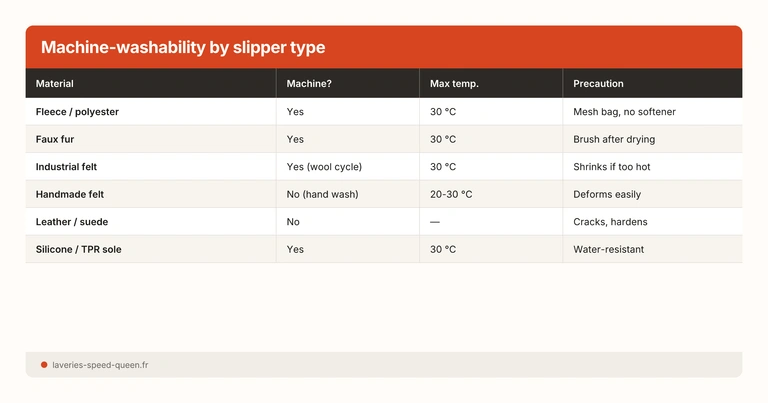
Before putting your slippers in the drum, identify the material. This information is usually on a small label inside the slipper, or on the original packaging. If there is no label, go by touch and appearance.
| Material | Machine? | Max temperature | Key precaution |
|---|---|---|---|
| Fleece / polyester | Yes | 30 °C | Laundry bag, no softener |
| Faux fur | Yes | 30 °C | Brush after drying to refluff |
| Industrial felt (Giesswein, Haflinger) | Yes (wool programme) | 30 °C | Shrinkage risk if too hot |
| Artisan felt (boiled wool) | No (hand wash) | 20-30 °C | Warps and shrinks easily |
| Leather / suede | No | — | Hardens, cracks, loses suppleness |
| Glued leather sole | No | — | Glue dissolves in water |
| Silicone / TPR sole | Yes | 30 °C | Water- and cold-resistant |
When in doubt
If the label is missing and you cannot identify the material, test a small hidden area: dampen a corner with cold water and rub gently. If the colour bleeds, the felt starts to distort or the sole softens, do not machine wash. Surface clean only.
The Machine Wash Protocol
Once the material is confirmed, machine washing is straightforward — as long as you follow a few precautions.
Preparation
- Remove the insoles — wash them separately in the same bag or by hand with Marseille soap↗.
- Brush the outer sole — remove dust, hair and small debris with a soft-bristle brush. Dirt lodged in the sole grooves ends up in the machine filter.
- Pre-treat stains — if the slippers have visible stains, rub damp Marseille soap on the area and leave for 10 minutes.
Machine Settings
- Programme: delicate or wool — short cycle, gentle agitation
- Temperature: 30 °C max
- Spin: 400-600 rpm (the minimum available). High spin distorts the slippers.
- Detergent: liquid, half the normal dose. Slippers do not have the bulk of laundry needed to absorb a full dose — excess leaves residue.
- Softener: none. Softener deposits a greasy film on fibres that attracts dust and reduces loft.
Balance the Drum
Do not wash slippers alone in a large machine: the drum will be unbalanced during spin. Add a few towels or cloths to even out the load. This also improves tumbling and therefore cleaning.
Material by Material: The Detailed Guide
Fleece / faux fur slippers
The easiest to wash. 30 °C, laundry bag, liquid detergent. After washing, shake vigorously to restore loft. If the fur stays flat after drying, brush gently with a clothes brush in the direction of the pile.
Felt slippers (industrial)
Wool programme at 30 °C, wool or mild liquid detergent. Felt is wool compacted by friction and heat -- too hot or too vigorous a wash continues this process and shrinks the slipper. Dry flat, always.
Slippers with silicone sole
Silicone withstands 30 °C washing perfectly. The non-slip pads will not come off. Just check that the upper is also machine washable.
Artisan felt slippers (boiled wool)
Hand wash only. Fill a basin with cold water (20 °C), add a drop of shampoo or wool detergent. Submerge, press gently without wringing. Rinse in cold water. Dry flat on a towel, reshaping by hand.
Leather / suede slippers
Never machine wash, never submerge in water. Wipe leather with a damp cloth + Marseille soap. For suede, dry brush with a dedicated suede brush. Treat insoles with baking soda overnight for odours.
Drying: The Critical Phase
Drying is where most damage happens. Incorrect drying warps, shrinks or unglues slippers.
What NOT to Do
- Tumble dryer -- the heat warps rubber and silicone soles, shrinks felt and can unglue thermally bonded parts.
- Radiator / direct sunlight -- concentrated heat cracks leather, yellows white textiles and warps soles.
- Drying upright -- the weight of the water pulls the slipper downward. Always dry flat or horizontally.
The Right Method
- Hand press — after removing from the machine, press the slippers gently (without wringing) to remove excess water. Place each slipper between two dry towels and press firmly: the towel absorbs residual water by capillary action, cutting drying time by several hours.
- Stuff with newspaper — crumple newspaper and fill the inside of each slipper. The paper absorbs moisture and holds the shape. Change the paper after 4-6 hours when it is saturated. Kitchen paper works too, but saturates faster — plan on 2-3 changes.
- Lay flat on a rack — a drying rack or raised dish rack is ideal because air circulates under the slipper too. If placed flat on a towel, flip at the halfway point to even out evaporation.
- Speed up with a fan — if the ambient air is humid (bathroom, rainy weather), point a fan at the slippers on low speed. Air movement cuts drying time by 30-50% without heat, preserving sensitive materials. This is the technique cobblers use to dry leather shoes.
- Allow 24-48 hours — depending on thickness and humidity. Felt and faux fur dry more slowly than fleece.
Deodorising Between Washes
Monthly washing is not always enough to keep slippers fresh. Daily foot perspiration (roughly 200 mL per day across both feet) creates a warm, damp environment ideal for the bacteria that cause odours.
Baking Soda: The Simple Solution
Baking soda is the best deodoriser for slippers between washes:
- Sprinkle 1 tablespoon of baking soda inside each slipper
- Leave overnight (8-12 hours)
- Shake out the powder the next morning
Baking soda absorbs the volatile fatty acids (isovaleric acid, propanoic acid) produced by sweat bacteria. A weekly application keeps slippers fresh between monthly washes.
Natural Alternatives
- Dry tea bag — place a used, dried black tea bag inside each slipper. The tannins absorb odours.
- Dried lavender — a lavender sachet in each slipper masks odour and repels moths.
- Freezer — place the slippers in a Ziploc bag in the freezer for 24 hours. The cold kills some odour-causing bacteria. Useful in a pinch.
Recommended Washing Frequency
How often to wash depends on your usage:
| Usage | Wash frequency | Deodorising between washes |
|---|---|---|
| Daily with socks | Once a month | Baking soda 1x/week |
| Daily barefoot | Every 2 weeks | Baking soda 2x/week |
| Occasional (weekends) | Every 2-3 months | Baking soda if needed |
| Guest slippers | After every use | — |
When to Replace Your Slippers
Even with good care, slippers have a limited lifespan. Here are the signs it is time for a new pair:
- Flattened sole — the inner padding no longer springs back after washing. Arch support is gone.
- Persistent odour despite washing — bacteria have colonised the fibres deep down and washing no longer removes them.
- Worn outer sole — the non-slip pads are smooth and the slipper slides on tiles. This is a fall risk.
- Visible deformation — the slipper has lost its original shape, the heel is crushed.
With daily use, expect 6-12 months for synthetic slippers, 1-2 years for quality felt (Giesswein) and 2-3 years for well-maintained leather.
Common Mistakes That Ruin Slippers
- Washing in hot water (40 °C+) -- the heat warps rubber soles and shrinks felt. Stay at 30 °C max regardless of the material.
- High-speed spin -- 1 000+ rpm spin crushes the shape and can unglue bonded soles. Limit to 400-600 rpm.
- Drying on a radiator -- concentrated heat cracks leather, yellows textiles and warps silicone soles. Always air dry at room temperature.
- Using fabric softener -- softener deposits a greasy film on faux fur that attracts dust and reduces loft. White vinegar (50 mL in the rinse) softens without residue.
- Washing slippers alone in a large machine -- the drum will be unbalanced during spin. Always add towels or cloths to balance the load.
Washing Slippers at the Laundromat
If you have several pairs to wash at once — for example, the whole family’s slippers at the end of the season — the laundromat is a practical option. Professional machines offer advantages for slippers.
The delicate programme at 30 °C on commercial machines is calibrated for fragile textiles. The larger drum (9 kg minimum) lets you wash 4-5 pairs in one cycle, with towels to balance the load. Auto-dosing detergent avoids the over-dosing that is common at home and leaves sticky residue in faux fur.
After washing, the professional low-heat tumble dryer can be useful for fleece and faux fur slippers (never for felt or leather). The mechanical tumbling refluffs fur flattened by washing. Allow 10-15 minutes of gentle drying max — slippers dry much faster than towels because they are small and light. Check the soles before drying: if they contain soft rubber, use the lowest temperature available.
For industrial felt slippers (Giesswein, Haflinger), skip the dryer even at the laundromat. Air dry with newspaper as described above — felt is too heat-sensitive for mechanical drying.
As an Amazon Associate, we earn a small commission on purchases made through the affiliate links in this article — at no extra cost to you. This helps us maintain the site and produce free guides.
Need to wash multiple pairs at once? Our self-service laundromats have delicate programmes designed for fragile textiles, with spacious drums and auto-dosing detergent for a residue-free result.
Sources and References
- Foot perspiration: approx. 200 mL/day — role of bacteria (Brevibacterium) in foot odour
- Wool felt: felting process via friction and heat — shrinkage threshold at 40 °C