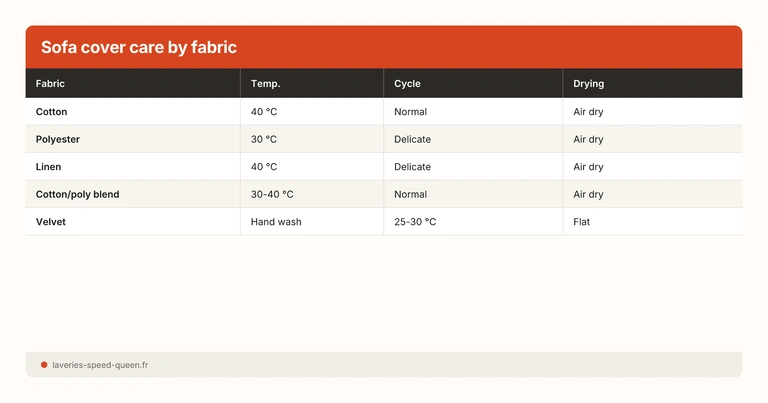
In short: a removable sofa cover can be machine washed at 30-40 °C depending on the fabric (cotton 40 °C, polyester 30 °C, linen 40 °C delicate, velvet hand wash only). Close zippers, turn inside out, pre-treat stains with Marseille soap. For a full set of covers (3-seater sofa), an 18 kg machine at a laundromat is essential. Air dry and refit the cover while slightly damp for a perfect fit.
At a glance
Check the care label — it dictates the temperature and cycle. No label = test on a hidden corner.
Close zippers, turn inside out — protects the visible surface and stops zippers from snagging.
Cotton: 40 °C / Polyester: 30 °C / Linen: 40 °C delicate — velvet is hand wash only.
First wash: -10 °C — lowering the temperature limits initial shrinkage on natural fibers.
Air dry — put back on the sofa while slightly damp for a perfect fit.
Removable or not: the first question
Before thinking about temperature or cycle, check whether your sofa has removable covers. This determines everything that follows.
A removable sofa has zippers (or Velcro) on each section — seat, back, armrests. The cover comes off like a pillowcase: you can put it straight in the machine.
A non-removable sofa has its upholstery sewn or stapled directly onto the frame. It cannot be removed without disassembling the sofa. In this case, cleaning is done on the surface (vacuuming, shampooing, steaming) rather than in a machine. The rest of this article covers removable covers.
How to check if your sofa is removable
- Look for zippers: they are usually located under the seat cushions, along the back edge, or under the armrests.
- Lift the cushions: removable seats lift independently from the frame.
- Check the product sheet: the sofa’s technical specifications (often available online with the exact model) indicate whether the covers are removable.
The care label: your definitive guide
Every cover has a care label sewn inside, usually near the zipper. This label is your absolute reference — it overrides any general advice, including this article.
Key information to read on the label:
- The wash symbol (basin with a number): indicates the maximum temperature. A line under the basin means delicate cycle. Two lines mean very delicate cycle. If you are not familiar with care label symbols, check our dedicated guide.
- The drying symbol (square with a circle): one dot = low temperature drying, two dots = high temperature, a cross = forbidden.
- The bleach symbol (triangle): crossed out = no bleach, useful if you plan to whiten.
Missing or illegible label?
If the label has been cut off or is unreadable, identify the fabric composition (often stated on the invoice or manufacturer’s website). When in doubt, wash at 30 °C on the delicate cycle — it is the safest setting for all machine-washable fabrics.
Wash temperature by fabric type
The cover fabric determines the temperature, cycle, and spin type. Here are the recommendations by material.
Cotton (most common)
40 °C normal cycle, spin 800-1000 rpm. Cotton is sturdy and handles washing well. For very dirty white covers, 60 °C is possible (check the label). First wash: 30 °C to limit shrinkage (3-5% possible).
Polyester and synthetic blends
30 °C delicate cycle, spin 600-800 rpm. Polyester does not shrink and dries quickly, but it is heat-sensitive (the fabric can warp above 40 °C). Cotton-polyester blends follow the rule of the most delicate component: 30 °C.
Linen
40 °C delicate cycle, spin 600 rpm maximum. Linen is a strong fiber but wrinkles easily and can shrink 5-7% on the first hot wash. Always wash on the delicate cycle to reduce agitation. Linen softens with each wash.
Velvet (hand wash only)
Velvet cannot handle the machine drum: the raised fibers get crushed and create irreversible marks. Wash by hand in a bathtub, lukewarm water 25-30 °C, gentle detergent. Wring by pressing into a terry towel, without twisting. Dry flat.
Fiber blends: which rule applies?
Most modern sofa covers are made from fiber blends (e.g. 65% polyester / 35% cotton). The rule is simple: always apply the conditions of the most delicate component. A cotton-polyester blend should be washed at 30 °C on the delicate cycle (polyester conditions), even though the cotton would tolerate 40 °C.
Before washing: preparing the cover
Good preparation makes the difference between a flawless result and a wrinkled or misshapen cover.
1. Remove all covers
Remove each section separately: seats, backs, armrests. Even if you only plan to wash the seats (the dirtiest), it is better to wash the whole set at the same time. Covers washed separately may show slight differences in shade or texture after drying.
2. Close the zippers
Open zippers can snag the fabric in the drum and cause tears. Close them all. If the zipper is fragile, place the cover in a large mesh laundry bag↗.
3. Turn inside out
This is an often overlooked but essential step. The inside of the cover is exposed to direct friction against the drum. By turning it, you protect the visible surface (the one you see while sitting on the sofa) from abrasion, fading, and pilling.
4. Pre-treat stains
Set-in stains (food, drink, sweat, pet urine) will not come out with a standard wash cycle. Treat them first:
- Grease stains (food, oil): sprinkle with baking soda, leave for 30 minutes, brush off.
- Drink stains (coffee, tea, wine): blot with cold water, then apply damp Marseille soap directly on the stain.
- Sweat stains (marks on armrests): paste of sodium percarbonate and water (1:1), leave for 1 hour.
- Persistent odors: soak for 30 minutes in cold water with 2 tablespoons of baking soda↗ per liter.
The first wash: watch out for shrinkage
Shrinkage is the main concern when washing sofa covers. A cover that shrinks by 3-5% no longer fits properly — the edges pull, zippers strain, and the cushion bulges.
Why shrinkage happens
Natural fibers (cotton, linen) are spun under tension during fabric manufacturing. On the first wash, hot water releases that tension and the fibers return to their natural length — shorter. This is an irreversible but predictable process.
How to minimize it
- First wash at cold or 30 °C — even if the label allows 40 °C, stay 10 °C below for the first cycle.
- No tumble dryer — dryer heat causes an additional 2-3% shrinkage on cotton.
- Moderate spin (600-800 rpm) — excessive spinning compresses fibers and increases shrinkage.
- Refit while slightly damp — a still-damp cover (not wet) naturally stretches back to the cushion shape.
Measure before and after
To quantify shrinkage, measure the cover flat (length x width) before the first wash and after complete drying. Shrinkage of 2-3% is normal for cotton. Above 5%, the cover will be difficult to put back on. This test lets you adjust the temperature for future washes.
Machine capacity: why the laundromat is often necessary
The weight and volume of a full set of sofa covers often catch people off guard. Here are the approximate figures:
- 2-seater sofa — single seat cover: 1.5-2.5 kg; full set: 3-5 kg
- 3-seater sofa — single seat cover: 2-3.5 kg; full set: 5-8 kg
- Corner/sectional sofa — full set: 7-12 kg
A domestic 7-8 kg machine can hold the covers of a 2-seater sofa, but the laundry will be packed — it will not circulate freely in the drum, rinsing will be insufficient, and detergent will not wash out properly.
For a 3-seater or sectional sofa, an 18 kg machine at a laundromat is the solution. The large drum allows covers to circulate freely, rinsing is thorough (50-60 liters of water), and the cycle finishes in under an hour. Check our article on laundry weight in the machine for better load estimation.
Drying: the critical phase
Drying is the stage where mistakes have the most impact — poor drying can cause shrinkage, musty odors, or permanent creases.
Air drying (recommended)
- Lay flat if possible (on a drying rack, on a table covered with a towel). Hanging vertically on a line pulls the fabric downward under its own weight and can distort the cover.
- Flip halfway through so both sides dry evenly.
- Avoid prolonged direct sunlight on colored fabrics — UV rays fade surface pigments.
- Drying time: allow 6 to 12 hours depending on the fabric and season. Linen dries faster than cotton.
Refit the cover while slightly damp
This is the key trick for a perfect fit. When the cover is still slightly damp (not wet — it should no longer drip), put it back on the cushion. Damp fabric is more pliable and stretches naturally to mold to the shape. As it finishes drying in place, the cover tightens perfectly without creases or pulling.
Tumble dryer: when it is allowed
If the label allows the tumble dryer (square with a circle symbol, one or two dots), use low heat only (one dot = 60 °C max). Remove the cover before it is fully dry and finish drying in place on the sofa. See our drying guide for more details.
Maintenance between washes
Washing the covers every 3 months is sufficient for normal use. Between washes, regular maintenance keeps things clean and extends the fabric’s lifespan.
Weekly vacuuming
Vacuum the covers weekly using the upholstery attachment (soft brush). Vacuuming removes dust, crumbs, pet hair, and surface dust mites. Use the narrow nozzle for seams and folds.
Fabric deodorizing spray
Between washes, neutralize odors with a homemade spray: 200 ml of water, 1 tablespoon of baking soda, 5 drops of lavender essential oil (optional). Mist from 30 cm away and let dry. The baking soda neutralizes odor molecules without masking the smell.
Cushion rotation
If your cushions are reversible, flip them weekly. Wear, fading, and stains distribute evenly across both sides, doubling the visible lifespan of the cover.
Temporary protection
For dinner parties or gatherings, drape a throw or temporary protective cover over the seats. It is easier to wash a throw than to remove an entire sofa set. Check our guide on washing a throw blanket.
Treating common stains on sofa covers
Coffee or tea
Blot immediately with cold water (never hot — heat sets tannins). Apply Marseille soap, rub gently, rinse. If the stain has dried: sodium percarbonate paste for 1 hour, then wash.
Red wine
Blot the excess, sprinkle table salt (salt absorbs the pigment), leave 10 minutes, brush off. Then dab with white vinegar. Machine wash at the usual temperature for the fabric.
Pen or marker
Ballpoint ink: dab with 70% rubbing alcohol (soaked cloth). Water-based marker: rinse thoroughly with cold water. Permanent marker: rubbing alcohol then hairspray (solvent for permanent pigments).
Pet urine
Blot with cold water, apply undiluted white vinegar (neutralizes ammonia and odor). Leave 15 min. Sprinkle baking soda, let dry, vacuum. Machine wash at 40 °C.
Mistakes to avoid
- Washing only one cover — the color difference with the others will be visible. Wash the whole set together.
- Tumble dryer on high heat — cotton can shrink 5% or more. Air dry or use a low-heat program.
- Leaving the cover balled up in the machine — remove immediately after the cycle to prevent creases set by moisture.
- Bleach on colored fabrics — bleach strips pigments. Use sodium percarbonate (oxygen bleach) for stain removal on colored covers.
- Spinning at 1200+ rpm — excessive spin speed deeply wrinkles the fabric and worsens shrinkage. Limit to 800 rpm.
- Skipping stain pre-treatment — a standard wash cycle is not enough for set-in stains. Treat first.
Non-removable sofa: the alternatives
If your sofa does not have removable covers, you cannot put the upholstery in the machine. Here are the surface cleaning methods.
Baking soda shampooing
Generously sprinkle baking soda over the entire sofa surface. Leave for 2 hours (overnight for stubborn odors). Vacuum thoroughly. The baking soda absorbs odors and moisture and loosens surface dirt.
Steam cleaning
A garment steamer or handheld steam cleaner disinfects the fabric without excessive wetting. Steam (100 °C+) kills surface dust mites and bacteria. Pass slowly over the entire surface, section by section. Ventilate the room afterward to remove moisture.
Spot cleaning
For an isolated stain, prepare a mix: 500 ml of warm water, 1 tablespoon of white vinegar, 1 tablespoon of dish soap. Apply with a clean cloth by blotting (never rubbing). Rinse with a damp cloth. Use a hairdryer at a distance to avoid watermarks.
Recommended wash frequency
The frequency depends on usage and environment:
- Every 3 months — standard use (adults, no pets)
- Every month — pets or young children
- Immediately — after a major stain (wine, urine, vomit)
- Weekly — surface vacuuming (not a full wash)
For a broader schedule, check our article on family laundry routines to work sofa cover washing into your plan.
At the laundromat: the solution for large covers
3-seater and sectional sofa covers consistently exceed the capacity of home machines. At the laundromat, 18 kg machines offer a drum large enough for the covers to circulate freely.
Why the laundromat is more effective
- Drum volume — covers are not compressed, rinsing is thorough.
- Water volume — 50 to 60 liters versus 40-50 liters for a domestic 8 kg machine. Detergent residue is better flushed out.
- Suitable programs — 30 °C and 40 °C cycles with adjustable spin.
- Time — a full cycle (wash + spin) at the laundromat takes approx. 35-45 minutes. You leave with clean, spun-out covers ready for drying at home.
Before heading to the laundromat, prepare your covers at home: remove them, pre-treat stains, close zippers, turn inside out. You will save time on-site. Check our guide for your first time at a laundromat.
As an Amazon Associate, we earn a small commission on purchases made through the affiliate links in this article — at no extra cost to you. This helps us maintain this site and produce free guides.
3-seater and sectional sofa covers need a large-capacity machine for effective washing and rinsing. Our laundromats in Blagnac, Croix-Daurade and Montaudran have 18 kg machines with detergent included — ideal for large textile items. Payment by contactless card or cash. Check our prices.
Sources and references
- Laundry care label symbols: complete guide
- Laundry weight guide: estimation by item
- Preventing shrinkage in the wash
- Drying guide: by textile and method
- Wash a pillow and its cover in the machine
- Baking soda and laundry: uses
- ISO 3759 — Method for measuring dimensional shrinkage of textiles after washing
- AFNOR NF EN ISO 6330 — Domestic washing and drying procedures for testing textiles