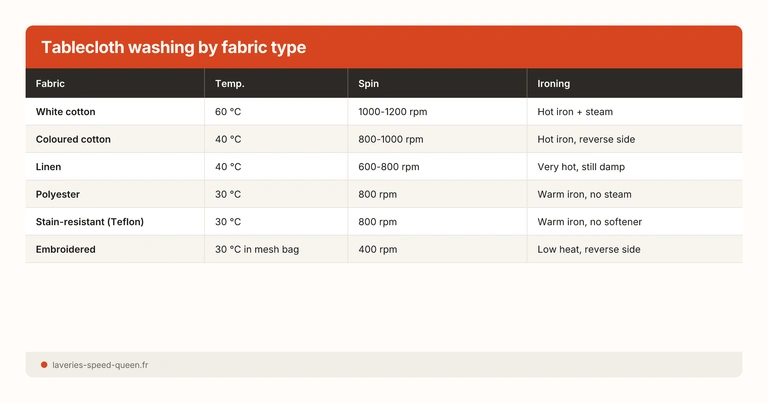
A tablecloth should be washed according to its fabric: white cotton at 60 °C, coloured cotton or linen at 40 °C, polyester or stain-proof at 30 °C, embroidered at 30 °C in a laundry bag. The critical step is not the wash itself but stain pre-treatment: wine, grease, candle wax — each stain needs specific treatment or it will set in the heat. Large tablecloths (10+ guests) need a 15-18 kg machine to tumble freely and wash evenly.
At a Glance
Always pre-treat stains before washing -- machine washing without pre-treatment sets wine, grease and candle wax stains.
Temperature by fabric -- white cotton 60 °C, linen/coloured cotton 40 °C, polyester/stain-proof 30 °C.
No softener on stain-proof tablecloths -- it neutralises the water-repellent coating and cancels the protective effect.
Iron while still damp -- a tablecloth that dries and is ironed later will never be as smooth as one ironed straight from the drum.
18 kg machine for large tablecloths -- a domestic drum that is too small stops the fabric from tumbling and produces an uneven wash.
Every Fabric Has Its Rules
Tablecloths come in a wide variety of materials, each with its own properties, resilience and care requirements. Identifying the fabric before washing guarantees a perfect result with no nasty surprises.
Cotton: The Tough Classic
The cotton tablecloth is the most common and easiest to maintain. Cotton tolerates high temperatures, sodium percarbonate, starch and hot ironing. It is the most forgiving fabric in your household linen.
- White cotton: wash at 60 °C, normal cotton cycle, spin at 1 000-1 200 rpm. Sodium percarbonate (1 tbsp in the detergent tray) boosts whitening and removes the yellowish marks that appear over time.
- Coloured cotton: wash at 40 °C, colour cycle, spin at 800-1 000 rpm. Vivid colours can bleed at 60 °C, especially reds and dark blues. Wash brand-new coloured tablecloths separately for the first two washes.
- Damask cotton (formal tablecloths): wash at 40 °C, delicate cycle. Damask is a tight weave that creates a pattern through light play — it is more fragile than plain cotton because the thread tension is uneven. Reduced spin (600-800 rpm) to preserve the lustre.
Linen: Noble but Wrinkle-Prone
Linen is a natural fibre valued for its strength and aesthetics. But it has one major flaw: it wrinkles severely, and those creases are hard to remove once the tablecloth dries.
- Temperature: 40 °C max. Linen technically tolerates 60 °C, but the fibre stiffens and colours fade. Vintage or high-quality linen tablecloths wash better at 30 °C.
- Programme: delicate, reduced spin (600-800 rpm). Wet linen is heavy and a vigorous spin creates near-permanent creases.
- The linen tip: Fill the drum only halfway. Linen needs space and water to unfold during washing. An overloaded drum = a bundled tablecloth = impossible wrinkles.
Polyester: Easy but Heat-Sensitive
Polyester tablecloths (often a cotton/polyester blend) are crease-resistant, quick-drying and hold up well against superficial stains. But polyester has a weak point: it distorts at high temperatures.
- Temperature: 30 °C, never above 40 °C. Polyester warps from 60 °C.
- Ironing: warm iron (synthetic setting), no steam. A too-hot iron creates irreversible shiny patches.
- Detergent: liquid, standard dose. Polyester retains odours — add a tablespoon of baking soda to the tray if the tablecloth has absorbed cooking smells.
Stain-Proof Tablecloth: A Coating to Protect
“Stain-proof” tablecloths (Teflon, Scotchgard, water-repellent treatment) have a PTFE (polytetrafluoroethylene) or silicone surface coating that repels liquids. The coating is effective but vulnerable to certain products.
30 °C, delicate cycle
Heat degrades the PTFE coating. Stay below 40 °C in all circumstances.
Zero softener
Softener deposits a cationic layer that neutralises the water-repellent effect. This is the most common mistake.
No percarbonate
Oxygen bleaching agents attack the protective coating and shorten its lifespan.
Limited lifespan
The stain-proof treatment wears off after 20-30 washes. This is normal -- no coating lasts forever.
Embroidered Tablecloth: Gentle Wash Only
Embroidered tablecloths (classic embroidery, Richelieu embroidery, drawn thread work) are valuable textiles that demand special treatment. The embroidery threads — often mercerised cotton, viscose or silk — are more fragile than the base fabric.
- Machine: 30 °C, delicate cycle, minimum spin (400 rpm). Place in a mesh laundry bag or tied pillowcase.
- Hand wash: preferable for antique embroidery or drawn thread work (pulled threads creating openwork patterns — they tear easily in the machine). Cold water, mild detergent, 15-minute soak, rinse without wringing.
- Drying: flat on a towel. Never hang a wet embroidered tablecloth — the weight distorts the embroidery threads.
Stain Pre-Treatment: Stain by Stain
A table tablecloth is on the front line against mealtime accidents. Wine, sauce, grease, candle wax — each stain has its own chemistry and protocol. The golden rule: never put it in the machine without treating each stain individually first. The heat of the wash sets most food stains.
Red Wine Stain
Red wine is the most dreaded stain on a white tablecloth. Wine tannins bond to cotton fibres through hydrogen bonds that become irreversible with heat.
Express protocol (during the meal):
- Blot immediately with paper towels by dabbing — do not rub, or you spread the stain.
- Pour a thick layer of fine salt over the stain. The salt absorbs the liquid and pigments by capillary action.
- Leave for at least 30 minutes (the rest of the meal if needed).
- Brush off the salt, rinse in cold water (never hot — heat cooks the tannins).
After the meal: treat with sodium percarbonate (1 tbsp per litre of water at 40 °C, soak for 1 hour) before machine washing.
The white wine myth
The idea of pouring white wine on a red wine stain is a myth. White wine contains no stain-removing agents — it simply dilutes the stain while adding sugar and acidity to the fabric. Cold water + salt is more effective, simpler and does not waste a bottle.
Grease Stain (Oil, Butter, Sauce)
Fats penetrate deep into fibres and form characteristic dark halos. The fresher the stain, the easier the treatment.
- Sprinkle fuller’s earth↗ or baking soda↗ on the fresh stain. These absorbent powders draw out grease by capillary action.
- Leave for 2-4 hours (overnight for large stains).
- Brush off the powder, then apply a few drops of concentrated washing-up liquid directly on the area. Washing-up liquid is the most effective degreaser available in every kitchen.
- Massage gently with your fingertips, rinse in warm water.
For sauces combining grease + pigment (tomato sauce, curry), treat the grease first (washing-up liquid) then the pigment (percarbonate or lemon depending on the colour).
Candle Wax Stain
Candle wax is a special case: it is solidified fat. Treatment is mechanical before chemical.
- Let it harden completely — if necessary, place the area in the freezer for 30 minutes.
- Scrape off the solid wax with the back of a spoon or a butter knife. Remove as much material as possible.
- Iron between two sheets of paper towel: place a sheet under the stain and one on top, then press with a hot iron (no steam). The wax melts and wicks into the paper by capillary action. Change the paper and repeat.
- Treat the residual grease mark with washing-up liquid before laundering.
For coloured candles, the wax leaves pigment as well as grease. Treat the pigment with 70% rubbing alcohol after removing all the wax.
Coffee or Tea Stain
Coffee and tea are tannic stains — the same chemical family as red wine, but less concentrated.
- Fresh stain: rinse immediately in cold water, then Marseille soap↗.
- Dried stain: warm glycerine (15 min), then sodium percarbonate soak.
- On white tablecloth: sodium percarbonate is devastatingly effective on coffee/tea tannins.
Large Tablecloths: The Volume Problem
This is the number one practical problem with tablecloth care. A tablecloth for 10-12 guests (250-300 cm long) in cotton weighs 1.5-2.5 kg. When wet, it takes up considerable space in a washing machine drum.
Why the Domestic Machine Falls Short
A 7-8 kg domestic machine can technically fit a large tablecloth by weight. But volume is the limiting factor. For a tablecloth to wash properly, it must be able to partially unfold and tumble during the cycle. In a too-small drum, the tablecloth stays in a compact ball. The result: unwashed areas in the centre, insufficient rinsing (detergent residue) and deep creases that are hard to iron out.
The Laundromat Solution
18 kg commercial machines offer a large-diameter drum that lets the tablecloth unfold and tumble freely. The higher water volume (50-60 litres) ensures a complete rinse with no detergent trapped in the folds.
Which machine for which tablecloth?
4-6 guests (150-180 cm): a 7 kg domestic machine is fine.
8 guests (200-220 cm): an 8-9 kg domestic machine, no other laundry in the load.
10-12 guests (250-300 cm): a 15-18 kg laundromat machine recommended.
Ironing: The Step That Makes the Difference
A properly ironed tablecloth transforms an ordinary table into a formal setting. But ironing tablecloths is a technical exercise that requires method.
The Golden Rule: Iron While Still Damp
Remove the tablecloth from the machine immediately after the cycle ends and iron without delay. A still-damp fabric relaxes under the iron far more easily than a dry one. If you cannot iron straight away, wrap the tablecloth in a damp towel and place it in the fridge (not the freezer) — it will stay evenly damp for several hours.
Ironing Temperature by Fabric
| Fabric | Iron setting | Steam | Side |
|---|---|---|---|
| White cotton | Very hot (3 dots / 200 °C) | Yes, plenty | Either side |
| Coloured cotton | Hot (2-3 dots / 180 °C) | Yes | Reverse (protects colours) |
| Linen | Very hot (3 dots / 200 °C) | Yes, generous | Reverse (protects lustre) |
| Polyester | Warm (1 dot / 110 °C) | No (risk of marks) | Reverse |
| Stain-proof | Warm (1 dot / 110 °C) | No | Reverse (protects coating) |
| Embroidered | Warm to hot (depends on base) | Light | Reverse on thick towel |
Ironing Technique for Large Tablecloths
On a standard ironing board, a large tablecloth trails on the floor and creases on one side while you iron the other. The professional technique is:
- Fold the tablecloth in half lengthways (fold on fold) and iron the outer surface.
- Open, refold the other way and iron the other side.
- Unfold completely on a clean surface (dining table) and iron the remaining fold lines with the steam iron.
For linen, a light spray starch before ironing gives a flawless finish and rigid hold that makes table setting easier.
Folding and Storage
The Crease Mark Problem
Any tablecloth folded and stored for weeks develops crease marks — visible lines that resist ironing. Linen and starched cotton are most affected. Two solutions:
- Roll on a tube: the professional method. Roll the ironed tablecloth around a cardboard tube covered in acid-free tissue paper. Store the roll horizontally. No folds, no marks.
- Alternate the folds: if you must fold, change the fold positions each time to avoid marking the same lines repeatedly.
Storage Conditions
Store tablecloths in a dry, cool and ventilated place. Humidity encourages mould, and heat yellows white cotton over time. Avoid sealed plastic bags and PVC covers — use cotton or linen covers that let the fabric breathe.
For valuable white tablecloths (linen, damask), slip acid-free tissue paper between each layer to prevent direct fibre-to-fibre contact, which causes yellowing through oxidation transfer.
Mistakes That Ruin Your Tablecloths
- Washing without pre-treating stains -- the heat sets red wine, coffee, grease and sauce. Treat every stain before machine washing.
- Bleach on linen -- bleach attacks linen fibres and paradoxically yellows them instead of whitening. Sodium percarbonate is the safe alternative.
- Softener on stain-proof tablecloths -- a single dose of softener can neutralise the water-repellent coating almost irreversibly.
- Tumble drying linen -- linen comes out of the dryer wrinkled and stiff. The creases set at high temperature are very hard to iron out afterwards.
- Storing a damp tablecloth -- mould develops within days in folded damp fabric, leaving permanent grey marks and a lingering smell.
Washing Frequency
Frequency depends on use. A daily-use tablecloth should be washed every week (or after every visible stain). A formal tablecloth used occasionally should be washed after every use, even if it looks clean — invisible food splashes (micro-droplets of sauce, volatile cooking grease) attract insects and yellow in storage.
Linen and damask cotton tablecloths benefit from an annual refresh wash even if they have not been used — prolonged storage yellows natural fibres through oxidation.
As an Amazon Associate, we earn a small commission on purchases made through the affiliate links in this article — at no extra cost to you. This helps us maintain the site and produce free guides.
Your large formal tablecloths deserve a professional wash. Our self-service laundromats have 18 kg machines that let tablecloths tumble freely, with professional detergent included and 50-60 litres of water for a perfect rinse.