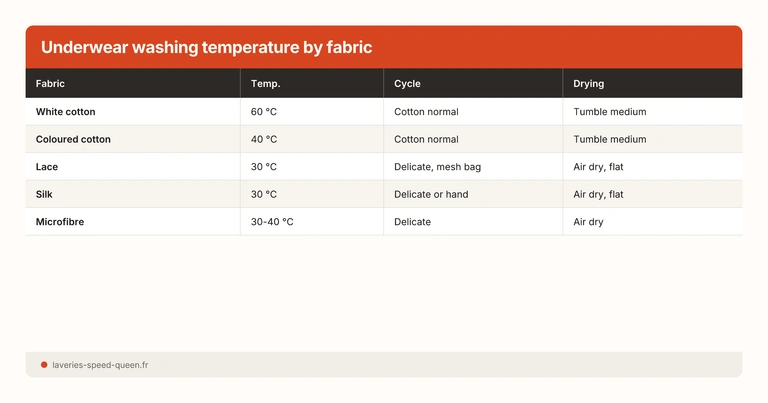
In short: underwear should be changed every day, no exceptions. White cotton is washed at 60 °C, coloured cotton at 40 °C, lace and silk at 30 °C in a mesh laundry bag. No fabric softener — use white vinegar instead. Boxers, briefs and thongs follow the same protocol based on their fabric. Washing underwear at a laundromat is perfectly safe and hygienic.
At a Glance
Daily change, non-negotiable — even in winter, even when working from home.
60 °C white cotton, 40 °C colours, 30 °C lace/silk — temperature depends on the fabric.
No fabric softener — white vinegar instead, to soften without irritation.
Mesh bag for delicates — lace, silk, underwired items.
Why Underwear Deserves a Dedicated Protocol
Underwear is not like the rest of your laundry. It sits directly against the most sensitive areas of your body — the genital region, groin folds, and buttocks — and accumulates within just a few hours:
- Sweat: the areas covered by underwear are among the most perspiration-prone on the body.
- Dead skin cells: skin renews constantly, shedding cells onto the fabric.
- Bacteria: E. coli (present in the anal area), staphylococci, streptococci — the bacterial flora is abundant and diverse.
- Secretions: vaginal secretions, microscopic urinary residue, sebum.
A pair of underwear worn for a single day harbours an average of 100 million bacteria. That is not a reason to panic — it is the reason why daily changes and washing at the correct temperature matter.
Frequency: Every Day, No Exceptions
Changing underwear daily is the baseline rule, non-negotiable. This does not depend on the season, your level of physical activity, or how clean they feel.
Why every day?
- Within 8 to 12 hours, the bacterial population on underwear reaches levels that promote irritation, odour and infections (UTIs, thrush).
- Perspiration creates a warm, moist environment ideal for bacterial and fungal growth.
- Microscopic faecal residue (invisible to the naked eye) migrates forward and can cause urinary tract infections in women.
Situations that require more frequent changes
- After exercise: change immediately after a workout — concentrated perspiration promotes irritation and fungal infections.
- In summer or hot climates: sweating is heavier. A second change during the day is recommended if needed.
- During an infection: thrush, UTI, irritation — change morning and evening throughout treatment. See our guide on washing laundry during a fungal infection for the full protocol.
Wash Temperature by Fabric
Wash temperature depends on the fabric, not the shape of the underwear. Cotton boxers are washed like cotton briefs. A lace thong is washed like lace knickers.
White cotton: 60 °C
White cotton is the simplest fabric to care for and the most hygienic choice for everyday underwear.
- Cycle: standard cotton (not eco) at 60 °C.
- Detergent: regular, standard dose. Sodium percarbonate↗ (1 to 2 tablespoons in the drum) boosts whitening and antibacterial action.
- Why 60 °C: this temperature kills 99.9% of bacteria (E. coli, staphylococci) and fungi (Candida). It is the benchmark temperature for textile hygiene. See our guide to washing at 60 °C for details.
White cotton is the safest choice
White cotton is the most recommended fabric for everyday underwear: it handles 60 °C, doesn’t retain odours, absorbs perspiration well, and requires no special washing precautions. Dermatologists recommend it as a first choice for people prone to irritation or infections.
Coloured cotton: 40 °C
Coloured cotton handles 40 °C without colour fading. It strikes a balance between hygiene and colour preservation.
- Cycle: standard cotton at 40 °C.
- Detergent: regular, standard dose. Avoid detergents with bleaching agents (chlorine bleach, percarbonate) that dull colours.
- When to go up to 60 °C: if you have an ongoing infection (thrush, UTI) or if the underwear is heavily soiled (blood stains, vomit). In that case, accept a slight colour loss in favour of hygiene.
Lace: 30 °C in a mesh bag
Lace is fragile — the fine fibres tear easily under heat and mechanical agitation.
- Cycle: delicate or wool at 30 °C maximum.
- Spin: reduced to 400-600 rpm.
- Mesh laundry bag: mandatory. Place each lace item in a fine-mesh bag. The bag protects embroidery, embellishments and fibres from friction against the drum and other items.
- Drying: air dry only, laid flat or on a hanger. Never tumble dry.
See our full guide on washing lingerie and bras for the detailed protocol.
Silk: 30 °C in a mesh bag or by hand
Silk is the most delicate fabric for underwear. Hand washing remains the safest method, but machine washing is possible with precautions.
- Machine: silk or delicate cycle at 30 °C, mesh laundry bag↗, minimal spin (400 rpm).
- Hand wash: soak for 5 minutes in lukewarm water with a little gentle detergent, rinse without wringing, press in a towel to remove water.
- Drying: flat on a clean towel, never in the tumble dryer, never in direct sunlight.
For detailed precautions, see our guide on washing silk fabrics.
Microfibre (polyamide, elastane): 30-40 °C
Technical underwear and “seamless” styles are typically made from microfibre.
- Cycle: delicate at 30-40 °C.
- No fabric softener: it clogs the micropores of microfibre and reduces its absorbency and breathability.
- No tumble dryer: elastane loses its stretch in heat. Air dry only.
- No ironing: microfibre doesn’t wrinkle. If it’s misshapen, that’s a sign of wear, not a crease.
Should Underwear Be Separated from Other Laundry?
Recommended, but not strictly mandatory at the same temperature.
Separating underwear is primarily about cross-contamination:
- Underwear harbours E. coli and other intestinal bacteria. If you wash at 40 °C with kitchen towels, bacteria can migrate between items.
- At 60 °C, the risk is virtually zero — the temperature kills pathogenic bacteria.
- Separating is strongly recommended for baby laundry and kitchen towels, regardless of temperature.
The practical compromise: wash white cotton underwear with towels and sheets at 60 °C (same temperature, same cycle). Wash delicate underwear (lace, silk, microfibre) in a separate delicate cycle at 30 °C.
Fabric Softener: Why to Avoid It
Fabric softener is not recommended for any underwear. Here’s why:
Greasy film on fibres
Fabric softener deposits a thin waxy layer on fibres. This film reduces absorbency, traps moisture and creates a more favourable environment for bacteria.
Mucous membrane irritation
The fragrances and chemical agents in fabric softener can irritate the genital mucous membranes, especially in people with sensitive skin. This is a common cause of unexplained itching.
Increased risk of infection
By reducing fabric breathability and trapping moisture, fabric softener creates the conditions for recurring thrush and urinary tract infections.
The alternative: white vinegar
Half a cup of white vinegar in the softener compartment softens fibres, neutralises odours and leaves no irritating residue. Compatible with all fabrics.
For more on fabric softener and alternatives, see our article on fabric softener: useful or not and our guide on white vinegar and laundry.
Boxers, Briefs, Thongs: The Protocol Is the Same
The shape of the underwear does not change the washing protocol. What matters is the fabric:
| Type | Common Fabric | Temperature | Precautions |
|---|---|---|---|
| Cotton boxers | Cotton, cotton/elastane | 60 °C white, 40 °C coloured | None |
| Cotton briefs | Cotton, cotton/elastane | 60 °C white, 40 °C coloured | None |
| Cotton knickers | Cotton, cotton/elastane | 60 °C white, 40 °C coloured | None |
| Lace knickers | Lace, polyamide | 30 °C | Mesh bag, reduced spin |
| Cotton thong | Cotton, cotton/elastane | 60 °C white, 40 °C coloured | None |
| Lace thong | Lace, polyamide | 30 °C | Mesh bag, reduced spin |
| Microfibre boxers | Polyamide/elastane | 30-40 °C | No softener, no tumble dryer |
| Silk underwear | Silk | 30 °C | Mesh bag, minimal spin, dry flat |
Drying: The Rules by Fabric
Drying is often overlooked, but poorly dried underwear is underwear that smells bad and wears out faster.
Cotton: tumble dryer acceptable
Cotton handles the tumble dryer at moderate heat. Avoid high heat, which can shrink the item and degrade the elastane (found in most modern underwear). Air drying is also perfectly suitable.
Lace and silk: air dry only
Never tumble dry. The heat deforms delicate fibres, breaks lace embellishments and irreversibly damages silk. Dry flat on a clean towel or on a hanger, away from direct sunlight.
Microfibre: air dry only
The elastane in microfibres loses its stretch in heat. Microfibre boxers put through the dryer regularly will lose their shape within a few months. Air dry — microfibre dries very quickly anyway.
Universal rule
Never put away underwear that is still damp. Residual moisture in a closed drawer encourages bacteria and mould. Make sure the item is completely dry before storing it.
Reusable Sanitary Pads
Reusable sanitary pads follow a specific protocol. See our dedicated guide for the full protocol: cold pre-rinse, wash at 40-60 °C depending on fabric, air dry.
At the Laundromat: Safe and Hygienic
Washing underwear at a self-service laundromat is perfectly hygienic. Commercial machines:
- Reach the displayed temperatures reliably (unlike some domestic eco cycles).
- Complete a full rinse cycle that removes all detergent residue.
- Are used by hundreds of customers — the 60 °C cycle kills the previous customer’s bacteria just as effectively as yours.
Practical laundromat tips:
- Use a mesh laundry bag for delicate items — they won’t get lost in the drum.
- Choose the right cycle: cotton 60 °C for white cotton, delicate 30 °C for lace.
- Run a tumble dry cycle for cotton — you’ll leave with dry laundry, ready to put away.
- For lace and silk, let them air dry at home.
The honest laundromat angle
Most people wash their underwear at home without any issues. The laundromat becomes useful when you need to catch up on a backlog (holiday suitcase, moving house), when you don’t have a machine at home, or when you want to wash at 60 °C and your domestic machine’s eco cycle doesn’t get hot enough.
What to Avoid
- Wearing the same underwear two days running — the bacterial population doubles in 24 hours. Change every day.
- Using fabric softener — greasy film, irritation, infection risk. White vinegar instead.
- Washing lace at 60 °C — it won't survive. 30 °C in a mesh bag, delicate cycle.
- Tumble drying microfibre — the elastane stretches out. Air dry only.
- Mixing underwear with kitchen towels — E. coli cross-contamination. Wash separately.
- Putting away damp underwear — guaranteed bacteria and odour.
Lifespan and Replacement
Underwear has a limited lifespan, even when well cared for:
- Standard cotton: 6 to 12 months of daily use in rotation (roughly 50 to 100 washes).
- Lace: 6 to 8 months if washed correctly. The fibres weaken over time.
- Microfibre: 8 to 12 months. The elastane gradually loses its stretch.
- Silk: 6 months to 1 year depending on quality. Silk is fragile but holds up well if hand-washed.
Signs it’s time to replace: the elastic no longer holds, the fabric has become see-through, holes or tears, permanent distortion, persistent odour even after washing. Worn-out underwear no longer fulfils its hygiene function — replace it without hesitation.
Where This Page Stops
This page covers washing underwear. For bras and lingerie, see our dedicated guide. For reusable sanitary pads, see our specific guide. For fungal infections, our guide on washing laundry contaminated by a fungal infection details the reinforced protocol. For how often to wash all types of clothing, see our temperature guide.
Methodology and Sources
- Dr. Tierno, Philip, The Secret Life of Germs, Atria Books, 2004 — reference on bacterial contamination of textiles
- NHS UK, Urinary tract infections (UTIs) — Prevention, 2025, accessed 20 March 2026
- Dermatology Practical & Conceptual, Textile contact dermatitis: how textiles can induce dermatitis, 2020
Sources and References
- NHS - Urinary tract infections prevention (lien externe)
- Washing lingerie and bras
- Reusable sanitary pads
- Fungal infection: washing contaminated laundry
- Washing at 60 °C: which clothes
- Fabric softener: useful or not
- White vinegar and laundry
- Washing silk fabrics
- Washing temperature guide
As an Amazon Associate, we earn a small commission on purchases made through the affiliate links in this article — at no extra cost to you. This helps us maintain this site and produce free guides.
To wash your cotton underwear at 60 °C with confidence, visit our laundromats in Blagnac, Croix-Daurade and Montaudran. Our commercial machines reach 60 °C reliably and deliver a full rinse cycle. Payment contactless card or cash.