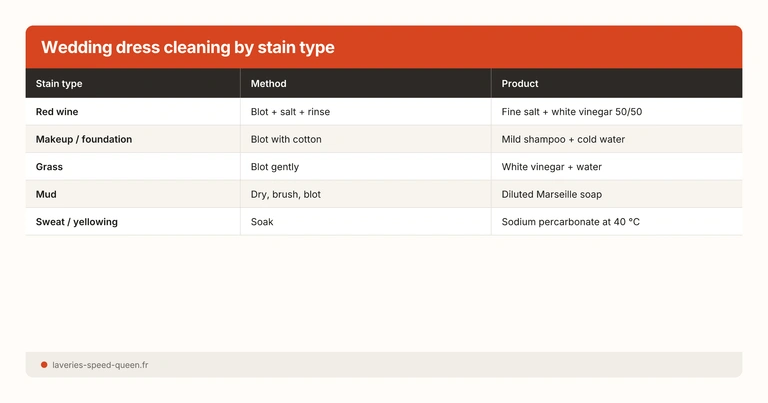
In short: A wedding dress should be washed by hand only (bathtub, lukewarm water 25-30 °C, gentle detergent). Never machine wash — risk of destroying fine fabrics and embellishments. Treat stains one by one with spot cleaning before the overall wash. Dry upside down, air only. Store in an acid-free box with tissue paper — never in plastic. Professional cleaning costs 150-400 dollars/euros.
At a glance
Assess first — fabric, embellishments, stain types. Heavily embellished dresses (glued pearls, antique lace) need a professional.
Spot clean before washing — treat each stain individually (wine, makeup, grass).
Hand wash in the bathtub — lukewarm water 25-30 °C, gentle detergent, agitate gently.
NEVER machine wash — even on delicate, the drum tears fine fabrics and rips off embellishments.
Store in an acid-free box — acid-free tissue paper, no plastic.
Before touching the dress: the assessment
Cleaning a wedding dress starts with a careful assessment. Every dress is different — fabric, embellishments, construction — and the cleaning method depends entirely on these characteristics.
Identifying the fabric
Satin (polyester or silk)
Polyester satin is the most common in modern dresses. It's relatively resilient to hand washing. Silk satin is more delicate and stains easily (water marks). Check the label: 'satin' doesn't indicate the fiber — it's a weave type.
Organza and tulle
Very lightweight, sheer fabrics used for veils, layered skirts, and sleeves. Organza wrinkles easily and needs a garment steamer. Tulle is more resilient but can snag (pulled threads). Gentle hand washing is acceptable.
Lace
Modern machine lace is fairly durable. Antique, vintage, or handmade lace is extremely fragile. If the dress features antique lace or fine lace, take it to a professional.
Crepe and mikado
Crepe is a matte, flowing fabric that washes well by hand. Mikado (thick structured satin) is more rigid and resilient. These two fabrics are among the easiest to care for.
Identifying embellishments
Embellishments determine whether you can wash the dress yourself or need a professional.
- Sewn-on pearls and crystals: withstand hand washing if the thread is in good condition.
- Glued pearls and crystals: the adhesive can dissolve in water, especially warm water. Risk of loss. Use a professional.
- Sequins: sewn-on sequins hold up; glued ones come off. Test on a hidden corner.
- Embroidery: generally withstands hand washing.
- Feathers: cannot withstand immersion — spot clean only, or use a professional.
- Corset boning: immersion can rust unprotected metal boning.
When to use a professional
If the dress has glued pearls, antique lace, feathers, metal boning, or you’re unsure about the fabric composition: take the dress to a bridal dry cleaning specialist. The cost (150-400 dollars/euros) is negligible compared to the risk of irreversibly damaging a dress worth 1,000-5,000+. See our guide to
dry cleaning and alternatives
.
Spot cleaning: treating stains one by one
Before any overall wash, treat each stain individually. Spot cleaning is more precise and less risky than full immersion — especially on embellished areas. For a general stain removal approach, see our tough stain solutions guide.
Red wine stain
Red wine is the most dreaded stain on a white dress. Act fast:
- Blot immediately with a clean white cloth to absorb as much wine as possible.
- Sprinkle fine salt on the stain — salt absorbs the liquid by osmosis.
- Let it sit for 10 minutes, gently brush off the salt.
- Blot with a 50/50 cold water and white vinegar↗ mixture.
- On white satin, follow up with a few drops of 3% hydrogen peroxide (test on a hidden hem first).
See our detailed guide on removing red wine stains.
Makeup stain (foundation, lipstick)
Foundation is a pigmented oil-water emulsion. Lipstick contains waxes and oily pigments.
- Blot (never rub) with a cotton pad dampened with cold water + gentle shampoo.
- Rub very gently with your fingertips.
- Rinse with cold water using a spray bottle (more controlled than running under the tap).
- For stubborn lipstick: a drop of glycerin on the stain, leave 15 min, rinse.
See our guide on removing makeup stains.
Grass stain
Grass stains (knees, train) contain chlorophyll, a green pigment.
- Blot with pure white vinegar.
- Let sit 10 minutes.
- Rinse with cold water.
- If the stain persists: blot with rubbing alcohol (except on silk).
See our guide on removing grass stains.
Mud stain (train)
Mud on the train is very common, especially for outdoor ceremonies.
- Let it dry completely — it’s counterintuitive, but dried mud comes off more easily than wet mud.
- Brush the dried mud with a soft brush.
- Blot any residue with a damp cloth.
- If marks remain: cold water + gentle shampoo.
See our guide on removing mud and dirt stains.
Sweat stain (armpits, back)
Perspiration leaves yellowish marks, especially on white satin:
- Blot with a cold water + baking soda paste.
- Let sit 20 minutes.
- Rinse with cold water.
- If needed: white vinegar blotting.
See our guide on sweat stains and yellow marks.
Hand wash in the bathtub: the full method
If the dress is fully hand-washable (durable fabric, sewn or no embellishments), the bathtub method is the safest and most thorough approach.
Preparation
Clean the bathtub — rinse it to remove any bath product residue that could stain the dress.
Fill with lukewarm water (25-30 °C max) — hot water can shrink certain fabrics and dissolve adhesives.
Add detergent — gentle liquid detergent with no enzymes, no optical brighteners, or mild shampoo. 1-2 capfuls for a full bathtub.
Check for stains — make sure spot cleaning has been done before immersion.
The wash
- Submerge the dress in the bathtub, gently unfolding it. Let it soak.
- Gently agitate with your hands for 10-15 minutes. Gently press the dirtiest areas (hemline, train, armpits). Never wring.
- Let it soak 30 minutes to 1 hour if the dress is very dirty.
- Drain the tub and rinse: fill again with clean cold water, gently agitate. Repeat 2-3 times until the water is perfectly clear and foam-free.
What not to use
- Bleach — even on white. Bleach yellows synthetic fibers and attacks silk.
- Detergent with optical brighteners — these fluorescent agents give an artificial 'blue-white' that can turn yellow over time.
- Detergent with protease enzymes — they break down protein fibers (silk, wool) and can damage silk embroidery thread.
- Fabric softener — weighs down lightweight fabrics (tulle, organza) and leaves a greasy film on satin.
Drying: upside down, air only
Drying a wedding dress is a critical step — improper drying can warp the dress, create permanent creases, or cause mold.
The method
- Absorb excess water — lay the dress on clean white bath towels and press gently. Never wring.
- Hang upside down — hang the dress by the waist (or straps if sturdy) on a wide padded hanger. The weight of the water should pull evenly downward, naturally smoothing the fabric.
- Out of the sun — UV rays yellow white fibers. Dry in an airy room, in the shade.
- 24-48 hours — a multi-layered wedding dress takes 1-2 days to dry completely. Check the inner layers.
- No tumble dryer — heat and agitation are incompatible with bridal fabrics. See our complete drying guide for alternatives.
De-wrinkling after drying
If creases persist:
- Garment steamer (recommended method) — hold 10-15 cm from the fabric. Steam relaxes fibers without contact. Ideal for tulle, organza, and lace.
- Iron (with caution) — low setting (110 °C), always with a press cloth (clean white cotton fabric) between the iron and the dress. Never place the iron directly on satin — it creates irreversible shine marks (glazing).
- Hang in the bathroom after a hot shower — ambient steam relaxes light creases. Gentle, risk-free method.
See our ironing temperature guide by fabric for details.
Professional cleaning: when and how
When to choose a professional
- Dress with glued embellishments (pearls, crystals, sequins).
- Fabric is natural silk or antique/vintage lace.
- Multiple complex stains on different areas.
- Dress with metal-boned corset.
- When the dress has irreplaceable sentimental value.
General dry cleaner vs bridal specialist
| Criteria | General dry cleaner | Bridal specialist |
|---|---|---|
| Price | 150-200 dollars/euros | 250-400 dollars/euros |
| Method | Standard dry cleaning | Specialized cleaning (wet cleaning or gentle solvents) |
| Embellishments | Basic protection | Individual protection for each embellishment |
| Stain removal | Standard | Stain-by-stain treatment under magnification |
| Storage included | Rarely | Often (acid-free box + tissue paper) |
| Turnaround | 1-2 weeks | 2-4 weeks |
When to bring the dress
Ideally, within 2 weeks of the wedding. The longer you wait, the more stains oxidize and become harder to treat. Wine, makeup, and sweat stains darken over time and set into the fibers.
Long-term storage: preserving the dress for 20-50 years
Storage is just as important as cleaning. A clean dress that’s poorly stored will yellow, mold, or degrade within a few years.
The preservation box
Acid-free cardboard box (pH neutral) — standard cardboard contains acids that migrate into the fabric and cause yellowing. Textile preservation boxes are available online (20-50 dollars/euros).
Acid-free tissue paper — layer it between each fold of fabric and inside creases. Tissue paper prevents color transfer and permanent creasing.
Loose folding — don't compress the dress. Fold it in halves or thirds with tissue paper in each fold. Stuff the sleeves and bodice with tissue paper to maintain shape.
No plastic — the dry cleaner's plastic garment bag is the worst packaging for long-term storage. Plastic traps moisture and acidic gases, causing yellowing and mold.
No hanger — the weight of the dress hanging for years stretches fibers and distorts the shoulders and waistline.
Storage conditions
- Temperature: 15-20 °C (60-68 °F), stable. Avoid attics (hot in summer, cold in winter) and basements (humidity).
- Humidity: 40-55% relative humidity. Too dry = brittle fibers. Too humid = mold.
- Light: total darkness. UV (even through a window) yellows white fabric.
- Location: interior closet, wardrobe in a living area (stable temperature and humidity).
Annual inspection
Open the box once a year to:
- Check for mold or yellowing.
- Check for moths (moths are attracted to natural fibers — silk, wool).
- Re-fold differently — change the fold lines to prevent permanent crease marks.
- Replace tissue paper if needed.
Natural moth deterrent
If your dress contains silk or wool, add a sachet of dried lavender or a piece of cedar wood in the preservation box. Moths are repelled by these scents. Don’t place the sachet directly on the fabric — tuck it in a corner of the box. Mothballs are effective but produce a persistent odor and contain potentially irritating compounds.
What NEVER to do with a wedding dress
- Machine wash — even the gentlest cycle tears fine fabrics (tulle, organza), rips off embellishments, and distorts the structure.
- Use bleach — yellows synthetic fibers, attacks silk, damages embroidery.
- Tumble dry — heat shrinks, friction destroys. Guaranteed destruction.
- Store in a plastic garment bag — yellowing and mold within 2-3 years.
- Hang for years — the dress weight stretches fibers and distorts the silhouette.
- Store in an attic or basement — temperature and humidity swings accelerate degradation.
- Wait months before cleaning — stains oxidize and become permanent.
- Iron satin directly — direct iron contact creates irreversible shine marks (glazing).
Total cost of care
| Option | Cost | Includes |
|---|---|---|
| Home hand wash | 5-15 dollars/euros (detergent) | Washing, drying |
| Preservation box | 20-50 dollars/euros | Acid-free box + tissue paper |
| General dry cleaner | 150-200 dollars/euros | Cleaning + pressing |
| Bridal specialist | 250-400 dollars/euros | Cleaning + stain removal + storage |
| Recommended total (pro + storage) | 200-450 dollars/euros | Professional cleaning + preservation box |
For a dress worth 1,000-5,000+, investing 200-450 in proper cleaning and storage represents 5-20% of the dress value — a reasonable investment to preserve an irreplaceable memory.
As an Amazon Associate, we earn a small commission on purchases made through affiliate links in this article — at no extra cost to you. This helps us maintain this site and produce free guides.
Our laundromats are not designed for washing wedding dresses (rotary drum machines). For wedding dresses, hand washing or a specialist dry cleaner is best. However, our machines are perfect for washing tablecloths, napkins, and reception linens — capacities from 11 to 18 kg. Payment by contactless card or cash. Check our prices.
Sources and references
- Dry cleaning and alternatives
- Delicate fabrics: silk, wool and cashmere
- Tough stain solutions guide
- Remove a red wine stain
- Remove a makeup stain
- Remove a grass stain
- Remove a mud and dirt stain
- Complete drying guide
- Ironing temperature guide by fabric
- Long-term textile preservation — acid-free materials (pH-neutral cardboard, tissue paper) prevent hydrolysis and oxidation of fibers
- Yellowing of white textiles from acid migration in standard packaging materials (cardboard, plastic)