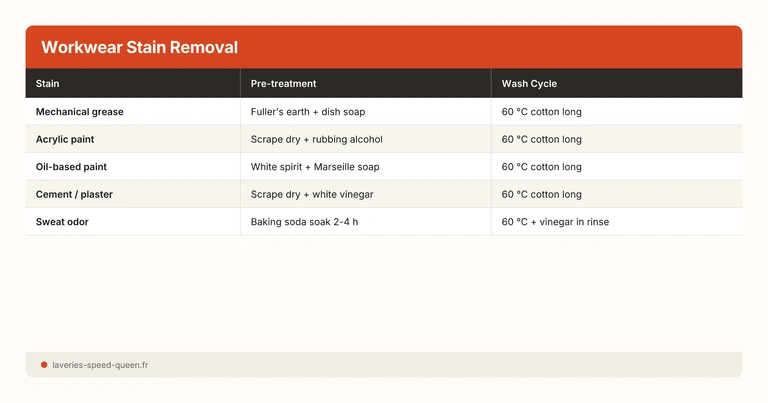
Workwear is a technical garment exposed to extreme soiling: engine grease, paint, cement, heavy sweating. Washing requires systematic pre-treatment (fuller’s earth + dish soap for grease, solvent for paint, vinegar for cement) followed by a 60 °C cotton cycle, always separate from everyday laundry. The 18 kg machines at the laundromat are ideal for these heavy, bulky garments.
At a glance
Always pre-treat — grease, paint, cement: each stain has its own protocol. The machine alone is not enough.
Separate wash mandatory — engine grease migrates and permanently stains everyday laundry.
60 °C, long cotton cycle — heavy cotton handles the heat. 60 °C degreases and disinfects.
Baking soda for odours — soak 2-4 hours before washing to neutralise sweat and chemical smells.
18 kg machine at the laundromat — overalls are heavy (1.5-2 kg each) and overload home machines.
Workwear: a textile apart
Workwear — overalls, coveralls, matching jackets and trousers — is built to withstand occupational wear. Its fabric is a heavy cotton twill (240-350 g/m2) or a cotton/polyester blend (65/35 or 80/20) offering mechanical strength, thermal comfort, and breathability.
This durability is an advantage for care: heavy cotton tolerates high temperatures, aggressive stain removers, and mechanical scrubbing that would destroy a delicate fabric. However, the weight and bulk of workwear creates a capacity problem in home machines.
Types of occupational soiling
Workwear is exposed to soiling very different from household laundry:
- Engine grease and motor oil: the most common stains in automotive repair, industry, and maintenance. These are hydrocarbons — petroleum-based fats that penetrate deep into fibres.
- Paint: acrylic (water-based) or alkyd (oil-based). Each requires a different solvent.
- Cement, plaster, filler: mineral materials that harden in the fibres.
- Chemicals: solvents, acids, bases, cutting oils — depending on the industry.
- Heavy sweating: physical work produces abundant sweat that soaks deep into the fabric.
- Dust: wood, metal, concrete, soil — fine particles that embed in the weave.
Stain removal by soiling type
Pre-treatment is the decisive step. Workwear put directly into the machine without stain removal comes out almost as dirty as it went in — heat sets grease and paint instead of removing them.
Engine grease and motor oil
Engine grease is a heavy, viscous hydrocarbon that penetrates fibres and resists water and standard detergents. It is the hardest stain to tackle on workwear. See our full grease stain guide for complex cases.
Fresh stain:
- Fuller’s earth: sprinkle this absorbent clay generously over the stain. Fuller’s earth↗ absorbs hydrocarbons by capillary action — the same principle used for oil spills on a garage floor.
- Leave for 2-4 hours (overnight for thick stains).
- Brush off the powder.
- Apply concentrated dish soap (supermarket brands tend to be more degreasing than “eco” versions) directly to the area. Massage in.
- Leave for 15 minutes, then scrub with a stiff brush.
Old stain:
For ingrained engine grease, a counter-intuitive but effective technique: apply butter (or margarine) to the stain. The chemical principle is simple — a fat dissolves a fat (“similia similibus solvuntur”). The butter liquefies hardened engine grease, making it easier to treat with dish soap afterwards.
- Apply soft butter to the stain.
- Leave for 30 minutes.
- Treat with concentrated dish soap.
- Scrub, rinse, and repeat if needed.
Sludge and used motor oil
Sludge (black engine grease) is a mixture of grease, metal particles, and soot. The metal particles abrade fibres during scrubbing. Use a knife to scrape off as much surface sludge as possible before applying fuller’s earth. The goal is to remove the solid matter before treating the greasy component.
Paint
Treatment depends entirely on the paint type. The most common mistake is treating oil-based paint with water — which has no effect — or acrylic paint with white spirit — which is unnecessary and toxic.
Acrylic paint (water-based)
Fresh: rinse thoroughly with warm water + soap. Dry: rubbing alcohol (70 %) or acetone on a cloth, dab then rinse.
Oil-based (alkyd) paint
Fresh: dab with white spirit, rinse with Marseille soap. Dry: white spirit + scraping. Do not rub — it spreads the stain.
Spray paint (aerosol)
Usually solvent-based. Dab with acetone (beware of synthetic fibres — acetone dissolves them). Rinse immediately.
Stain and varnish
Water-based: warm water + soap. Solvent-based: white spirit. Check the tin label to identify the base.
For details, see our full guide on paint stains.
Cement, plaster, and filler
Construction materials are mineral — treatment is mechanical before chemical.
Essential rule: let it dry completely before treating. Wet cement sticks to fibres and smears when rubbed. Dry cement breaks away more easily by scraping.
- Scrape the dry cement/plaster with the back of a knife or a spatula.
- Brush off residue with a stiff brush.
- For ingrained traces, soak the area in neat white vinegar for 30 minutes. The acetic acid dissolves the calcium (the main component of cement and plaster).
- Brush again, rinse.
- Wash in the machine at 60 °C.
Resin, tar, and bitumen
Waterproofing and road materials are heavy hydrocarbons, similar to engine grease but even more viscous.
- Cool with ice cubes to harden the product, then scrape off as much as possible.
- Dab with turpentine (gentler on fibres than white spirit).
- Treat with dish soap and wash at 60 °C.
Persistent odours: sweat and chemicals
Workwear worn daily develops stubborn odours that a standard wash does not always remove. Heavy sweating in physical environments produces fatty acids and sulphur compounds that embed in cotton.
The anti-odour protocol
Baking soda is the most effective agent for neutralising organic odours. Its alkaline pH (8.3) neutralises the fatty acids responsible for sweat smell.
- Fill a basin or bucket with warm water (40 °C).
- Add 3 tablespoons of baking soda↗ per litre of water.
- Submerge the workwear and soak for 2-4 hours.
- Wring lightly and put in the machine for the normal 60 °C cycle.
White vinegar↗ as a complement: add 100 ml of white vinegar to the machine’s softener compartment. It activates during the final rinse and removes odour residues that the wash did not dislodge. White vinegar also neutralises chemical odours (solvents, cutting oils).
Solvent or cutting-oil odours
Industrial solvent odours (trichloroethylene, acetone, white spirit) evaporate better in open air than in the machine. Hang the workwear outside for 24 hours before washing — natural ventilation eliminates the volatile organic compounds (VOCs). Washing then removes the non-volatile residues.
Machine washing: settings and precautions
Why you must always wash separately
This is an absolute rule for workwear: never mix it with everyday laundry. The reasons are multiple:
- Engine grease migrates easily from one fabric to another in the wash water. A grease mark on a white T-shirt is nearly impossible to remove.
- Chemical residues (solvents, acids, bases) can damage delicate fibres.
- Metal shavings and other debris trapped in pockets scratch other fabrics and the drum.
- Indigo dye from classic workwear can bleed, especially in the first washes. Even “old” workwear can release pigment in the presence of residual solvents.
The optimal programme
| Garment type | Temperature | Programme | Notes |
|---|---|---|---|
| Cotton workwear | 60 °C | Cotton long, normal spin | Most durable. Tolerates percarbonate and scrubbing. |
| Cotton/polyester workwear | 60 °C | Cotton or synthetic, normal spin | Polyester dries faster but retains odours more. |
| High-visibility jacket | 40 °C | Synthetic, reduced spin | Reflective strips degrade at high temperatures. |
| Disposable coverall (Tyvek) | Not washable | — | Single use. Do not machine wash. |
| Welding apron (leather) | Not washable | — | Damp wipe only. Leather cannot go in the machine. |
Before putting in the machine
- Empty all pockets: screws, nails, metal shavings, bolts — these objects damage the drum and other fabrics.
- Turn garments inside out: grease and dust residue on the surface is better exposed to the drum’s mechanical action.
- Close zippers and Velcro: zipper teeth and hook-and-loop abrade other fabrics.
The laundromat: the solution for large volumes
A single pair of work overalls weighs 1.5-2.5 kg depending on the model (full coverall vs trousers only). In a 7-8 kg home machine, you can only wash 2-3 sets per cycle — not enough if you have a week’s worth of workwear to process.
Why the 18 kg machine
The 18 kg commercial machines at the laundromat offer three decisive advantages for workwear:
- Capacity: 4-5 sets in a single cycle, with room for the garments to tumble freely in the drum.
- Water volume: 50-60 litres per cycle, versus 15-20 litres for a home machine. This volume is essential for diluting and flushing engine grease, cement, and chemical residues.
- Mechanical power: the large drum creates a more effective beating action on heavy fabrics than a small domestic drum.
The commercial tumble dryer completes the advantage: heavy cotton overalls take hours to line-dry, but only 45-60 minutes in a high-capacity commercial dryer.
Tip: batch your washing
If you work in a team (building site, workshop, garage), pool the workwear of several colleagues for a group wash at the laundromat. An 18 kg machine easily handles 6-8 overalls in a single cycle — more economical and more effective than individual home washing.
PPE and regulations: who pays for laundering?
The legal framework
In many countries, labour law requires the employer who supplies personal protective equipment (PPE) — including mandatory work clothing — to maintain it at their own expense. This obligation includes washing, repairing, and replacing worn garments.
In practice
Three organisational models coexist:
- Commercial laundry service: the employer sends garments to a provider. The most common solution in industry and construction.
- Maintenance allowance: the employee washes their own garments and receives a fixed allowance covering real costs (detergent, water, electricity, machine wear).
- On-site machine: some companies install a washing machine in the changing rooms. Employees wash their workwear during the working day.
What the employer may not do
- Refuse maintenance without compensation — if the employer supplies PPE, they must maintain it. The employee cannot be forced to do so without an allowance.
- Require home washing of contaminated garments — clothing exposed to hazardous substances (asbestos, lead, CMR chemicals) must NEVER be washed at home. The risk of household contamination is real.
- Charge for normal wear and tear — the employer cannot deduct the cost of worn workwear from wages. Wear is inherent to professional use.
Wash frequency by trade
Wash frequency depends on the intensity of soiling and physical effort:
| Trade / sector | Recommended frequency | Main reason |
|---|---|---|
| Automotive / industrial mechanics | After every shift | Engine grease, oil, soot |
| Construction / masonry | After every shift | Cement, plaster, dust |
| Painting / decorating | After every shift | Paint, solvents, fillers |
| Logistics / warehousing | Every 2-3 days | Sweat, dust |
| Landscaping / gardening | Every 2-3 days | Grass, soil, sap |
| Office / light craft | Once a week | Light soiling, moderate sweating |
To maintain a smooth rotation, plan a minimum of 3 sets of workwear per person. This allows a clean set every day while leaving time to wash and dry the others.
Mistakes that ruin workwear
- Washing without stain-treating — the machine alone does not degrease workwear covered in sludge. Pre-treatment is mandatory.
- Mixing with everyday laundry — engine grease migrates in the wash water and permanently stains other fabrics.
- Forgetting to empty pockets — screws, nails, and metal shavings damage the drum and puncture clothes.
- Using bleach routinely — bleach weakens cotton and strips indigo dye. Reserve it for occasional disinfection of white cotton.
- Ignoring high-visibility garments — reflective strips degrade above 40 °C and in a hot tumble dryer. Wash them separately at 40 °C.
As an Amazon Associate, we earn a small commission on purchases made through the affiliate links in this article — at no extra cost to you. This helps us maintain this site and produce free guides.
5 sets of workwear to wash in one cycle? Our 18 kg commercial machines handle large volumes with 50-60 litres of water and powerful spin. Laundromats in Blagnac, Croix-Daurade and Montaudran, payment by contactless card or cash. See our prices.
Sources and references
- Remove a grease or oil stain
- Remove a paint stain
- White vinegar and laundry
- Baking soda and laundry
- Washing temperatures guide
- Laundry smells bad after washing
- Labour law — PPE maintenance obligations (employer responsibility)
- Case law on the duty to maintain and replace work clothing