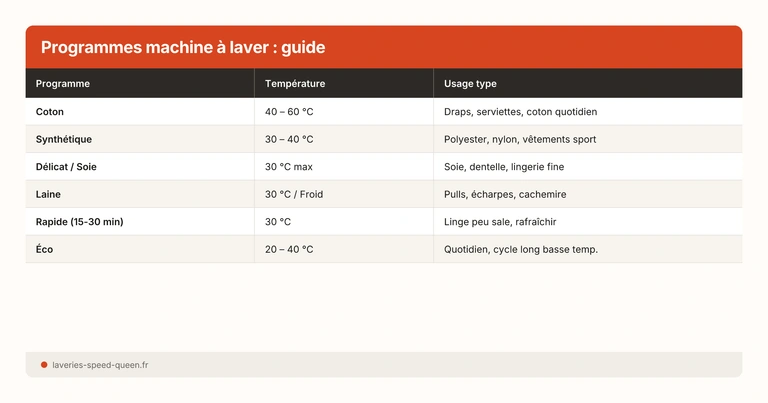
In short: every washing machine cycle is designed for a specific fabric type and soil level. The cotton cycle (40-60 °C, 1h30-2h) suits sturdy fabrics; the synthetic cycle (30-40 °C, 1h-1h30) handles everyday clothes; the delicate or wool cycle (30 °C, reduced spin) protects fragile fibres. The eco cycle cleans just as well but takes longer. The quick wash is only for lightly soiled items.
At a Glance
One cycle = one fabric type — cotton for cotton/linen, synthetic for polyester, delicate for silk.
The care label decides — the tub symbol shows the max temperature and permitted cycle type.
The eco cycle cleans just as well — it compensates for the lower temperature with a longer tumbling time.
Quick wash is not a universal cycle — reserved for lightly soiled items, small loads only (1-2 kg).
Match the spin speed — 1200-1400 rpm for cotton, 400-600 for wool. Too high a spin damages fibres.
The Washing Triangle: Understanding How Cycles Work
Before diving into each cycle, it helps to understand the fundamental principle behind all of them: Sinner’s Circle (named after chemist Herbert Sinner). Washing effectiveness depends on four interdependent factors:
- Temperature — heat activates surfactants and breaks down grease
- Time — duration lets cleaning agents work and soiling detach
- Mechanical action — drum rotation rubs fabric against itself
- Chemistry — the detergent (surfactants, enzymes, alkaline agents) dissolves soiling
If you reduce one factor, you need to increase one or more of the others to achieve the same result. That is exactly what the different cycles do:
- The eco cycle lowers the temperature, so it increases the time
- The quick wash cuts the time, so it only works for lightly soiled items (chemistry and mechanics are enough)
- The delicate cycle reduces mechanical action, so it increases the water volume (less friction)
The 8 Main Cycles Explained
1. Cotton Cycle
The cotton cycle is the benchmark: the one manufacturers use to calibrate machine performance. It is the most versatile cycle for sturdy fabrics.
Temperature
20 to 90 °C depending on the setting. 40 °C for coloured cotton, 60 °C for whites and bedding, 90 °C for disinfection. The right wash temperature depends on the fabric and soil level.
Duration
1h30 to 2h30 depending on temperature and load. This is the longest of the standard cycles — cotton needs sustained tumbling to release soiling from its absorbent fibres.
Spin Speed
1000 to 1400 rpm. Cotton absorbs a lot of water — a high spin speed reduces drying time. Sheets and towels can handle 1400 rpm with no issues.
Suitable For
White and coloured cotton, linen, sheets, towels, tea towels, cotton underwear, workwear. This is the go-to cycle for any sturdy fabric that can withstand vigorous tumbling.
2. Synthetic Cycle
The synthetic cycle uses more water and a gentler tumbling action than the cotton cycle. Synthetic fibres are smoother — soiling adheres less — but they warp under heat and mechanical stress.
- Temperature: 30-40 °C (60 °C maximum, rarely needed)
- Duration: 1h to 1h30
- Spin speed: 800-1000 rpm (synthetics retain little water)
- Suitable for: polyester, nylon, acrylic, cotton-polyester blends, lightweight outerwear
This is the everyday workhorse for most modern clothing, which is typically a cotton-polyester blend.
3. Delicate Cycle
The delicate cycle protects fragile fibres by dialling down every stress factor: less rotation, more water, no intense spin.
- Temperature: 30 °C (40 °C maximum)
- Duration: 45 min to 1h15
- Spin speed: 400-600 rpm (or no spin at all)
- Suitable for: silk, viscose/rayon, lace, fine lingerie, delicate fabrics
The higher water volume lets the laundry “float” inside the drum, reducing mechanical friction. It is the machine equivalent of hand washing.
4. Wool Cycle
The wool cycle is the gentlest of all. It is designed to prevent felting — an irreversible process where the scales on wool fibres lock together under the combined effect of heat, agitation and pH change.
- Temperature: 20-30 °C (never higher)
- Duration: 40 min to 1h
- Spin speed: 400 rpm maximum (some machines offer 0 rpm)
- Suitable for: wool, cashmere, mohair, alpaca, angora
The drum does not spin continuously: it rocks back and forth in short bursts with long pauses. This intermittent motion cleans without felting. Most modern machines carry Woolmark certification for this cycle.
Wool in the Machine: 3 Conditions
To machine-wash wool safely: (1) wool cycle at 30 °C max, (2) specialist liquid wool detergent (never powder detergent or fabric softener), (3) a mesh laundry bag. If any of these conditions is missing, hand wash instead. Our
guide to washing a wool jumper
covers the full protocol by wool type.
5. Quick Wash / Express
The quick wash (15 to 30 minutes depending on the machine) is designed to freshen up lightly soiled laundry. It reduces soaking time and sometimes the number of rinses.
- Temperature: 20-40 °C
- Duration: 15-30 min
- Spin speed: variable (often the same as the standard cycle)
- Suitable for: clothes worn once, lightly soiled, no stains
Limitations: the shorter contact time means detergent enzymes do not have time to work fully. The quick wash is unsuitable for towels, smelly sportswear or stained items. Keep the load to 1-2 kg maximum so water and detergent can circulate properly.
6. Eco Cycle
The eco cycle uses the least energy and water. It became the benchmark for EU energy-labelling tests under Regulation EU 2019/2014.
- Temperature: 40-60 °C nominal, but the actual temperature reached is often lower (the machine heats for less time)
- Duration: 2h to 3h30 — that is the trade-off
- Spin speed: same as the standard cycle
- Suitable for: any normally soiled laundry that tolerates the cotton cycle
Why it takes so long: the machine compensates for the lower temperature with extended soaking. Detergent enzymes (proteases, lipases, amylases) need time to break down proteins, fats and starches. At 20-30 °C these enzymes work effectively but slowly. The final result is identical to a hotter standard cycle.
Eco Does Not Mean Poorly Washed
The eco cycle is often underestimated. European energy-labelling studies show that eco cycles on A-rated machines use up to 60 % less energy than a cotton 60 °C cycle, for an equivalent wash result. The only trade-off is duration: allow 2 to 3 hours. Run it in the evening or while you are out.
7. Intensive / Heavy Soil Cycle
The intensive cycle turns everything up: temperature, tumbling time, water volume and number of rinses. It is the most aggressive cycle — reserve it for sturdy, heavily soiled items.
- Temperature: 60-90 °C
- Duration: 2h30 to 3h
- Spin speed: 1200-1400 rpm
- Suitable for: very dirty workwear, sportswear after competition, kitchen towels, household linen after illness
This cycle uses significantly more water and energy. Only use it when the laundry is genuinely very dirty — a cotton 40 °C cycle is enough for the vast majority of situations.
8. Rinse + Spin
This is not a wash cycle: it rinses laundry in clean water and then spins it. No heating, no detergent.
- Temperature: cold
- Duration: 15-20 min
- Spin speed: adjustable
- Suitable for: rinsing after a soak (sodium percarbonate↗, stain remover), spinning hand-washed items, topping up an insufficient rinse
Full Summary Chart
| Cycle | Temperature | Duration | Spin Speed | Recommended Fabrics |
|---|---|---|---|---|
| Cotton | 40-90 °C | 1h30-2h30 | 1000-1400 rpm | Cotton, linen, sheets, towels, tea towels |
| Synthetic | 30-40 °C | 1h-1h30 | 800-1000 rpm | Polyester, nylon, blends, everyday clothes |
| Delicate | 30 °C | 45 min-1h15 | 400-600 rpm | Silk, viscose, lace, lingerie |
| Wool | 20-30 °C | 40 min-1h | 400 rpm max | Wool, cashmere, mohair, alpaca |
| Quick Wash | 20-40 °C | 15-30 min | Variable | Lightly soiled items (1-2 kg max) |
| Eco | 40-60 °C (nominal) | 2h-3h30 | Standard | Any normally soiled laundry |
| Intensive | 60-90 °C | 2h30-3h | 1200-1400 rpm | Very dirty items, workwear |
| Rinse + Spin | Cold | 15-20 min | Adjustable | After soaking or hand washing |
Which Cycle for Which Fabric: The Reverse Lookup
Rather than starting from the cycle, start from the fabric. This table gives you the recommended cycle for every common type of laundry.
| Fabric | Cycle | Temperature | Spin Speed |
|---|---|---|---|
| White cotton t-shirt | Cotton | 40-60 °C | 1200 rpm |
| Coloured cotton shirt | Cotton | 40 °C | 1000 rpm |
| Polyester trousers | Synthetic | 30-40 °C | 800 rpm |
| Jeans / denim | Cotton / Jeans | 30 °C | 800-1000 rpm |
| Cotton sheets | Cotton | 60 °C | 1200-1400 rpm |
| Terry towels | Cotton | 60 °C | 1200 rpm |
| Wool jumper | Wool | 30 °C | 400 rpm |
| Silk blouse | Delicate | 30 °C | 400 rpm |
| Sportswear | Synthetic | 30 °C | 800 rpm |
| Puffer jacket | Delicate / Synthetic | 30 °C | 600-800 rpm |
| Duvet | Cotton / Delicate | 40-60 °C | 800-1000 rpm |
| Baby clothes | Cotton | 60 °C | 1000-1200 rpm |
Useful Options
Beyond the main cycle, modern machines offer options that modify the wash. Here are the most common ones and their real-world usefulness.
Pre-Wash
A short rinse (10-15 min) before the main cycle. Flushes out dirt, mud and heavy soiling so the main cycle tackles residual grime instead of thick layers. Useful for very dirty items (workwear, gardening clothes). Unnecessary for everyday laundry — it adds 15 min and extra water.
Extra Rinse
Adds a rinse in clean water. Essential for sensitive skin and baby clothes — it removes detergent residue that can cause irritation. Also recommended if you have overdosed the detergent.
Anti-Crease
The drum continues to turn slowly after the spin to stop the laundry from settling and creasing. Useful if you cannot hang the wash straight after the cycle. Reduces the need for ironing.
Delayed Start
Lets you schedule the cycle to start at a specific time. Useful for running a wash on off-peak electricity or having it ready when you get home. Caution: do not leave damp laundry in the machine for more than 2 hours — it will develop bad odours.
At the Laundromat: Which Cycles Are Available?
The professional machines in our Speed Queen laundromats offer pre-set cycles optimised for volume and efficiency:
- Hot cycle (60 °C): for white cotton, sheets, towels and hygiene washes
- Warm cycle (40 °C): for coloured cotton and normally soiled everyday laundry
- Cold cycle (30 °C): for synthetics, bright colours and lightly soiled items
- Delicate cycle: available on front-loading machines, for wool and fragile textiles
The advantage of professional laundromat machines: the water volume is higher (50-60 litres versus 40-50 for a domestic machine), which improves rinsing and reduces detergent residue. A 1000 rpm spin in a professional machine is as effective as 1400 rpm in a domestic machine thanks to the larger drum diameter.
For your first laundromat visit, choosing a cycle usually comes down to picking the right temperature. Sorting your laundry at home beforehand lets you pick the right cycle for each load straight away.
The 5 Most Common Cycle Mistakes
- Washing everything on cotton 60 °C — synthetics warp, colours fade, energy is wasted. 80 % of everyday laundry washes perfectly at 30-40 °C.
- Using the quick wash for everything — clothes come out looking clean, but bacteria, sweat residue and odours are not eliminated. The quick wash does not replace a standard cycle.
- Ignoring the spin speed — too high a spin for wool or silk damages fibres. Too low a spin for cotton adds several hours of drying time.
- Overdosing detergent on the eco cycle — the eco rinse uses less water. If you overdose, detergent residue stays in the fabric. Use the dosage marked for 'soft water'.
- Running the intensive cycle out of habit — the intensive cycle uses 2 to 3 times more water and energy than a standard cycle. It is only justified for genuinely very dirty items (mud, mechanical grease, ground-in stains).
How to Read Care Symbols on the Label
The garment label is your guide to choosing the right cycle. The standardised symbols (ISO 3758 / GINETEX) are universal:
- Tub with no bar: normal cycle (cotton)
- Tub with 1 bar: moderate cycle (synthetic)
- Tub with 2 bars: very gentle cycle (delicate/wool)
- Crossed-out tub: do not machine wash
- Number inside the tub: maximum permitted temperature
Our complete care label guide explains every symbol with visual examples.
Machine Maintenance: The Cycle You Must Not Skip
Whatever your washing habits, run an empty cycle at 60-90 °C once a month with a machine cleaner or white vinegar. Repeated low-temperature washes encourage bacterial biofilm to build up in the drum, door seal and pipes. This maintenance cycle eliminates detergent residue, mould and the bacteria responsible for bad odours.
Our guide to cleaning your washing machine covers the full protocol.
As an Amazon Associate, we earn a small commission on purchases made through affiliate links in this article — at no extra cost to you. This helps us maintain this site and produce free guides.
Our laundromats in Blagnac, Croix-Daurade and Montaudran are equipped with professional Speed Queen machines with cycles suited to every fabric type. Detergent included, dryers available. Payment contactless card or cash. See our prices.
Sources and References
- Wash temperature guide by fabric type
- Textile care labels: complete guide
- Detergent dosage guide by machine type
- Complete drying guide
- Washing a wool jumper without felting
- Caring for delicate fabrics
- Cleaning your washing machine
- EU Regulation 2019/2014 — energy labelling for domestic washing machines
- Herbert Sinner — Sinner’s Circle (1959), fundamental cleaning principles
- GINETEX — ISO 3758 standard, textile care symbols